
信贷投放

Search documents
【银行】7月金融数据前瞻:社融向上、贷款向下——流动性观察第115期(王一峰/赵晨阳)
光大证券研究· 2025-08-10 00:03
Core Viewpoint - The article discusses the seasonal increase in loan issuance in June, but highlights the ongoing pressure from insufficient demand, leading to a weaker credit growth outlook for July [6][7]. Group 1: Loan Issuance and Credit Growth - In June, new loans totaled 3.1 trillion yuan, a year-on-year decrease of 670 billion yuan, indicating a relative weakness in credit growth after the initial surge at the beginning of the year [6]. - For July, it is anticipated that new RMB loans will be less than 100 billion yuan, with a year-on-year decrease of 200 billion yuan, resulting in a growth rate around 7% [6][7]. - The loan issuance pattern is expected to follow a "front low, back high" trend, with significant pressure on negative growth in early July due to the expiration of concentrated loans from June [6]. Group 2: Corporate and Retail Credit Dynamics - On the corporate side, short-term loans are expected to experience seasonal negative growth, while the demand for medium and long-term loans is declining due to ongoing economic pressures [7]. - The manufacturing sector is facing increased operational pressures, leading to a seasonal decline in financing demand, as indicated by the PMI remaining below the "expansion line" for four consecutive months [7]. - Retail credit growth remains weak, with low willingness among residents to increase leverage, particularly in mortgage loans, which are expected to show negative growth due to seasonal declines in the real estate market [7]. Group 3: Social Financing and Monetary Supply - It is projected that new social financing in July will be between 1 to 1.2 trillion yuan, with a year-on-year increase of approximately 300 to 500 billion yuan, maintaining a growth rate around 9% [8]. - The government bond issuance is expected to be the main driver of social financing growth [8]. - M1 growth is expected to remain stable around 4.5%, while M2 growth may slightly decline to approximately 8.1%, reflecting seasonal shifts in deposits [9][10].


上半年陕西省信贷运行平稳 重点领域信贷支持稳固有力
Sou Hu Cai Jing· 2025-08-02 00:18
Core Viewpoint - The People's Bank of China, Shaanxi Branch, has implemented a moderately loose monetary policy since 2025, focusing on key areas and increasing credit support to the real economy, resulting in a steady growth of financing and a favorable monetary environment for economic recovery [1] Group 1: Loan Growth - As of the end of June, the total balance of RMB loans in Shaanxi reached 61,173.27 billion yuan, with a year-on-year growth of 7.93%, surpassing the national average by 0.83 percentage points [2] - In the first half of the year, new loans amounted to 3,169.07 billion yuan, an increase of 210.51 billion yuan compared to the previous year, achieving 74% of last year's total [2] - Corporate loans were the main driver of credit growth, with new loans to enterprises totaling 2,547.44 billion yuan, accounting for 80.38% of the total loan increase [2] Group 2: Sectoral Loan Distribution - The manufacturing sector saw a significant increase in medium and long-term loans, with a balance of 4,690.34 billion yuan, growing by 17.73% year-on-year [3] - Loans to the leasing and business services, manufacturing, and construction industries increased by 1,042.76 billion yuan, 362.87 billion yuan, and 350.01 billion yuan respectively, together accounting for 68% of the sectoral loan increase [2][3] Group 3: Deposit Growth - The total balance of RMB deposits in Shaanxi reached 74,896.67 billion yuan, with a year-on-year growth of 8.29%, slightly above the national level [4] - Household deposits maintained a double-digit growth, reaching 46,424.36 billion yuan, with an increase of 2,810.01 billion yuan in the first half of the year [4] - Government bond issuance accelerated, contributing to a significant increase in fiscal deposits, which grew by 18.43% year-on-year, reaching a balance of 1,201.98 billion yuan [4]
月末银票转贴利率 大跳水
Sou Hu Cai Jing· 2025-07-30 16:41
Core Viewpoint - The article discusses the significant fluctuations in the bill discount rates in the market, particularly highlighting the sharp decline on July 30, 2023, and the implications for credit demand and supply dynamics in the banking sector [1][2][3]. Group 1: Market Dynamics - On July 30, the central bank conducted a reverse repurchase operation of 309 billion yuan, resulting in a net injection of 158.5 billion yuan after accounting for maturing reverse repos [1]. - The bill discount rates experienced a dramatic drop, with the 6-month bill discount rate falling to 0.2%, marking a 30 basis point decrease from the previous day [2]. - The 3-month and 6-month bill discount rates rebounded significantly in the afternoon after reaching historical lows, indicating a volatile supply-demand balance in the market [2][3]. Group 2: Seasonal Trends - July is traditionally a "small month" for credit, leading to expectations of a seasonal decline in credit issuance, which is reflected in the lower bill discount rates [4][5]. - The 6-month bill discount rate has shown a downward trend throughout July, dropping from 1.19% at the end of June to 0.41%, a decrease of 78 basis points [3][4]. Group 3: Credit Demand and Supply - The article notes that the bill discount rates have been influenced by banks' shifting preferences towards short-term loans, which have reduced the demand for bills [5][6]. - The analysis indicates that the recent fluctuations in bill rates are symptomatic of a broader imbalance in supply and demand within the market, exacerbated by seasonal factors and changing lending practices [5][6]. Group 4: Financial Data Insights - In June, the total new corporate loans reached 1.77 trillion yuan, with short-term loans contributing significantly to this figure, reflecting a trend towards short-term financing over bill financing [5][6]. - The current spread between bill rates and other financial instruments, such as government bonds and interbank certificates of deposit, has reached new highs, indicating a potential misalignment in market pricing [6].
再现零利率!月末银票转贴利率大跳水,信贷“晴雨表”失灵了吗?
Di Yi Cai Jing· 2025-07-30 11:31
Group 1 - The bill market experienced significant volatility as the end of the month approached, with banks increasingly focusing on "using bills to fill loans" due to insufficient credit demand [2][5] - On July 30, the bill discount rates saw a sharp decline, with the six-month bill discount rate dropping to 0.2%, marking a historical low, while the three-month rate also fell significantly [3][4] - The overall trend for bill discount rates in July has been downward, with the six-month rate decreasing from 1.19% at the end of June to 0.41%, a drop of 78 basis points [4][5] Group 2 - The significant fluctuations in bill rates indicate a serious imbalance in supply and demand within the bill market, with banks competing for bills leading to a drop in rates [4][6] - The traditional seasonal characteristics of bill rates have been affected, with a notable shift towards short-term loans, which are seen as a substitute for bills [6][7] - The People's Bank of China has increased open market operations to maintain liquidity, with a net injection of 158.5 billion yuan on July 30 [7][8]
营收、净利双双提速,宁波银行上半年净利润近150亿
Nan Fang Du Shi Bao· 2025-07-25 09:20
Core Insights - Ningbo Bank reported a revenue of 37.16 billion yuan for the first half of 2025, representing a year-on-year growth of 7.9%, and a net profit attributable to shareholders of 14.77 billion yuan, up 8.2% year-on-year [2][4] Financial Performance - Revenue for the first half of 2025 was 37.16 billion yuan, compared to 34.44 billion yuan in the same period of 2024, marking a 7.91% increase [3] - Operating profit reached 16.12 billion yuan, a 3.09% increase from 15.63 billion yuan in 2024 [3] - Total profit was 16.05 billion yuan, up 3.18% from 15.56 billion yuan [3] - Basic earnings per share increased to 2.24 yuan, an 8.21% rise from 2.07 yuan [3] - The annualized return on average equity decreased by 0.94 percentage points to 13.80% [3] Asset Quality - As of June 2025, the non-performing loan ratio remained stable at 0.76%, unchanged from the end of the first quarter [5] - The provision coverage ratio improved to 374.16%, up 3.62 percentage points from the previous quarter, indicating enhanced risk mitigation capacity [5] - The core Tier 1 capital adequacy ratio increased by 0.33 percentage points to 9.65% [5] Loan and Deposit Growth - Total loans and advances reached 1.67 trillion yuan, with a year-on-year growth of 13.36% [4] - The growth rate of loans and advances was 18.7%, although it decreased by 1.7 percentage points compared to the end of the first quarter [4] - Total deposits amounted to 2.08 trillion yuan, reflecting a year-on-year increase of 12.7%, but a decline of 4.9 percentage points from the end of the first quarter [4]


上半年广东贷款增速三连升支撑经济回升向好
Guang Zhou Ri Bao· 2025-07-21 11:59
Economic Recovery in Guangdong - Guangdong's economy continues to show signs of recovery in the first half of 2025, supported by a steady increase in social financing and credit growth, injecting strong momentum into the real economy [1] - The People's Bank of China (PBOC) Guangdong Branch reported that the reserve requirement ratio cut implemented on May 15 provided approximately 140 billion yuan in new available funds for financial institutions in Guangdong [1] - As of the end of June, the balance of loans in both domestic and foreign currencies reached 29.6 trillion yuan, with a year-on-year growth of 4.8%, marking three consecutive months of recovery [1] Financing Structure Optimization - The financing structure in Guangdong is continuously optimizing, with direct financing's share rising. Market-driven direct financing, including bonds and stocks, increased by 389.4 billion yuan, accounting for 29.2% of the social financing increment [2] - Manufacturing has become a key focus for credit allocation, with new loans to the manufacturing sector amounting to 278.7 billion yuan, representing 22.6% of total loan growth [2] Innovation in Financial Products - The PBOC Guangdong Branch is promoting innovative financial products tailored to the needs of technology enterprises, such as "Technology Talent Loans" and "Technology R&D Loans," which consider talent and R&D investments as important credit references [3] - New financing models like "Technology Equity Loans" and "Pilot Loans" have been successfully launched, addressing the financing needs of technology enterprises at various stages [3] Decreasing Financing Costs - The average interest rate for newly issued general loans in Guangdong was 3.04% in June 2025, a historical low, with a year-on-year decrease of 38 basis points [4] - The balance of deposits in Guangdong reached 37.7 trillion yuan, with a year-on-year growth of 5.6%, indicating a shift towards more liquid deposits, which is expected to stimulate consumption and investment [4]
上半年金融数据出炉!社融规模增量近23万亿元,M2增速8.3%
Sou Hu Cai Jing· 2025-07-14 14:09
Core Viewpoint - The People's Bank of China (PBOC) reported that in June 2025, new loans and social financing both exceeded market expectations, indicating a positive trend in credit growth and monetary policy effectiveness [1][2]. Group 1: Credit Growth - In June 2025, new RMB loans amounted to 2.24 trillion yuan, an increase of 1.1 billion yuan year-on-year [1]. - The total social financing scale in June reached 4.1993 trillion yuan, up by 900.8 billion yuan year-on-year [1]. - The balance of RMB loans at the end of June was 268.56 trillion yuan, reflecting a year-on-year growth of 7.1% [2]. Group 2: Monetary Policy and Economic Support - The PBOC has implemented a moderately loose monetary policy, utilizing various tools to support high-quality development of the real economy [2]. - The increase in credit is attributed to the PBOC's actions, including interest rate cuts and liquidity injections, which have improved financing conditions for businesses and households [3][4]. - The government bond issuance peak has also contributed to the rise in social financing data [1]. Group 3: Loan Structure and Sector Focus - The first half of 2025 saw a total loan increase of 12.92 trillion yuan, with significant allocations to manufacturing and infrastructure sectors [4]. - Corporate medium- and long-term loans increased by 400 billion yuan in June, ending a four-month decline [5]. - The demand for medium- and long-term loans is supported by various factors, including financial support measures and ongoing infrastructure investments [5]. Group 4: Social Financing and Government Bonds - The total social financing increment for the first half of 2025 was 22.83 trillion yuan, an increase of 4.74 trillion yuan year-on-year [6][7]. - Government bond financing was a major contributor to the increase, with a year-on-year rise of 4.32 trillion yuan [7]. - In June, new social financing reached 4.20 trillion yuan, reflecting a seasonal increase and a year-on-year growth of 9008 billion yuan [7]. Group 5: Future Outlook - Experts anticipate that the PBOC may continue to implement interest rate cuts and reserve requirement ratio reductions in the second half of 2025 [9][10]. - The growth of M2 money supply is expected to support the financing needs of enterprises and households, with a year-on-year increase of 8.3% [9]. - The ongoing adjustments in monetary policy are aimed at enhancing domestic demand and mitigating external economic pressures [10].
今年机构密集调研银行股超200次,哪些指标最受关注?
2 1 Shi Ji Jing Ji Bao Dao· 2025-07-14 11:36
Core Viewpoint - The banking sector has seen increased institutional research interest, with over 1,000 institutions conducting intensive investigations into bank stocks this year, reflecting a significant rise in market attention towards this sector [1][4]. Group 1: Institutional Research and Market Performance - A total of 42 listed banks have been researched 263 times by 1,667 institutions since the beginning of the year, with an overall research count of 2,724 times from their listing to the latest closing date [1]. - The Shenwan Bank Index (801780) has increased by 33.66% over the past year, outperforming the CSI 300 Index, which rose by 15.70% [1]. - The weighted average dividend yield of the 42 listed banks is approximately 3.61%, indicating strong investment attractiveness [1]. Group 2: Focused Banks in Research - Among the banks, rural commercial banks and city commercial banks have emerged as the main subjects of research, with the top ten banks by research frequency including four rural banks and six city banks [2]. - Changshu Bank has been the most researched, with 34 investigations, while Ningbo Bank received the highest number of institutional inquiries at 221 [3][4]. Group 3: Key Topics in Institutional Research - The most frequently discussed topics during institutional research include net interest margin stability, asset quality, and credit issuance [5][6]. - The net interest margin for commercial banks was reported at 1.43% in Q1, a year-on-year decrease of 12 basis points [5]. - Four banks among the top ten have non-performing loan ratios exceeding 1%, while the remaining six are below this threshold [6]. Group 4: Foreign Investment Interest - Foreign institutions have shown significant interest in listed banks, with Ningbo Bank, Hangzhou Bank, and Shanghai Bank being the most researched by foreign entities [7][8]. - The foreign capital inflow into A-shares has increased, with a notable rise in holdings of bank stocks, particularly among joint-stock banks [9][10].
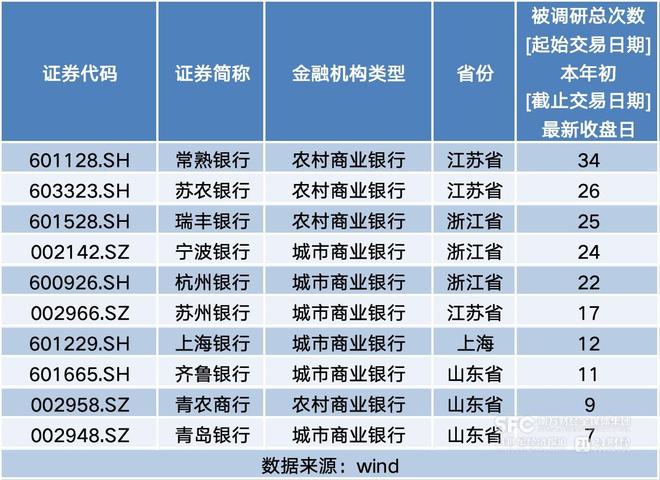
超千家机构调研上市银行 宁波银行是“人气王”
Zheng Quan Ri Bao· 2025-07-03 16:28
Core Viewpoint - The surge in institutional research on listed banks in the first half of the year indicates a significant increase in market interest in bank stocks, particularly focusing on credit issuance, dividend plans, and asset quality [1][2]. Group 1: Institutional Research Trends - In the first half of the year, 19 A-share listed banks received over 1,000 institutional research visits, with Ningbo Bank, Changshu Bank, and Hangzhou Bank being the most popular [1][2]. - The focus of institutional research has been on key operational areas of banks, especially credit allocation and dividend strategies [2][3]. Group 2: Credit Issuance and Dividend Plans - Ningbo Bank, Changshu Bank, and Hangzhou Bank were the top three banks in terms of research visits, with 235, 192, and 153 visits respectively [2]. - Hangzhou Bank reported that its credit issuance has improved compared to the previous year, with a focus on strategic sectors such as technology and manufacturing [2]. - Chongqing Bank has maintained a high cash dividend level for 11 consecutive years since its H-share listing, with plans for a sustainable dividend strategy [3][4]. Group 3: Asset Quality and Net Interest Margin - Many banks expressed confidence in maintaining stable asset quality throughout the year, with measures in place to enhance risk management [5][6]. - Suzhou Bank reported a net interest margin of 1.34% at the end of Q1, which is a slight decrease compared to the end of 2024, but better than the industry average [6]. - The overall expectation is for a marginal improvement in asset quality, supported by policy measures and digital risk management [5][6].




流动性观察第111期:5月金融数据前瞻
EBSCN· 2025-06-09 14:21
Investment Rating - The report maintains a "Buy" rating for the banking industry, indicating an expected investment return exceeding the market benchmark index by over 15% in the next 6-12 months [1]. Core Insights - The April credit data showed a significant decline due to insufficient demand, hidden debt replacement, and seasonal factors, leading to a "smaller month" characteristic. In May, loan issuance is expected to seasonally increase but may still be constrained by a lack of effective demand, resulting in a year-on-year decrease [4][5]. - The report predicts that May's new RMB loans will be around 700 billion, with a growth rate of approximately 7.1%, slightly down by 0.1 percentage points from the end of April. The overall credit expansion is expected to remain weak due to insufficient effective demand [5][16]. - The report anticipates that the growth of social financing (社融) in May will be stable at around 1.9 trillion, maintaining a growth rate of 8.7%, supported mainly by government bond issuance [14][21]. Summary by Sections Credit Market Outlook - In May, the new RMB loans are expected to be around 700 billion, with a year-on-year decrease of 250 billion. The credit issuance will show a seasonal rebound but will still be affected by insufficient effective demand [4][5]. - The report highlights that the corporate sector remains the mainstay of credit expansion, while retail lending continues to show weak performance. Corporate medium and long-term loans are expected to support growth, while retail loans are anticipated to remain subdued due to weak consumer demand [5][7]. Social Financing - The report forecasts that social financing will see an addition of approximately 1.9 trillion in May, with a stable growth rate of 8.7%. This stability is largely attributed to the continued issuance of government bonds [14][21]. - The breakdown of social financing indicates that the new RMB loans will contribute around 500 billion, with a year-on-year decrease of about 300 billion. The report also notes a low strength of bill discounting compared to April [15][16]. Monetary Supply - The report expects a slight upward adjustment in M1 growth for May, while M2 growth is anticipated to remain stable at around 7.9% to 8%, similar to the end of April. The growth of M1 is influenced by seasonal factors and the low base effect from the previous year [18][21]. - The report discusses the impact of fiscal deposits on the growth of resident and corporate deposits, indicating that government deposits may exert a certain crowding-out effect on these deposits [19][21].
