利差损

Search documents
瑞众保险万能险保费追加受限争议背后:利差损需防范,销售误导须改正
Bei Jing Shang Bao· 2025-08-08 07:25
Core Viewpoint - The phenomenon of "deposit migration" is increasing as deposit rates continue to decline, leading consumers to seek alternatives like universal insurance products that promise higher interest rates, but uncertainties are rising regarding the ability to add premiums to these accounts [1][2]. Group 1: Consumer Experiences - A consumer reported that after purchasing a universal insurance product from 瑞众保险, they were unable to add funds to the associated savings account, which was initially promised to yield at least a 3% annual interest rate [1]. - Another consumer expressed frustration after discovering that their account for a universal insurance product had been disabled for additional premium payments, leading them to seek a full refund and compensation from the insurance company [2]. Group 2: Company Policies - 瑞众保险 announced in April that it would suspend additional premium payments for ten universal insurance products, including the "华夏金管家终身寿险," effective from April 26, 2025, citing the need to ensure stable operations of these accounts [3]. - The company clarified that the suspension of premium additions is a system-wide decision and not targeted at individual customers [2]. Group 3: Regulatory and Contractual Context - The insurance contracts typically include clauses that require approval from the insurance company for additional premium payments, which may not be clearly communicated to consumers at the time of sale [5][6]. - Recent regulatory changes emphasize the need for insurance companies to clearly define the conditions for additional premium payments in their product terms to prevent sales misrepresentation and protect consumer interests [9][10]. Group 4: Industry Challenges - The decline in market interest rates has pressured insurance companies, leading them to restrict additional premium payments for high-guarantee universal insurance products to manage operational risks and stabilize interest rates [7][8]. - The industry faces challenges in aligning sales practices with regulatory requirements, as past sales strategies may have misled consumers regarding the flexibility of premium additions [8][10].
分红险红利实现率陆续出炉!突破100%的产品增多
Zhong Guo Zheng Quan Bao - Zhong Zheng Wang· 2025-08-05 12:25
Core Viewpoint - The dividend realization rate of various insurance companies has shown a year-on-year increase, with many products exceeding 100%, a significant improvement compared to the previous year when few products achieved this level [1][2]. Group 1: Dividend Realization Rate Trends - Multiple insurance companies, including China Life, New China Life, and Ping An Life, have reported their latest dividend realization rates, indicating a notable recovery in these rates compared to last year [2]. - For instance, New China Life reported that 56 out of 59 participating dividend products achieved a dividend realization rate of 100%, with an average of 152% [2]. - The increase in dividend realization rates is attributed to rising investment returns and the relaxation of the "high limit" policy for dividend insurance [1][2]. Group 2: Industry Shift Towards Dividend Insurance - The insurance industry is accelerating its transition towards dividend insurance, driven by a lower guaranteed interest rate cap and the need to mitigate "interest spread loss" risks [4]. - The latest research indicates that the preset interest rate for life insurance is now 1.99%, with adjustments leading to a reduction in the upper limit for guaranteed rates [4]. - Companies are aiming for a significant increase in the proportion of dividend insurance products, with one leading insurer targeting at least 30% of its business portfolio to be dividend insurance by 2025 [4]. Group 3: Market Dynamics and Competitive Landscape - Insurers with strong investment performance and substantial special reserves for dividends are expected to have greater flexibility in offering higher dividends, enhancing their competitive edge in the market [5][6]. - The long-term sustainability of dividend insurance will be tested on both liability and asset sides, requiring insurers to balance dividend distribution with future expectations and operational performance [6].




全市场唯一港股通非银ETF(513750)连续22天净流入,累计“吸金”达74.68亿元!权重股中国人寿获南下资金连续20天净买入
Xin Lang Cai Jing· 2025-08-01 01:53
Group 1 - The latest scale of the Hong Kong Stock Connect Non-Bank ETF reached 12.707 billion yuan as of July 31, 2025, with a record high of 7.689 billion shares [1] - The ETF has seen continuous net inflows over the past 22 days, with a maximum single-day net inflow of 820 million yuan, totaling 7.468 billion yuan [1] - The ETF's net value increased by 85.25% over the past year, ranking 34th out of 2,943 index equity funds, placing it in the top 1.16% [1] Group 2 - The CSI Hong Kong Stock Connect Non-Bank Financial Theme Index includes up to 50 listed companies that meet the non-bank financial theme criteria, reflecting the overall performance of these companies [2] - The top ten weighted stocks in the index account for 78.19%, with China Ping An, AIA, and Hong Kong Exchanges and Clearing each exceeding 14% [2] - China Life Insurance received a net inflow of 1.114 billion HKD from southbound funds, with a cumulative net inflow of 7.828 billion HKD over the past 20 days [2] Group 3 - In the first half of 2025, life insurance companies' original premium income grew by 5.4% year-on-year, with a second-quarter growth rate of 16.3% [3] - Property insurance companies reported a premium income of 964.5 billion yuan, also reflecting a year-on-year growth of 5.1% [3] - The insurance industry faces significant interest spread loss risks, with a need to lower new single liability costs to alleviate pressure [3] Group 4 - The "interest spread loss" pressure is identified as the core reason for the valuation pressure on insurance stocks, with potential for valuation recovery if the risk converges [4] - The Hong Kong Stock Connect Non-Bank ETF is the first and only ETF tracking the non-bank index, with over 60% of its composition in insurance stocks [4]


保险股有望复刻银行股行情吗
Zheng Quan Zhi Xing· 2025-07-29 08:01
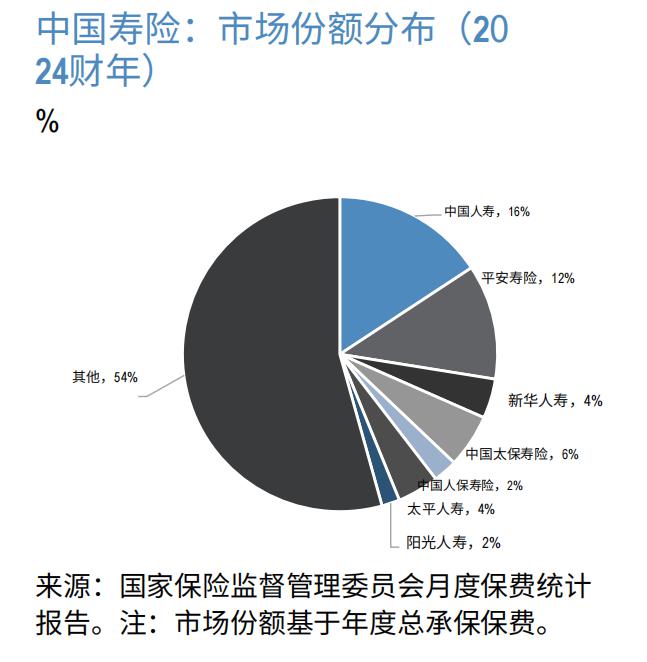
Core Viewpoint - The recent fluctuations in the A-share market around the 3600-point mark have drawn attention to insurance funds, which have become significant players in the market by frequently acquiring bank stocks. This shift is driven by a decline in the preset interest rate for ordinary life insurance to 1.99%, creating pressure for asset allocation amidst falling bond yields, leading to a potential transformation in investment logic for insurance stocks [1][8]. Group 1: Insurance Market Dynamics - The Chinese insurance market is characterized by a dual-track system of property and life insurance, with distinct participants, product forms, and profit logic, contributing to a diverse commercial model [2]. - In the property insurance sector, six major non-life insurance companies, including China Pacific Insurance and Ping An Property Insurance, hold a combined market share of 70%, focusing on quantifiable losses from risks like property damage and business interruption [2]. - The life and health insurance market is dominated by seven major companies, including China Life and Ping An Life, which contribute 46% of the premium scale, with products spanning life insurance, pensions, and health insurance [4]. Group 2: Profit Sources and Challenges - Investment spread is the core profit driver for Chinese life insurance companies, with a shift towards dividend-type policies to mitigate pressure from declining risk-free interest rates [6]. - The mortality/morbidity spread reflects the value of protection products, with a focus on accurate pricing and commission control, necessitating enhanced actuarial capabilities and channel management [6]. - The expense spread in the Chinese market is unique, with larger companies benefiting from economies of scale, contrasting with smaller firms that face higher marketing costs [6]. Group 3: Future Outlook and Valuation - Recent changes in the insurance industry have sparked discussions about whether it can replicate the valuation recovery seen in bank stocks, driven by improvements in fundamentals and valuation [8]. - The adjustment of preset interest rates is crucial for alleviating the "spread loss" pressure in the life insurance sector, with expectations of a decline in new business liability costs [8][9]. - Current internal insurance companies have a PEV (Present Embedded Value) below 1, indicating significant undervaluation, with companies like China Pacific Insurance and China Life being notably undervalued [9][10]. Group 4: Market Catalysts - The combined effect of policy guidance and the insurance companies' own needs is expected to accelerate the influx of incremental funds into the market, enhancing stability and long-term investment returns [11]. - The insurance sector's current improvement in fundamentals and low valuations may lead to a similar valuation recovery as seen in bank stocks if asset returns continue to improve and liability structures adjust smoothly [11].



A股突破3600点唤醒牛市记忆,平安成金融保险股领涨先锋
Ge Long Hui· 2025-07-28 11:44
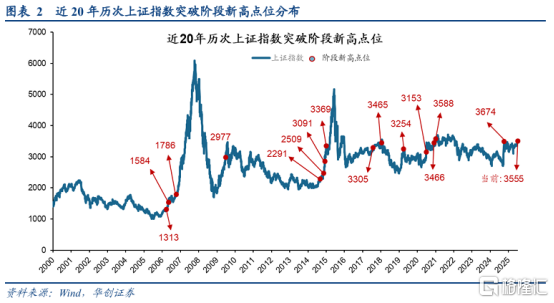
Group 1 - The Shanghai Composite Index has surpassed the 3600-point mark for the first time since October 8 of the previous year, indicating a potential bullish market trend [1][8] - Historical data suggests that once the index stabilizes above 3600 points, targets of 3700 and even 4000 points become achievable [1][8] - The market has shown strong bullish sentiment, with trading volumes exceeding 1 trillion yuan for 43 consecutive days, recently hovering around 1.8 trillion yuan [1][8] Group 2 - Multiple institutions are optimistic about the current bull market, with reports indicating that the index has confirmed a comprehensive market rally [2][8] - The index has broken through previous high points, signaling a significant shift in market sentiment and the establishment of a bull market [2][8] Group 3 - The insurance sector is gaining attention due to its deep connection with the capital markets, with leading companies like Ping An showing strong performance [4][21] - As of July 28, the insurance index has seen a cumulative increase of 28% since April 8, while the Hong Kong insurance sector has risen nearly 48% in the same period [22][23] Group 4 - The current bull market is characterized by a "slow bull" trend, driven by policy guidance and a reassessment of confidence in Chinese assets [9][10] - The influx of foreign capital into A-shares and Hong Kong stocks has increased investor confidence, with a net increase of 10.1 billion USD in domestic stocks and funds in the first half of the year [9][10] Group 5 - The insurance sector is expected to benefit from a combination of policy support, market conditions, and improvements in the fundamentals of insurance companies [24][29] - The recent adjustments in preset interest rates and the easing of capital constraints are likely to enhance the valuation recovery of insurance companies [24][30] Group 6 - Ping An is positioned as a key beneficiary of the current market dynamics, with significant growth in its new business value and improvements in its operational efficiency [38][40] - The company's integrated financial and healthcare ecosystem is expected to provide additional valuation premiums, distinguishing it from traditional insurance firms [40][41]
保险基本面梳理108:定价利率下调,利差及扩表能力有望增强-20250728
Changjiang Securities· 2025-07-28 01:47
Investment Rating - The report maintains a "Positive" investment rating for the insurance industry [12]. Core Insights - The insurance industry is transitioning from a focus on "spread loss" to a growth mindset, with expectations of a sustained increase in interest spreads driving profitability [2][9]. - The adjustment of pricing rates is expected to alleviate spread loss risks, with major insurers announcing reductions in their pricing rates, which will lower new business liability costs [7][8]. - The competitive landscape is becoming more concentrated, favoring leading insurers who are better positioned to expand their balance sheets amid stricter regulations [8]. Summary by Sections Pricing Rate Adjustments - The insurance industry association has set the predetermined interest rate at 1.99%, with a mechanism in place for dynamic adjustments based on market conditions [6]. - Major insurers like China Life and Ping An have announced reductions in their pricing rates, which will benefit the industry by lowering liability costs [7]. Competitive Landscape - Regulatory measures are tightening, particularly around liability management, which is expected to favor compliant leading insurers [8]. - The anticipated reduction in predetermined rates will challenge smaller insurers that previously relied on aggressive pricing strategies to gain market share [8]. Profitability Outlook - The report suggests that the insurance industry's profitability is likely to improve as interest spreads are expected to rise in the medium to long term [2][9]. - Recommendations for individual stocks include New China Life, China Pacific Insurance, China Life, and Ping An, as they are expected to benefit from the evolving market dynamics [2][9].
研究值跌破2% 人身险“降息”在即
Bei Jing Shang Bao· 2025-07-27 15:32
Core Viewpoint - The recent adjustment of the maximum guaranteed interest rate for life insurance products in China reflects ongoing trends in the market, with the current rate set at 1.99%, down from 2.13% in the previous quarter, indicating a continuous decline in interest rates and a shift in product attractiveness towards participating insurance [1][3][10]. Summary by Sections Current Rate Adjustments - The current guaranteed interest rate for ordinary life insurance products is 1.99%, which is a decrease of 14 basis points from the previous quarter's 2.13% [1][3]. - The maximum guaranteed interest rate for ordinary life insurance products is now set at 2.5%, with adjustments triggered by the rate being above the research value for two consecutive quarters [3][4]. Market Reactions - Major insurance companies like China Life and Ping An Life have announced adjustments to their new insurance products' maximum guaranteed interest rates following the announcement from the Insurance Association [4][11]. - The new maximum rates are 2% for ordinary products, 1.75% for participating products, and 1% for universal products [4][11]. Industry Trends - The downward adjustment of interest rates is seen as a necessary response to the broader economic context, including declining market interest rates and the impact of new accounting standards on financial reporting [5][6]. - The shift towards participating insurance products is expected to increase as their relative attractiveness grows due to smaller rate reductions compared to other types of insurance [6][9]. Future Implications - Short-term effects may include a temporary halt in the sale of existing products as companies adapt to the new rates, potentially leading to increased training costs for sales personnel [7][10]. - Long-term, the low-interest-rate environment is likely to accelerate structural changes in the industry, with participating insurance products becoming more dominant due to their combination of guaranteed and variable returns [7][10]. Premium Growth - The insurance industry reported a total premium income of 3.74 trillion yuan in the first half of the year, with life insurance premiums growing by 5.34% year-on-year [8][10]. - The demand for savings-type insurance products remains strong, driven by the decline in deposit rates, although the recent rate adjustments may impact future premium growth [8][10][12].

险资成A股上涨中坚力量
Hua Xia Shi Bao· 2025-07-27 04:20
Group 1 - The A-share market experienced a significant rise of 200 points in July, driven by insurance capital seeking returns in a low-interest-rate environment [1] - Insurance companies are increasingly investing in high-dividend stocks and quality equity assets to hedge against the challenge of "interest spread loss" due to declining bond yields [1][2] - The long-term bond market, which has been profitable for insurance capital, is undergoing adjustments, leading to a shift towards bank stocks, particularly H-shares, which offer stable cash flow [2][3] Group 2 - All bank stocks saw price increases in the first half of 2025, with 18 banks reaching historical highs and 32 banks rising over 10% [3] - The insurance capital's pursuit of dividend stocks is evident, with significant investments in various sectors beyond banking, including utilities, energy, and technology [4] - Regulatory policies are encouraging insurance capital to adopt long-term investment strategies, with a focus on high-dividend, low-volatility assets [5][6] Group 3 - The insurance capital's investment in A-shares is still below the regulatory limit, indicating potential for further investment growth in the future [6]
人身险预定利率研究值再下调 保险公司“抢2.5”战来了!
Sou Hu Cai Jing· 2025-07-26 08:19
Core Insights - The China Insurance Industry Association announced a new benchmark interest rate for ordinary life insurance products at 1.99%, a decrease of 14 basis points from the previous rate, indicating a trend of declining interest rates in the insurance sector [1][4][5] - Major insurance companies, including China Life and Ping An Life, have announced adjustments to their insurance product interest rates, with the maximum rate for ordinary insurance products set at 2.0% [5][9] - The downward adjustment of the benchmark interest rate is seen as a necessary response to the ongoing decline in market interest rates, which helps insurance companies manage their financial stability and reduce liability costs [9][14] Industry Adjustments - The new maximum interest rates for various insurance products are as follows: ordinary insurance products at 2.0%, participating insurance products at 1.75%, and universal insurance products at a maximum guaranteed rate of 1.0% [5] - The adjustment aligns with the regulatory framework established earlier this year, which mandates that if the maximum interest rate for insurance products exceeds the benchmark rate by 25 basis points for two consecutive quarters, it must be lowered [4] Market Reactions - Insurance agents are leveraging the current market conditions to promote sales, emphasizing the urgency for consumers to secure higher rates before further declines [10][13] - The trend indicates a shift towards participating insurance products as the maximum interest rates for fixed-income products decrease, which may enhance the appeal of variable yield products [13] Expert Opinions - Experts suggest that the adjustment in interest rates reflects the need for insurance products to align with market realities, thereby improving pricing strategies and reducing the risk of interest rate mismatches [9][14] - There is a cautionary note regarding potential marketing practices that may exaggerate the impact of interest rate changes, which could mislead consumers [14]
研究值跌破2%,人身险预定利率创历史新低,如何影响市场
Bei Jing Shang Bao· 2025-07-25 15:01
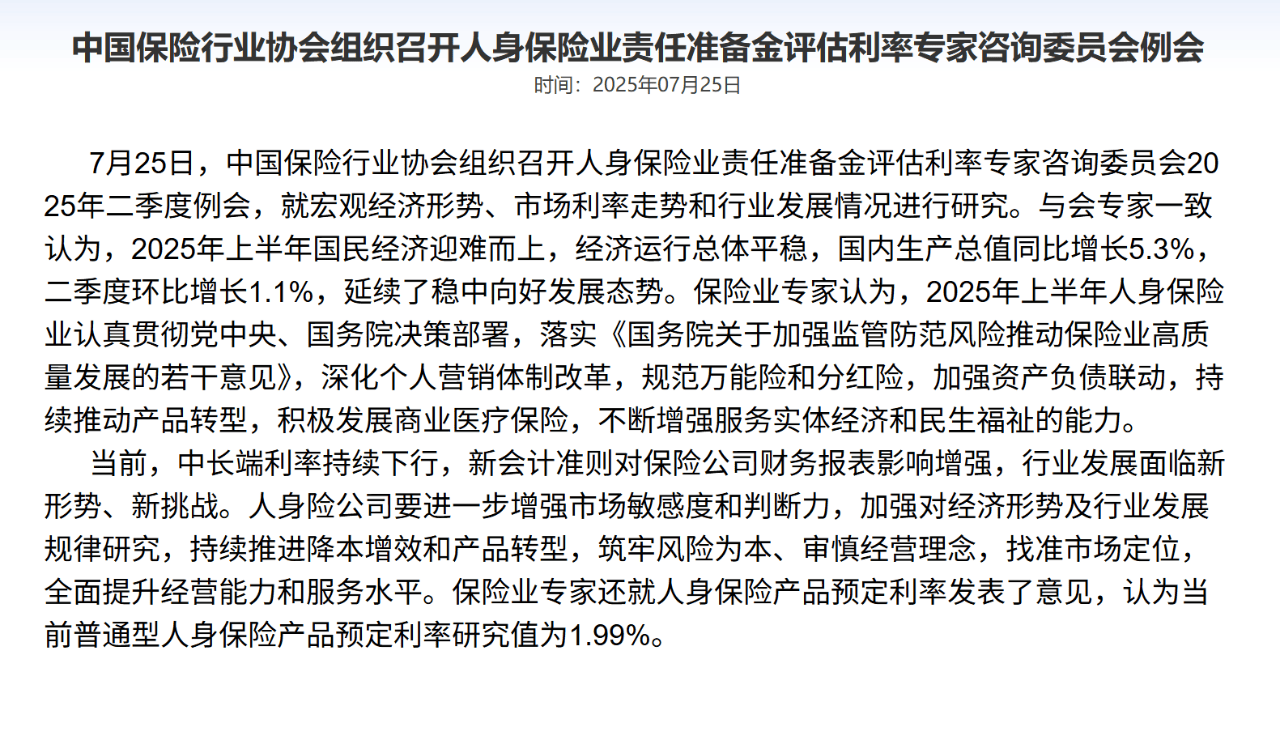
Core Viewpoint - The upper limit of the predetermined interest rate for personal insurance has been lowered to 1.99%, down from 2.13%, triggering the adjustment mechanism for the second consecutive quarter [1][3][4]. Summary by Relevant Sections Predetermined Interest Rate Adjustment - The current predetermined interest rate for ordinary personal insurance products is set at 1.99%, a decrease of 14 basis points from the previous quarter [1][3]. - The adjustment mechanism is activated when the maximum predetermined interest rate exceeds the research value by 25 basis points for two consecutive quarters, which has now occurred [4][5]. Market Impact and Company Responses - Major insurance companies like China Life and Ping An Life have announced adjustments to the maximum predetermined interest rates for their new insurance products following the association's announcement [5]. - The new maximum rates are 2% for ordinary insurance products, 1.75% for participating insurance products, and 1% for universal insurance products [5]. Industry Trends and Future Outlook - The downward adjustment of the predetermined interest rate is seen as a necessary response to the ongoing decline in market interest rates, with 1-year fixed deposit rates falling below 1% and 10-year government bond yields at 1.74% [4][6]. - The adjustment is expected to enhance the relative attractiveness of participating insurance products, as their reduction is less than that of other types [6]. - In the short term, the adjustment may lead to a temporary halt in the sale of old products, while in the long term, it is anticipated to accelerate the structural transformation of the industry, with participating insurance becoming more dominant [7].