
房地产高质量发展

Search documents
“尽力而为量力而行”:公租房扩围如何稳步覆盖新市民?
Zheng Quan Shi Bao· 2026-01-13 18:11
Core Viewpoint - The State Council's recent meeting emphasizes the need to address the housing issues of the unregistered permanent population by expanding the public rental housing (公租房) guarantee scope, improving education policies for migrant children, and ensuring basic public services based on residence [1][2]. Group 1: Public Rental Housing Expansion - The expansion of public rental housing guarantees will no longer be limited to registered residents but will include those holding residence permits who meet certain criteria, such as being from "double-difficult" families [2][3]. - Local governments are encouraged to assess their financial capabilities and housing resources to gradually include the unregistered permanent population in the public rental housing guarantee scope [1][3]. Group 2: Financial and Policy Implications - The inclusion of non-registered populations in public rental housing will require adjustments in fiscal policies and land allocation mechanisms, particularly in how fiscal transfers are linked to permanent population numbers [4]. - The expansion of public rental housing guarantees is expected to enhance the consumption potential of long-term urban residents, thereby stimulating domestic demand [4]. Group 3: Implementation Strategies - Local governments should establish reasonable criteria for prioritizing applicants, such as the duration of residence permit holding and employment in essential urban services [3]. - The increase in the scope of guaranteed public rental housing will necessitate a corresponding rise in supply, which can be aligned with ongoing efforts to convert existing commercial housing into affordable housing [3].
房地产行业周报(26/1/3-26/1/9):国常会扩大公租房保障范围,多地公积金继续放宽-20260113
Hua Yuan Zheng Quan· 2026-01-13 14:01
Investment Rating - The investment rating for the real estate industry is "Positive" (maintained) [4] Core Viewpoints - The report emphasizes that real estate is a crucial asset allocation and investment direction for Chinese households, and stabilizing housing prices is significant for facilitating economic circulation. The policy environment is expected to strengthen further, promoting high-quality development in the real estate sector. The report suggests that high-quality residential properties may experience a development wave due to policy guidance and changes in supply-demand structure [5][49]. - The report highlights that multiple favorable factors are driving a gradual recovery in the sentiment of the Hong Kong private residential market, indicating that Hong Kong developers may face a new round of value reassessment [5]. Market Performance - The Shanghai Composite Index rose by 3.8%, the Shenzhen Component Index by 4.4%, the ChiNext Index by 3.9%, and the CSI 300 by 2.8%. The real estate sector (Shenwan) increased by 5.1% during the week [5][8]. - The top five stocks in terms of growth were Chengjian Development (+34.5%), Yingxin Development (+22.0%), Shangshi Development (+20.8%), *ST Rong Control (+19.7%), and *ST Sunshine (+16.0%) [5][8]. Data Tracking New Housing Transactions - In the week of January 3-9, new housing transactions in 42 key cities totaled 1.37 million square meters, a week-on-week decrease of 46.7% and a year-on-year decrease of 41.3% [13]. - For January up to the week of January 9, new housing transactions totaled 1.55 million square meters, a month-on-month decrease of 30.1% and a year-on-year decrease of 46.6% [19]. Second-Hand Housing Transactions - In the week of January 3-9, second-hand housing transactions in 21 key cities totaled 2.06 million square meters, a week-on-week increase of 25.4% but a year-on-year decrease of 13.2% [33]. - For January up to the week of January 9, second-hand housing transactions totaled 2.14 million square meters, a month-on-month decrease of 16.1% and a year-on-year decrease of 23.9% [37]. Industry News - The State Council, led by Premier Li Qiang, held a meeting to implement a package of policies to promote domestic demand, including expanding the scope of public rental housing guarantees [49]. - The People's Bank of China emphasized the continuation of a moderately loose monetary policy and the integration of incremental and stock policies to enhance financial services for the real economy [49]. - Local policies include the extension of the down payment ratio in Shenyang to 15% until the end of 2026 and the increase of the public loan limit from 60% to 80% [49].




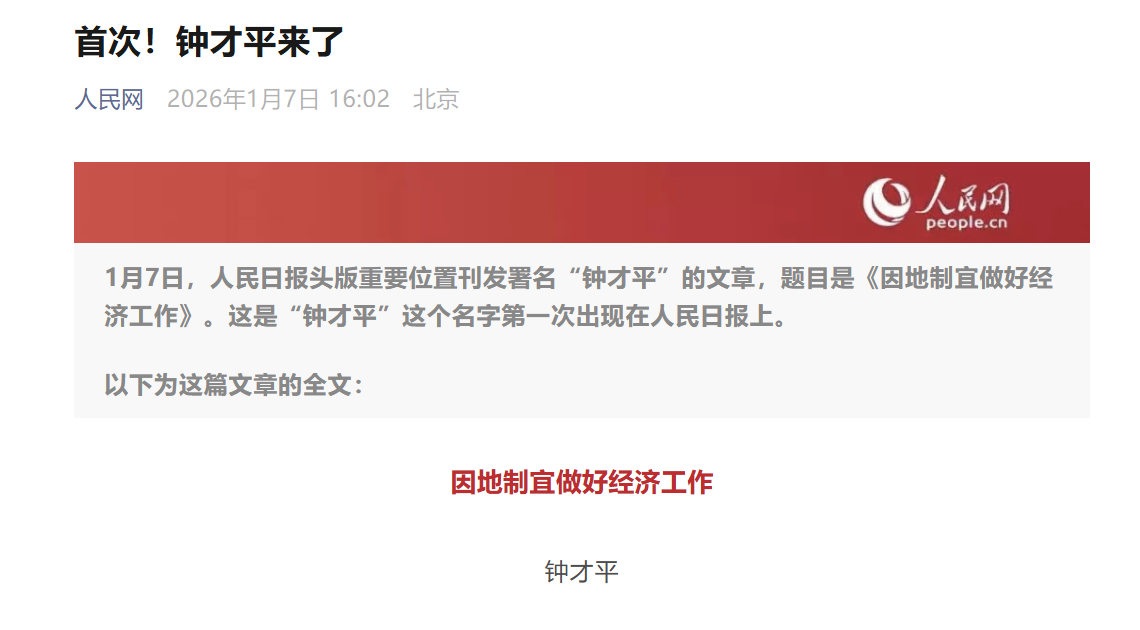
“钟才平”连发重磅文章,有何深意
21世纪经济报道· 2026-01-13 04:10
Core Viewpoint - The series of articles by "Zhong Caiping" published in the People's Daily serves as a significant indicator of the government's economic strategy for 2026, emphasizing the importance of adapting economic policies to local conditions and addressing current challenges in economic governance [1][4]. Summary by Relevant Sections Economic Work Principles - The articles cover essential principles and key areas of economic work, including adapting economic strategies to local conditions, promoting consumption and investment, and enhancing macroeconomic governance [3][4]. Policy Interpretation - The article titled "Enhancing Policy Integration Effects to Improve Macroeconomic Governance Efficiency" highlights the new emphasis on stabilizing economic growth and ensuring reasonable price recovery as key considerations for monetary policy [6]. It discusses the need for a forward-looking and scientific approach to monetary policy in 2026, aiming for a balance between liquidity and economic growth [6]. Consumption and Investment - The article "Coordinating Consumption and Investment to Build a Strong Domestic Market" argues that investment and consumption should not be seen as mutually exclusive but rather as mutually reinforcing elements of economic growth [8]. It emphasizes the importance of maintaining fiscal stimulus and expanding government investment to achieve a growth target of around 5% in 2026 [8][9]. Real Estate Development - The article "Using Livelihood Improvement to Open New Development Space" discusses the potential for high-quality development in the real estate sector, noting that there remains significant unmet housing demand among urban residents [11][12]. It suggests that real estate will continue to play a crucial role in driving domestic demand and economic growth [12]. Employment and Income - The articles stress the need to promote a virtuous cycle of employment, income, consumption, and investment, with a focus on implementing plans to increase urban and rural residents' incomes [12]. This includes reforms in income distribution and fiscal policies to support low-income groups [12].


“钟才平”首次亮相人民日报,连发重磅文章有何深意
2 1 Shi Ji Jing Ji Bao Dao· 2026-01-12 14:01
Core Viewpoint - The series of articles by "Zhong Caiping" published in the People's Daily starting January 7 serves as a significant indicator of the government's economic strategy for 2026, emphasizing practical guidance for economic work and addressing key areas of focus [1][4]. Group 1: Articles Overview - The "Zhong Caiping" series consists of six articles covering themes such as tailored economic work, development towards new and superior standards, enhancing macroeconomic governance, promoting consumption and investment, improving livelihoods, and expanding openness [5]. - The articles aim to clarify the central government's strategic framework for the upcoming period, particularly in light of the recent Central Economic Work Conference's focus on 2026's key tasks [5][6]. Group 2: Economic Policy Insights - The article titled "Enhancing Policy Integration Effects" highlights a new emphasis on stabilizing economic growth and reasonable price recovery as key considerations for monetary policy, reflecting a shift in approach [8]. - The 2026 monetary policy is expected to maintain a moderately loose stance, focusing on high-quality economic development and reasonable price recovery, with a combination of total and structural policy tools to support demand and stabilize market expectations [9]. Group 3: Investment and Consumption Dynamics - The article "Coordinating Consumption and Investment" argues that investment and consumption are not mutually exclusive but rather mutually reinforcing, essential for achieving a growth target of around 5% in 2026 [10]. - Recent measures include the early release of a project list and central budget investment plan totaling 295 billion yuan, aimed at stabilizing investment and ensuring continuity in project execution [11]. Group 4: Real Estate Sector Outlook - The article "Promoting High-Quality Development in Real Estate" indicates that there remains significant potential in the real estate sector, with unmet housing demand among urban residents, suggesting a continued role as a pillar industry [12]. - The focus on improving livelihoods through real estate development is expected to stimulate substantial investment, with initiatives like affordable housing and urban infrastructure projects projected to generate nearly 2 trillion yuan in annual investment [12].
第 2 周成交回落,期待未来政策对冲外部不利影响
GUOTAI HAITONG SECURITIES· 2026-01-11 13:12
Investment Rating - The report maintains an "Overweight" rating for the real estate industry [2][5] Core Insights - Recent real estate transactions have declined due to external uncertainties, but future policies are expected to mitigate these negative impacts and stabilize the market [2][5] - The report highlights a significant drop in new home sales across major cities, with a 67.4% decrease week-on-week and a 46.3% decrease year-on-year for the 30 major cities [5][10] - The land transaction volume also showed a decline, with a total land supply area of 13.38 million square meters and a transaction area of 12.19 million square meters, reflecting a supply-to-sales ratio of 1.10 [4][10] Summary by Sections Transaction Data - In the second week of 2026, new home sales in 30 major cities amounted to 1.03 million square meters, down 67.4% from the previous week and down 46.3% year-on-year [5][10] - First-tier cities recorded a sales area of 320,000 square meters, a decrease of 54.9% week-on-week and 50% year-on-year [5][10] - Second-tier cities saw a sales area of 460,000 square meters, down 76.9% week-on-week and 41% year-on-year [5][10] - Third-tier cities had a sales area of 260,000 square meters, down 46.3% week-on-week and 50.6% year-on-year [5][10] Land Transaction Data - The total land supply area for the year to date in the top 100 cities is 2.37 million square meters, down 12% year-on-year, while the cumulative transaction area is 4.694 million square meters, down 23.2% year-on-year [4][10] - The total land transfer revenue reached 36.2 billion yuan, reflecting a year-on-year decrease of 31.9% [4][10] - The land premium rate was recorded at 0.5%, a decrease of 1.69 percentage points from the previous week [4][10] Inventory and Market Dynamics - The available housing inventory in 35 cities was 31.526 million square meters, down 1.07% month-on-month and down 2.03% year-on-year [10][12] - The inventory clearance cycle for these cities increased to 26.17 months, up 5.64% month-on-month and up 23.51% year-on-year [10][12]
以惠民生为牵引 打开发展新空间
Ren Min Ri Bao· 2026-01-10 22:02
Group 1 - The core viewpoint emphasizes the importance of improving and safeguarding people's livelihoods while expanding development space, aligning with the strategy of expanding domestic demand [1] - The Central Economic Work Conference highlights the need to prioritize people's livelihoods and to combine consumer and investment needs effectively, promoting a virtuous cycle between supply and demand [1] - The formation of a strong domestic market is crucial for constructing a new development pattern and is supported by the continuous upgrading of people's livelihood demands across various sectors [1] Group 2 - There is significant potential for high-quality development in the real estate sector, as many urban residents' housing needs remain unmet despite a substantial total housing stock [2] - The urbanization rate for permanent residents is projected to reach 67% by 2024, while the registered urbanization rate is below 50%, indicating a gap that presents opportunities for housing demand [2] - The need for housing improvements is driven by aging properties and uneven distribution, with over 30% of urban residential stock built before 2000, suggesting a strong market for upgrading and new developments [2] Group 3 - A new model for real estate development is necessary, focusing on high-quality urban renewal and increasing the supply of better-quality housing to meet the public's expectations [3] - There is a shift in consumer preferences towards service consumption, with spending on service-related consumption rising from 5,000 yuan to 13,000 yuan per capita from 2013 to 2024, indicating a growing market for experiential and service-oriented offerings [3] Group 4 - The development of new supply must be driven by new consumer demands, with an emphasis on creativity and technology to enhance product and service offerings [4] - Examples include the transformation of traditional products into multi-functional items and the use of advanced technologies for personalized consumer experiences, which are gaining popularity [4] Group 5 - To promote development through improving livelihoods, it is essential to establish a virtuous cycle of employment, income, consumption, and investment [5] - Employment stability is prioritized, with policies aimed at enhancing job quality and providing support for key employment groups, which is vital for increasing household income and consumption [5] - The focus is on removing unreasonable restrictions in the consumption sector to unleash potential in various service industries, adapting to new consumer demands [5][6]
供需结构有变化,二手房成新晋顶流,不是市场火了而是价格到位了
Sou Hu Cai Jing· 2026-01-10 05:49
Core Insights - The second-hand housing market is undergoing a "value reassessment," with a notable phenomenon where new homes are priced significantly higher than second-hand homes in the same community, indicating a shift in consumer purchasing preferences from new to second-hand properties [1][4]. Market Restructuring - The national housing and urban-rural construction work conference has signaled that the real estate market still has development potential, but the approach must shift towards "high quality," emphasizing the importance of optimizing existing housing stock [2][10]. - The proportion of second-hand home transactions in the overall real estate market is increasing annually, with some key cities reporting that the transaction area of second-hand homes has surpassed that of new homes [2][4]. Supply and Demand Dynamics - The price inversion phenomenon reflects fundamental changes in supply and demand, with ample new home supply and developers facing cash flow pressures leading to increased promotional efforts [4][12]. - The market is transitioning from a seller's market to a buyer's market due to increased competition among second-hand home sellers, resulting in changing buyer and seller mindsets [4][12]. Buyer Behavior Changes - Homebuyers are becoming more rational, prioritizing cost-effectiveness over the traditional preference for new homes, with many opting for well-located second-hand homes in core urban areas instead of new homes in suburban locations [6][10]. - Practical needs such as commuting time, educational facilities, and convenience are becoming key decision-making factors, replacing the previous focus on the age of the property [6][10]. Policy Adaptation - Multiple cities have introduced "mortgage transfer" policies to simplify second-hand home transactions, effectively reducing transaction costs and time [6][10]. - Over 100 cities have implemented similar policies, enhancing the convenience of second-hand home transactions [6][10]. Upgrading Existing Housing Stock - Nationwide, the renovation of old residential communities is ongoing, with over 300 new projects launched in Beijing in 2023, benefiting hundreds of thousands of residents [7][14]. - Various models of community renovation are being explored, improving both the physical and management aspects of old neighborhoods, leading to increased property values and resident satisfaction [7][14]. Young Buyers' Influence - Young people are becoming a significant force in the second-hand housing market, with their practical needs for convenient commuting and comprehensive living facilities driving demand for well-located second-hand homes [7][14]. Rental Market Synergy - The rental market is interlinked with the second-hand housing market, with some cities promoting "rent-to-buy" initiatives, providing stability in rental demand that supports the second-hand market [7][14]. Quality Focus - There is a growing emphasis on housing quality, with buyers increasingly valuing design, construction quality, and energy efficiency over mere size [8][14]. - Digital technologies are transforming transaction methods, enhancing efficiency and transparency in second-hand home transactions [8][14]. Healthy Development Ecosystem - The real estate market is entering a new development phase, moving away from high-leverage, high-turnover models towards a more stable and healthy growth consensus [10][12]. - The active second-hand housing market contributes to a virtuous cycle in the overall market, facilitating better resource allocation [10][12]. Market Stabilization - Market expectations are gradually stabilizing, with both buyers and sellers developing a more rational understanding of prices, leading to reduced volatility and increased transaction activity [12][16]. - Financial institutions are adjusting strategies to enhance support for second-hand home loans, introducing more flexible financial products tailored to the unique characteristics of second-hand transactions [12][16]. Professionalization of the Industry - The professionalism of real estate services is improving, with better-trained personnel and more transparent information disclosure, enhancing the industry's image and social acceptance [14][16]. - Urbanization continues, with ongoing population concentration in urban areas, sustaining housing demand despite changing demand structures [14][16].

国泰海通|地产:如何理解“房地产高质量发展”——房地产行业“十五五”系列研究
国泰海通证券研究· 2026-01-08 14:11
报告导读: 十四五和十五五期间,党中央对地产行业发展要求,房地产行业总量所处阶段 存在明显差异。房地产行业高质量发展要求的提出,从防风险、提品质、促转型等多维度 为行业提供纲领性指引。我们认为未来五年行业将步入提质增效发展新阶段,看好行业迈 入格局和盈利稳定,蓝筹基本面持续优化阶段。 当前 AH 房地产板块总市值与行业在经济中所处地位不匹配 ,推荐 : 1 )开发类; 2 )商住类; 3 )物业类; 4 )文旅类 。 行业环境变化,十五五提出新目标。 十四五前端行业政策以降杠杆、缩总量,防止泡沫扩大甚至压降泡沫为主,以上政策导向下,行业总量大幅回落。伴随 产能和市场杠杆水平逐步回归合理水平,十四五后端中央政策开始逐步推动行业平稳触底。从要求上,明确表达"着力稳定房地产市场"、"止跌回稳"等清晰 表态。我们认为,高质量发展要求的提出,代表十五五和十四五期间中央对房地产发展要求存在变化。基于全球成熟国家历史经验,中国自身人口和国情,我 们认为十五五期间行业需求有望企稳回升,维持在 7-8 亿平区间。 高质量发展意义深刻要求前瞻,六大任务指示明确蓄势待发。 面对行业供需关系与经济环境深刻变化,人民、经济和行业对房地 ...

专访宋丁:房地产改善预期是关键,政策需一次性给足
Nan Fang Du Shi Bao· 2026-01-08 11:32
Core Insights - The year 2026 marks the beginning of China's "14th Five-Year Plan," which outlines the development blueprint for the country until 2030, focusing on the transformation of the real estate sector towards high-quality development and the stabilization of market expectations [2][3]. Group 1: Real Estate Market Trends - The real estate industry is entering a critical transformation phase, shifting from scale expansion to quality development, with the key macro trend being the "improvement and stabilization of market expectations" [3][4]. - The emphasis on "improvement" over "stability" is crucial, as previous efforts to stabilize expectations have not achieved desired outcomes due to inadequate implementation of improvement measures [3][5]. Group 2: Policy Recommendations - Policies must be precise and implemented in a single step rather than gradually, such as the removal of purchase restrictions to boost market confidence [3][8]. - Positive media narratives are essential to reshape market sentiment and alleviate negative emotions accumulated over recent years [4][5]. - Sufficient financial support from both central and local governments is necessary to address the industry's challenges, including debt resolution and inventory reduction [5][6]. Group 3: Market Dynamics and Participation - The market recovery requires a balanced approach to supply and demand, avoiding prolonged imbalances that could hinder growth [5][6]. - Engaging the public and consumers in the real estate market is vital for creating a supportive environment for the industry's transformation [5][6]. Group 4: Urban Market Differentiation - The real estate market is experiencing significant differentiation, with structural gaps remaining despite overall market saturation, necessitating respect for market dynamics without forced interventions [6][7]. - Investment attributes of real estate must be acknowledged, particularly in major cities where demand is driven by both residential and investment needs [6][7]. Group 5: High-Quality Development Initiatives - The focus on high-quality development involves creating premium housing products, promoting green building practices, and enhancing urban renewal efforts [10][11]. - The current year is seen as a critical testing phase for high-quality development strategies, with expectations for the industry to establish a mature model for future growth [10][11].

如何理解“房地产高质量发展”
Haitong Securities International· 2026-01-08 08:05
Investment Rating - The report recommends a positive investment outlook for the real estate sector, highlighting specific stocks in various categories such as development, commercial residential, property management, and cultural tourism [1]. Core Insights - The report emphasizes the shift in the real estate industry from a focus on quantity to a focus on quality, driven by the new requirements set forth during the "15th Five-Year Plan" period, which aims for high-quality development [1][13]. - It identifies six key tasks to achieve high-quality development, including optimizing affordable housing supply and enhancing property service quality [1][61]. Summary by Sections 1. High-Quality Development as a New Requirement - The report discusses the significant changes in the real estate market, transitioning from a supply-demand imbalance to a potential oversupply situation, necessitating a focus on high-quality development [3][6]. - It outlines the central government's shift in policy from reducing leverage and total volume to stabilizing the real estate market and promoting quality [6][7]. 2. Understanding High-Quality Development - The report defines high-quality development as essential for meeting the people's aspirations for a better life, advancing modernization, and facilitating the transformation of the real estate industry [22][24]. - It presents three major significances, four key requirements, and six essential tasks for high-quality development [21][28]. 3. Policy Expectations for the 15th Five-Year Plan - The report anticipates that future policies will focus on risk prevention, quality improvement, and transformation in the development sector [62]. - It emphasizes the need for a balanced approach between short-term market stabilization and long-term structural reforms [36][60]. 4. Six Key Tasks for High-Quality Development - The report outlines six tasks: optimizing affordable housing supply, promoting sustainable market development, reforming development and financing systems, enhancing housing quality, improving property service quality, and establishing a safety management system for the entire lifecycle of housing [61][62].
