
AI转型

Search documents
【2025年三季报点评/理想汽车】业绩短期承压,构建具身智能完整AI系统
东吴汽车黄细里团队· 2025-11-27 14:33
Core Viewpoint - The article discusses the financial performance and strategic adjustments of Li Auto, highlighting a significant decline in revenue and profitability in Q3 2025, alongside a shift back to a startup management model to enhance efficiency and user value [2][3][5]. Financial Performance - Li Auto reported Q3 2025 revenue of 27.36 billion yuan, a decrease of 36.2% year-on-year and 9.5% quarter-on-quarter, with vehicle sales revenue at 25.87 billion yuan, down 37.4% year-on-year and 10.4% quarter-on-quarter [2]. - The net profit attributable to shareholders was -620 million yuan, with Non-GAAP net profit at -360 million yuan, indicating a shift to losses compared to previous periods [2]. - The overall gross margin for Q3 2025 was 16.3%, down 5.2 percentage points year-on-year and 3.7 percentage points quarter-on-quarter, primarily due to increased manufacturing costs from the MEGA recall [3]. Cost Management - R&D expenses for Q3 2025 were 2.97 billion yuan, up 15.0% year-on-year, reflecting increased costs related to new model projects and technology [3]. - Selling, general, and administrative expenses were 2.77 billion yuan, a year-on-year increase of 17.6% [3]. Sales and Production - The company achieved wholesale sales of 93,000 vehicles in Q3 2025, with an average revenue per vehicle of 278,000 yuan, compared to approximately 260,000 yuan in Q2 2025 [3]. Strategic Adjustments - Li Auto plans to revert to a startup management model starting Q4 2025, focusing on deep dialogue, user value, and efficiency improvements to adapt to industry changes [5]. - The company is developing the M100 chip for its AI system, expected to be commercially available in 2026, aiming for a performance-to-power ratio three times better than current high-end chips [5]. Revenue and Profit Forecast - Due to structural adjustments in vehicle models, revenue forecasts for 2025-2027 have been revised down to 113.4 billion yuan, 138.1 billion yuan, and 191.2 billion yuan, respectively, with year-on-year changes of -22%, +22%, and +39% [6]. - Net profit forecasts for the same period have also been reduced to 900 million yuan, 1.6 billion yuan, and 6.4 billion yuan, reflecting significant declines in 2025 but strong recovery in subsequent years [6].



赔钱,道歉,视觉中国“碰瓷式”维权何时休
3 6 Ke· 2025-11-25 07:42
Core Viewpoint - Visual China is facing significant challenges due to ongoing copyright disputes, weakening core business profitability, and an AI transformation that has yet to yield substantial results [1][12]. Copyright Disputes - On November 22, Visual China and its two affiliated companies issued an apology regarding a copyright infringement case involving photographer Dai Jianfeng, concluding a two-year legal battle [2][4]. - The Tianjin court ruled that Visual China illegally sold Dai's photos and improperly sought compensation from him, leading to a compensation order of 15,000 yuan and a public apology [4][5]. - This incident is not the first copyright controversy for Visual China, as it previously faced backlash in 2019 over claims of owning the rights to the first human black hole photo and other issues [6]. Financial Performance - For the first three quarters of 2025, Visual China reported a slight revenue increase of 0.3% to 610 million yuan, while net profit fell by 9.03% year-on-year [7][12]. - Over the past five years, the company's gross margin has decreased from 63.52% to 46.81%, indicating a decline in core business profitability [7][9]. - The company's revenue growth has been inconsistent, with net profit showing a "decline-increase-decline" pattern from 2022 to 2024, including an 18.17% drop in 2024 [9]. AI Transformation Efforts - Visual China is heavily investing in AI transformation, with AI training service revenue increasing by 300% in 2025, although AI-related income accounted for only 2.22% of total revenue in 2024 [11][12]. - The company has launched an AI-assisted creative platform and partnered with major firms like Baidu and Huawei to enhance its AI capabilities [9][11]. - Despite the growth in AI revenue, it remains a small portion of overall income, and high R&D expenditures have increased cash flow pressure, with a net cash outflow of 41.38 million yuan in the first half of 2025 [12]. Future Outlook - Visual China is planning to issue H-shares for listing on the Hong Kong Stock Exchange to support its global strategy, but specific plans and timelines are still uncertain [12].


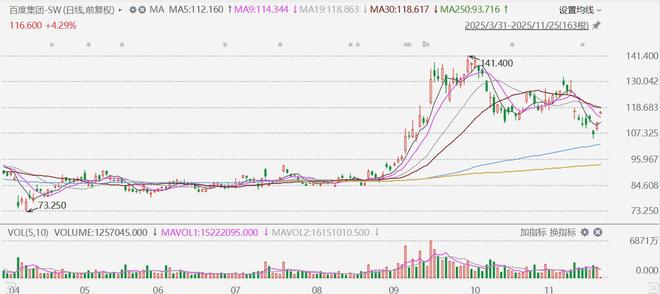
港股异动丨百度涨超4%,获小摩大幅上调目标价
Ge Long Hui· 2025-11-25 01:49
Core Viewpoint - Baidu's stock has seen significant gains, with a more than 4% increase in Hong Kong and over 7% in the US market, driven by a fundamental shift in its business narrative towards AI infrastructure [1] Group 1: Stock Performance - Baidu Group's stock rose over 4% to HKD 116.6, while in the US market, it closed up over 7% at USD 119.21, translating to HKD 116.17 per share [1] - Morgan Stanley has raised Baidu's target price significantly to USD 188 [1] Group 2: Business Transformation - Morgan Stanley's report on November 23 indicates a fundamental transformation in Baidu's business model from a traditional search advertising company to an AI infrastructure provider [1] - The report highlights that revenue from Baidu's Kunlun chips is expected to surge from approximately RMB 1.3 billion in 2025 to RMB 8.3 billion in 2026, marking a sixfold increase [1] - The market is said to be underestimating the speed and scale of Baidu's AI transformation, with cloud business revenue projected to grow by 61% in 2026 due to increased sales of Kunlun chips [1]
环球问策:如何破解企业AI转型“两难”困局
Huan Qiu Wang· 2025-11-19 04:24
Core Insights - The article discusses the challenges enterprises face in digital transformation amidst rapid AI technology adoption, emphasizing the shift from "whether to transform" to "how, when, and if they can transform" [1][4] - It highlights the structural mismatch between the disruptive nature of technological iterations and the gradual development of enterprises, leading to a complex set of challenges [2][4] Group 1: Challenges in Digital Transformation - Enterprises are experiencing a fundamental contradiction between rapid technological advancements and their gradual IT architecture evolution, resulting in compounded challenges [2] - The conflict between IT departments and business units is intensifying, as business diversification demands high flexibility from IT systems, while IT teams prioritize stability and simplified management [4] - Three core challenges are identified: compatibility with historical investments while embracing AI innovation, simplifying management while supporting business diversification, and ensuring system stability while enabling rapid iteration [4] Group 2: Proposed Solutions - Qingyun Technology proposes a "gradual innovation" approach with the launch of the AI Infra 3.0 architecture, focusing on "restructuring and unifying" to bridge the gap between historical and future needs [4][5] - The AI Infra 3.0 architecture consists of four layers, including a foundational operating system, a unified scheduling layer, a capabilities layer covering various technologies, and an open layer for ecosystem customization [5] - The architecture aims to provide full-stack capabilities, on-demand expansion, standardized delivery, and evolution, allowing enterprises to introduce AI capabilities in a phased manner without overhauling existing systems [5] Group 3: The Role of AI Infrastructure - The role of AI infrastructure is evolving from a mere tool to a foundational strategy for enterprises, with a focus on effectively utilizing AI models rather than merely selecting the best ones [6] - AI Infra 3.0 is positioned as a pathway for enterprises to connect with the AI era, built on over a decade of technological accumulation and deep insights into customer needs and industry trends [6] - The article reflects the sentiment of many enterprises that are cautious about AI transformation, fearing the loss of past investments while trying to seize future opportunities [6]


中国银河证券:钢铁行业盈利修复 关注供给侧变革
Zhi Tong Cai Jing· 2025-11-17 08:32
Group 1 - The core viewpoint of the report indicates that the steel industry is experiencing a significant recovery in profitability, with leading steel companies showing substantial increases in net profit and some turning losses into profits [1] - In the first three quarters of 2025, the cumulative operating revenue of key steel enterprises was 4.56 trillion yuan, a year-on-year decrease of 2.36%, while total profit reached 96 billion yuan, a year-on-year increase of 1.9 times, indicating a marked improvement in industry efficiency [1] - The sales profit margin for the steel industry increased to 2.1%, up by 1.39 percentage points year-on-year, reflecting enhanced profitability [1] Group 2 - The supply-side policies aimed at reducing overcapacity have been intensified, with the Ministry of Industry and Information Technology and five other departments jointly issuing a plan for stable growth in the steel industry, targeting an average annual growth of around 4% in value-added from 2025 to 2026 [2] - The structure of steel products is continuously optimizing, with the proportion of steel used in manufacturing rising from 42% in 2020 to an expected 50% in 2025, while the proportion used in construction is declining [2] - High-end product development is accelerating, with the production of silicon steel expected to reach approximately 18 million tons in 2024, a 48% increase from 2020 [2] Group 3 - As of September 30, 2025, the number of steel industry holdings by fund companies increased to 41, with a total holding amount of 21.99 billion yuan, a year-on-year increase of 22.44% [3] - The steel industry holdings accounted for 0.50% of total fund holdings, indicating a growing interest in the sector [3] - Fund holdings in the steel industry are expected to have significant upward potential due to ongoing supply-side reforms and marginal recovery in company performance [3]

Cognizant收购3Cloud,塑造行业领军力量
Huan Qiu Wang· 2025-11-17 06:59
Core Insights - Cognizant has signed a definitive agreement to acquire 3Cloud, a leading independent Microsoft Azure service provider, enhancing its capabilities in data, AI, application innovation, and enterprise cloud platforms [1][3][4] - The acquisition is expected to significantly expand Cognizant's Azure product portfolio and deepen its expertise in complex engineering projects, driving AI-led business transformation [3][5] - 3Cloud has achieved a 20% organic compound annual growth rate since 2020, with expectations to maintain similar growth through 2025, driven by strong demand for Microsoft Azure-based business transformation [3][6] Company Overview - 3Cloud primarily serves enterprise clients across sectors such as banking, healthcare, technology, and consumer goods [3] - The integration will add over 1,000 Azure experts and more than 1,500 Microsoft certifications to Cognizant's existing team of nearly 20,000 Azure-certified employees [3][5] - 3Cloud has been recognized multiple times as a top Microsoft Azure partner, winning various awards for its innovative Azure solutions [6] Strategic Implications - The acquisition is seen as a critical step for Cognizant in advancing its enterprise AI strategy, enabling organizations to rapidly build, deploy, and scale AI solutions [3][4] - Cognizant aims to establish itself as a leading partner within the Azure ecosystem, leveraging 3Cloud's expertise to enhance client value in their AI journeys [4][5] - The deal is expected to close in the first quarter of 2026, pending regulatory approvals and other closing conditions [6]



钢铁行业25Q3业绩综述:盈利修复,关注供给侧变革
Yin He Zheng Quan· 2025-11-17 06:07
Investment Rating - The report suggests a positive outlook for the steel industry, indicating a recovery in profitability and a focus on supply-side reforms [4][29]. Core Insights - The steel industry has shown significant improvement in profitability during the first three quarters of 2025, with total profits reaching 96 billion yuan, a year-on-year increase of 190% [4][6]. - The report highlights the implementation of supply-side reforms aimed at optimizing the structure of steel products and controlling production capacity [4][13]. - The demand for steel is expected to benefit from manufacturing upgrades and AI transformation, with a focus on high-end product development [4][29]. Summary by Sections 1. Industry Profit Recovery and Supply-Side Policies - In the first three quarters of 2025, the cumulative operating revenue of key steel enterprises was 4.56 trillion yuan, a year-on-year decrease of 2.36%, while total profits reached 96 billion yuan, marking a significant recovery [4][6]. - The production of crude steel was 746 million tons, down 2.9% year-on-year, while steel consumption fell by 5.7% [4][6]. - The report notes that the sales profit margin increased to 2.1%, up 1.39 percentage points year-on-year [4][6]. 2. Fund Holdings in the Steel Sector - As of September 30, 2025, the number of fund holdings in the steel sector increased to 41, with a total holding value of 21.99 billion yuan, up 22.44% year-on-year [4][17]. - The report indicates that the steel sector's holdings accounted for 0.50% of total fund holdings, with a notable increase in the number of holdings during the first and third quarters [4][17]. 3. Investment Recommendations - The report recommends focusing on leading companies in the ordinary steel sector that are expected to benefit from improved supply-demand dynamics, as well as companies in the special steel sector with strong fundamentals [4][29].



本届计算机毕业生,找工作比文科生还难
首席商业评论· 2025-11-15 04:45
Core Viewpoint - The article discusses the declining employment rates and salaries for computer science graduates in China, highlighting the impact of AI and technological advancements on job markets and the necessity for continuous learning and adaptation in the workforce [5][7][23]. Employment Trends - The employment rate for 2024 computer science graduates is only 82.4%, ranking 11th from the bottom among 61 major disciplines, significantly lower than the national average of 86.7% [5][6]. - In comparison, the employment rates for history and foreign language graduates are higher, at 87.2% and 86.9% respectively, indicating a shift in job market dynamics [7]. Salary Trends - Salaries for computer science graduates have also seen a decline, dropping from the 5th position in 2014 to 27th in 2023, with many graduates reporting starting salaries below 6,000 [7][8]. Impact of AI on Employment - The rise of AI technologies is significantly affecting the demand for computer programmers, with major companies like Amazon and Microsoft announcing large-scale layoffs, citing a shift towards AI-driven operations [8][10]. - AI's ability to generate code is reducing the need for traditional programming roles, leading to a perception of programmers as less essential [10][11]. Educational System Critique - The article critiques the traditional higher education system, suggesting that it may not adequately prepare students for the current job market, as companies like Palantir are now recruiting directly from high school graduates [13][16]. - There is a growing sentiment that practical skills and adaptability are more valuable than formal degrees in today's rapidly changing job landscape [17][23]. Continuous Learning and Adaptation - The article emphasizes the importance of continuous learning and the ability to adapt to new tools and technologies, suggesting that success in the modern workforce is increasingly determined by one's willingness to learn rather than by one's academic background [23][25].

融泰药业递交港交所上市申请 焦数字化医药流通
Quan Jing Wang· 2025-11-13 08:54
Core Viewpoint - Guangdong Rontai Pharmaceutical Co., Ltd. has officially submitted its main board listing application to the Hong Kong Stock Exchange, with CITIC Securities as the sole sponsor [1] Industry Overview - The Chinese off-hospital pharmaceutical market is experiencing continuous growth driven by policies such as prescription outflow and the separation of medical services and pharmaceuticals. The market size has increased from 520.8 billion yuan in 2019 to an expected 655.2 billion yuan in 2024, and is projected to exceed 1 trillion yuan by 2030 [1] Company Business Segments - The company operates in three main segments: - **Digital Sales to Individual Customers**: Rontai Pharmaceutical sells drugs through B2C and O2O e-commerce platforms like JD Health, Alibaba Health, and Meituan Pharmacy, providing brand operation, data monitoring, and smart inventory management services. As of 2024, the company has established partnerships with 196 e-commerce platform clients [2] - **Sales to Grassroots Endpoints**: The company supplies drugs to grassroots medical institutions and retail endpoints through B2B platforms such as Yaoshi Bang and 1Yaocheng. By June 30, 2025, Rontai Pharmaceutical has collaborated with 1,757 regional sales partners, covering over 1.7 million institutions in its grassroots endpoint database [2] - **Sales to Large Chain Pharmacies**: The company directly supplies products to national and regional chain pharmacies, currently covering 787 chain pharmacy brands, thereby enhancing its off-hospital retail network [2] Financial Performance - In 2023, the company's net profit was 45.72 million yuan, which is expected to decline to 3.74 million yuan in 2024 due to strategic layout completion of five subsidiaries across various regions. However, in the first half of 2025, net profit is projected to rebound to 17.09 million yuan, surpassing the total for 2024. During the same period, the number of regional sales partners increased from 754 to 1,705, a growth of 126%, with over 154,000 grassroots endpoints covered through e-commerce channels [2] Client Resources and AI Strategy - Rontai Pharmaceutical has provided services to 15 of the top 20 global pharmaceutical companies by revenue in 2024, including major international firms like Huizhi, Kefu, Johnson & Johnson, and Pfizer, as well as 81 of China's top 100 pharmaceutical companies [3] - The company is advancing an AI transformation strategy, establishing a nationwide AI and IoT-driven intelligent supply chain network, implementing dynamic AI marketing to identify market opportunities, and launching 24/7 customer service based on natural language processing. Additionally, it is creating a comprehensive knowledge graph for decision support and introducing AI-driven automatic compliance monitoring to reduce regulatory risks [3] Future Outlook - Looking ahead, Rontai Pharmaceutical plans to further expand its product portfolio, deepen collaborations with pharmaceutical companies, and promote the implementation of AI technology in supply chain management, precision marketing, customer service, and compliance regulation [3] - With the initiation of the Hong Kong stock listing process, the company is expected to enter a new development phase against the backdrop of the continuous growth of the Chinese off-hospital pharmaceutical market [3]
AI 转型不再“推倒重建”,青云 AI Infra 3.0 为企业打造平滑升级路径
Quan Jing Wang· 2025-11-12 09:19
Core Insights - QingCloud Technology officially launched AI Infra 3.0, emphasizing "All in One, One for AI" as its strategic core, aiming to transform the barriers of AI implementation into growth momentum for enterprises [1][2] Group 1: Challenges in Digital Transformation - Enterprises face three core challenges during digital transformation: balancing historical IT investments with AI innovation, simplifying management while meeting diverse business needs, and ensuring business stability alongside rapid technological iteration [2] - The CEO of QingCloud, Lin Yuan, highlighted the mismatch between the disruptive nature of technology iteration and the gradual nature of enterprise development as the essence of the pain points in digital transformation [2] Group 2: Key Features of AI Infra 3.0 - AI Infra 3.0 possesses four key characteristics: full-stack capability, on-demand scalability, standardized delivery, and smooth evolution [3][4][5][6] - The unified architecture provides a stable, scalable, and highly compatible technical foundation for enterprises, integrating virtualization, cloud, cloud-native, and AI computing capabilities [7] Group 3: Core Values of AI Infra 3.0 - The architecture creates four core values for enterprises: investment assurance (75% cost savings), transformation assurance (100% smooth upgrades), operational assurance (over 70% improvement in management efficiency), and innovation assurance (evolutionary architecture meeting future AI needs) [8] Group 4: Industry Applications - In the education sector, QingCloud provides GPU computing, model inference services, and high-performance computing resources, addressing the core challenges of diverse deployment and usage of computing resources in universities [9] - In smart manufacturing, the unified architecture enhances IT response speed by 75% and significantly shortens the cycle from AI model development to production [9] - In the media industry, the open architecture allows for rapid compatibility with various hardware, improving deployment efficiency and addressing the challenges of scattered computing resource management [9] Group 5: Ecosystem Collaboration - QingCloud aims to create a win-win ecosystem in the AI era by collaborating with partners, emphasizing standardization and openness throughout the design, development, testing, and delivery processes [11] - The AI Infra 3.0 architecture supports heterogeneous needs and helps partners meet customer demands through its open and plug-in architecture [11] Group 6: Partner Benefits - Numerous partners have benefited from the AI Infra 3.0 architecture, including a pharmaceutical research group that quickly launched medical AI analysis capabilities and an operator that achieved integrated deployment and management of AI solutions [12]