M2

Search documents
股市即将变盘的逻辑,财富洗牌的前夜
Sou Hu Cai Jing· 2025-11-27 05:11
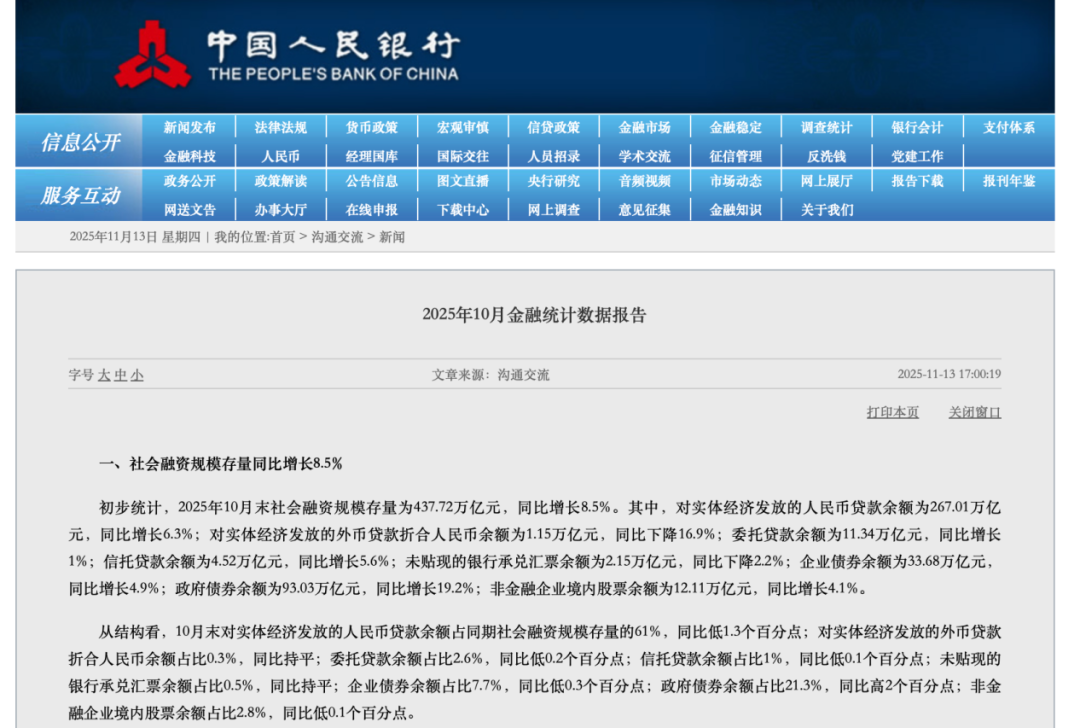
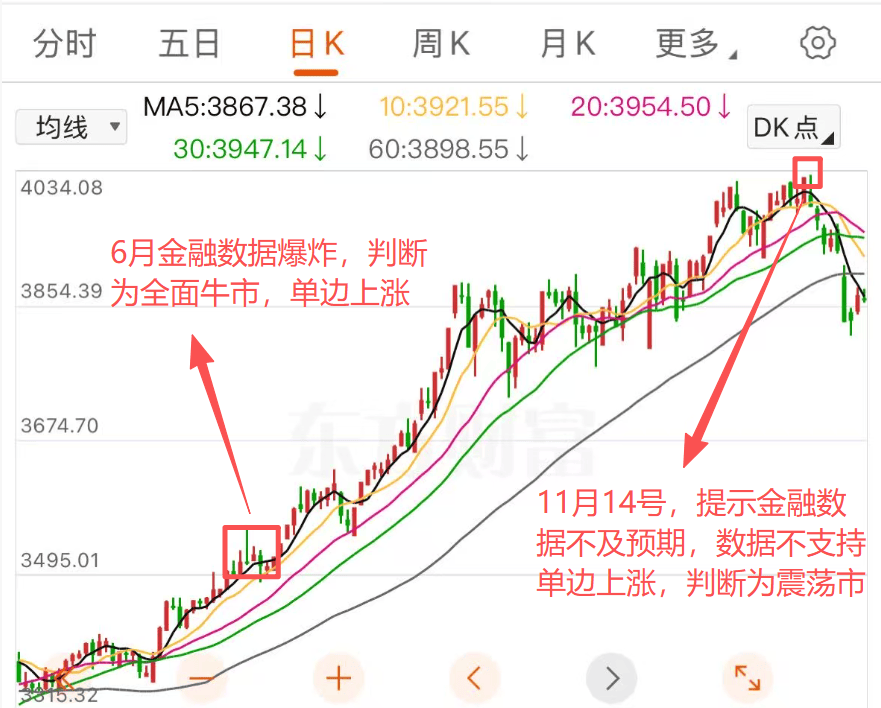
Core Viewpoint - The stock market began a downward trend starting November 14, triggered by the release of disappointing financial data for October on November 13, which did not meet expectations [1][3]. Financial Data Analysis - On July 14, the central bank released June financial data that significantly exceeded expectations, leading to a bullish market trend [3]. - The October financial data released on November 13 was below expectations, resulting in a noticeable decline in the stock market starting November 14 [3][4]. - The primary reason for the explosive data in July was the unexpected increase in money supply driven by bond purchases, while the October data reflected a downturn in bond issuance, impacting money supply growth [5][12]. Monetary Mechanism Explanation - The central bank is the issuer of currency, and the total money supply (M2) is determined by the base currency and the reserve requirement ratio [5][7]. - Commercial banks can create money through asset expansion, which includes buying bonds, but they must first attract deposits [6][9]. - The difference between commercial banks and the central bank in money creation lies in the need for deposits and the type of money created (derived vs. base money) [9][10]. Market Outlook - The recent data indicated a turning point for both M1 and M2, primarily due to a decline in bond issuance [13]. - Despite the downward pressure, the market is expected to stabilize rather than enter a prolonged decline, as the bond market can be adjusted by issuers in response to economic conditions [13]. - The long-term outlook remains optimistic, with confidence in the market's potential for recovery driven by bond issuance mechanisms [13][14]. Sector Focus - Future national development priorities include technology, new productive forces, and industrial upgrades, which may lead to high valuations in tech sectors [15]. - Traditional sectors, while not the focus of future growth, have lower valuations and may present safer investment opportunities [15][16].

经观月度观察|“稳中求进”基调不变 重点转向激发内需与修复工业品价格
Jing Ji Guan Cha Bao· 2025-11-21 14:49
Core Insights - The macroeconomic data for October indicates a short-term increase in economic downward pressure, with a focus on stimulating domestic demand and repairing industrial product prices while maintaining the overall principle of "seeking progress while maintaining stability" [1] CPI - The Consumer Price Index (CPI) rose to 0.2% in October from -0.3% in the previous month, marking a 0.5 percentage point increase [2] - The month-on-month increase was 0.2%, up 0.1 percentage points from the previous month, driven by rising prices of fruits and vegetables [2] PPI - The Producer Price Index (PPI) decreased by 2.1% year-on-year in October, improving from a decline of 2.3% in September, with the mining sector providing significant support [3] - The prices of production materials increased by 0.1%, with mining prices up by 1% [3] PMI - The Manufacturing Purchasing Managers' Index (PMI) fell to 49% in October from 49.8% in September, indicating a contraction in manufacturing activity [4] - The decline in PMI is attributed to high inventory levels, a weakening demand structure, and reduced investment demand due to accelerated debt repayment [5] Fixed Asset Investment - Fixed asset investment (FAI) decreased by 1.7% year-on-year in October, worsening from a decline of 0.5% in September [6] - The decline in infrastructure investment is influenced by multiple factors, including accelerated debt repayment and insufficient project reserves [6] Credit - New credit issuance in October was 220 billion yuan, a decrease of 280 billion yuan compared to the same period last year [7] - The total social financing (TSF) increased by 815 billion yuan, but the growth rate has slowed down [7] M2 - The M2 money supply grew by 8.2% year-on-year in October, down from 8.4% in September, influenced by a rebound in fiscal deposits [8] - The central government allocated 500 billion yuan to local governments to support effective investment and address existing debt issues [9]
10月金融数据“信贷弱、社融稳”,M1增速维持高位凸显资金活力
Hua Xia Shi Bao· 2025-11-14 07:11
Core Viewpoint - The financial data for October indicates a continued decline in credit growth, while social financing and M2 growth remain relatively high, reflecting strong financial support for the real economy [2][3]. Group 1: Financial Data Overview - In October, new RMB loans amounted to 220 billion, with a month-on-month decrease of 1.07 trillion and a year-on-year decrease of 280 billion, leading to a loan growth rate of 6.5%, the lowest on record [6][7]. - The total social financing scale at the end of October was 437.72 trillion, with a year-on-year growth of 8.5% [8]. - M2 growth was 8.2% year-on-year, slightly down by 0.2 percentage points from the previous month, while M1 grew by 6.2% year-on-year [3][4]. Group 2: Loan and Financing Structure - The M1-M2 spread was 2%, indicating a solid trend of funds being converted into demand deposits, reflecting good activity in corporate operations and personal consumption [4][5]. - The structure of financing is shifting, with non-loan financing methods now accounting for over half of the total social financing increment, indicating a diversification in corporate financing channels [9]. Group 3: Future Outlook - There may be a new round of reserve requirement ratio cuts and potential interest rate reductions by the central bank before the end of the year, aimed at directing financial resources towards key sectors such as technology innovation and small enterprises [10].

——10月金融数据点评:社融和存款的变化预示什么?
Huachuang Securities· 2025-11-14 06:46
Group 1: Financial Data Overview - In October 2025, new social financing (社融) amounted to 815 billion, a decrease from the previous value of 3.53 trillion[2] - The year-on-year growth of social financing stock was 8.5%, down from 8.7%[2] - M2 year-on-year growth was 8.2%, a decline from 8.4%[2] - New M1 year-on-year growth was 6.2%, down from 7.2%[2] Group 2: Key Insights - The continuous decrease in corporate medium to long-term loans for four months indicates a potential improvement in supply-demand balance[4] - The decline in household loans over the same period is more closely related to operational loans rather than consumer loans, which still show growth compared to 2024[4] - The significant increase in entrusted loans in October may be linked to the deployment of policy financial tools, although the impact on policy banks' balance sheets appears limited[4] - Direct financing through corporate bonds and domestic stock financing has shown consistent year-on-year growth, indicating a positive trend for high-tech and innovative enterprises[4] Group 3: Deposit Trends - Non-bank financial institution deposits increased by 770 billion year-on-year, suggesting stability in equity market transaction volumes[5] - The new M1's year-on-year decline is attributed to seasonal factors, with a notable drop from September's high growth[5] - The old M1 is expected to show a year-on-year decline, potentially dropping from 6.2% in September to around 3.4% by year-end, still above the -1.4% expected for the end of 2024[5] Group 4: Economic Indicators - Economic cycle indicators have shown a shift from the upward trend observed in the first eight months of the year, with September and October maintaining a fluctuating trend[6] - The change in the enterprise-resident deposit scissors difference indicates a potential slowdown in economic activity, which could impact future corporate profits[6]
央行:社会融资已发生结构性变迁 贷款增速略低一些也合理
2 1 Shi Ji Jing Ji Bao Dao· 2025-11-14 00:23
Core Insights - The financing structure for enterprises in China is shifting from reliance on bank loans to a more diversified approach that includes bonds and stocks, reflecting changes in the economic and financial landscape [1][2] Financing Trends - In the first ten months of 2025, the total social financing scale increased by 30.9 trillion yuan, which is 3.83 trillion yuan more than the same period last year. The net financing from corporate bonds was 1.82 trillion yuan, and government bonds accounted for 11.95 trillion yuan [1] - Other financing methods, excluding loans, now account for over half of the total social financing growth, with government bond net financing nearing 40% [1] Monetary Policy and Economic Indicators - The M2 money supply reached 335.13 trillion yuan at the end of October, with a year-on-year growth of 8.2%, indicating a supportive monetary policy stance [3][5] - The M1 money supply also showed a year-on-year increase of 6.2%, reflecting improved business activity and consumer demand [4][5] Loan Dynamics - In the first ten months, RMB loans increased by 14.97 trillion yuan, which is a decrease of 1.55 trillion yuan compared to the previous year. Corporate loans are performing better than residential loans, which remain weak [7][8] - The demand for medium to long-term loans from enterprises is expected to improve due to recent policy measures aimed at supporting key industries and projects [7] Consumer Credit and Housing Market - Residential loans decreased by 3.604 trillion yuan, with both short-term and medium to long-term loans showing significant reductions. The overall credit demand from households remains fragile [8] - Recent adjustments in housing purchase policies in major cities have led to a slight increase in new home sales, but the market remains uneven, particularly in the second-hand housing sector [8] Future Outlook - The focus of future policies will be on boosting domestic demand and consumption, with an emphasis on improving living standards, stabilizing employment, and enhancing the consumer environment [9]
前10个月人民币贷款增加近15万亿元 金融总量合理增长
Zhong Guo Zheng Quan Bao· 2025-11-13 23:32
Core Viewpoint - The People's Bank of China (PBOC) has reported that the growth rates of broad money (M2) and social financing remain high, creating a favorable monetary environment for economic recovery. The central bank is expected to continue implementing a moderately accommodative monetary policy to support the real economy [1][5]. Group 1: Social Financing and Government Bonds - As of the end of October, the total social financing stock reached 437.72 trillion yuan, with a year-on-year growth of 8.5%. The cumulative increase in social financing for the first ten months was 30.9 trillion yuan, which is 3.83 trillion yuan more than the same period last year [2]. - The rapid issuance of government bonds, including special refinancing bonds, has significantly supported the growth of social financing. In the first ten months of this year, the cumulative issuance of government bonds was approximately 22 trillion yuan, nearly 4 trillion yuan more than the previous year [2]. - The M2 balance at the end of October was 335.13 trillion yuan, with a year-on-year increase of 8.2%, while the narrow money (M1) balance was 112 trillion yuan, growing by 6.2% year-on-year [2]. Group 2: Loan Structure and Interest Rates - The total RMB loan balance reached 270.61 trillion yuan at the end of October, with a year-on-year growth of 6.5%. In the first ten months, RMB loans increased by 14.97 trillion yuan [3]. - The structure of loans is improving, with inclusive small and micro loans reaching 35.77 trillion yuan, growing by 11.6% year-on-year, and medium to long-term loans for the manufacturing sector at 14.97 trillion yuan, increasing by 7.9% [3]. - The average interest rate for newly issued corporate loans was 3.1%, approximately 40 basis points lower than the same period last year, while the average interest rate for new personal housing loans was also 3.1%, about 8 basis points lower year-on-year [3]. Group 3: Monetary Policy and Price Stability - The financial data for October indicates reasonable growth, providing strong financial support for the real economy. The supportive monetary policy is expected to continue promoting a reasonable recovery in prices [4]. - The growth rates of social financing and M2 have consistently remained above 8%, exceeding the nominal GDP growth rate by about 4 percentage points, with financing costs remaining low [4].
前10个月人民币贷款增加近15万亿元 金融总量合理增长 货币政策保持力度
Zhong Guo Zheng Quan Bao· 2025-11-13 20:10
Core Viewpoint - The People's Bank of China reported that in October, both the broad money supply (M2) and the social financing scale maintained a high year-on-year growth rate, creating a favorable monetary environment for economic recovery [1] Group 1: Social Financing - As of the end of October, the total social financing scale was 437.72 trillion yuan, with a year-on-year growth of 8.5%. The cumulative increase in the first ten months was 30.9 trillion yuan, which is 3.83 trillion yuan more than the same period last year [2] - The issuance of government bonds, including special refinancing bonds, has accelerated, significantly supporting the growth of social financing. In the first ten months of this year, the cumulative issuance of government bonds was approximately 22 trillion yuan, nearly 4 trillion yuan more than the same period last year [2] - The M2 balance at the end of October was 335.13 trillion yuan, with a year-on-year growth of 8.2%, while the narrow money supply (M1) was 112 trillion yuan, growing by 6.2% year-on-year [2] Group 2: Loan Structure - The balance of RMB loans at the end of October was 270.61 trillion yuan, with a year-on-year growth of 6.5%. In the first ten months, RMB loans increased by 14.97 trillion yuan [3] - The structure of loans is continuously optimizing, with inclusive small and micro loans at 35.77 trillion yuan, growing by 11.6% year-on-year, and medium to long-term loans for the manufacturing sector at 14.97 trillion yuan, growing by 7.9% [3] - The average interest rate for newly issued corporate loans was 3.1%, approximately 40 basis points lower than the same period last year, while the average interest rate for new personal housing loans was also 3.1%, about 8 basis points lower year-on-year [3] Group 3: Price Recovery - The financial total in October maintained reasonable growth, providing strong financial support for the real economy. Supportive monetary policy is expected to continue promoting price recovery [4] - The growth rates of social financing scale and M2 have consistently remained above 8%, exceeding the nominal GDP growth rate by about 4 percentage points [4] - The effects of previous monetary policy adjustments are expected to continue to manifest, with the need for ongoing implementation of moderately loose monetary policy to maintain strong support for the real economy [5]
(经济观察)中国金融数据三个“高增长”,意味着什么?
Zhong Guo Xin Wen Wang· 2025-11-13 16:32
Core Insights - The financial statistics released by the People's Bank of China for October show significant year-on-year growth in three key indicators, indicating a robust financial environment supporting the economy [1][2]. Group 1: Financial Growth Indicators - As of the end of October 2025, the M2 (broad money) balance reached 335.13 trillion yuan, reflecting an 8.2% year-on-year increase, which is 0.8 percentage points higher than the same period last year [1]. - The total social financing stock stood at 437.72 trillion yuan, with an 8.5% year-on-year growth, surpassing the previous year's growth by 0.7 percentage points [1]. - From January to October this year, the incremental social financing amounted to 30.9 trillion yuan, exceeding the previous year's figure by 3.83 trillion yuan [1]. Group 2: Drivers of Social Financing Growth - The rapid issuance of government bonds, including special refinancing bonds, has significantly contributed to the growth of social financing, with a cumulative issuance of approximately 22 trillion yuan in government bonds from January to October, nearly 4 trillion yuan more than last year [2]. - The issuance of ultra-long-term special government bonds increased from 1 trillion yuan last year to 1.3 trillion yuan this year, indicating proactive fiscal support for economic growth [2]. Group 3: Monetary Supply and Economic Activity - The M2 balance's 8.2% year-on-year growth, alongside a 6.2% increase in M1 (narrow money) to 112 trillion yuan, suggests improved liquidity and economic activity, with the "M1-M2 spread" narrowing to 2 percentage points [2]. - This indicates a shift towards more active deposits, reflecting heightened business operations and a recovery in personal consumption [2]. Group 4: Comprehensive Financial Indicators - The sustained high growth in financial data underscores strong financial support for the real economy, with a shift in corporate financing from traditional bank loans to a more diversified approach utilizing bonds and stocks [3]. - Over half of the incremental social financing this year has come from non-loan sources, highlighting the changing structure of financing and the importance of observing broader financial metrics [3]. Group 5: Monetary Policy and Economic Environment - Current monetary policy remains supportive, aimed at fostering a conducive environment for reasonable price recovery, with M2 and social financing growth rates consistently above 8%, outpacing nominal GDP growth [4]. - While there is still room for monetary policy adjustments, the diminishing marginal efficiency of excessive easing and potential negative effects, such as capital market volatility, warrant careful management of monetary conditions [4].
央行 重磅发布!
Zhong Guo Ji Jin Bao· 2025-11-13 14:28
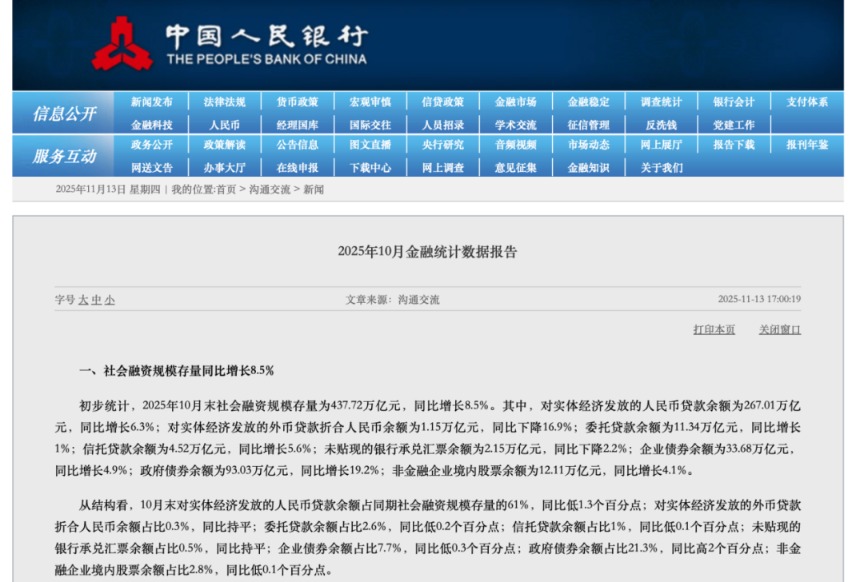
Core Viewpoint - The People's Bank of China (PBOC) has reported that M2 and social financing growth rates remain high, creating a favorable monetary environment for economic recovery. The current monetary policy stance is supportive, aiming to promote reasonable price recovery and maintain strong support for the real economy [1][12]. Monetary Supply and Financing - As of October 2025, the M2 balance reached 335.13 trillion yuan, with a year-on-year growth of 8.2% [4]. - The social financing scale stood at 437.72 trillion yuan, reflecting a year-on-year increase of 8.5% [5]. - From January to October, the incremental social financing was 30.9 trillion yuan, which is 3.83 trillion yuan more than the same period last year [6]. - The balance of various loans in renminbi was 270.61 trillion yuan at the end of October, showing a year-on-year growth of 6.5% [7]. Loan Rates and Structure - The average interest rate for newly issued corporate loans (in both domestic and foreign currencies) in October was 3.1%, approximately 40 basis points lower than the same period last year [7]. - The structure of loans is continuously optimizing, with inclusive small and micro loans growing by 11.6% year-on-year, and medium to long-term loans for the manufacturing sector increasing by 7.9% [11]. Government Bonds and Financing Channels - The issuance of government bonds and special refinancing bonds has accelerated, significantly supporting the growth of social financing. In 2025, the issuance of ultra-long special government bonds increased from 1 trillion yuan to 1.3 trillion yuan [8]. - The financial system has become more diversified, with enterprises increasingly utilizing bonds and stocks for financing rather than relying solely on bank loans [8]. Economic Indicators and Price Trends - The Consumer Price Index (CPI) turned positive in October, rising by 0.2% year-on-year, while the core CPI (excluding food and energy) increased by 1.2%, marking the highest growth since March 2024 [12]. - The Producer Price Index (PPI) decreased by 2.1% year-on-year, with the rate of decline narrowing for three consecutive months [12]. Future Monetary Policy Outlook - The current monetary policy is deemed supportive, with expectations for continued implementation of moderately loose monetary policies to maintain strong support for the real economy [12].
央行,重磅发布!
Zhong Guo Ji Jin Bao· 2025-11-13 10:59
Core Insights - The central bank's October financial data indicates that M2 and social financing growth rates remain high, supporting economic recovery [1][4] - Loan growth is reasonable, with an optimized credit structure and low loan interest rates [1][4] Monetary Policy - Current monetary policy stance is supportive, creating a conducive environment for reasonable price recovery [1][10] - Future implementation of moderately loose monetary policy is necessary to maintain strong support for the real economy [1][10] Financial Data Highlights - As of October 2025, M2 balance reached 335.13 trillion yuan, with a year-on-year growth of 8.2% [4][6] - Social financing stock was 437.72 trillion yuan, growing 8.5% year-on-year [4][5] - From January to October, the increment in social financing was 30.9 trillion yuan, exceeding last year's figure by 3.83 trillion yuan [4][5] - By the end of October, the balance of RMB loans was 270.61 trillion yuan, with a year-on-year increase of 6.5% [4][8] Credit Structure - The structure of loans continues to improve, with inclusive small and micro loans growing by 11.6% and medium to long-term loans for manufacturing increasing by 7.9% [8][9] - The growth of loans related to new economic drivers indicates a shift towards high-quality development [8][9] Government Bonds and Financing - Rapid issuance of government bonds and high demand for corporate bonds have significantly supported the growth of social financing [5] - The issuance of special long-term government bonds increased from 1 trillion yuan last year to 1.3 trillion yuan this year, reflecting fiscal support for economic growth [5] Price Trends - Consumer Price Index (CPI) turned positive in October, indicating a 0.2% year-on-year increase, while core CPI rose by 1.2% [10] - Producer Price Index (PPI) decreased by 2.1%, with the rate of decline narrowing for three consecutive months [10]