
人民币升值

Search documents
突然“起飞”!多重利好,重磅来袭!
券商中国· 2025-10-20 08:27
Core Viewpoint - The aviation sector is experiencing a significant rally, with major airlines seeing substantial stock price increases due to improved operational metrics and favorable market conditions [1][3][6]. Group 1: Market Performance - Hong Kong aviation stocks rose collectively, with China Eastern Airlines up over 10%, China Southern Airlines up over 7%, and Air China up over 5% [1][3]. - The overall aviation sector in the Hong Kong market saw a 3.5% increase, with notable gains in A-shares as well [3][4]. Group 2: Operational Metrics - The Civil Aviation Administration of China reported a reduction in domestic flight slots for the upcoming winter-spring season, with decreases of 1.0% and 1.8% for 2024 and 2025 respectively [6]. - Domestic average ticket prices increased by 5.9%, and the average passenger load factor rose to 87.9%, an increase of 3.5 percentage points compared to the previous year [6]. Group 3: Industry Drivers - The recent price hikes by global shipping giants are attributed to a combination of factors, including reduced port capacity in Europe and North America, adjustments in the Red Sea and African routes, and global manufacturing restocking [6]. - The recovery in business travel demand has led to improved revenue levels, with domestic ticket prices turning positive, increasing by 3.0% compared to a decline of 6.5% in the previous months [8]. Group 4: Currency Impact - The appreciation of the Renminbi against the US dollar, reaching a new high in over 11 months, is expected to benefit the aviation sector, supported by expectations of US Federal Reserve interest rate cuts and stable domestic economic policies [9].



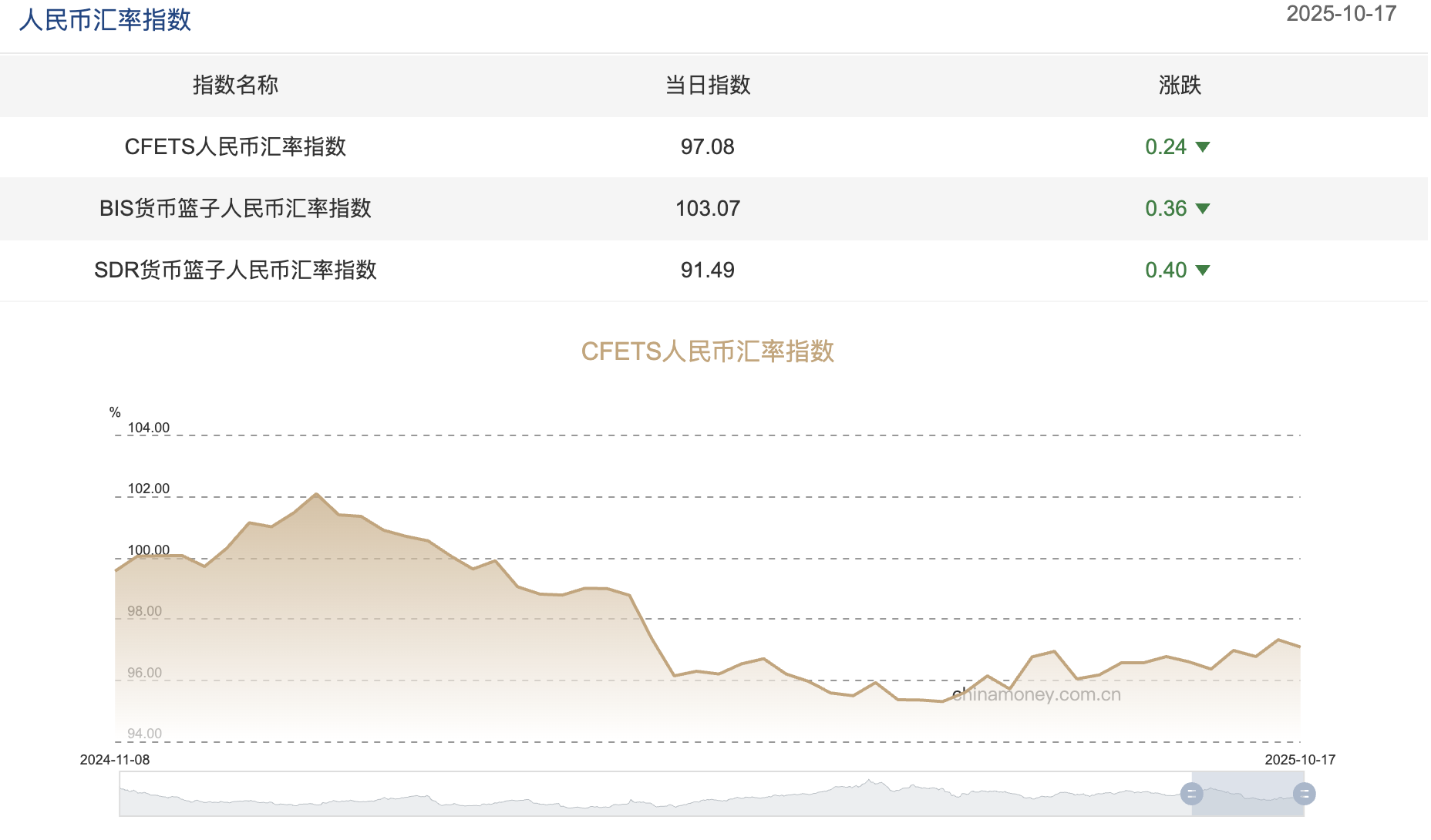
三大人民币汇率指数下行,CFETS指数按周跌0.24
Xin Hua Cai Jing· 2025-10-20 04:36
Core Points - The three major RMB exchange rate indices all declined in the week of October 17, with the CFETS index at 97.08, down 0.24% week-on-week, the BIS index at 103.07, down 0.36%, and the SDR index at 91.49, down 0.40% [1][2] Exchange Rate Trends - The US dollar index weakened overall last week, closing at 98.55, down 0.27% for the week. This weakness supported non-USD currencies, with the euro, pound, and yen all appreciating against the dollar [5] - The RMB against the USD middle rate was reported at 7.0949, with a weekly increase of 186 basis points. The onshore RMB closed at 7.1277, up 83 basis points, while the offshore RMB closed at 7.1269, down 37 basis points [5] - Year-to-date, the RMB middle rate has appreciated over 900 points, with the onshore and offshore RMB appreciating 2.40% and over 2.8% respectively [5] Factors Influencing RMB Appreciation - Analysts attribute the recent RMB appreciation to both internal and external factors. External factors include the impact of the US government shutdown on economic data, increasing uncertainty in financial markets, and accelerated capital flow from the US to non-USD countries [6] - Internal factors include the release of consumer potential, industrial structure upgrades, and continuous optimization of market competition, which provide fundamental support for the RMB exchange rate [6] - The core driver of RMB appreciation is the easing of the Federal Reserve's monetary policy, which influences the RMB through direct effects on the dollar's exchange rate and interest rates [6] Economic Indicators - In September, the consumer market remained stable, with the CPI rising 0.1% month-on-month and falling 0.3% year-on-year. The core CPI rose 1.0% year-on-year, marking the fifth consecutive month of expansion [8] - China's foreign trade continued to show a steady upward trend, with total goods trade value reaching 33.61 trillion yuan in the first three quarters, a year-on-year increase of 4% [8] - The broad money supply (M2) was 335.38 trillion yuan at the end of September, growing 8.4% year-on-year, while the narrow money supply (M1) was 113.15 trillion yuan, up 7.2% year-on-year [9]
今日美元人民币7.0968,升值趋势下,普通人怎么玩转外汇
Sou Hu Cai Jing· 2025-10-17 16:56
Core Viewpoint - The recent appreciation of the Chinese yuan against the US dollar, with a midpoint exchange rate of 7.0968, is seen as beneficial for consumers, particularly for those engaging in overseas purchases and travel, while it poses challenges for export-oriented businesses [1][4]. Exchange Rate Dynamics - The yuan's appreciation is attributed to stable economic performance in China, strong export data, and increased foreign investment, alongside a weakening US dollar due to uncertain Federal Reserve policies and fluctuating US Treasury yields [1][4]. - The onshore and offshore exchange rates reflect different liquidity conditions, with the onshore rate at 7.1238 and the offshore rate at 7.1298, indicating slight discrepancies influenced by global market expectations [1]. Impact on Consumers - The appreciation of the yuan allows consumers to save money on international travel and purchases, with examples showing significant savings on expenses like flights and accommodations [2][4]. - For students studying abroad, the lower exchange rate reduces the financial burden on families sending remittances for tuition and living expenses [4]. Challenges for Exporters - Export businesses face difficulties as the stronger yuan means they receive less in local currency when converting foreign earnings, which may impact their competitiveness [4]. - Individuals holding US dollar savings may find it less advantageous to convert to yuan at this time, although the long-term outlook suggests the yuan's appreciation may enhance its value retention [4]. Practical Tips for Consumers - Consumers are encouraged to monitor exchange rates regularly and utilize various platforms for currency exchange to maximize savings [5]. - Strategies such as splitting currency exchanges and using international payment apps can help mitigate risks associated with fluctuating exchange rates [5]. Long-term Outlook - The medium-term forecast suggests the yuan will remain stable within the range of 7.0 to 7.2, contingent on global economic recovery and domestic policy stability, while potential US interest rate hikes could lead to a rebound in the dollar [7]. - The overall sentiment indicates a cautious optimism regarding the yuan's performance, with recommendations for consumers to balance their currency holdings to manage risks effectively [7].
港股科技ETF(513020)延续反弹,历史走势长期跑赢恒生科技、港股通互联网
Mei Ri Jing Ji Xin Wen· 2025-10-16 06:30
Core Viewpoint - The Hong Kong stock market continues to rebound, with the Hong Kong Technology ETF (513020) rising over 0.6% and experiencing a net inflow of over 700 million yuan for 10 consecutive trading days [1] Group 1: Market Performance - The Hong Kong Technology ETF (513020) tracks the CSI Hong Kong Stock Connect Technology Index, which includes leading technology stocks in sectors such as the internet, new energy, and innovative pharmaceuticals [1] - The index has outperformed the Hang Seng Technology Index and the Hong Kong Stock Connect Internet Index over the long term, with a cumulative increase of 65.26% since 2018, while the Hong Kong Stock Connect Internet Index has decreased by 0.80% and the Hang Seng Technology Index has increased by 9.67% during the same period [1] Group 2: Investment Outlook - Huafu Securities expresses optimism about the Hong Kong stock market's "catch-up" trend, particularly in the context of the appreciation of the renminbi and strengthened expectations for US interest rate cuts, highlighting the focus on Hong Kong technology stocks that concentrate on AI core assets [1]
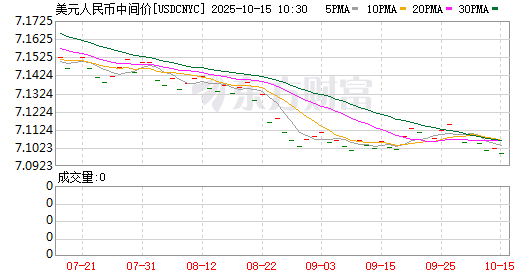
10月15日报7.0995创一年新高 人民币对美元汇率中间价释放强力“稳”信号
Shang Hai Zheng Quan Bao· 2025-10-15 18:35
Group 1 - The central parity rate of the RMB against the USD has shown a strong "stability" signal, with the rate reported at 7.0995 on October 15, marking an increase of 26 points and the first time above 7.10 since late October last year [1] - The onshore RMB opened at 7.1270, rising over 140 points, while the offshore RMB saw a daily increase of approximately 200 points, indicating an appreciation trend [1] - Experts suggest that the recovery of the RMB against the USD and the new high since October 21, 2024, reflects a focus on "stabilizing the exchange rate" as a current policy priority [1] Group 2 - The growth rate of foreign exchange deposits in domestic financial institutions has surpassed the threshold of 6% to 10%, indicating that the RMB has entered an appreciation cycle [2] - The current appreciation cycle of the RMB is primarily driven by the weakening of the USD due to the Federal Reserve's easing policies, with expectations of continued RMB appreciation until mid-next year [2] - Analysts predict that the RMB will continue to appreciate against the USD amid increasing global political uncertainties and the potential for funds to flow from the US to non-US countries [2]
人民币发出重大信号,升值窗口开启?中国资产迎来大利好!
Sou Hu Cai Jing· 2025-10-15 09:50
Group 1 - The core point of the news is the appreciation of the Chinese yuan, which has reached a midpoint of 7.10 against the US dollar for the first time since November last year, indicating a strengthening trend in the currency [1][4]. - The offshore yuan has seen a significant rise, gaining over 100 points following the midpoint adjustment, reflecting positive market sentiment [4][6]. - The rebound in equity assets is noted, with the latest data from the National Bureau of Statistics showing a year-on-year decline in PPI of 2.3% for September, but a narrowing of the decline by 0.6 percentage points compared to the previous month [3][5]. Group 2 - Analysts attribute the yuan's appreciation to two main factors: increased expectations of interest rate cuts and the end of balance sheet reduction by the Federal Reserve, alongside a rebound in domestic price indices [5][8]. - The core CPI rose by 1.0% year-on-year in September, marking the first return to a 1% increase in nearly 19 months, indicating positive changes in some industry prices [5][6]. - The market has reacted positively, with major stock indices in Hong Kong and mainland China showing significant gains, driven by the favorable yuan movement [6][7]. Group 3 - The stability of the yuan is highlighted as being stronger compared to the stock and bond markets, suggesting a potential opening for further appreciation [7][8]. - The recent trade tensions and the depreciation of the US dollar have contributed to the yuan's strength, with the dollar index dropping significantly [7][8]. - The narrowing of the 10-year China-US interest rate differential and the easing of liquidity in the US market are also influencing the yuan's performance [7][8].
突发!中国资产迎大利好!
天天基金网· 2025-10-15 05:43
Core Viewpoint - The article discusses the recent appreciation of the Chinese yuan against the US dollar, highlighting its implications for the financial markets and the economy [3][4][6]. Currency Appreciation Factors - The recent rise in the yuan's value is attributed to two main factors: expectations of interest rate cuts by the Federal Reserve and a rebound in domestic price indices [7]. - The core Consumer Price Index (CPI) in September increased by 1.0%, marking the first time in 19 months that it returned to a 1% growth rate, while the Producer Price Index (PPI) fell by 2.3%, with a narrowing decline compared to the previous month [7]. Market Reactions - The appreciation of the yuan has led to a rebound in equity markets, with the Hang Seng Index opening up by 1.08% and the A-share indices also showing positive movements, particularly in technology stocks [8]. - The offshore yuan saw a significant rise, gaining over 100 points following the adjustment of the central parity rate [4][8]. Economic Context - The article notes that the current economic environment, characterized by a weakening labor market in the US and potential monetary easing by the Federal Reserve, is conducive to the yuan's appreciation [10]. - The narrowing of the interest rate differential between China and the US has also contributed to the yuan's strength, with the 10-year US Treasury yield dropping significantly [9][10]. Future Outlook - Analysts suggest that the yuan's appreciation may signal the opening of a favorable window for further gains, especially in light of ongoing trade tensions and the shifting dynamics of global monetary policy [9][10].
人民币,突发!中国资产,迎来大利好!
Sou Hu Cai Jing· 2025-10-15 04:48
Core Viewpoint - The Chinese yuan has shown significant strength, with the central parity rate rising to 7.10 against the US dollar for the first time since November last year, indicating a potential shift in currency dynamics and market sentiment [1][2]. Currency Dynamics - The yuan's appreciation is attributed to two main factors: expectations of interest rate cuts by the Federal Reserve and a rebound in domestic price indices, with the core CPI rising by 1.0% in September, marking the first increase to this level in 19 months [3][4]. - The offshore yuan experienced a sharp increase, rising over 100 points following the adjustment of the central parity rate [2][3]. Market Reactions - The strengthening of the yuan has led to a broad rebound in equity markets, with the Hang Seng Index opening up by 1.08% and the Hang Seng Tech Index surging over 21%. A-shares also saw a significant recovery, particularly in the ChiNext Index, which rose by over 1% [3]. - The bond market reacted negatively, with a notable drop in government bond prices as a result of the yuan's appreciation and changing market conditions [1]. Economic Indicators - The National Bureau of Statistics reported a 2.3% year-on-year decline in the Producer Price Index (PPI) for September, although the rate of decline has narrowed compared to the previous month. This reflects some positive changes in industry prices [1][3]. - The narrowing of the PPI decline and the increase in core CPI suggest that macroeconomic policies are having a positive impact, leading to improved price stability in certain sectors [3][4]. Broader Economic Context - The current environment is characterized by a significant narrowing of the interest rate differential between China and the US, with a 5 basis point reduction in the 10-year spread, which may further support the yuan's strength [4][5]. - The ongoing trade tensions and the recent US government shutdown have contributed to increased uncertainty in financial markets, prompting a shift of capital from the US to non-US markets [6].
人民币,突发!中国资产,迎来大利好!
券商中国· 2025-10-15 04:41
Core Viewpoint - The recent appreciation of the Renminbi signals a shift in market dynamics, influenced by both domestic economic indicators and international monetary policy changes [1][4][6]. Currency Exchange Rate - On October 15, the Renminbi's central parity against the US dollar rose to 7.0995, an increase of 26 points from the previous day's rate of 7.1021 [2][4]. - The offshore Renminbi also saw a significant rise, gaining over 100 points following the central rate adjustment [2]. Economic Indicators - The National Bureau of Statistics reported a year-on-year decline in the Producer Price Index (PPI) of 2.3% for September, with the decline narrowing by 0.6 percentage points from the previous month [1][4]. - The core Consumer Price Index (CPI) rose by 1.0% year-on-year in September, marking the first return to a 1% increase in nearly 19 months [1][4]. Market Reactions - The appreciation of the Renminbi has led to a rebound in equity markets, with the Hang Seng Index opening up by 1.08% and the Hang Seng Technology Index rising over 21% [5]. - A-shares also experienced a broad-based rally, with the ChiNext Index increasing by over 1% [5]. Monetary Policy Influence - Analysts attribute the Renminbi's strength to expectations of a potential interest rate cut by the Federal Reserve, as indicated by Chairman Powell's comments on the labor market and the possibility of halting balance sheet reduction [4][6]. - The narrowing of the interest rate differential between China and the US, with a 5 basis point reduction in the 10-year spread, has also contributed to the Renminbi's appreciation [6][7]. Trade and Economic Context - The current trade tensions and the US government's fiscal challenges have led to a depreciation of the US dollar, further supporting the Renminbi's rise [6][7]. - The shift in the dollar's value is also influenced by the market's perception of the Federal Reserve's dovish stance compared to other major economies [7].

申银万国期货首席点评:贸易担忧情绪缓解
Shen Yin Wan Guo Qi Huo· 2025-10-13 03:43
1. Report Industry Investment Rating - The report provides a "Bullish" or "Bearish" view for various commodities, with "Bullish" for corn, cotton, apple, zinc, silver, gold, iron ore, hot-rolled coil, rebar, and "Bearish" for crude oil, treasury bonds (T), treasury bonds (TL), and stock index (IM) [6] 2. Core Viewpoints of the Report - Trade concerns have eased, with US stock futures opening higher, S&P 500 futures up 1.1%, and Nasdaq futures up 1.4%. Brent crude futures rose more than 1% at the start, and cryptocurrencies rebounded on Sunday, with Ethereum up more than 10% overnight. Copper in New York rose more than 2% at the start of Asian trading on Monday [1] - After a high-level oscillation in September, the stock index is likely to enter a direction - selection phase again and maintain a bullish trend. In the short term, affected by Sino - US trade, market volatility may increase. The market style may shift towards value in the fourth quarter [2][13] - Gold may benefit from the resurgence of the trade war. Central banks around the world are continuously increasing their gold holdings, and investors' recognition of gold as a safe - haven and value - storage asset is rising [3][22] - The resurgence of the Sino - US trade war has led to a decline in oil prices. In the short term, oil prices tend to break downward. However, there is still a possibility of trade friction mitigation, and low oil prices may cause OPEC to slow down production increases [4][5][16] 3. Summary by Relevant Catalogs 3.1 Daily Main News Concerns 3.1.1 International News - The US Bureau of Labor Statistics will release the September Consumer Price Index (CPI) on October 24 at 8:30 am Eastern Time (20:30 Beijing time) [7] 3.1.2 Domestic News - China's Ministry of Commerce and General Administration of Customs have implemented export controls on relevant rare - earth items, which is a proper measure to improve the export control system [8] 3.1.3 Industry News - In September, China's Small and Medium - Sized Enterprise Development Index (SMEDI) was 89.0, down 0.1 point from August but higher than the same period last year. Some sub - indexes showed a stable and positive development trend [9][10] 3.2 Outer - Market Daily Earnings - From October 9 to 10, major outer - market indexes such as the S&P 500, European STOXX50, and FTSE China A50 futures declined. The US dollar index also fell, while gold and silver prices rose. ICE Brent crude oil fell 4.81% [11] 3.3 Morning Comments on Major Varieties 3.3.1 Financial - **Stock Index**: After a high - level oscillation in September, the stock index is likely to maintain a bullish trend. In the short term, trade issues may increase market volatility. The market style may shift towards value in the fourth quarter [2][13] - **Treasury Bonds**: Affected by US trade remarks, treasury bond yields have declined, and treasury bond futures prices are expected to remain strong until the end of October. The central bank may implement more relaxed monetary policies in the fourth quarter [15] 3.3.2 Energy and Chemicals - **Crude Oil**: The Sino - US trade war has led to a decline in oil prices. Trade friction affects oil prices through supply - chain disruption and risk - asset selling. In the short term, oil prices tend to break downward [4][5][16] - **Methanol**: The average operating load of coal - to - olefin plants has increased, and coastal methanol inventories are rising. Methanol is short - term bearish [17] - **Rubber**: The natural rubber futures rebounded slightly last week. Supply pressure may increase later, and the demand support is limited. The post - holiday trend of Shanghai rubber is expected to be oscillating and bullish [18] - **Polyolefins**: Polyolefin futures are running weakly. Prices are affected by cost fluctuations and market sentiment is cautious [19][20] - **Glass and Soda Ash**: Glass futures continue to be weak, and soda ash futures closed down. The market is waiting for autumn consumption to digest inventory and for policy changes [21] 3.3.3 Metals - **Precious Metals**: Gold may benefit from the resurgence of the trade war. Central banks' gold - buying and investors' recognition of gold as a safe - haven asset support its price [3][22] - **Copper**: The copper price rebounded in the morning. The supply of concentrates has been tight, and the Indonesian mine accident may lead to a supply - demand gap, supporting the copper price in the long term [23] - **Zinc**: The zinc price fell due to the decline in the copper price. The smelting output is expected to increase, and the domestic zinc price may be weaker than the foreign price [24] - **Lithium Carbonate**: Supply has increased, demand is in the peak season, and inventory is decreasing. The lithium salt price is supported, and there is an expectation of project resumption [25][26] 3.3.4 Black Metals - **Coking Coal and Coke**: The coking coal and coke futures were weak on Friday night. The fundamentals changed little during the holiday. The short - term price may fluctuate sharply [27] - **Iron Ore**: Steel mills' production enthusiasm is high, iron ore demand is supported, and global iron ore shipments have decreased. The market is expected to be oscillating and bullish [28] - **Steel**: The supply pressure of steel is increasing, and the inventory is accumulating. The market supply - demand contradiction is not significant. The market is expected to be bullish in the medium term, with hot - rolled coil stronger than rebar [29] 3.3.5 Agricultural Products - **Protein Meal**: The bean and rapeseed meal oscillated weakly at night. The USDA report is expected to lower the US soybean yield, but the report is postponed. The domestic market is well - supplied, and the market is expected to oscillate [30] - **Oils and Fats**: The oils and fats were weak at night. The MPOB report showed an increase in palm oil inventory, which may put short - term pressure on prices. In the long term, prices are expected to rise [31][32] - **Sugar**: The international sugar market is in the inventory - accumulation phase, and the domestic market is affected by new - season sugar production and import pressure. Sugar prices are expected to oscillate [33] - **Cotton**: The US cotton price fell. The domestic cotton market is affected by new - cotton supply and weak downstream demand. The price is expected to be oscillating and bearish [34] 3.3.6 Shipping Index - **Container Shipping to Europe**: The EC index oscillated downward. The off - season trading may have ended, and the near - term market will enter a game for the year - end peak season. The short - term peak - season expectation may weaken due to the trade war, and the far - term market is affected by the Red Sea resumption progress [35]