
自动驾驶

Search documents
Robotaxi暗战:“Waymo时刻”来临,马斯克磨刀霍霍
Sou Hu Cai Jing· 2026-02-05 02:40
Core Viewpoint - Waymo's valuation has surged to $126 billion following a $16 billion funding round, making it one of the largest private financing cases in tech history, despite ongoing controversies and operational challenges [4][10]. Group 1: Valuation and Funding - In February 2024, Waymo's valuation was $45 billion, but it has nearly tripled to $126 billion in just 16 months, despite limited operations in five cities and annual revenue of approximately $350 million [5]. - The funding round included top-tier investors like Sequoia Capital and Dragoneer, with Alphabet contributing over 75% of the total, indicating a shift in Waymo's status from an experimental project to a core business for Alphabet [4][10]. Group 2: Competitive Advantages - Waymo's competitive edge lies in three main areas: data barriers, first-mover advantage, and scalability potential, having completed over 20 million real commercial rides and surpassed 100 million miles of fully autonomous driving [6][8]. - The company has established a hybrid business model by operating its own app and partnering with Uber, which is expected to enhance user habits and network effects [8]. Group 3: Future Prospects and Challenges - Waymo plans to provide automated ride services at San Francisco International Airport by 2025, a significant step as airport trips account for about 20% of ride-hailing demand [11][13]. - Despite its leading position, Waymo faces challenges such as technical risks related to "long-tail scenarios," competition from Tesla's aggressive Robotaxi strategy, and the need to establish a sustainable profitability model [15][22][24]. - Regulatory hurdles and public trust issues remain significant obstacles, as varying traffic laws and safety incidents could hinder expansion efforts [24][26].


海外市场成车企销量关键支撑
Jin Rong Shi Bao· 2026-02-05 02:31
Core Insights - In January 2026, the Chinese automotive market entered a traditional off-season, with new energy vehicle (NEV) companies facing significant sales pressure and a reshuffling of the sales rankings [1][2] New Energy Vehicle Sales Dynamics - Hongmeng Zhixing topped the new energy vehicle sales in January with 57,915 units delivered, marking a 65.6% year-on-year increase [2] - Xiaomi Auto delivered over 39,000 units, with a focus on the YU7 model as the initial SU7 model has been phased out [2] - Leap Motor delivered 32,059 units, a 27% year-on-year increase, but showed a notable month-on-month decline [2] - Li Auto's deliveries were 27,668 units, experiencing both year-on-year and month-on-month declines due to delays in the i6 model's delivery [3] - NIO delivered 27,182 units, a 96.1% year-on-year increase, with the new ES8 model performing exceptionally well [3] - XPeng Motors delivered 20,011 units, facing declines as it is in a product iteration phase [3] Traditional Automakers' Performance - BYD achieved total NEV sales of 210,051 units in January, with exports reaching 100,482 units, a 51.47% year-on-year increase [4] - Chery Group exported 119,605 vehicles, a 48.1% year-on-year increase, maintaining its position as a leading exporter [4] - SAIC Group sold 327,413 vehicles, a 23.9% year-on-year increase, with a significant rise in overseas sales [4] - Geely's total sales reached 270,167 units, with a notable increase in exports, achieving a doubling in export numbers [4] - Great Wall Motors sold 90,312 vehicles, with overseas sales growing by 43.77% [5] Market Trends and Future Outlook - The decline in market demand is attributed to changes in the new energy vehicle purchase tax policy and the release of pent-up demand from 2025 [5] - Analysts suggest that the domestic passenger car market's growth momentum will shift towards overseas markets, with companies focusing on international expansion as a core growth strategy [5]

优步20260204
2026-02-05 02:21
Uber Earnings Call Summary Company Overview - **Company**: Uber - **Date**: February 4, 2026 Key Financial Metrics - **Revenue Growth**: Uber's revenue exceeded 20%, reaching $8.7 billion [2][3] - **Adjusted EBITDA Margin**: 35% [2][3] - **Free Cash Flow**: $9.8 billion, a year-over-year increase of 42% [2][3] - **Annual Active Users**: Over 450 million [2][6] Core Insights Revenue and User Growth - **Monthly Active Users**: Over 202 million, indicating strong user engagement [2][6] - **User Retention**: Significant improvement in user retention due to early lifecycle experience optimization and investment in membership programs, with 40% of users utilizing more than one Uber product [2][7] - **Membership Growth**: Membership program grew by 55% year-over-year [2][7] Autonomous Driving Technology - **Impact on Efficiency**: Autonomous driving technology has improved platform efficiency, with vehicle utilization rates increasing by 30% [2][4] - **Market Expansion**: Plans to enter 15 cities by year-end in collaboration with partners like Waymo and NVIDIA [2][5] - **Long-term Ecosystem**: Anticipation of a diversified ecosystem in the autonomous driving market, with multiple players expected to participate [2][5][7] Strategic Investments and Capital Return - **Capital Return Commitment**: Uber plans to return 50% of free cash flow to shareholders while reinvesting in core business opportunities [2][8] - **Stock Buyback**: Active stock repurchase program due to undervaluation of the company's stock [2][8] Delivery Business Growth - **Factors Driving Growth**: 1. Improved product selection capabilities [2][14] 2. Growth in low-density areas [2][14] 3. Introduction of new products and partnerships [2][14] 4. High membership engagement [2][14] 5. International market expansion [2][14] Additional Insights - **Logistics Efficiency**: Effective utilization of idle vehicles and trucks is a core strategy to enhance logistics ecosystem efficiency [2][12] - **Advertising Business Potential**: The advertising business, particularly in delivery, is experiencing rapid growth, with penetration rates exceeding initial targets [2][13] - **Challenges in Autonomous Vehicle Deployment**: The transition to fully autonomous vehicles will require collaboration with OEMs and local regulatory bodies [2][9][10] Conclusion - **Outlook**: Uber maintains a strong growth trajectory with a clear operational framework supporting sustainable growth, driven by user engagement, technological advancements, and strategic investments [2][3][6]

Uber第四季度净利暴跌96%,押注自动驾驶
第一财经· 2026-02-05 02:08
Core Viewpoint - Uber's Q4 2025 financial report shows a 20% year-over-year revenue growth to $14.4 billion, but a significant 96% drop in net profit to $296 million, primarily due to tax valuation releases and investment re-evaluations [2][3]. Financial Performance - Q4 revenue increased by 20% to $14.4 billion compared to the previous year [2]. - Net profit for Q4 was $296 million, down 96% year-over-year [2]. - Non-GAAP net profit for Q4 grew by 25% to $1.5 billion [2]. - The company reported a 22% increase in order volume to 3.8 billion [3]. User Growth and Product Development - Monthly Active Platform Users (MAPC) rose by 18% to 200 million [3]. - The ride-hailing segment's transaction volume increased by 20%, while the delivery segment's transaction volume grew by 26% [3]. - New product offerings, such as Moto and Reserve, have attracted diverse user groups, including suburban residents and those with urgent travel needs [3]. Autonomous Driving Initiatives - CEO Dara Khosrowshahi emphasized the potential of autonomous vehicles to create significant business opportunities, estimating trillions of dollars in market potential [4]. - Uber is collaborating with companies like Pony.ai and WeRide to enhance its autonomous driving capabilities [4]. - Recent advancements include a partnership with NVIDIA for AI-driven autonomous technology and the establishment of AV Labs to accelerate development in this field [5].

Uber第四季度净利暴跌96% 押注自动驾驶
Di Yi Cai Jing· 2026-02-05 02:05
Core Insights - Uber's Q4 2025 revenue increased by 20% year-over-year to $14.4 billion, but net profit dropped by 96% to $296 million, primarily due to tax valuation releases and investment re-evaluations [2][3] - The company reported a 22% increase in order volume to 3.8 billion, driven by an 18% rise in monthly active platform users (MAPC) to 200 million [3] Financial Performance - Q4 2025 GAAP net profit was $296 million, down 96% year-over-year [2] - Non-GAAP net profit for Q4 2025 grew by 25% year-over-year to $1.5 billion [2] - The company anticipates a $1.6 billion pre-tax net loss in Q4 2025 due to investment re-evaluations [2] User Growth and Product Development - Uber's transaction volume in the rideshare segment grew by 20%, while the delivery segment saw a 26% increase [3] - The introduction of new products, such as Moto and Reserve, has attracted new user segments, including suburban residents and those with urgent travel needs [3] Autonomous Driving Initiatives - CEO Dara Khosrowshahi emphasized the potential of autonomous vehicles to create significant business opportunities, estimating trillions in potential revenue [4] - Uber is collaborating with companies like Pony.ai and WeRide on autonomous driving technology and has launched L4 autonomous Robotaxi services in Abu Dhabi [4] - The establishment of AV Labs aims to enhance Uber's capabilities in autonomous driving through data mining, simulation, and system-level improvements [4]
Uber第四季度净利暴跌96%,押注自动驾驶
Di Yi Cai Jing Zi Xun· 2026-02-05 01:57
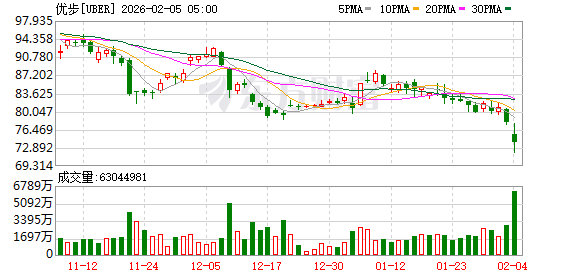
Core Insights - Uber's Q4 2025 revenue increased by 20% year-over-year to $14.4 billion, but net profit dropped by 96% to $296 million, influenced by tax valuation releases and investment re-evaluations [1] - The company reported a 22% increase in order volume to 3.8 billion, driven by an 18% rise in monthly active platform users (MAPC) to 200 million [1] Financial Performance - Q4 2025 net profit included a $6.4 billion gain from tax valuation releases and a $556 million pre-tax gain from investment re-evaluations, while the non-GAAP net profit rose by 25% to $1.5 billion [1] - The stock price fell over 5% following the announcement of the net profit decline [1] User Growth Strategies - CEO Dara Khosrowshahi highlighted that product segmentation and market targeting have driven user growth, with lower-priced offerings like Moto attracting new user demographics [2] - New products such as "Reserve" and "Women Preferred" have successfully reached non-target user groups, including suburban residents and those with urgent travel needs [2] Autonomous Driving Initiatives - The company sees autonomous vehicles as a significant opportunity for customer acquisition, estimating trillions in potential market value [4] - Khosrowshahi noted that the autonomous driving sector will not have a single winner, with multiple suppliers like Pony.ai and WeRide developing their technologies [5] - Recent advancements include a partnership with NVIDIA for AI-driven autonomous technology and the establishment of AV Labs to enhance core capabilities in autonomous driving [5]

Grab获授权,将在东南亚分销禾赛科技激光雷达产品
Xin Lang Cai Jing· 2026-02-05 01:33
Core Viewpoint - Hesai Technology has announced a strategic partnership with Southeast Asian ride-hailing giant Grab, making Grab the exclusive distributor of Hesai's lidar products in the region [1] Group 1: Partnership Details - Grab will be responsible for sales, customer support, and marketing of Hesai's lidar products in Southeast Asia [1] - This collaboration aims to facilitate easier access to lidar technology for customers in Southeast Asia [1] Group 2: Application and Impact - The lidar technology will be applicable in various industry scenarios, including robotic solutions and autonomous driving systems [1]


【百度集团-SW(9888.HK)】广告业务企稳为主,AI云业务支撑中长期逻辑——2025年四季报业绩前瞻(付天姿/杨朋沛)
光大证券研究· 2026-02-04 23:06
Core Viewpoint - The article discusses the anticipated performance of Baidu in Q4 2025, highlighting challenges in advertising revenue and a temporary slowdown in cloud business growth, while Non-GAAP profit recovery becomes a key marginal variable [4]. Group 1: Online Marketing Business - Baidu's advertising revenue is expected to be approximately 62.2 billion yuan in 2025, reflecting a year-on-year decline of 14.7%. The current advertising business is not a primary focus for the company, as traditional search advertising continues to lose its share in the revenue structure due to user attention being diverted to AI search and applications [5]. Group 2: Non-Online Marketing Business - The AI cloud revenue for Baidu is projected to reach around 27.2 billion yuan in 2025. The growth rate in Q4 2025 is expected to slow down sequentially due to seasonal factors and a high base effect, but this does not indicate a weakening demand trend. The core drivers of growth remain AI training and inference demand [6]. Group 3: Profitability - Following the completion of a one-time asset impairment in Q3 2025, there will be no further depreciation and amortization related to this impairment, which is expected to provide ongoing positive contributions to Non-GAAP operating profit starting from Q4 2025. Overall, the improvement in profitability is more reflective of accounting-level marginal recovery, while the operational fundamentals still await stabilization in revenue [7]. Group 4: Business Progress - Baidu has begun to disclose progress in AI applications separately since Q3 2025, covering various products such as document libraries, cloud storage, enterprise-level AI tools, and overseas products. The company maintains a positive outlook on the commercialization prospects of these applications, emphasizing their synergy with AI cloud and Kunlun chip. In terms of autonomous driving, the order volume for Robotaxi continues to grow rapidly, with partnerships established with Uber and Lyft, and plans for trial runs of driverless taxis in the UK, marking a significant step in international expansion. However, these businesses are still in the investment and scale expansion phase, contributing limited short-term earnings [8][9]. Group 5: Kunlun Chip - Kunlun chip, as an important part of Baidu's self-developed AI chip and computing platform, is gaining increasing market attention. It is deeply involved in the overall delivery of Baidu's intelligent cloud and is starting to target industries such as telecommunications, finance, energy, and manufacturing, becoming part of the "cloud + computing" solution. In early 2026, the company announced plans to spin off Kunlun chip for independent listing, aiming to enhance its image among customers, suppliers, and potential strategic partners, and to strengthen its position in business negotiations, allowing the company to benefit from Kunlun chip's growth through its retained shares [10].

优步CEO:自动驾驶将为优步解锁数万亿美元机遇
Xin Lang Cai Jing· 2026-02-04 17:05
Core Viewpoint - Uber's stock price declined in early trading despite optimistic comments from the CEO regarding opportunities in autonomous driving, as investors reacted negatively to the company's earnings guidance [1][4]. Financial Performance - Uber expects adjusted earnings per share (EPS) for Q1 to be in the range of $0.65 to $0.72, below analyst expectations of $0.77 [1][4]. - The expected adjusted EBITDA for the quarter is between $2.37 billion and $2.47 billion, also falling short of analyst median expectations [1][4]. - In Q4, Uber's total bookings grew by 22% to $54.1 billion, with adjusted EBITDA increasing by 35% to $2.5 billion [7]. Leadership Changes - Uber appointed Balaji Krishnamurthy as the new Chief Financial Officer, succeeding Prashanth Mahendra-Rajah, who will step down on February 16 [1][4]. Autonomous Driving Initiatives - CEO Dara Khosrowshahi expressed confidence that autonomous vehicles will unlock trillions of dollars in opportunities for Uber [5]. - Uber plans to launch new service markets, including Houston, Hong Kong, Madrid, and Zurich, with a goal to introduce autonomous taxi services alongside human-driven vehicles in over ten markets by the end of 2026 [5][6]. Strategic Partnerships - Uber has partnered with Lucid to develop an autonomous taxi fleet, with software provided by Nuro [2][5]. - The company is also collaborating with Joby Aviation to integrate helicopter services into its platform and plans to include electric vertical takeoff and landing (eVTOL) aircraft in the future [2][5]. Business Model Advantages - Khosrowshahi highlighted the benefits of a mixed network of autonomous and human-driven vehicles, which is seen as the best option for most markets due to fluctuating demand [6]. - Uber's diversified business model, including Uber Eats and freight services, enhances vehicle utilization rates [6].
类权益月报:如何欢度新春行情?-20260204
HUAXI Securities· 2026-02-04 14:33
Market Overview - In January, the market transitioned from volatility to consolidation, with the Wind All A index rising by 5.83% and the China Convertible Bond index increasing by 5.82%[7][8] - The policy change on January 14 raised the minimum margin requirement from 80% to 100%, cooling speculative market sentiment and shifting focus to high-quality and high-elasticity stocks like computing power and non-ferrous metals[19][22] Market Structure - Despite a calm index, sector performance was turbulent, with significant outflows from equity ETFs totaling 817.5 billion CNY from January 14 to 29, indicating a correction of irrational behaviors[22][23] - The implied volatility dropped significantly post-policy announcement, suggesting a reduction in speculative funds[26][28] Convertible Bonds - Convertible bond demand remains strong but is sensitive to market fluctuations; the valuation of convertible bonds has been stretched, with the valuation center for bonds priced at 100 CNY dropping by 1.55 percentage points to 39.57%[13][41] - The tendency for forced redemptions remains around 50%, indicating potential volatility risks, especially as the earnings season approaches[52][60] Investment Strategy - There are opportunities in undervalued large-cap stocks, as the excess return of the CSI 300 over the CSI 500 has decreased at an unprecedented rate since 2016[64] - Seasonal effects suggest that small-cap stocks typically perform well in February, with historical data showing positive returns for the National Index 2000 in most years since 2010[65][69]