价格战

Search documents
正视汽车价格战
第一财经· 2025-05-27 15:51
Core Viewpoint - The recent price war in the Chinese automotive market, initiated by BYD's promotional activities, reflects significant advancements in the industry and indicates a shift towards a more competitive landscape [3][4][5]. Group 1: Price War Dynamics - BYD launched a "6·18" promotional event with subsidies up to 53,000 yuan, continuing a trend of price reductions over the past three months [1]. - Other automakers like Geely and SAIC have begun to follow suit, indicating a resurgence of price competition in the automotive sector [2][3]. Group 2: Implications of the Price War - The price war signifies the maturity and vibrancy of the Chinese automotive industry, suggesting that it is not merely a sign of "involution" but a necessary phase for enhancing core competitiveness [3][6]. - Historical examples from other industries, such as home appliances, demonstrate that price wars can lead to industry growth and competitiveness rather than decline [3]. Group 3: Policy Considerations - The resurgence of price competition in the new energy vehicle (NEV) sector suggests that government subsidies may no longer be necessary, as the industry has developed sufficient market strength [4][5]. - It is proposed that companies engaging in price wars should not benefit from state subsidies, indicating a potential policy shift regarding support for the NEV sector [4][5]. Group 4: Future of Automotive Consumption - The automotive market is evolving from a simple product sale to a service-oriented model, with vehicles becoming multifunctional and integral to various consumer experiences [5]. - This transformation may lead to new business models, such as purchasing smart driving capabilities or integrated service offerings, changing the landscape of automotive commerce [5][6].


一财社论:正视汽车价格战
Di Yi Cai Jing· 2025-05-27 14:15
Core Viewpoint - The recent price war in the automotive market, particularly in the electric vehicle sector, reflects the maturity and competitiveness of China's automotive industry, indicating a shift towards sustainable service models rather than mere product sales [3][4][5]. Group 1: Price War Dynamics - BYD initiated a promotional campaign on June 18, offering subsidies up to 53,000 yuan, marking a continuation of price reduction strategies that began in March [1]. - Following BYD's lead, other manufacturers like Geely and SAIC have also started to engage in price competition, intensifying the automotive price war [1][2]. - The price war is seen as a normal market competition rather than a destructive "involution" as long as it does not lead to unfair practices like dumping or quality degradation [3][4]. Group 2: Implications for Policy and Industry - The resurgence of the price war suggests that the Chinese electric vehicle industry has matured to a point where government subsidies may no longer be necessary, prompting a reevaluation of existing support policies [4]. - The government is encouraged to consider ending subsidies for electric vehicles, as companies engaging in price wars should not simultaneously benefit from state incentives [4]. - Financial performance data from Q1 indicates that companies like BYD and Geely have achieved revenue growth and maintained positive net profits, reinforcing the legitimacy of the price war [4]. Group 3: Evolution of Automotive Business Models - The automotive industry is transitioning from a focus on product sales to a model centered around sustainable services, reflecting changes in consumer behavior and technology [5]. - As electric vehicles become more multifunctional and integrated into various service scenarios, the core value of automobiles is expected to shift towards service satisfaction rather than just transportation [5]. - This evolution may lead to new business models, such as purchasing smart driving capabilities while enjoying mobile office and consumption services [5].
5.27犀牛财经晚报:第6代新型半导体显示器件生产线全面量产 小米一季度净利润106.76亿元
Xi Niu Cai Jing· 2025-05-27 10:54
Group 1: Banking and Financial Services - Multiple bank wealth management subsidiaries are applying for membership in the China Insurance Asset Management Association, with plans for all to join, potentially leading to a name change for the association to encompass the entire banking insurance asset management industry [1] - City commercial banks are gradually lowering deposit rates to align with national banks, reducing their competitive advantage in attracting savings [1] - Industrial and Commercial Bank of China has adjusted its deposit rates for various terms, now aligning with several joint-stock banks [1] Group 2: Automotive Industry - A price war in the Chinese automotive market, initiated by companies like BYD and Geely, is putting significant pressure on suppliers, with profit margins dropping to around 10% and extended payment terms of up to 120 days [2] - Industry experts warn that this price war could lead to supplier losses and potential safety issues in automotive quality [2] Group 3: Technology and Semiconductor - BOE Technology Group has commenced full-scale production of its 6th generation new semiconductor display device production line in Beijing, representing a significant advancement in China's high-end display sector with a total investment of 29 billion yuan and a designed monthly capacity of 50,000 pieces [1] Group 4: Corporate Financial Performance - Xiaomi Group reported a net profit of 10.676 billion yuan for Q1 2025, a year-on-year increase of 64.5%, with total revenue reaching 111.293 billion yuan, up 47.4% [2] - Zhihu reported a net loss of 10.1 million yuan for Q1 2025, a significant reduction of 93.9% compared to the previous year, with total revenue of 730 million yuan [3] Group 5: Legal and Regulatory Issues - Shaanxi Construction Group is involved in 76 litigation and arbitration cases, with a total amount in dispute of 3.02 billion yuan, affecting the company's current and future profits [3] - Sunac Real Estate Group has been executed for a total of 2.52 billion yuan across multiple cases, with over 416 billion yuan in total execution information [5] Group 6: Corporate Governance - Xu Ruizhe has been appointed as the new chairman of LQ Group, taking over from his father, who significantly expanded the company's operations across various sectors [5] Group 7: Market Activity - The Shanghai Composite Index experienced a slight decline of 0.18% amid a trading volume of 998.9 billion yuan, with mixed performance across sectors [10]






5.58万一辆车!比亚迪再掀价格战、吉利率先响应,车企降本能力迎极限考验
Sou Hu Cai Jing· 2025-05-27 10:00
Core Viewpoint - The automotive industry is entering a new round of price wars, initiated by BYD, which has prompted responses from other car manufacturers, leading to significant stock price declines for major players like BYD [3][4][5]. Group 1: Price War Initiation - BYD launched a significant promotional campaign on May 23, with discounts up to 53,000 yuan on 22 models, indicating a strong pressure in the terminal market [4][6]. - Other companies, such as Geely and Leap Motor, have also introduced substantial cash subsidies and fixed pricing strategies in response to BYD's actions [4][5]. - Analysts from Morgan Stanley noted that the current price competition could further deteriorate investor sentiment, as the pressure on BYD's pricing strategy signals a challenging market environment [4][5]. Group 2: Financial Implications - The average discount rate for Chinese automakers reached a record 16.8% in April, indicating a significant increase in price competition [9]. - BYD's net profit margin for Q1 2025 was reported at 5.54%, while the average net profit margin for the new energy vehicle sector was only 3.77%, highlighting the financial strain on manufacturers [9][10]. - The price war is expected to further compress profit margins across the industry, with analysts predicting that smaller companies may be forced out of the market due to unsustainable financial conditions [9][12]. Group 3: Market Dynamics and Future Outlook - The price war is seen as a necessary move for BYD to meet its ambitious sales targets of 5.5 million units by 2025, especially after only achieving 1.38 million units in the first four months of this year [7][11]. - The competition is expected to intensify, with predictions that companies like Xpeng and Tesla may also introduce similar promotional strategies [5][12]. - The long-term outlook suggests that the industry will shift focus from price competition to technological depth and supply chain integration, with companies that excel in cost control and innovation likely to dominate the market [12].
比亚迪港股两日累跌超10%,大降价引爆市场“血战”预期
Jin Shi Shu Ju· 2025-05-27 05:41
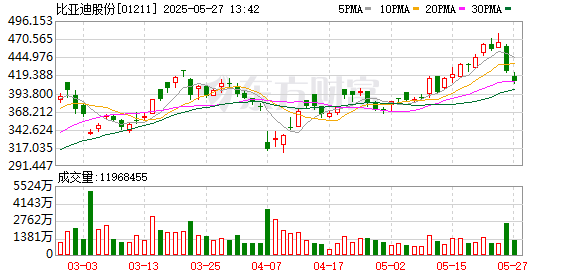
Group 1 - BYD's stock price has dropped over 10% in two days, with concerns about a potential price war in the electric vehicle market following significant price cuts on 22 models, with discounts up to 34% [2][3] - The recent price cuts come at a time when BYD's April sales growth was the slowest in over four years, despite a 21% year-on-year increase [2] - The price cuts have disrupted BYD's strong stock performance earlier this year, where it had reached a historical high and had a market capitalization exceeding Ford, GM, and Volkswagen combined [3] Group 2 - The electric vehicle industry is experiencing intensified competition, with Geely's Xingyuan doubling its production to over 200,000 units in just three months, surpassing BYD's Seagull in sales [3] - Analysts predict that BYD's price cuts may lead to a broader industry price war, with average price reductions in the Chinese automotive market expected to rise from 15%-16% in the second half of the year [4] - BYD's recent actions have sparked concerns about its impact on market sentiment, affecting ETFs related to batteries, automobiles, and new energy vehicles [3][4] Group 3 - BYD's price cuts are seen as a strategy to boost sales volume ahead of its 2025 targets, potentially forcing competitors to lower prices or lose market share [4] - The company's recent social media activity suggests a growing rivalry with Great Wall Motors, reflecting increasing tensions within the Chinese automotive industry [5] - BYD is projected to achieve sales of 4.27 million units in 2024, significantly outpacing Great Wall Motors, which is expected to sell 1.23 million units [5]
高盛:中国新能源车产能扩张峰值已过 但“淘汰赛”仍未结束
Di Yi Cai Jing· 2025-05-27 01:55
Core Viewpoint - The competition in China's new energy vehicle (NEV) market is intensifying, with ongoing price wars and a need for industry consolidation as over 50 companies compete in the space [1][2]. Group 1: Market Dynamics - The price competition in the NEV sector began in January 2023, with an estimated price drop of over 10% for the entire industry in both 2023 and 2024 [2]. - The top ten car manufacturers in China hold approximately 70% of the market share, while mature global markets have around 90%, indicating a need for further consolidation in the Chinese market [2]. - The peak of production capacity expansion occurred in 2023, with over 5 million units added, which is expected to slow to around 3 million units in 2024 [3]. Group 2: Industry Outlook - The current state of the NEV market suggests that the price war is not yet over, with industry leaders predicting at least two more years of competition and consolidation [4]. - The capital expenditure peaked in 2023 and is projected to decline in 2024, reflecting a shift in investment strategies within the industry [3]. - The utilization rate of production capacity is improving, but the industry is still far from achieving a healthy and profitable level [4].


魏建军在炮轰谁?
表舅是养基大户· 2025-05-26 13:32
Core Viewpoint - The recent significant decline in the stock prices of major Chinese automakers BYD and Geely is attributed to a combination of industry price wars and negative commentary from industry leaders regarding market practices [1][2][14]. Group 1: Industry Issues - The automotive industry is facing severe issues, including a price war that has led to losses exceeding 100 billion yuan, with some companies reportedly losing money on every vehicle sold [4][5]. - The price war has resulted in compromised vehicle safety due to cost-cutting measures, delayed payments to suppliers, and a drastic drop in the resale value of used cars, which negatively impacts the reputation of Chinese automakers abroad [5][6]. - There is a trend of capital-driven blind expansion in the industry, leading to decreased capacity utilization and increased losses, with some companies relying heavily on external funding rather than profitability [5][6]. - The phenomenon of "zero-kilometer used cars" is prevalent, where new cars are registered as used to inflate sales figures and obtain subsidies, effectively creating hidden price reductions [6][7]. Group 2: Company-Specific Developments - BYD recently announced a major promotional event, reducing prices on 22 models by up to 53,000 yuan, which is seen as a direct escalation in the ongoing price war [11][14]. - The competitive landscape is further complicated by the fact that BYD and Geely have significantly higher sales volumes compared to Great Wall Motors, which has a lower focus on electric vehicles [7][8]. Group 3: Market Reactions and Future Outlook - The stock market's reaction to the price war and industry commentary has led to significant declines in share prices for major automakers, reminiscent of past market responses to similar pricing strategies [16]. - Despite current challenges, the long-term outlook suggests that the industry may consolidate, benefiting leading companies as the market stabilizes and matures [16]. - There is potential for growth in the export of traditional and hybrid vehicles, particularly in regions lacking electric vehicle infrastructure, indicating a broader market opportunity beyond just electric vehicles [18][19].

比亚迪:逼我出绝招是吧
虎嗅APP· 2025-05-26 09:49
Core Viewpoint - A new round of price competition is expected to sweep the Chinese automotive market, initiated by BYD's recent promotional pricing strategy for its main brands, "Dynasty" and "Ocean" [1][4]. Group 1: Promotional Strategy - BYD has launched a "limited-time fixed price" promotion for all 22 of its main models, offering significant discounts [1][3]. - The promotional campaigns for the "Dynasty" and "Ocean" brands differ in structure, with the former focusing on cash discounts and manufacturer subsidies, while the latter includes national subsidies [3][4]. - The promotion period runs from May 23 to June 30, indicating a strategic push to stimulate sales amid competitive pressures [3][4]. Group 2: Market Context - The automotive market has been relatively calm for nearly two months, but BYD's actions are likely to reignite intense price competition [4][18]. - The decision to implement a more visible discount strategy follows a previous "silent" price reduction in April, aimed at countering competitive pressures from other automakers [5][10]. - Competitors like Geely have introduced models that directly challenge BYD's offerings, intensifying the competitive landscape [17][18]. Group 3: Sales Dynamics - Sales representatives from BYD have expressed support for the promotional strategy, as it could attract more potential customers and streamline the sales process [10][19]. - However, there are concerns about the potential negative impact on brand image and customer loyalty due to frequent price changes [10][11]. - The overall market demand for vehicles has shown signs of weakness, necessitating aggressive sales tactics to maintain market share [21][22]. Group 4: Competitive Landscape - The automotive industry is experiencing a shift where competitors are adopting BYD's strategy of enhancing "comprehensive cost-performance" to compete effectively [18][22]. - The current market dynamics suggest that BYD is not the aggressor in this price war but is instead responding to external pressures from rivals [18][22]. - The ongoing competition is expected to continue as long as the supply-demand imbalance persists in the market [22].

比亚迪618百亿补贴,港股汽车全线重挫,港股科技ETF(159751)回调整固
Xin Lang Cai Jing· 2025-05-26 08:33
Group 1 - The Hong Kong stock market for automobiles experienced a significant decline, with major players like BYD, Li Auto, Geely, and Xpeng seeing drops of 8.60%, 8.45%, 9.46%, and 4.44% respectively [1] - BYD initiated a substantial price reduction campaign from May 23 to June 30, with some models priced as low as 60,000 yuan, raising concerns about a new wave of price wars in the market [1] - This marks the third promotional effort by BYD since the end of March, with the latest promotion being more extensive than previous ones [1] Group 2 - The current competition in the new energy vehicle market is product-centric, with cost-performance strategies being a key choice for companies, especially those with weaker brand power [1] - The automotive sector's deflationary environment has increased consumer price sensitivity, leading to a short-term focus on cost-performance in competition [1] - The Hong Kong Technology Index saw a 3.33% decline, with the automotive sector comprising 21.5% of the index, indicating a significant impact from the automotive industry's downturn [1] Group 3 - As of April 30, 2025, the top ten weighted stocks in the CSI Hong Kong Stock Connect Technology Index include Xiaomi, Alibaba, BYD, Tencent, Meituan, SMIC, BeiGene, Kuaishou, Li Auto, and Xpeng, collectively accounting for 71.55% of the index [3]
“吹灭鬼灯”背后:魏建军怒揭价格战如何毁掉中国汽车产业
第一财经· 2025-05-26 07:46
" 吹灭别人的灯,关键是什么灯,它要是鬼灯我一定要把它吹灭了。只要这个行业得到健康的发展, 不要为中国制造抹黑,遭受巨大的损失,我觉得挨两句骂也值。 " 长城汽车董事长魏建军近日在新 浪财经的专访中表示。 近两年来,中国汽车行业陷入史无前例的 " 内卷式价格战 " 。 2024 年,中国车市上超 200 款车型 主动或被迫卷入价格战,单车平均降价幅度达 9.2% ,导致全行业利润率严重下滑。中国汽车流通协 会数据显示,仅 1-8 月全行业因价格战直接损失 1380 亿元,产业链整体利润率跌破 3% ,部分车 企甚至出现 " 卖一辆亏一辆 " 的畸形现象。 在这个充满乱象的行业环境中,长城汽车董事长魏建军多次站出来发声,直指行业问题。无底线价格 战导致企业亏损、品质下滑、售后体系崩塌,最终将破坏用户对中国汽车品牌的信任。如今,汽车行 业正站在十字路口,如何摆脱价格战的泥沼,回归健康发展的轨道,是整个行业亟待解决的问题。 汽车产业拉响亏损警报 值得注意的是,当前,电动车产业整体面临盈利困境,多家企业电动车业务处于亏损状态,企业为了 追求销量规模不断压缩成本,而价格战的连锁反应已蔓延至产业链上游。一些车企为了在价格 ...