电动化

Search documents
23.59万元起售!AUDI首款电车上市,30分钟订单达10153台,宋斐明:它更是一份宣言
Mei Ri Jing Ji Xin Wen· 2025-09-17 05:20
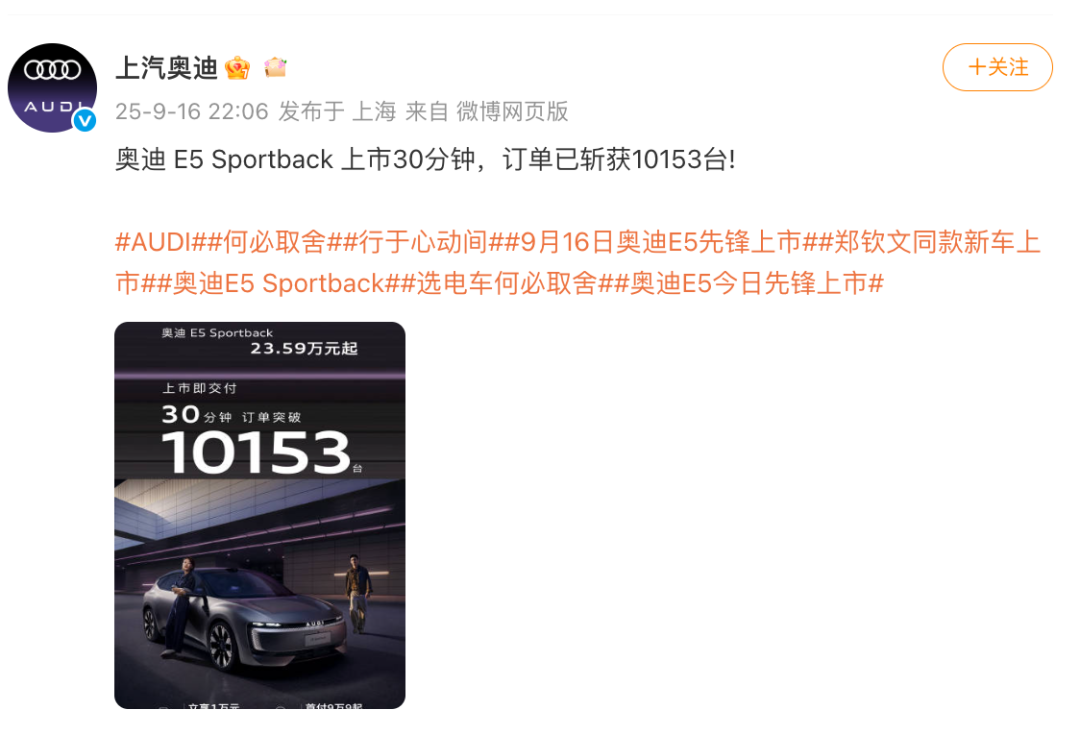
Core Insights - Audi has launched its first electric model, the E5 Sportback, as a significant step in its electrification strategy in China [1][4] - The E5 Sportback is priced between 235,900 to 319,900 RMB, with an introductory offer that brings the effective price down to 220,000 RMB [1] - The vehicle has received over 10,153 orders within 30 minutes of its launch [1] Product Features - The E5 Sportback features a CTP battery from CATL, offering a maximum range of 773 km and the ability to charge 370 km in just 10 minutes [6] - It is equipped with a dual-motor quattro all-wheel-drive system, enhancing performance and driving control [6] - The vehicle incorporates advanced driver assistance systems developed in collaboration with Momenta and features the new AUDI OS operating system [6] Market Strategy - Audi plans to expand its sales channels for the E5 Sportback, aiming to increase the number of dealerships to 240 by the end of the year, covering over 100 key cities [6] - The collaboration between Audi and SAIC has led to a new development model that has reduced product update cycles by 30% [7] - Over the next three years, Audi intends to launch more electric models to enhance its product lineup in the Chinese market [7]


23.59万元起 !AUDI首款车型上市 宋斐明:它不仅是一款车,更是一份宣言
Mei Ri Jing Ji Xin Wen· 2025-09-16 13:32
Core Insights - Audi has launched its first electric model, the E5 Sportback, marking a significant milestone in its electrification strategy in China [1][4] - The E5 Sportback is positioned to compete with models such as Xiaomi SU7, Model 3, Zeekr 001, and Zhiji L6, with a price range from 235,900 to 319,900 yuan [1][4] Product Features - The E5 Sportback features a CTP battery from CATL, offering a maximum range of 773 km and the ability to charge 370 km in just 10 minutes due to its 800V high-voltage platform [4] - It is equipped with a dual-motor quattro intelligent all-wheel-drive system, enhancing performance and driving control [4] Technological Innovations - Audi has partnered with Momenta to develop an advanced driver assistance system based on Momenta's Flywheel model, alongside a new AUDI OS operating system integrated with Qualcomm Snapdragon 8295 digital cockpit chip [5] - Customers who place an order for the E5 Sportback will receive a lifetime free benefit of the Audi panoramic assistance driving system [5] Market Strategy - Audi plans to expand its sales channels for the E5 Sportback, aiming to increase the number of dealerships to 240 by the end of the year, covering over 100 key cities [5] - The collaboration between Audi and SAIC has led to a 30% reduction in product update cycles, with plans to launch more electric models in the next three years to enhance Audi's product lineup in China [5]
从技术创新到全球布局:深蓝汽车在新央企起点上加速“奔跑”
Ren Min Wang· 2025-09-16 07:48
Core Viewpoint - Deep Blue Automotive is accelerating its development as a new independent central enterprise under Changan Automobile Group, focusing on becoming a world-class electric vehicle brand through product innovation, technology advancement, and global expansion [1][2]. Group 1: Leadership and Product Launches - On September 8, Deep Blue Automotive announced Jiang Hairong as the new CEO, with Chairman Deng Chenghao emphasizing collaboration to enhance the brand's global standing [1]. - The company has had a busy product launch schedule, debuting the new Deep Blue S07 and the refreshed Deep Blue S05 520 electric version at the Chengdu International Auto Show in late August [1]. - At the autumn global product launch on September 8, Deep Blue unveiled five new products, including the pre-sale of the Deep Blue S07 and the launch of the Deep Blue S09 with Huawei's advanced ADS4 intelligent driving system [1]. Group 2: Technological Innovations - In the context of increasing competition in the global automotive industry, Deep Blue Automotive is focusing on mastering core technologies through independent innovation and deep collaboration [2]. - The company has developed proprietary technologies such as the "Micro-core High-frequency Pulse Heating Technology" to alleviate low-temperature concerns for northern users and the "Super Range Extender" technology to provide economical and convenient solutions in areas with limited charging infrastructure [2]. - Deep Blue is collaborating with Huawei to integrate the Huawei Dry Kun ADS SE intelligent driving system into mainstream SUVs and sedans, with an upgraded version in the higher-end Deep Blue S09 [2]. Group 3: Global Expansion Strategy - Deep Blue Automotive is transitioning from a "product export" model to a "system output" approach in its globalization strategy, emphasizing localized operations across various markets [2][3]. - The company has localized production of the S05 model at its Rayong factory in Thailand and made over a hundred adaptive modifications to meet local regulations and user preferences [3]. - Deep Blue has achieved market coverage in over 70 countries and regions within a year and a half, with plans to expand to 150 countries and regions in the future [3]. - The company aims to launch 30 new models over the next five years, reinforcing its commitment to technological self-reliance and enhancing its competitiveness in the global new energy vehicle market [3].
政策、技术、全球景气三重叠加,智能汽车板块走强,智能车ETF泰康(159720)冲击4连涨
Xin Lang Cai Jing· 2025-09-16 06:17
Core Viewpoint - The smart vehicle ETF, TaiKang (159720), is experiencing a significant upward trend driven by policy, technology, and global market conditions, indicating a shift from "electrification" to "intelligentization" in the automotive sector [1][5]. Short-term Driving Logic - Policy expectations have been fulfilled with clear guidelines on L3 access trials and energy storage targets, reducing market uncertainty and enhancing sector valuations [2]. - Accelerated technological iterations, such as breakthroughs in solid-state batteries and AI models for vehicles, validate industry growth potential and open long-term opportunities [3]. - Global benchmarks, including Tesla's Robotaxi progress and large orders from Hesai, confirm the commercial viability of smart vehicles and strengthen the global supply chain position [4]. Medium to Long-term Trends - The competitive focus is shifting from battery range to intelligent driving experiences, with software-defined vehicles becoming a core barrier to entry [5]. - The deepening of domestic substitution in critical areas like semiconductors and lidar, along with accelerated overseas expansion (e.g., localized production in Europe), is building global competitiveness [5]. Profit Model Reconstruction - Automotive companies are transitioning from "hardware sales" to "software services" (e.g., subscription-based intelligent driving), with future gross margins expected to continue rising [6]. Related Products - The smart vehicle ETF, TaiKang (159720), employs a full replication investment strategy closely tracking the CSI Smart Electric Vehicle Index, achieving a recent scale of 59.69 million yuan, a six-month high [1][7]. - The ETF's top ten holdings include leading companies in electric and smart vehicle sectors, with a combined weight of 55.33%, indicating strong alignment with the electrification and intelligentization trends [7][8]. - The ETF is positioned to benefit from the positive cycle of "technological breakthroughs - commercial implementation - scale expansion," particularly as Robotaxi operations grow and intelligent driving hardware costs decrease [7][8]. - The CSI Smart Electric Vehicle Index reflects the overall performance of listed companies in the smart electric vehicle industry, with key players like CATL and BYD establishing competitive advantages in battery technology and smart cockpit areas [9].





曹东杰,回归东风本田
Jing Ji Guan Cha Bao· 2025-09-16 02:49
Core Viewpoint - Dongfeng Honda is undergoing a personnel adjustment aimed at optimizing its management system and strengthening strategic implementation, with key leadership changes that reflect the company's commitment to high-quality development and transformation in the electric and intelligent vehicle sectors [1][2] Group 1: Leadership Changes - Pan Jianxin has been appointed as the Party Secretary and Union Chairman candidate of Dongfeng Honda, transitioning from his previous role as Executive Vice President [1] - Cao Dongjie, former CEO of Dongfeng Warriors Technology, has been recommended as a board member and Executive Vice President of Dongfeng Honda, bringing extensive automotive industry experience [1] Group 2: Strategic Focus - The personnel adjustments are part of a normal rotation within Dongfeng Motor Group, aimed at enhancing management efficiency and leveraging shareholder resources for better cross-business collaboration [1] - Dongfeng Honda has maintained a stable operational performance during Pan Jianxin's tenure, focusing on product layout, digital transformation, and local strategy deepening [1] - The company emphasizes that these changes will not affect its established strategic progress, continuing its commitment to high-quality development and the transition to new energy vehicles [2]
中国汽车工业协会:呼吁国内外企业继续加强技术创新与产业链协同
Xin Hua Wang· 2025-09-16 02:36
声明表示,汽车产业的技术进步与可持续发展,尤其需要开放、公平、非歧视的国际市场环境。中 国汽车工业协会呼吁国内外企业继续加强技术创新与产业链协同,深化在电动化、智能化等领域的开放 合作,共同推动全球汽车产业绿色、安全、高质量发展。 声明表示,中国汽车工业协会将积极支持和配合调查机关的调查,坚定维护公平贸易和产业合法权 益。 新华社北京9月16日电 记者16日获悉,中国汽车工业协会发布声明,呼吁国内外企业继续加强技术 创新与产业链协同。 声明称,2025年9月13日,中国商务部发布公告,对自美国进口的相关模拟芯片发起反倾销调查, 就美国对华集成电路领域相关措施发起反歧视立案调查。中国汽车工业协会对此高度关注,坚决支持商 务部依法采取必要措施。 【纠错】 【责任编辑:焦鹏】 ...
岚图汽车卢放:企业内部坚持技术第一位,在市场上坚持用户第一位
Xin Jing Bao· 2025-09-15 13:21
Core Insights - Lantu Motors emphasizes technology as its top priority internally and user experience as its primary focus in the market [1] Company Strategy - Lantu Motors aims to redefine the MPV category in response to the evolution of electric and intelligent vehicles, highlighting the need for continuous technological innovation to meet user experience demands [1] - The company has introduced the 2026 Lantu Dreamer, which has undergone three product evolutions since its launch in 2022, with an average price exceeding 390,000 yuan [1] Product Details - The 2026 Lantu Dreamer features five models with official prices ranging from 329,900 yuan to 439,900 yuan [1] - The new model is equipped with advanced features such as 800V ultra-fast charging, Huawei ADS 4, HarmonyOS cockpit 5, and intelligent rear-wheel steering [1]
超级增程+优质智能化体验,至境L7树立增程豪华轿车标杆
Xin Lang Cai Jing· 2025-09-15 12:14
Core Viewpoint - The automotive industry in China is undergoing structural adjustments, with electric and intelligent technologies reshaping consumer preferences and decision-making. Buick aims to enhance brand value through smart technology, launching the new high-end electric sub-brand "Zhijing" to compete in the market [1][27]. Group 1: Product Launch and Features - Buick's Zhijing L7 is the first mass-produced sedan built on the "Xiaoyao" architecture, developed with an investment of 10 billion yuan, combining luxury and intelligent experiences [3][7]. - The L7 features the "Zhenlong" range extender system, offering a pure electric range of 302 km and a total range exceeding 1400 km, addressing range anxiety for users [9][11]. - The vehicle boasts a 5.9 seconds acceleration from 0 to 100 km/h and a fuel consumption of 0.5 L per 100 km, with advanced noise reduction technologies for a smooth driving experience [9][11]. Group 2: Technological Innovations - The "Xiaoyao" architecture is fully developed by a Chinese team, representing a significant advancement in local research and development capabilities, integrating four key technology domains: power, chassis, assisted driving, and intelligent cabin [7]. - The L7 incorporates the "Xiaoyao Zhixing" assisted driving system, developed in collaboration with Momenta, featuring advanced capabilities such as "no interruption" city navigation and industry-leading parking assistance [14][27]. - The vehicle is equipped with Qualcomm's latest SA8775P automotive-grade chip, providing high computational power for intelligent cabin features and ensuring stable performance under extreme conditions [16][27]. Group 3: Design and Comfort - The exterior design of the L7 draws inspiration from the ELECTRA-L concept, featuring a luxurious front grille and streamlined body lines that enhance its aesthetic appeal [19]. - The interior utilizes a modern color scheme and innovative design elements, creating a spacious and comfortable environment with advanced seating options and high-quality materials [23][24]. - The L7 includes a premium sound system with 27 speakers and soundproofing features, achieving a quiet cabin experience comparable to a library [26]. Group 4: Market Positioning - The launch of the Zhijing L7 is positioned to redefine the competitive landscape for joint venture brands in the new energy vehicle market, targeting the 200,000 to 300,000 yuan segment [27]. - The vehicle aims to fill gaps in intelligent features and enhance Buick's presence in the electric vehicle sector, leveraging its brand heritage and technological advancements [27].
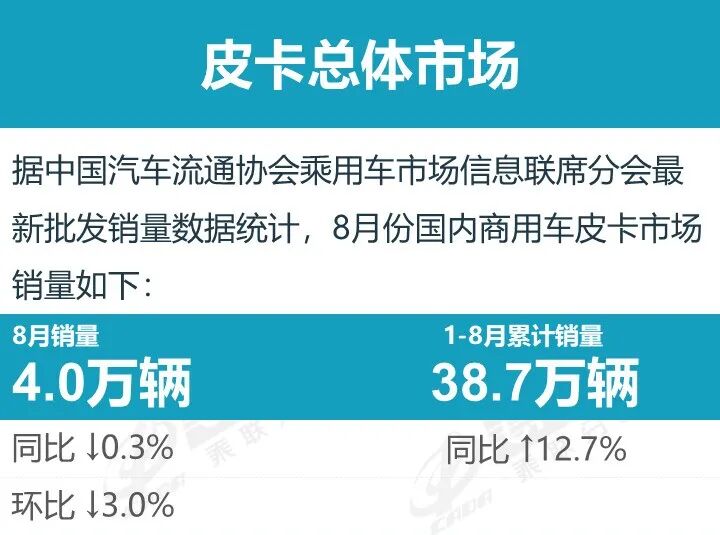
中国汽车流通协会:8月皮卡市场销售4万辆 同比下降0.3%
智通财经网· 2025-09-15 08:59
Group 1: Market Overview - In August 2025, the pickup market sold 40,000 units, a year-on-year decrease of 0.3% and a month-on-month decrease of 3.0%, remaining at a mid-high level compared to the past five years [1] - From January to August 2025, the pickup market sold 387,000 units, showing a year-on-year growth of 12.7% [1] - The main demand for pickups is concentrated in the Southwest and Northwest regions, accounting for 45% of total demand in August 2025 [1] Group 2: Company Performance - Great Wall Motors continues to lead the pickup market, with stable performance both domestically and internationally [1] - In the August 2025 pickup sales ranking, Great Wall Motors sold 13,322 units, a decrease of 2.9% year-on-year, while Changan and Zhengzhou Nissan saw significant increases of 53.5% and 56.3% respectively [4] - From January to August 2025, Great Wall Motors sold 123,322 units, a year-on-year increase of 4.8% [5] Group 3: Export and New Energy Pickup Trends - In 2024, China exported a total of 244,000 pickups, with an impressive growth rate of 85% [2] - In August 2025, the pickup export volume was 21,000 units, a year-on-year increase of 3% [2] - The sales of new energy pickups reached 2,120 units in 2024, a year-on-year increase of 170%, with a cumulative sales of 49,000 units from January to August 2025, reflecting a growth of 536% [2] Group 4: Competitive Landscape - In the new energy pickup segment for August 2025, Geely Radar sold 1,221 units, BYD sold 861 units, and Changan sold 710 units, indicating a growing market for new energy pickups [3] - The competitive landscape shows that the "one strong, three weak" pattern in the domestic pickup market continues, with Great Wall Motors, Jiangling Motors, and Zhengzhou Nissan performing well [1]
急了?奔驰设计师狂怼奥迪「过时」,CEO嫌「太卷」
Feng Huang Wang Cai Jing· 2025-09-15 06:33
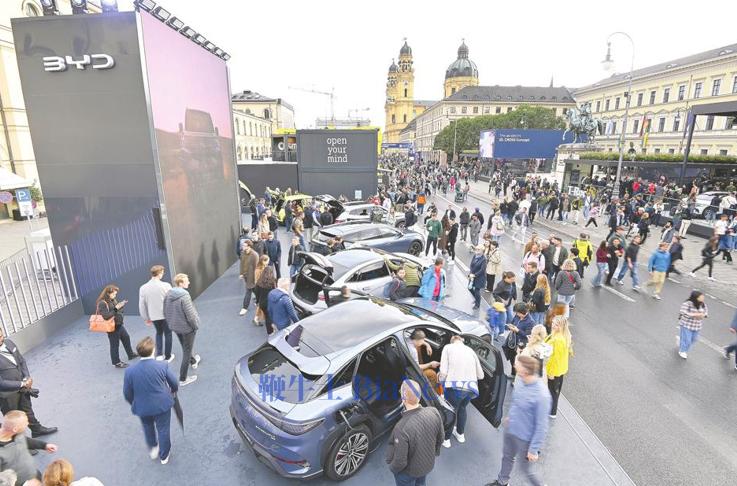
Core Insights - The Munich Auto Show has seen a significant increase in Chinese car manufacturers, with over 100 companies participating, marking a nearly 50% rise compared to the previous event, turning the event into a battleground between Chinese and German automakers [1][2] - Chinese brands have nearly doubled their market share in Europe to 5.1%, closely trailing behind Mercedes-Benz at 5.2%, indicating a shift in consumer preferences [2] - The German automotive giants, particularly the BBA (Benz, BMW, Audi), are facing unprecedented challenges as they struggle to keep pace with the rapid advancements of Chinese electric vehicle manufacturers [6][7] Group 1: Market Dynamics - Chinese car registrations have surged by 91% since the beginning of the year, reflecting a robust demand for domestic brands [2] - The BBA's sales in China have plummeted, with Mercedes-Benz down 14% to 290,000 units and Audi down 10.2%, collectively losing nearly 300,000 units in sales [7] - The profit margins of these traditional automakers are under pressure, with Mercedes-Benz's net profit halving by 55.8% and Volkswagen's operating profit declining by 32.8% to €6.7 billion [7] Group 2: Competitive Landscape - The BBA is criticized for outdated designs, with Mercedes-Benz's design chief publicly mocking competitors for their lack of innovation [5] - The shift in strategy for BBA has moved from aggressive electrification to a more pragmatic approach of hybrid models, indicating a response to the competitive landscape [11][12] - New electric models from BBA, such as the Mercedes-Benz GLC EV and BMW's iX3, are being introduced to counter the competitive threat from Chinese brands [14] Group 3: Consumer Preferences - Chinese consumers are increasingly favoring local brands due to their competitive pricing and advanced technology, with models like BYD Han and NIO ET5 offering high performance at lower prices compared to BBA vehicles [9] - The demographic shift towards younger consumers, with over 64% of BYD's users being from the post-90s and post-00s generations, is influencing market trends [9] - The penetration rate of new energy vehicles in China is projected to exceed 55.3% by 2025, further solidifying the dominance of local brands [8]