
即时零售

Search documents
4个季度狂撒约1200亿元,净利润承压 阿里“豪赌”AI与即时零售值不值?
Sou Hu Cai Jing· 2025-11-26 14:05
Core Insights - Alibaba reported a revenue of 247.795 billion RMB for Q2 of FY2026, marking a 5% year-on-year increase, with a 15% increase when excluding disposed businesses [1] - The company is heavily investing in AI and instant retail, leading to a significant drop in net profit by 53% to 20.612 billion RMB and a 68% decrease in net cash flow from operating activities [4][6] - Alibaba's cloud revenue grew by 34% year-on-year, driven by increased adoption of AI-related products [3] Revenue and Growth - Alibaba's customer management revenue increased by 10% to 78.927 billion RMB, primarily due to improved take rates and the introduction of new software service fees [2] - Instant retail revenue reached 22.906 billion RMB, a 60% increase compared to the same period last year, largely attributed to the launch of "Taobao Flash Purchase" [2] - The cloud intelligence group's revenue was 39.824 billion RMB, reflecting a 34% year-on-year growth, driven by public cloud business [3] Investment and Profitability - The company invested approximately 120 billion RMB in AI and cloud infrastructure over the past four quarters, indicating a focus on long-term growth despite short-term profit fluctuations [1][6] - Adjusted EBITA decreased by 78% due to investments in instant retail and user experience [1] - Free cash flow showed a net outflow of 21.840 billion RMB, compared to a net inflow of 13.735 billion RMB in the previous year [4] Strategic Focus - Alibaba's CEO emphasized the importance of building AI technology and infrastructure, aiming to create a large consumer platform that integrates life services and e-commerce [6][11] - The company plans to maintain high levels of investment in AI infrastructure, with a potential increase beyond the previously announced 380 billion RMB over three years [6] - The dual focus on AI to B and AI to C strategies aims to enhance core business synergies and drive sustainable growth [7][10] Future Outlook - Experts suggest that while AI presents significant potential, current monetization remains limited, with many applications still in the user acquisition phase [10] - Alibaba's integration of AI into its ecosystem is expected to enhance operational efficiency and customer engagement [8][10] - The company is positioning itself to capture market share in the large consumer sector by integrating various business units and enhancing collaboration [11]



平均每单提速6至60分钟,“独享专送”助力餐饮品牌打造差异化优势
Yang Zi Wan Bao Wang· 2025-11-26 13:46
Core Insights - The instant retail market is expanding, with consumer demand shifting from "delivery" to "quality delivery" [1] - Companies like Meituan and SF Express are enhancing their delivery services to meet diverse consumer needs [1][3] - SF Express's "Exclusive Delivery" service is experiencing rapid growth, with a threefold increase in restaurant orders compared to last year [1][3] Group 1: Service Enhancements - SF Express's "Exclusive Delivery" employs a one-to-one service model, reducing average delivery times by 6 to 60 minutes compared to standard services [3] - The collaboration between SF Express and merchants creates a unified quality service standard, enhancing brand differentiation [3] - Merchants can now accept orders from further distances, expanding their market reach and improving customer retention through high-quality delivery [3] Group 2: Fresh Produce Solutions - SF Express and SF Group have developed a comprehensive solution for the fresh produce sector, providing end-to-end service from transportation to delivery [5] - This model has achieved full coverage in Shenzhen, allowing seafood merchants to expand beyond traditional market limits [5] - Consumer preferences are shifting towards faster, safer, and higher-quality delivery experiences, with over 50% of post-95 consumers willing to pay a premium for speed [5] Group 3: Market Trends - The demand for personalized and value-added services is increasing, with consumers showing a higher willingness to pay for such offerings [5] - The "Exclusive Delivery" service is becoming a key strategy for merchants to attract high-end customers and differentiate their services [5]

阿里Q3激战外卖:销售费用是京东3倍,单均亏损已减半,调整后净利下降72%
Sou Hu Cai Jing· 2025-11-26 13:40
Core Insights - Alibaba's net profit for Q2 of fiscal year 2026 dropped significantly to 20.6 billion yuan, a year-on-year and quarter-on-quarter decline of 53% and over 51% respectively, primarily due to massive subsidies in the food delivery and instant retail sectors [2][6] - The company's sales expenses doubled to 66.5 billion yuan, reflecting a 105% year-on-year increase, as it invested nearly 120 billion yuan in the first half of the year to compete in the market [3][4] - Alibaba's revenue for the quarter reached 247.8 billion yuan, a 5% year-on-year growth, which, when excluding divested businesses, translates to a 15% growth, aligning with JD's performance and surpassing Pinduoduo's 9% [2][4] Financial Performance - The adjusted net profit under non-GAAP standards was 10.4 billion yuan, marking a substantial 72% year-on-year decline [2][6] - Alibaba's adjusted EBITA for its China e-commerce group was approximately 10.5 billion yuan, down nearly 73% quarter-on-quarter and 76% year-on-year, largely due to losses in instant retail [6][5] - The revenue from Alibaba's cloud business was 39.8 billion yuan, showing a 34% year-on-year increase, driven by growth in public cloud services [9][10] Market Competition - The intense competition in the food delivery market led to Alibaba's significant investment in the Taobao Flash Sale, which announced a 50 billion yuan subsidy plan [3][4] - JD's marketing expenses were more restrained at 21.1 billion yuan, reflecting a 110% year-on-year increase but a decrease in quarter-on-quarter growth [4] - Instant retail revenue for Alibaba reached 22.9 billion yuan, with a year-on-year growth of 60%, indicating a strong performance despite the overall profit decline [4][5] Strategic Focus - Alibaba's CEO expressed confidence in the potential of AI and cloud services, stating that there is no AI bubble expected in the next three years, and the company plans to continue investing heavily in these areas [9][11] - The company has invested approximately 120 billion yuan in AI and cloud infrastructure over the past four quarters, with a capital expenditure of 31.5 billion yuan in the latest quarter [10][11] - Future investments in instant retail are expected to decrease, while AI investments may increase, reflecting a strategic shift in focus [8][11]

利润承压,阿里全面转向
2 1 Shi Ji Jing Ji Bao Dao· 2025-11-26 13:15
在利润承压的背景下,阿里巴巴正加速向AI驱动型公司转型。 11月25日晚间,阿里巴巴(NYSE:BABA;HKEX:9988)发布截至2025年9月30日的财报。在2026财 年第二季度(自然年2025年第三季度),阿里巴巴营收为2477.95亿元,同比增长5%。净利润为206.12 亿元,同比下滑53%。在强劲的AI需求推动和公共云收入增长带动下,阿里云季度营收同比增长34%至 398.24亿元,AI相关产品收入连续9个季度实现三位数同比增长。值得注意的是,阿里巴巴即时零售业 务收入达到229.06亿元人民币,较上年同期的143.21亿元增长60%。 与此同时,新加坡国家AI计划宣布放弃Meta模型,转而采用阿里千问技术,标志着阿里AI生态的全球 影响力进一步扩大。 阿里巴巴CEO吴泳铭在财报电话会议上表示,当前处于构建AI技术基础设施与生活服务+电商大消费平 台的关键投入期,短期利润承压是为长期壁垒铺路,集团不排除在已承诺的三年3800亿元AI+云投资外 追加投入。 AI双面出击 中信建投(601066)此前发布研报称,进入四季度后,随着奶茶类订单因季节性因素减少,以及平台逐 步回归理性运营,预计外卖补贴 ...
即时零售市场规模持续扩张,品牌如何探寻新增长路径?
Xin Hua Cai Jing· 2025-11-26 12:16
Core Insights - The instant retail market in China is expanding rapidly, with projections indicating it will surpass 1 trillion yuan by 2026 and reach 2 trillion yuan by 2030, with an average annual growth rate of 12.6% during the 14th Five-Year Plan period [1] - The rise of AI and instant retail is reshaping the industry value network, with instant retail expected to account for 20% to 25% of the retail market [4] - Companies face three core challenges: increased market uncertainty due to economic cycles, widening growth disparities among enterprises, and intensified competition from overcapacity and product homogeneity [1] Industry Trends - Instant retail is characterized by online ordering and offline fulfillment, meeting local demand through local retail supply [1] - The convenience of "30-minute fulfillment" is creating irreversible consumer habits and driving double-digit growth in the market [4] - The integration of AI in e-commerce is shifting decision-making from human to AI-driven processes, fundamentally altering customer acquisition strategies [4] Company Strategies - Companies are encouraged to embrace new models like AI and instant retail while maintaining operational fundamentals and continuous innovation to navigate market fragmentation [1] - The focus on offline marketing is becoming crucial for brand growth, with efforts to digitize and automate offline media to enhance market share [4] - New潮传媒 plans to expand its coverage to 300 cities by 2026 and increase its smart screen installations to 800,000, indicating a strong commitment to enhancing its digital presence [5]

电商“掼蛋局”,没有人愿意“下牌桌”
3 6 Ke· 2025-11-26 11:23
Core Insights - The e-commerce industry is undergoing a significant restructuring, moving from a phase of rapid growth to a deep adjustment, with traditional players facing increasing competition from new entrants like Douyin and Xiaohongshu [1][4][5] - Major e-commerce platforms are experiencing pressure on profitability despite revenue growth, indicating a shift in market dynamics [8][9][10] Financial Performance - Alibaba reported a revenue of 247.8 billion yuan for Q2 2026, a 5% year-on-year increase, but its adjusted net profit plummeted by 72% to 10.35 billion yuan [8] - JD.com achieved a revenue growth of 14.9% to 299.1 billion yuan in Q3 2025, but its net profit fell by 54.7% [9] - Pinduoduo's revenue growth slowed to 9%, marking a second consecutive quarter of deceleration [9] Market Dynamics - The e-commerce market is seeing a structural change, with the concentration ratio (CR2) dropping from 60% in 2022 to 57% by early 2025, while CR5 surged from 84% to 93% [4] - Online retail penetration has plateaued, with the share of online sales of physical goods stabilizing between 24-27% of total retail sales [5] Competitive Landscape - New players like Douyin and Xiaohongshu are intensifying competition, leading to price wars and increased reliance on traffic subsidies, which undermine long-term profitability [10] - Merchants are facing challenges with diminishing returns on advertising and promotional efforts, indicating a need for more sustainable growth strategies [10] Strategic Adjustments - E-commerce platforms are exploring new growth avenues, such as instant retail and leveraging AI technologies to enhance operational efficiency [12][15] - Alibaba is integrating its platforms and focusing on instant retail, while JD.com is expanding its food delivery services, both of which are impacting their profit margins [14][24] Future Outlook - The e-commerce market is projected to reach approximately $1.5 trillion globally by 2025, with a focus on quality improvement over mere scale expansion [19] - Companies are encouraged to prioritize technological innovation, supply chain optimization, and enhanced user experiences to thrive in the evolving landscape [19][25]



阿里也不想给外卖砸钱了
3 6 Ke· 2025-11-26 10:42
Core Insights - Alibaba's Q3 2025 financial results show a revenue increase of 5% year-on-year, reaching 247.795 billion RMB, driven by its cloud and core e-commerce businesses [1][2] - However, profits have significantly declined, with operating profit down 85% to 5.365 billion RMB and net profit down 53% to 20.612 billion RMB, attributed to heavy investments in instant retail and technology [1][6] Revenue Growth Driven by E-commerce and Cloud - The revenue growth is primarily attributed to the contributions from Alibaba's China e-commerce group and cloud business, with the latter seeing a 34% year-on-year increase [2][4] - The China e-commerce group's revenue reached 132.578 billion RMB, marking a 16% increase, while the international digital commerce group grew by 10% to 34.799 billion RMB [4] Profit Decline and Cost Pressures - The intense competition in the instant retail sector has led to a 105% increase in sales and marketing expenses, totaling 66.496 billion RMB [6] - The adjusted EBITDA for Alibaba's China e-commerce group fell by 76% to 10.5 billion RMB, indicating that the instant retail battle has significantly impacted core e-commerce profitability [6][7] Strategic Focus on Instant Retail and AI - Alibaba is focusing on reducing losses in its Taobao Flash Sale segment, with plans to optimize unit economics and improve operational efficiency [8][9] - The company aims to leverage AI to enhance its e-commerce and cloud services, with a goal of becoming a leading full-stack AI service provider [9][11] Future Outlook and Investment Strategy - Alibaba's management indicated that future investments in Taobao Flash Sale may decrease as operational efficiencies improve [8] - The company is committed to enhancing user experience and expanding its ecosystem, with ambitions to achieve a trillion RMB in transaction volume within three years [8][9]
千亿AI投入下的阿里财报,成色几何?
Guo Ji Jin Rong Bao· 2025-11-26 10:41
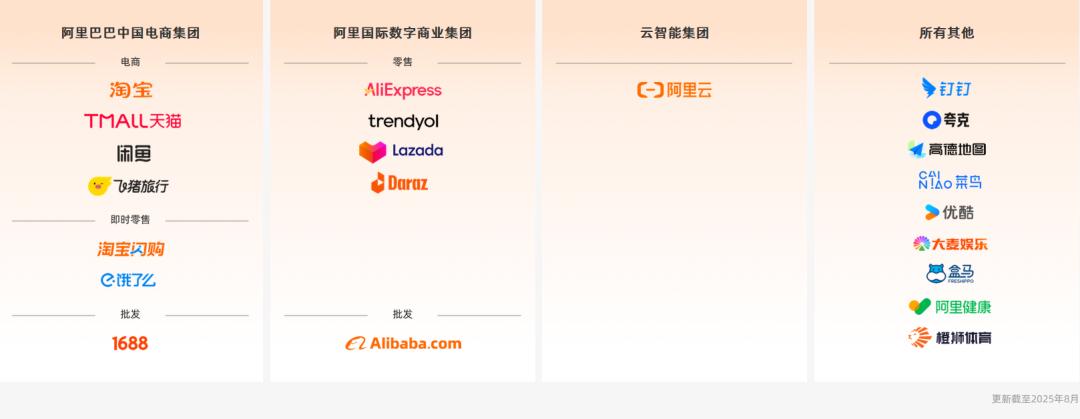
Core Viewpoint - Alibaba is undergoing a critical transition between old and new growth engines, with e-commerce profits under pressure while cloud business shows strong performance [1] Financial Performance - For Q3 FY2025, Alibaba reported revenue of 247.8 billion RMB, a 5% year-on-year increase; excluding divested businesses, revenue growth reached 15% [1] - Operating profit significantly declined by 85% to 5.4 billion RMB, with adjusted EBITA down 78% to 9.1 billion RMB; net profit under non-GAAP was 10.4 billion RMB, a 72% decrease [1] - The Chinese e-commerce group achieved revenue of 132.6 billion RMB, a 16% increase, but adjusted EBITA fell 76% to 10.5 billion RMB [4] Business Segments - The e-commerce segment includes three main areas: e-commerce, instant retail, and wholesale, with the e-commerce group contributing approximately 54% of total revenue [3] - Instant retail revenue grew by 60%, with a focus on expanding scale and improving user experience [4] - The international digital commerce group turned profitable for the first time, with a 10% revenue increase to 34.8 billion RMB [4] Cloud Business - The cloud intelligence group showed the strongest performance, with revenue increasing by 34% to 39.8 billion RMB, surpassing the international digital commerce group [5] - AI-related product revenue has maintained triple-digit year-on-year growth for nine consecutive quarters, with adjusted EBITA up 35% to 3.6 billion RMB [5] Strategic Investments - Alibaba is increasing investments in AI and instant retail, with a commitment to a 3-year capital expenditure plan of 380 billion RMB for AI [1] - Cumulatively, Alibaba has spent 120 billion RMB on "AI + Cloud" infrastructure over the past four quarters [1] - The company aims for instant retail GMV to reach 1 trillion RMB within three years, focusing on enhancing market share in related categories [1] Market Position - Alibaba Cloud leads the Chinese public cloud IaaS market with a 26.8% share, while the overall market is expected to exceed 100 billion RMB in the first half of 2025 [6] - The company anticipates a continued imbalance between AI resource demand and supply over the next three years, driven by explosive growth in AI demand [7][8]

A股五张图:自己的下跌固然可怕,但指数的大涨更令人揪心
Xuan Gu Bao· 2025-11-26 10:31
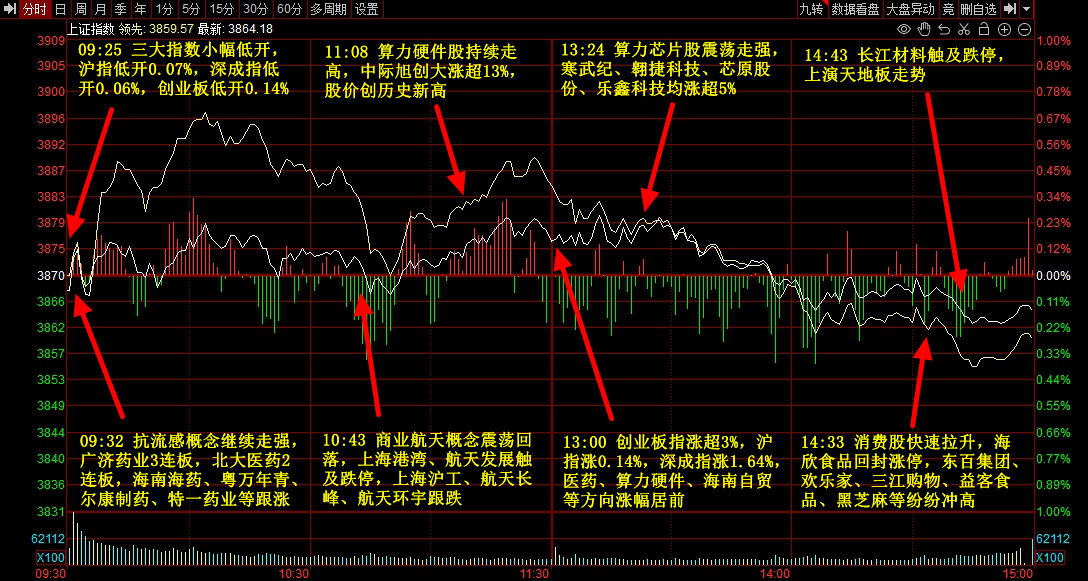
Market Overview - The market exhibited a fragmented low-volume trading pattern, with the Shanghai Composite Index slightly down by 0.15%, while the Shenzhen Component and ChiNext Index rose by 1.02% and 2.14% respectively. Approximately 3,600 stocks declined against over 1,600 that rose, with total trading volume reaching 1.7 trillion [1][3]. AI Hardware Sector - The AI hardware sector saw significant gains, with OCS continuing to strengthen and the CPO sector experiencing a collective rise. Key stocks such as Special Information and Zhongji Xuchuang hit new highs, while others like Saimicroelectronics and Yuxi Technology also saw substantial increases [4][6][7]. Consumer Sector - The consumer sector experienced a resurgence in the afternoon following the release of a plan by six departments aimed at enhancing the adaptability of consumer goods supply and demand. This plan anticipates the formation of three trillion-level consumption areas and ten billion-level consumption hotspots by 2027. Retail stocks like Dongbai Group and Sanjiang Shopping surged, with several stocks hitting the daily limit [9][10]. Shenzhen Local Stocks - Following the announcement of a financial support plan for enterprises in Guangdong, Shenzhen local stocks initially showed little reaction but later surged in the afternoon, led by stocks like Teli A and Shenhua A. The rally was partly driven by news regarding Vanke's debt situation and restructuring plans, which sparked interest in related local stocks [12][14][15][17]. Reader Culture - Reader Culture experienced a sudden surge of over 7% in the afternoon, closing with a 5.1% increase. The rise was attributed to heightened media attention surrounding figures like Luo Yonghao, suggesting that market movements may be influenced by social media trends rather than fundamental factors [20].





电厂 | 阿里也不想给外卖砸钱了
Xin Lang Cai Jing· 2025-11-26 10:28
Core Insights - Alibaba's Q3 2025 financial results show a revenue increase of 5% year-on-year, reaching 247.795 billion RMB, driven by its cloud and core e-commerce businesses [1][4] - However, profits have significantly declined, with operating profit down 85% to 5.365 billion RMB and net profit down 53% to 20.612 billion RMB, attributed to heavy investments in instant retail and technology [1][8] Revenue Growth Driven by E-commerce and Cloud - Alibaba's revenue growth is primarily attributed to its Chinese e-commerce group and cloud business, with the e-commerce group generating 1,325.78 billion RMB, a 16% increase year-on-year [4][6] - The cloud segment saw a 34% increase in revenue, with AI-related products contributing significantly to this growth [6][11] Profit Decline and Cost Pressures - The company's sales and marketing expenses surged by 105% to 664.96 billion RMB, reflecting the costs associated with competitive promotions in the instant retail sector [8][9] - The adjusted EBITDA for the Chinese e-commerce group fell by 76% to 105 billion RMB, indicating that the intense competition in the food delivery market has severely impacted profitability [8][9] Strategic Focus on Instant Retail and AI - Alibaba is focusing on reducing losses in its instant retail segment, with plans to optimize unit economics and improve operational efficiency [10][11] - The company is also investing heavily in AI, aiming to become a leading full-stack AI service provider, with significant developments in both AI to B and AI to C applications [11][13] Future Outlook and Market Positioning - Alibaba's strategy includes enhancing user experience and leveraging synergies within its ecosystem to drive growth in instant retail, targeting a transaction scale of one trillion RMB over the next three years [10][11] - The company is positioning itself to capture the AI market, with new applications like the Qianwen App aiming to integrate AI into everyday user experiences [11][13]
