新能源转型

Search documents
车企一季度财报出炉,有人吃肉有人喝汤,谁在加速谁在掉队?
3 6 Ke· 2025-05-21 01:27
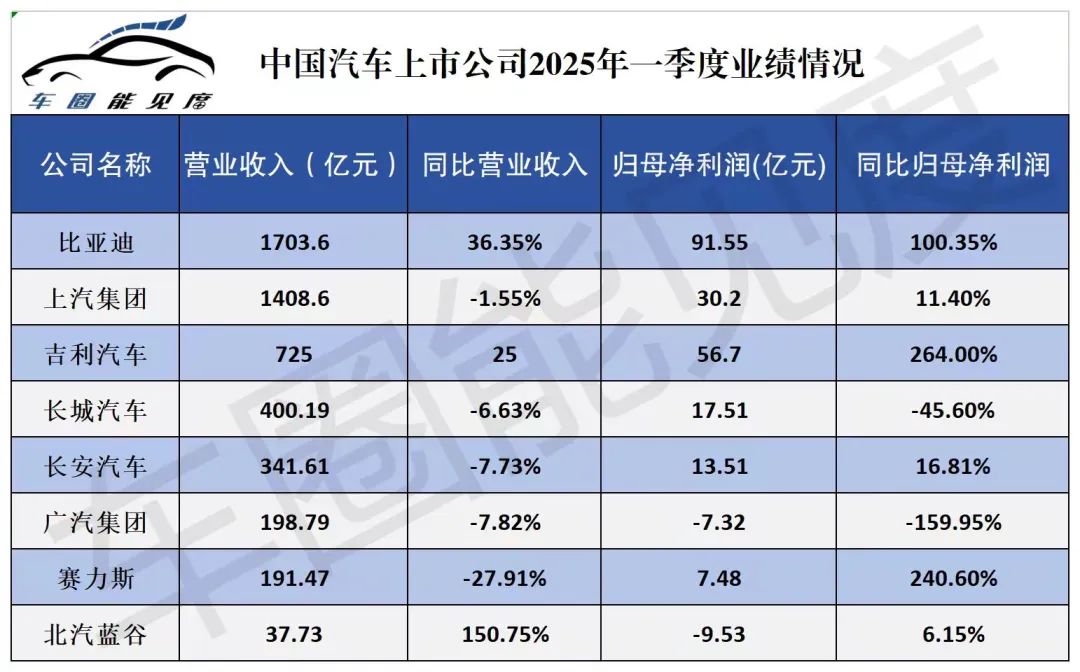
Core Insights - The automotive industry in Q1 2025 shows a mixed performance among companies, with some achieving significant growth while others face declines in revenue and profit [1][3][9] - The differentiation in the performance of electric vehicle (EV) manufacturers is becoming more pronounced, with leading companies benefiting from technological upgrades and global expansion, while those lagging in transformation experience sales declines [1][3] Revenue and Profit Performance - BYD reported a revenue of 170.36 billion yuan, a year-on-year increase of 36.35%, and a net profit of 9.155 billion yuan, up 100.38% [2][3] - Geely Automotive achieved a revenue of 72.5 billion yuan, a 25% increase, and a net profit of 5.67 billion yuan, up 264% [2][3][4] - SAIC Group's revenue was 140.86 billion yuan, down 1.55%, but net profit increased by 11.4% to 3.023 billion yuan [6][7] - Changan Automobile's revenue decreased by 7.73% to 34.161 billion yuan, while net profit rose by 16.81% to 1.351 billion yuan [5] - Seres experienced a revenue drop of 27.91% to 19.147 billion yuan, but net profit surged by 240.6% to 748 million yuan [5] - GAC Group's revenue fell by 7.82% to 19.879 billion yuan, with a net profit decrease of 159.95% to a loss of 732 million yuan [9] - Great Wall Motors reported a revenue decline of 6.63% to 40.019 billion yuan and a net profit drop of 45.6% to 1.751 billion yuan [9][10] Sales Performance - BYD's total sales exceeded 1 million units, marking a 59.8% year-on-year increase, making it the first EV manufacturer to achieve this milestone in a single quarter [3] - Geely's total sales reached 704,000 units, a 48% increase, with significant contributions from its Galaxy and Lynk & Co brands [4] - SAIC Group's total sales were 945,000 units, a 13.3% increase, with a notable performance in the EV segment [6][7] - Changan's total sales were 705,200 units, with 194,200 units being EVs [5] - Seres' total sales dropped by 46.31% to 45,135 units [5] - GAC Group's total sales decreased by 9.42% to 371,100 units, with a decline in EV sales [9] - Great Wall Motors' total sales fell by 6.73% to 256,800 units, indicating challenges in its transition to EVs [9][10] Market Trends and Challenges - The automotive market is characterized by a complex competitive landscape, with companies needing to enhance their core competencies to maintain market positions [10] - The performance of companies reflects their strategies in technology innovation, market positioning, and product development [10] - The growth in EV sales is accompanied by significant upfront investments and long return cycles, impacting short-term profitability for many manufacturers [8]





【财经分析】外资机构:投资者对中国市场关注度与配置意愿提升 中国市场或迎价值重估
Xin Hua Cai Jing· 2025-05-21 01:02
"在刚刚结束的摩根士丹利中国BEST会议上,80%以上的投资者表示,有可能近期增加对中国股票的敞 口。" 摩根士丹利董事总经理、中国在岸股票业务主管沈黎表示,这意味着更多投资者在"加码"中国资 产的路上。 深交所理事长沙雁以数据举例说,去年9月26日中央政治局会议以来,外资持有深市战略性新兴产业企 业股票市值增幅达40%,交易金额增幅达90%。越来越多的外资机构增加对中国的关注,正在密集走访 调研A股上市公司。对此,深交所顺应境外投资者与上市公司对接需求,累计组织14批次全球路演,覆 盖上市公司107家次,受到境外投资者热烈欢迎。"中国资产向上重估成为全球投资者的热议话题,这 个'共识'正在不断扩大。" 新华财经深圳5月21日电(记者卫韦华)近期,合格境外机构投资者(QFII)对中国A股市场展现出强 劲的配置热情,引发市场关注。据今年上市公司一季报数据显示,截至4月末,有20家外资机构出现在 A股上市公司前十大流通股股东名单中,显示出外资对中国资本市场的持续看好态势。 在5月19日至20日举办的2025全球投资者大会上,多位境内外机构代表、业界专家纷纷表示,随着中国 经济转型升级的持续推进、政策红利不断释放以 ...
渤海汽车分析师会议-20250520
Dong Jian Yan Bao· 2025-05-20 14:12
1. Reported Industry Investment Rating - No relevant content provided 2. Core View of the Report - The report mainly presents the results of the institutional research on Bohai Automobile, including the company's cooperation products, R & D achievements, financial status, and future development plans [23][24][25] 3. Summary According to the Table of Contents 3.1 Research Basic Situation - The research object is Bohai Automobile, belonging to the automotive parts industry. The reception time was May 20, 2025. The listed company's reception staff included the vice - chairman and general manager Zhao Jicheng, independent director Fan Xiaohua, financial director She Changcheng, and board secretary Yuan Chunhui [16] 3.2 Detailed Research Institutions - The reception object was investors participating in Bohai Automobile's 2024 annual and Q1 2025 performance briefing, and the type was "other" [19] 3.3 Research Institution Proportion - No relevant content provided 3.4 Main Content Data - **Cooperation Products**: The subsidiary Bohai Piston supplies pistons for BAIC BluePark's Xiangjie extended - range version and Scania; the subsidiary Binzhou Lightweight supplies body shock towers and other products for some BAIC BluePark ARCFOX models and shock towers and body longitudinal beams for BAIC BluePark Xiangjie, and supplies hybrid cylinder blocks for enterprises such as Chery, BYD, and BAIC Powertrain [23][24][30] - **R & D Achievements**: In 2024, Bohai Piston focused on the design and R & D of high - end commercial vehicle pistons and marine - electric pistons. The designed explosion pressure of forged steel pistons reached 29 MPa, and the multi - position remelting technology was first applied in engineering. The project "Key Technologies and Industrialization of High - Thermal - Efficiency Engine Pistons" won the second - class prize of the Science and Technology Award of the Chinese Society of Internal Combustion Engines. Binzhou Lightweight successfully developed and mass - produced Xiangjie's longitudinal beams and shock towers and developed hybrid cylinder blocks [25][26] - **Financial Status**: As of the end of March 2025, the total number of shareholders was 38,119. In Q1 2025, the net profit attributable to shareholders of the listed company was 556,800 yuan [26][32] - **Future Plans**: In 2025, the company will focus on the main business and advantageous fields, invest resources in the R & D and product iteration of piston products and lightweight business, control costs, optimize the asset structure, and promote the new - energy transformation of the lightweight business. The company announced a 2025 valuation improvement plan, aiming to enhance the company's investment value through various measures [27][28] - **Project Progress**: The high - end high - power piston project has completed project establishment, equipment bidding, and procurement. Five out of six production lines have been调试 completed, and one is being调试. The German subsidiary BTAH entered bankruptcy proceedings on April 19, 2025, and is no longer included in the company's consolidated statements [30]

东风商用车新领导班子组建!董事长、总经理都是谁? | 头条
第一商用车网· 2025-05-20 13:51
近日,东风商用车有限公司官网信息更新显示,公司迎来重大人事调整。张小帆出任公司董事 长,刘利成担任公司总经理一职。 据公开资料显示,东风商用车有限公司现任董事长为张小帆,张小帆接任后主导专用车转型战 略。 用车领域的优势地位,推动企业迈向新的发展阶段。第一商用车网将持续关注东风商用车在新 领导班子带领下的战略布局与市场表现。 张小帆出生于1970年3月,河南洛阳人,大学本科学历,1992年7月入职东风公司。他从东风 公司襄樊管理部基层岗位逐步成长,后在东风汽车股份有限公司多个关键部门任职,积累了丰 富的公关、宣传策划及营销经验。 张小帆在任期间,东风商用车的市场表现显著提升。2025年4 月,东风公司中重卡国内市场占有率达到23.6%,排名第一。此外,东风公司在31个省市区中有15 个省市区排名中重卡市占率第一。这些成就部分归功于张小帆的领导和东风集团内部的商用车业务 整合计划。 战略方向上, 张小帆全力推动专用车向高端化、智能化转型,目标在2025年实现东风商用车专用底 盘年销量达5万辆,稳固在环卫、危化等细分市场的领先地位;新能源布局上,着重强调智能网联与 新能源技术研发,加速商用车绿色化发展进程。 新任 ...

东风集团股份(00489.HK):2024年实现扭亏为盈 国企改革迈入快车道
Ge Long Hui· 2025-05-20 08:00
Core Viewpoint - The company reported a revenue of 106.2 billion yuan for 2024, marking a year-on-year increase of 6.9%, and achieved a net profit of 0.06 billion yuan, indicating a turnaround from losses [1][2]. Group 1: Financial Performance - The company achieved a total revenue of 106.2 billion yuan in 2024, with a year-on-year growth of 6.9% [1][2]. - The gross profit for 2024 was 13.59 billion yuan, resulting in a gross margin of approximately 12.8%, which is an increase of 2.9 percentage points year-on-year [2]. - The operating cash flow net amount reached 17.4 billion yuan, and the cash on hand at the end of 2024 was 75.85 billion yuan [2]. Group 2: Sales Performance - The overall vehicle sales for the company in 2024 were 1.896 million units, a decrease of 9.2% year-on-year [1]. - The sales of passenger vehicles were 1.545 million units, down 11.5%, while commercial vehicle sales increased by 2.4% to 352,000 units [1]. - The sales of new energy vehicles reached 395,000 units, representing a year-on-year increase of 4.1 percentage points in total sales [1]. Group 3: Brand Performance - The company's self-owned brands achieved sales of 439,000 units, a significant increase of 26.4% year-on-year, with the Lantu brand growing over 59% [1]. - The joint venture brands faced challenges, with total sales of 1.105 million units, including declines of 29.2% and 12.7% for Dongfeng Honda and Dongfeng Nissan, respectively [1]. Group 4: Future Outlook - The company set a target of achieving 3 million total vehicle sales by 2025, with a focus on high-quality growth in new energy vehicles [3]. - Plans include launching 7 new passenger vehicle models and developing a new platform for commercial vehicles to support low-carbon logistics [3]. - Revenue forecasts for 2025-2027 are projected at 145.82 billion, 171.75 billion, and 189.14 billion yuan, with net profits expected to reach 1.45 billion, 2.38 billion, and 3.17 billion yuan, respectively [3].

吉利汽车(00175):公司一季度业绩大幅增长,整合稳步推进,建议“买进”
CSC SECURITIES (HK) LTD· 2025-05-20 06:23
Investment Rating - The report assigns a "Buy" rating for the company, indicating a potential upside in the stock price [6][7]. Core Insights - The company reported significant growth in Q1 2025, with revenue reaching 72.495 billion RMB, a year-on-year increase of 24.5%, and a net profit of 5.67 billion RMB, up 264% year-on-year, exceeding expectations [7][9]. - The company is accelerating its electric vehicle transformation, with a notable increase in sales of its new energy vehicle brands, which accounted for 48.2% of total sales in Q1, up 18 percentage points year-on-year [9]. - The company is pursuing a strategic integration of its automotive business, including a plan to privatize its brand Zeekr, which is expected to enhance operational efficiency and reduce costs [9]. Summary by Sections Company Overview - The company operates in the automotive industry, with a current H-share price of 19.24 HKD and a market capitalization of approximately 135.241 billion RMB [2]. Recent Performance - In Q1 2025, the company sold 703,800 vehicles, a 48% increase year-on-year, with new energy vehicle sales rising by 135% [9]. - The overall gross margin for Q1 was 15.8%, reflecting a slight improvement [9]. Financial Projections - Expected net profits for 2025, 2026, and 2027 are projected to be 13.2 billion RMB, 17.6 billion RMB, and 21.8 billion RMB, respectively, with year-on-year growth rates of 44%, 30%, and 24% [7][9]. - The earnings per share (EPS) for the same years are forecasted at 1.35 RMB, 1.75 RMB, and 2.2 RMB, with corresponding price-to-earnings (P/E) ratios of 13, 10, and 8 [7][9]. Strategic Initiatives - The company is focusing on integrating its automotive operations to improve quality and efficiency, with an anticipated overall benefit exceeding 5% post-integration [9].
中国华能携三家控股上市公司集体亮相 累计分红已超千亿元
Zheng Quan Ri Bao Wang· 2025-05-19 13:15
5月16日,中国华能集团有限公司(简称"中国华能")携控股华能国际(600011)电力股份有限公司(简 称"华能国际")、华能澜沧江水电股份有限公司(简称"华能水电(600025)")、内蒙古蒙电华能热电股份 有限公司(简称"内蒙华电(600863)")三家沪市上市公司在上海证券交易所召开集体业绩说明会。 作为内蒙古自治区首家上市公司,近年来,内蒙华电依托"煤电一体化+新能源转型"双轮驱动战略,构 建了涵盖火电、煤炭、新能源的业务布局。 内蒙华电董事长高原介绍称,截至2024年底,公司火电总装机容量1,140万千瓦,煤炭产能1500万吨/ 年,新能源运营装机容量188万千瓦,在建新能源项目204万千瓦。从经营业绩来说,公司毛利率整体呈 现上升趋势,即从2020年的14.56%上升至2025年一季度的25.04%。 会上,中国华能董事长、党组书记温枢刚强调,未来,中国华能将更加注重提高上市公司发展质量,进 一步明确各上市公司专注领域,优化产业布局,提升运营质量,增强价值创造能力;推动上市公司建立 健全常态化回报机制,促进各上市公司提高分红比例和频次,吸引战略资本、长期资本、耐心资本成为 上市公司股东,不断增强投 ...



瑞典上万家企业已扎根,新时代“哥德堡号”加码投资中国
Di Yi Cai Jing· 2025-05-18 14:05
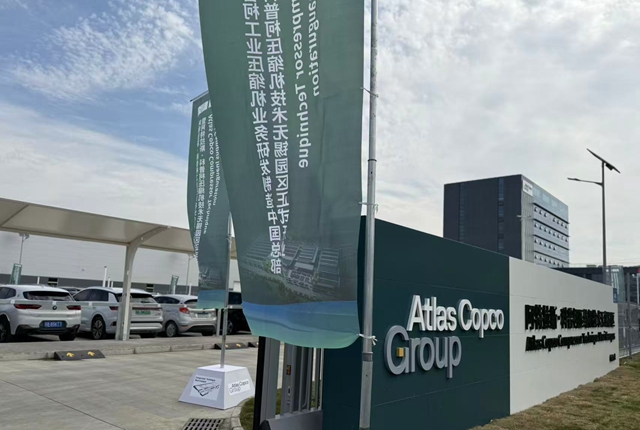
Group 1: Sweden-China Trade Relations - Over 10,000 Swedish companies are engaged in trade with China, with notable firms like IKEA, Ericsson, and Volvo having a long-standing presence in the Chinese market [1] - This year marks the 75th anniversary of diplomatic relations between China and Sweden, with both countries being each other's largest trading partners in their respective regions [1] - Chinese investment in Sweden is expected to grow by 70% in 2024, with high-tech Chinese companies contributing to Sweden's economic growth and green transition [1] Group 2: Swedish Companies Investing in China - Atlas Copco has established a key technology center in Wuxi, which will serve as a hub for manufacturing, R&D, talent development, and customer interaction, supporting both local and global markets [2] - Scania, a subsidiary of Volkswagen Group, is also increasing its investment in China, including plans for a new heavy truck manufacturing plant [4] - Volvo has emphasized the rapid development of the electric vehicle market in China, highlighting the competitive and innovative nature of the Chinese automotive industry [5][7] Group 3: R&D and Talent Acquisition - Volvo's R&D vice president noted that China has a significant talent pool, with 10 million university graduates annually, compared to Sweden's limited population [7] - Swedish companies are increasingly shifting R&D efforts to China to develop products that better meet local market demands [9] - The trend of Chinese automotive manufacturers expanding globally is noted, with local suppliers entering European markets as Chinese carmakers establish production facilities abroad [7][8] Group 4: Market Dynamics and Challenges - Swedish companies face challenges in profitability, which is a common issue for foreign and domestic firms in the current economic climate [9] - The main export sectors from Sweden to China include industrial equipment, ships, and robots, with a growing number of consumer goods companies increasing their investments in the Chinese market [9] - STIGA, a well-known table tennis brand, holds a 40% market share in China's first-tier market, reflecting the strong demand for Swedish products [11]
裁员2万人,关厂7家,曾经的全球销冠最后一搏
Xin Lang Cai Jing· 2025-05-18 12:24
Core Viewpoint - Nissan is facing its most severe crisis since 1999, with a net loss of 670.9 billion yen (approximately 32.6 billion RMB) and negative free cash flow, marking a financial cliff that puts the company at a crossroads of survival [1][2]. Financial Performance - Nissan reported its worst financial results in 25 years, with a net loss of 670.9 billion yen and an operating profit margin of less than 1% [1][2]. - The company aims to cut costs by 500 billion yen by the fiscal year 2027 and reduce its production capacity from 3.5 million to 2.5 million vehicles [2]. Strategic Initiatives - The new CEO, Ivan Espinosa, has launched the "Re:Nissan" revival plan, which includes closing seven factories and laying off 20,000 employees [2]. - Nissan plans to focus on six core markets globally, with China identified as a strategic priority for the next three years [2][5]. Market Challenges - Nissan's global sales declined by 2.8%, with an 88% drop in operating profit, particularly struggling in the U.S. and Chinese markets [4]. - In the U.S., sales of the Rogue SUV fell nearly 10%, and the Titan pickup was discontinued, while in China, sales plummeted by 12.2% [4]. Competitive Landscape - Nissan's electric vehicle, Leaf, has been outperformed by competitors like BYD and Tesla in key areas such as range and acceleration [4]. - The company's CHAdeMO charging standard has been phased out in favor of more widely accepted standards, and the new electric vehicle Ariya has seen poor sales performance [4]. Collaboration and Partnerships - Nissan's collaboration with Honda has ended due to fundamental disagreements over platform control and technology integration [5]. - The company is exploring potential partnerships with firms like Foxconn and some U.S. tech companies, but these discussions are still in early stages [5]. Future Outlook - Nissan views the Chinese market as crucial for its recovery, despite a significant drop in sales from 1.13 million units in 2018 to under 700,000 units [6][7]. - The company is adapting to local market dynamics by decentralizing R&D to Chinese teams and planning to launch 10 new energy models by 2027 [6]. - The success of Nissan's "Re:Nissan" plan hinges on its ability to tell a new story in the smart electric vehicle era within three years, or it risks irreversible decline [6].

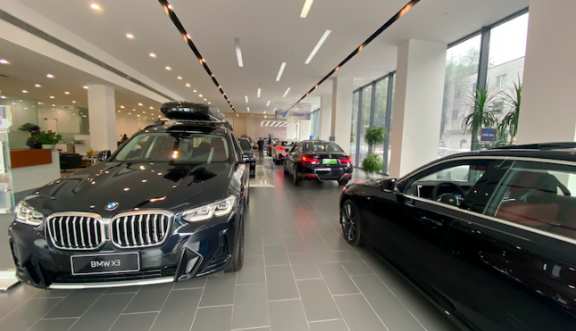
豪车市场竞争加剧 “BBA”大幅降价销量仍未改善
Cai Jing Wang· 2025-05-18 10:16
Group 1 - The core viewpoint is that the traditional luxury car brands BBA (Benz, BMW, Audi) are facing significant sales pressure due to the rise of domestic new energy vehicle brands in China [1][2][3] - The entry-level sedan prices have dropped below 200,000 yuan, prompting BBA to focus sales efforts on higher-end models like the "56E" series instead of the previously popular "34C" models [1][3] - The competitive landscape has shifted, with domestic brands like NIO, Xpeng, and Li Auto gaining market share in the high-end luxury segment, leading to a decline in sales for BBA [3][8] Group 2 - Despite price reductions, BBA's sales have not improved significantly; for instance, the BMW 3 Series has a current price of approximately 208,000 yuan after discounts, down from a guide price of 319,900 yuan [3][6] - In Q1 2025, BBA reported declines in vehicle deliveries: BMW down 1.4% to 586,100 units, Mercedes down 7% to 529,200 units, and Audi down 3.3% to 388,800 units [7][8] - The net profits for these companies have also decreased, with Mercedes experiencing a 42.8% drop to 1.731 billion euros, BMW down 26.4% to 2.173 billion euros, and Audi down 14.5% to 630 million euros [7] Group 3 - The market share of Chinese brands in the passenger car segment has increased significantly, accounting for 68.1% of total sales in Q1 2025, with a year-on-year growth of 28.8% [9] - The shift in consumer preferences towards domestic brands is evident, as many consumers are opting for models like Li Auto's L9 or AITO's M9 due to their advanced features and appealing designs [10]