
创新药出海

Search documents
行业景气度回暖叠加政策利好 逾50家生物医药A股公司2025年业绩预盈
Shang Hai Zheng Quan Bao· 2026-01-26 19:16
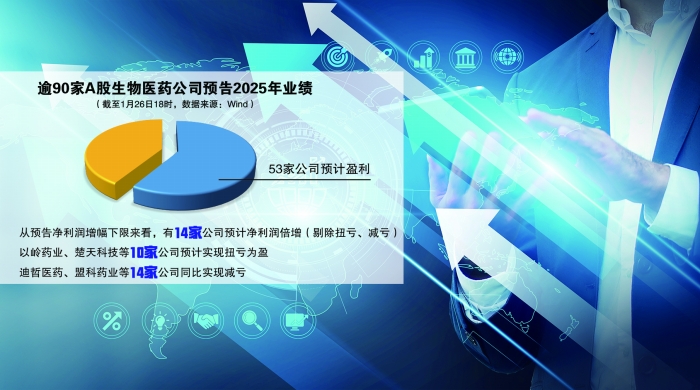
Core Insights - The A-share biopharmaceutical companies are expected to deliver innovative results in 2025, benefiting from industry recovery, overseas market expansion, and favorable pharmaceutical policies [2] - Over 90 A-share biopharmaceutical companies have released performance forecasts for 2025, with 53 companies expected to be profitable [2] - Among the profit forecasts, 14 companies anticipate a net profit increase of over 100%, while 10 companies expect to turn losses into profits [3][2] Group 1: Performance Growth Drivers - Sales volume growth and internal cost reduction are key factors for the significant profit increases among the companies [4] - Shanghai Yizhong leads with a projected net profit increase of 760.18% to 903.54%, expecting a net profit of 60 million to 70 million yuan in 2025 due to its core product being included in the national medical insurance directory [4] - Yuheng Pharmaceutical anticipates a net profit of 350 million to 420 million yuan, a year-on-year increase of 50.37% to 80.44%, driven by steady sales growth of its products [4] - Nawei Technology expects a net profit of 128 million to 145 million yuan, a year-on-year increase of 54.51% to 75.03%, focusing on market strategies in key sectors [4][5] Group 2: International Market Expansion - International business is a significant growth driver for biopharmaceutical companies [6] - WuXi AppTec, a leading CXO company, forecasts a revenue of 45.456 billion yuan, a year-on-year increase of approximately 15.84%, and a net profit of 19.151 billion yuan, a 102.65% increase [6] - Ganli Pharmaceutical expects a net profit of 1.1 billion to 1.2 billion yuan, a year-on-year increase of 78.96% to 95.23%, attributed to steady growth in domestic and international revenues [6] Group 3: Innovation and Recovery - Several innovative drug companies are entering a recovery phase, with many turning losses into profits or significantly reducing losses [8] - BeiGene expects a full-year operating profit for 2025, with revenue projections between 36.2 billion and 38.1 billion yuan, reflecting an upward adjustment from previous estimates [8] - DiZhe Pharmaceutical anticipates a revenue of 800 million yuan, a year-on-year increase of 122.28%, with a reduced net loss of 770 million yuan [9]




突发疫情!印度,尼帕病毒突袭!20%涨停,医药股集体异动!
券商中国· 2026-01-26 11:31
医药股,集体异动! 今日(1月26日)午后,医药股大幅走强,生物疫苗、体外诊断、肝炎等方向领涨。其中,凯普生物直线拉升 至20%涨停,用时不足1分钟;海王生物、科华生物等股票也陆续涨停。 印度突然出现尼帕病毒疫情,截至目前,印度已有5例确诊病例,其中包括医护人员。这一消息可能刺激了医 药股的上涨。另外,年初多个创新药BD交易落地,中国创新药出海趋势向好。有券商研究机构表示,随着更 多国产创新药的出海、医保谈判的常态化以及产业链的成熟,创新药赛道有望持续成为资金配置的核心方向。 医药股异动 午后,医药股突然拉升,凯普生物直线涨停,海王生物、科华生物、迈克生物、金迪克等股票也陆续封死涨停 板。此前,华兰疫苗、鲁抗医药、达安基因等个股已涨停。截至下午收盘,生物疫苗、流感指数涨幅超过 3%,体外诊断、肝炎指数涨超2%。 | (分时 1分钟 更多) | | 壳价 叠加 重播 统计 | 画线 F10 标记 -自选 返回 | | 凯普生物 300639 R | | 医疗保健 | | --- | --- | --- | --- | --- | --- | --- | --- | | 7.25 | 凯普生物 分时 成交量 | ...

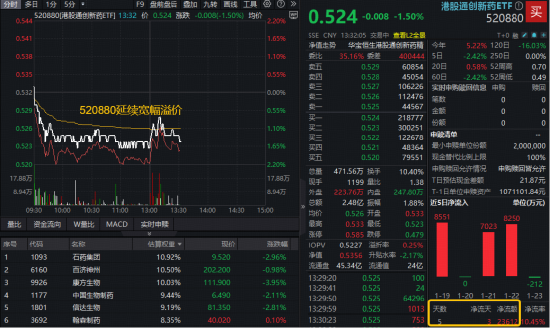
ETF盘中资讯 创新药出海BD仍然火爆!港股通创新药ETF(520880)跌1.5%延续高溢价,最新单周吸金2.36亿元
Jin Rong Jie· 2026-01-26 05:58
Core Viewpoint - The Hong Kong stock market is experiencing a downturn, particularly in the innovative drug sector, with the Hong Kong Stock Connect Innovative Drug ETF (520880) declining by 1.5% on January 26, despite a positive buying attitude reflected in high premiums [1][3]. Group 1: Market Performance - The Hong Kong Stock Connect Innovative Drug ETF (520880) has seen a cumulative decline of 3.2% over the past week, with over 236 million yuan in funds being used to buy on dips [1]. - Major stocks in the sector are experiencing widespread declines, with leading companies such as CSPC Pharmaceutical falling by 3%, and Innovent Biologics dropping nearly 4% [1]. Group 2: Industry Transactions - Several innovative drug business development (BD) transactions have been completed at the beginning of the year, indicating a positive trend for Chinese innovative drugs going overseas. Key transactions include: 1. Rongchang Biologics granting AbbVie overseas rights for RC148 (PD-1/VEGF) dual antibody, receiving a $650 million upfront payment and up to $4.95 billion in milestone payments [3]. 2. Haisco granting overseas rights for HSK39004 (PDE3/4) to AirNexis, with an upfront payment of $108 million and up to $955 million in milestone payments [3]. 3. Zai Lab granting AbbVie overseas rights for ZG006 (CD3xDLL3xDLL3 tri-antibody), receiving a $100 million upfront payment and milestone payments totaling $1.135 billion [3]. 4. Yilian Biologics granting Roche overseas rights for YL201 (B7-H3ADC), with upfront and near-term milestone payments totaling $570 million [3]. Group 3: Investment Opportunities - Investors are encouraged to consider core assets in innovative drugs during market dips, with a focus on the high elasticity T+0 tool, the Hong Kong Stock Connect Innovative Drug ETF (520880), and its associated funds [3]. - The index for the ETF (Hang Seng Hong Kong Stock Connect Innovative Drug Select Index) has three unique advantages: 1. 100% purity, covering only innovative drug R&D companies [3]. 2. A significant concentration of leading companies, with the top ten innovative drug leaders accounting for over 73% of the index [4]. 3. Better risk control through forced de-weighting of less liquid constituent stocks [5].
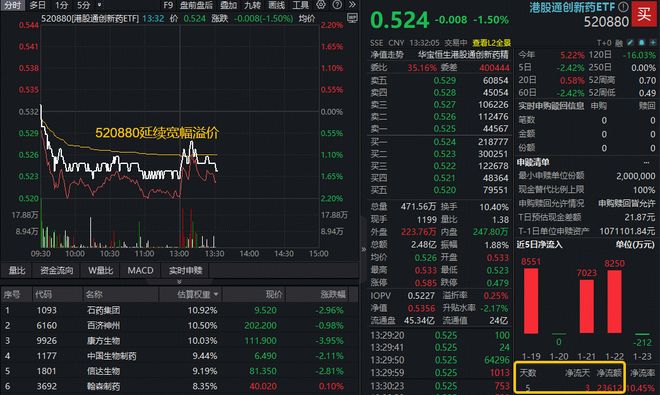
创新药出海BD仍然火爆!港股通创新药ETF(520880)跌1.5%延续高溢价,最新单周吸金2.36亿元
Xin Lang Cai Jing· 2026-01-26 05:47
Group 1 - The Hong Kong stock market is experiencing a downturn, with the innovative drug sector declining again, as evidenced by the Hong Kong Stock Connect Innovative Drug ETF (520880) falling by 1.5% [1][6] - Last week, the ETF accumulated a total decline of 3.2%, with over 236 million yuan in funds being used to buy on dips [1][6] - Major stocks in the sector are generally down, including CSPC Pharmaceutical Group down 3%, CanSino Biologics down nearly 4%, and China Biologic Products and Innovent Biologics both down over 2% [1][6] Group 2 - Multiple innovative drug business development (BD) transactions have been completed at the beginning of the year, indicating a positive trend for Chinese innovative drugs going overseas [8] - Key transactions include: 1) Rongchang Biologics granting AbbVie overseas rights for RC148 (PD-1/VEGF) dual antibody, receiving a $650 million upfront payment and up to $4.95 billion in milestone payments [8] 2) Haisco granting overseas rights for HSK39004 (PDE3/4) to AirNexis, receiving a $108 million upfront payment and up to $955 million in milestone payments [8] 3) Zai Lab granting AbbVie overseas rights for ZG006 (CD3xDLL3xDLL3 tri-antibody), receiving a $100 million upfront payment and milestone payments totaling $1.135 billion [8] 4) Yilian Biologics granting Roche overseas rights for YL201 (B7-H3ADC), with upfront and milestone payments reaching $570 million [8] Group 3 - The Hong Kong Stock Connect Innovative Drug ETF (520880) and its associated funds are highlighted as high-elasticity investment tools, with the underlying index (Hang Seng Stock Connect Innovative Drug Select Index) offering three unique advantages [9] - The ETF has a 100% purity, excluding CXO, and fully covers innovative drug R&D companies [9] - The top ten innovative drug leaders account for over 73% of the ETF, showcasing the strength of the innovative drug sector [9][10]

医药行业周报:重视供给端的变量
Huaxin Securities· 2026-01-26 05:45
Investment Rating - The report maintains a "Recommended" investment rating for the pharmaceutical industry as of January 26, 2026 [1] Core Insights - The report emphasizes the importance of supply-side variables, particularly the operating rates of raw material drugs, and highlights the potential for price recovery in the antibiotic market due to changes in competition and supply dynamics [2] - Multi-departmental policy support is enhancing the value positioning of pharmacies, transforming them from mere sales points to comprehensive health service platforms [3] - The trend of Chinese innovative drugs going global is gaining momentum, with significant licensing deals and the need for continuous clinical data validation to support long-term investment confidence [4] - Major companies are increasingly investing in the small nucleic acid field, which is expected to accelerate the development of the supporting industrial chain [5] - A new pricing system for GLP-1 drugs is forming in China, with significant market potential anticipated for weight loss and diabetes treatments [6] - The report highlights the market value of oral autoimmune drugs, with promising clinical trial results for new treatments [7] Summary by Sections 1. Pharmaceutical Market Tracking - The pharmaceutical industry outperformed the CSI 300 index by 0.23 percentage points in the last week, ranking 27th among 31 sectors [20] 2. Pharmaceutical Sector Trends and Valuation - The pharmaceutical sector index increased by 4.98% over the past month, outperforming the CSI 300 index by 3.21 percentage points [37] - The current PE (TTM) for the pharmaceutical sector is 38.51, above the five-year historical average of 31.06 [43] 3. Recent Research Achievements - The report includes various deep-dive studies on topics such as the growth of the blood products industry and the potential of GLP-1 drugs [45] 4. Recent Industry Policies and News - Recent policies include the promotion of high-quality development in the pharmaceutical retail sector and the approval of numerous medical devices by the National Medical Products Administration [46][48]
医药行业周报:重视供给端的变量-20260126
Huaxin Securities· 2026-01-26 05:33
Investment Rating - The report maintains a "Recommended" investment rating for the pharmaceutical industry as of January 26, 2026 [1] Core Insights - The report emphasizes the importance of supply-side variables, particularly the operating rates of raw material drugs, and highlights the potential for price recovery in the antibiotic market due to changes in competition and supply dynamics [2] - Multi-departmental policy support is enhancing the value positioning of pharmacies, transforming them from mere sales points to comprehensive health service platforms [3] - The trend of Chinese innovative drugs going global is gaining momentum, with significant licensing deals and the need for continuous clinical data validation to support long-term investment confidence [4] - Major companies are increasingly investing in the small nucleic acid field, which is expected to accelerate the development of the supporting industrial chain [5] - A new pricing system for GLP-1 drugs is forming in China, with expectations for market growth driven by a large patient population [6] - The report highlights the market value of oral autoimmune drugs, with promising clinical trial results for new treatments [7] Summary by Sections 1. Pharmaceutical Market Tracking - The pharmaceutical industry outperformed the CSI 300 index by 0.23 percentage points in the last week, ranking 27th among 31 sectors [20] 2. Pharmaceutical Sector Trends and Valuation - The pharmaceutical sector index increased by 4.98% over the past month, outperforming the CSI 300 index by 3.21 percentage points [37] - The current PE (TTM) for the pharmaceutical sector is 38.51, above the five-year historical average of 31.06 [43] 3. Recent Research Achievements - The report includes various deep-dive studies on topics such as the growth of the blood products industry and the impact of policies on inhalation formulations [45] 4. Recent Industry Policies and News - Recent policies include the approval of numerous medical device registrations and the promotion of high-quality development in the pharmaceutical retail sector [46][48]
中国创新药BD出海创历史纪录,恒生创新药ETF(520500)开年以来日均成交额超6亿
Xin Lang Cai Jing· 2026-01-26 03:34
Group 1 - The core viewpoint of the articles highlights the strong momentum of China's innovative pharmaceuticals in the global market, with significant growth in business development (BD) transactions and supportive policy measures [1][2]. - The Hang Seng Innovative Drug ETF (520500) has shown high trading activity, with an average daily turnover of 624 million yuan since 2026, and a fund size of 2.102 billion yuan, indicating strong investor interest [1]. - In 2025, China completed 157 BD transactions for innovative drugs, totaling 135.655 billion USD, with 7 billion USD in upfront payments, marking a historical high [1]. Group 2 - The report indicates that in 2025, China accounted for 49% of the global BD transaction total, surpassing the United States for the first time, with eight out of the top ten global license-out transactions originating from China [1][2]. - The policy environment is supportive, as the Ministry of Commerce and other departments have issued guidelines to enhance the drug retail industry, encouraging innovative drugs to enter retail pharmacy sales channels [1]. - Looking ahead to 2026, the trend of Chinese innovative drugs going global is expected to continue, with a focus on clinical progress and data validation of pipelines that have already gone abroad [2].
中国医药:创新药出海BD仍然火爆,关注IO2.0抢位赛
Zhao Yin Guo Ji· 2026-01-26 03:31
Investment Rating - The report assigns a "Buy" rating to several companies in the pharmaceutical sector, indicating a potential upside of over 15% in their stock prices over the next 12 months [29]. Core Insights - The MSCI China Healthcare Index has increased by 9.2% since the beginning of 2026, outperforming the MSCI China Index, which rose by 5.6% [1]. - The pharmaceutical industry has seen significant growth, driven by strong institutional investor interest and the ongoing trend of innovative drugs going global [1]. - The report emphasizes the importance of clinical progress and data validation for pipelines that have already gone overseas, suggesting that this trend will continue in the long term [1]. Summary by Sections Industry Overview - The report highlights a robust trend in the outbound licensing of innovative drugs, with multiple business development (BD) transactions occurring at the start of 2026, reflecting a high level of activity in the sector [4]. - Key transactions include significant upfront and milestone payments for various drugs, indicating strong market interest and potential for future growth [4]. Company Ratings and Valuations - The report provides detailed valuations for several companies, including: - **Sangfor Technologies (1530 HK)**: Market cap of $7,598.4 million, target price of $37.58, with a 54% upside potential [2]. - **Gusongtang (2273 HK)**: Market cap of $963.3 million, target price of $44.95, with a 46% upside potential [2]. - **WuXi AppTec (2268 HK)**: Market cap of $10,551.0 million, target price of $88.00, with a 28% upside potential [2]. - **China National Pharmaceutical Group (1177 HK)**: Market cap of $15,951.4 million, target price of $9.40, with a 42% upside potential [2]. Market Trends - The report notes that the competition in the PD-(L)1/VEGF space is intensifying, with several companies advancing their clinical trials and aiming for first-line indications [4]. - The report suggests that the efficiency and breadth of clinical trials, as well as the richness of combination therapies, will be critical factors in determining success in this competitive landscape [4].
中国创新药BD出海创历史纪录,恒生创新药ETF(520500)开年以来日均成交额超6亿
Xin Lang Cai Jing· 2026-01-26 03:31
Group 1 - The core viewpoint highlights the strong momentum of China's innovative pharmaceuticals in international markets, with a record number of outbound licensing deals and total transaction value in 2025 [2][4] - In 2025, China completed 157 outbound licensing transactions with a total value of $135.655 billion, including $7 billion in upfront payments, marking a historical high [2][4] - China accounted for 49% of the global total of outbound licensing deals in 2025, surpassing the United States for the first time [2][4] Group 2 - The policy environment is supportive, with the Ministry of Commerce and nine other departments issuing guidelines to enhance the drug retail industry and encourage innovative drugs to enter retail channels [2][4] - The continuous growth in business development (BD) transactions in 2025 indicates a sustained high level of industry activity, with expectations for higher transaction values based on early clinical data in 2026 [2][4] - The Hang Seng Innovative Drug ETF (520500) invests in 31 leading Hong Kong innovative pharmaceutical companies, focusing on key areas such as biopharmaceuticals and chemical drugs [3][4] Group 3 - The Hang Seng Innovative Drug ETF (520500) has a significant scale and liquidity, supporting T+0 trading, making it an effective tool for investors to capture opportunities in the Hong Kong innovative drug market [4][9] - The ETF's management by Huatai-PB Fund, a pioneer in ETF management in China, adds credibility and expertise to its operations [10]
20cm速递|科创创新药ETF国泰(589720)盘中涨近2%,连续10日净流入近4亿元,中国创新出海迎来开门红
Mei Ri Jing Ji Xin Wen· 2026-01-23 08:08
Group 1 - The core viewpoint of the news highlights the significant growth and potential of China's innovative pharmaceuticals, particularly in the context of international expansion and investment confidence [1] - The year 2025 is marked as a pivotal year for China's innovative pharmaceuticals, with total outbound licensing transaction amounts reaching $135.655 billion and a record 157 transactions [1] - The continuous successful BD transactions validate the global competitiveness of Chinese innovative drugs, supporting long-term investment confidence [1] Group 2 - The small nucleic acid drug sector is making notable progress, with leading companies accelerating their development in new target discovery and treatment convenience, attracting increased attention [1] - The GLP-1 sector is expected to have long-term market potential following the establishment of a new pricing system [1] - Domestic companies are actively pursuing relevant targets in the oral autoimmune drug space, indicating significant value [1] Group 3 - The brain-computer interface technology is at a critical juncture for industrialization, with substantial advancements in policy support, device approval, insurance coverage, and clinical applications [1] - Developments in radiation therapy equipment technology are creating new market opportunities worth billions [1] Group 4 - The ETF Guotai (589720) tracks the innovative drug index (950161), which includes listed companies engaged in innovative drug research and development, covering various fields such as biopharmaceuticals, chemical drugs, and traditional Chinese medicine [2] - The index reflects the overall performance of listed companies in China's pharmaceutical innovation sector [2]