房地产去库存

Search documents
辽宁专项债券收购存量房用作保障房
Liao Ning Ri Bao· 2025-12-08 01:37
Core Insights - The province has successfully passed the review for four projects aimed at acquiring existing commercial housing for rental and sale as affordable housing, involving 1,323 units and a total investment of 566 million yuan [1][2] - The initiative is part of a broader strategy to enhance affordable housing development, stabilize the real estate market, and improve living conditions, utilizing special bonds to support the acquisition of existing commercial housing [1][2] Group 1 - The total investment for the projects includes a demand for 123 million yuan in special bond funds, which have completed the necessary approval processes and are set to be issued soon [1] - The policy aims to increase the supply of affordable housing while addressing the inventory issues in the real estate market, thereby alleviating financial pressures on property developers [1][2] Group 2 - The acquired housing can include completed existing commercial properties or unfinished properties that are part of the "guaranteed delivery" initiative, ensuring clear property rights and no legal obstacles [2] - The province emphasizes the comprehensive use of various funding sources, including central urban affordable housing subsidies, local government special bonds, and other financing methods, to maximize resource allocation [2] - Future efforts will focus on collaboration between the provincial finance and housing departments to ensure compliance and efficiency in the acquisition of existing commercial housing for affordable housing purposes, aiming for a win-win situation for residents, enterprises, and the government [2]
房子少了4.8万亿!楼市重回8年前,去库存要再次上演了?
Sou Hu Cai Jing· 2025-12-03 22:10
有个朋友最近坐在我对面,拿出手机给我看了一个数据,脸色挺难看。他说去年买的房子,按照现在的市价算,已经缩水了两百多万。这还不是最气的,最 气的是他买的时候这个价钱已经是打过折的了。简单算算就知道,这套房子从最高点到现在,贬值了接近一半。我问他后悔吗,他苦笑了一下说,与其说后 悔,不如说是被现实教了一课。 在这样的背景下,"去库存"这个词又开始出现在各种政策文件里。人们开始回忆起十年前那轮"去库存"。十年前为什么要去库存?因为那时候也出现了房子 卖不动的情况。但那一轮的去库存是怎么成功的?主要是通过货币化补偿。也就是说,拆迁户不再获得一套房子,而是获得现金。这些现金进入房产市场, 就变成了购房需求,库存就消化了。 但十年后的今天,情况已经完全不同了。那时候还有源源不断的农村人口进城买房。现在呢?农村人口进城的红利已经基本释放完了。结婚登记人数在下 降,出生人口也在下降。这意味着购房的潜在需求正在收缩。你不能让拆迁户再去买房,因为他们根本找不到接盘侠。 所以今年的"去库存"政策思路就完全不同了。政府不再依靠市场需求来消化库存,而是直接出手收购。根据目前的规划,政府将拿出数万亿甚至十万亿的资 金来收购房地产库存。目 ...


土地月报|成交规模同比延续缩量,平均溢价率迎来回升(2025年11月)
克而瑞地产研究· 2025-11-28 08:13
Core Viewpoint - The industry is undergoing a transformation from old to new models, with the land market expected to adjust first as a key upstream indicator [2][7]. Supply and Demand - The supply of land in November 2025 was 290 million square meters, a 250% increase month-on-month but a 9% decrease year-on-year. The transaction area was 86.04 million square meters, up 39% month-on-month but down 27% year-on-year [3][4][10]. - The overall supply and demand scale continues to decline year-on-year, indicating a contraction in the land market [4][10]. Market Heat - The average premium rate in November was 4.1%, an increase of 1.29 percentage points from the previous month. However, the bidding heat remains concentrated in a few premium areas, with many plots sold at base prices [5][20]. - In November, 9% of land parcels failed to sell, remaining at a near-low level, indicating ongoing challenges in the market [22]. Distribution - First-tier cities saw a year-on-year increase in transaction value by 43%, while second-tier cities decreased by 17%, and third and fourth-tier cities dropped by 39% [6]. Future Outlook - The land market is expected to adjust significantly as it is a leading indicator for the industry. The total land transaction area for 2025 is projected to be only 1.1 times that of new housing transactions, down from 1.8 times in 2020, indicating a shift towards a new inventory reduction cycle [7][10]. - The Ministry of Housing and Urban-Rural Development has emphasized urban renewal, which is expected to provide quality projects and support high-quality urban development, potentially stabilizing the market [8][14]. Key Land Transactions - Notable land transactions in November included a residential plot in Beijing's Chaoyang District sold for 5.024 billion yuan with a premium rate of 18.21%, and a commercial plot in Yiwu with a premium rate of 159% [27][28]. - The highest nominal floor price was recorded for a residential plot in Beijing at 81,120 yuan per square meter, reflecting the premium nature of certain urban areas [31][33].
房地产行业第47周周报:本周新房二手房同比降幅均收窄,郑州拟推行房屋体检制度-20251125
Bank of China Securities· 2025-11-25 09:14
Investment Rating - The report rates the real estate sector as "Outperform the Market" [7] Core Views - New home transaction area has seen a month-on-month increase of 6.5% but a year-on-year decrease of 31.5%, indicating a narrowing decline compared to the previous week [7] - The second-hand housing market also shows a month-on-month increase of 3.6% and a year-on-year decrease of 18.2%, with a similar trend of narrowing decline [7] - The report highlights the implementation of a housing inspection system in Zhengzhou, targeting residential properties aged 30 years and above [7] Summary by Sections 1. Key City New Home Market, Second-Hand Home Market, and Inventory Tracking - New home transaction area in 40 cities is 206.7 million square meters, with a month-on-month increase of 6.5% and a year-on-year decrease of 31.5% [18] - The inventory of new homes in 12 cities is 11,343 million square meters, showing a month-on-month increase of 0.04% and a year-on-year decrease of 11.2% [42] - The second-hand home transaction area in 18 cities is 169.1 million square meters, with a month-on-month increase of 3.6% and a year-on-year decrease of 18.2% [50] 2. Land Market Tracking - The total area of land transactions across 100 cities is 1,836.6 million square meters, with a month-on-month increase of 95.7% and a year-on-year decrease of 39.1% [67] - The total transaction price of land is 362.5 billion yuan, reflecting a month-on-month increase of 56.2% and a year-on-year decrease of 60.3% [67] - The average floor price of land is 1,973.6 yuan per square meter, with a month-on-month decrease of 20.2% and a year-on-year decrease of 34.8% [67] 3. Policy Overview - The report notes that the National Bureau of Statistics indicates a continuous decline in the inventory of unsold commercial housing, with a reduction of 3.22 million square meters from the previous month [106] - The report emphasizes the government's focus on controlling new supply and optimizing existing inventory to alleviate market pressure [106] 4. Investment Recommendations - The report suggests focusing on companies with stable fundamentals and high market share in core cities, such as Binjiang Group and China Merchants Shekou [7] - It also highlights smaller companies that have made significant breakthroughs in sales and land acquisition since 2024, such as Poly Real Estate Group [7] - Companies exploring new consumption scenarios and operational models in commercial real estate, like Joy City and China Resources, are also recommended [7]




地产微观:数据透视与结构格局
Jing Ji Guan Cha Bao· 2025-11-24 11:46
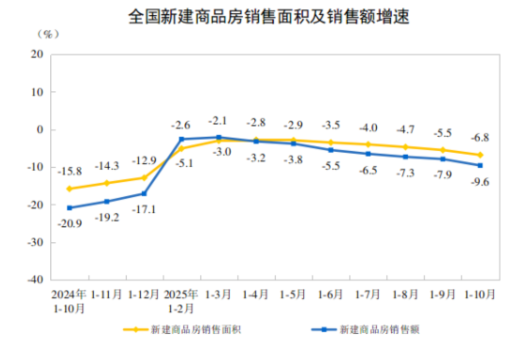
Group 1 - The real estate market is undergoing a structural differentiation, with significant variations across city tiers and product types, indicating a new market layout logic that requires detailed data observation [1] Group 2 - From January to October, national real estate development investment decreased by 14.7% year-on-year, with residential investment down by 13.8% and new construction area declining by 19.8%, reflecting the cautious strategies of real estate companies focused on "ensuring delivery and controlling new starts" [2] - Sales data shows a trend of "overall pressure with endogenous improvement," with commodity housing sales area and sales amount down by 6.8% and 9.6% year-on-year, respectively, but the decline has narrowed by 9.0 and 11.3 percentage points compared to the same period last year [2] - The inventory reduction is progressing steadily, with the area of unsold commodity housing decreasing for eight consecutive months, down by 3.22 million square meters at the end of October compared to September, although the total inventory remains relatively high with a year-on-year increase of 3.3% [2] Group 3 - There is a growing differentiation at the city level, with core cities showing resilience that supports market recovery; for instance, new home prices in first-tier cities fell only by 0.8% year-on-year, while Shanghai saw a 5.7% increase [3] - The "dual screening" mechanism at the product and enterprise levels is reshaping the industry landscape, with mid-range residential products showing better resilience compared to entry-level products due to stronger purchasing power and product quality [3] - The trend of quality resources concentrating among leading enterprises is evident, with state-owned and financially stable private companies increasing their market share and achieving project average sales rates 15-20 percentage points higher than the industry average [3]
中国矿业大学南湖校区2.93亿买490套房做学生宿舍?学校及开发商回应
Mei Ri Jing Ji Xin Wen· 2025-11-24 07:57
Core Viewpoint - China University of Mining and Technology plans to spend 293 million yuan to acquire 490 existing residential units to address student accommodation shortages [1][3] Group 1: Acquisition Details - The project aims to solve a dormitory space shortfall of 137,634 square meters at the university [3] - The acquisition is deemed the least risky and most reliable option, as there is no available land for new construction on campus or in the surrounding area [3] - The targeted property, located in the Yinxian Guanhai community, is close to public transport and has mature surrounding facilities [3] Group 2: Broader Context - The issue of insufficient student accommodation has been highlighted as many universities, including Peking University and Fudan University, have stopped providing dormitories for professional degree master's students [5] - The Ministry of Education and the Ministry of Housing and Urban-Rural Development have been exploring innovative solutions, such as the purchase of existing residential properties for student housing [5][7] - Other universities, like Hubei University and Hefei University of Technology, are also engaging in similar acquisition strategies to alleviate accommodation shortages [7][8]

地产10月观察及数据点评:基数扰动,延续去库存
Haitong Securities International· 2025-11-17 06:35
Investment Rating - The report maintains a preference for high-quality companies in the real estate sector, specifically recommending: 1) Development: A-Shares - China Vanke, Poly Developments, China Merchants Shekou, Gemdale; H-Shares - China Overseas Land & Investment; 2) Residential: Longfor Group; 3) Property Management: Onewo, China Resources Mixc Lifestyle Services, China Overseas Property, Poly Property Services, China Merchants Property; 4) Cultural Tourism: Shenzhen Overseas Chinese Town [63][70]. Core Insights - October data showed a significant decline due to high base effects, expected to continue until year-end. Both investment and demand sides exhibited accelerated declines, with development investment year-on-year growth at -23.2% and new construction area at -29.3%. Sales amount and area decreased by -25.1% and -19.6% respectively [63][71]. - The base effect is anticipated to narrow the year-on-year decline in 2026, but it cannot be linearly extrapolated for long-term industry judgments. Continuous tracking of industry trends and high inventory levels is necessary [64][72]. - The current inventory reduction trend persists, with a rapid decline in completed areas indicating a decrease in unsold projects. The proportion of unsold units in construction is rising, suggesting that the industry faces significant challenges in inventory reduction [64][73]. Summary by Sections 1. Investment Decline and Sales - In the first ten months of 2025, real estate development investment decreased by 14.7% year-on-year, with a notable decline in new construction area by 19.8% [6][10]. - Sales figures also reflected a downturn, with total sales area down by 6.8% and sales amount down by 9.6% compared to the same period in 2024 [27][8]. 2. Funding Sources - Total funding sources for real estate reached 7.89 trillion yuan, a decrease of 9.7% year-on-year. Domestic loans accounted for 15.42% of funding sources, with a decline of 1.8% year-on-year [47][49]. 3. Inventory and Sales Ratios - As of October 2025, the nationwide unsold housing area was 7.56 billion square meters, with a sales-to-completion ratio of 2.06, indicating ongoing inventory challenges [39][44]. 4. Market Outlook - The report suggests that while short-term new projects may drive sales, long-term inventory issues remain due to high debt levels among developers. The market is currently treating new and old projects separately, which may be feasible in the short term but poses long-term pressures [64][73].
楼市库存连降八个月,释放止跌回稳关键信号
Huan Qiu Wang· 2025-11-15 03:10
Core Insights - The national real estate market is showing signs of stabilization as the inventory of unsold residential properties has decreased for eight consecutive months, indicating a potential recovery from the ongoing adjustment phase [1][3] - The reduction in unsold housing inventory is attributed to effective policies aimed at controlling new supply and optimizing existing stock, which has improved market confidence and supply-demand dynamics [1][3] Group 1: Inventory and Sales Data - As of the end of October, the total unsold residential property area in China was 75,606 million square meters, a decrease of 3.22 million square meters from the end of September, with residential inventory down by 2.92 million square meters [1] - From January to October, the year-on-year decline in new residential property sales area and sales revenue has narrowed significantly by 9 percentage points and 11.3 percentage points, respectively, compared to the same period last year [3] Group 2: Financial Health of Real Estate Companies - The financial situation of real estate companies has improved, with the decline in funds available to developers narrowing by 9.5 percentage points compared to the same period last year and by 7.3 percentage points compared to the entire previous year [3] - The expansion of the "white list" projects has positively influenced the financing environment for real estate companies, contributing to the reduction in sales decline and improved inventory management [3] Group 3: Market Outlook - Despite positive signals, some indicators remain at low levels, reflecting the complexity of the real estate market's transition, which is currently in a period of adjustment between old and new models [3] - The focus of short-term policies will be on stabilizing the market, while long-term strategies will aim to establish a new development model, with expectations for improved supply in key cities to support market stabilization [3]
连续八个月减少!楼市又一关键数据出炉,意味着什么?
券商中国· 2025-11-14 23:38
Core Viewpoint - The real estate market in China is showing signs of improvement, with a significant narrowing of the year-on-year decline in new housing sales and a continuous reduction in unsold inventory, indicating the effectiveness of government policies [1][2][5]. Sales Performance - From January to October, the sales area of new commercial housing reached 71,982 million square meters, a year-on-year decrease of 6.8%, while the sales amount was 69,017 billion yuan, down 9.6% [2][5]. - The decline in sales area and amount has narrowed by 9 percentage points and 11.3 percentage points, respectively, compared to the same period last year [2]. Inventory Reduction - As of the end of October, the unsold housing inventory was 75,606 million square meters, a decrease of 322 million square meters from the end of September, with residential inventory down by 292 million square meters [2]. - The continuous reduction in unsold inventory over the past eight months reflects positive progress in inventory clearance efforts across various regions [2][5]. Funding for Real Estate Companies - The total funds received by real estate developers from January to October amounted to 78,853 billion yuan, representing a year-on-year decline of 9.7%, but the decline has narrowed compared to previous periods [3][5]. - Specific funding sources showed varied declines, with domestic loans down 1.8%, self-raised funds down 10.0%, and personal mortgage loans down 12.8% [3]. Market Outlook - The real estate market is currently undergoing a transition, and fluctuations in certain indicators should be viewed objectively [4][6]. - Future policies are expected to focus on stabilizing the market and promoting high-quality development, with an emphasis on both short-term and long-term strategies [6].

商品房库存连续8个月减少
21世纪经济报道· 2025-11-14 12:10
Core Viewpoint - The real estate market is experiencing fluctuations, but the effectiveness of policies is becoming evident, with a narrowing decline in sales and ongoing inventory reduction efforts [1][7]. Group 1: Market Performance - From January to October, the sales area of new commercial housing decreased by 6.8% year-on-year, and sales revenue fell by 9.6%, but the decline has narrowed compared to the same period last year [1][7]. - As of the end of October, the nationwide inventory of unsold commercial housing was 75,606 million square meters, a reduction of 3.22 million square meters from September, marking eight consecutive months of decline [1][6][7]. Group 2: Price Trends - In October, new home prices in first-tier, second-tier, and third-tier cities fell by 0.3%, 0.4%, and 0.5% month-on-month, respectively, with six cities, including Shanghai and Hangzhou, experiencing price increases [2][3]. - The second-hand housing market is also adjusting, with prices in first-tier, second-tier, and third-tier cities decreasing by 0.9%, 0.6%, and 0.7% month-on-month, indicating a process of price correction [5]. Group 3: Investment and Financing - Real estate development investment from January to October was 73,563 billion yuan, down 14.7% year-on-year, with the decline rate widening by 0.8 percentage points compared to previous values [7][9]. - The funding for real estate companies has seen a reduction in decline, with total funds received amounting to 78,853 billion yuan, a year-on-year decrease of 9.7%, but the decline has narrowed compared to previous years [9]. Group 4: Policy and Future Outlook - The government is actively implementing supportive policies to stimulate housing demand and stabilize the real estate market, with a focus on high-quality development [9]. - The next phase will involve adhering to the central government's directives to construct a new model for real estate development, emphasizing a combination of short-term and long-term strategies [9].