
算力芯片

Search documents
年内收益218%!这只基金提前锁定冠军
Di Yi Cai Jing Zi Xun· 2025-12-15 12:36
Core Insights - The year-end ranking battle among funds has intensified, with 67 funds achieving over 100% returns year-to-date as of December 12, 2023, including 57 active equity funds [2][3] - The leading fund, Yongying Technology Smart A, has a return rate of 218%, significantly ahead of the second-place fund by over 51 percentage points, making its victory nearly certain [4] - The performance of top funds is heavily influenced by investments in sectors like computing chips and optical modules, which are considered standard in their portfolios [2][4] Fund Performance - The top-performing fund, Yongying Technology Smart A, has a cumulative return of 218%, while the second-place fund, Zhonghang Opportunity Leading A, has a return of 166.65% [4] - The competition for rankings among mid-tier funds is fierce, with several funds like Hongtu Innovation Emerging Industry A and Xin'ao Performance Driven A achieving returns above 147% [4] - The top ten funds have a performance threshold set at 136.83%, indicating a narrow margin for ranking changes in the remaining trading days [4] Market Trends - The strong performance of active equity funds this year is attributed to a combination of technology, demand, and capital, with over 95% of active equity funds achieving positive returns [6] - The computing and optical module indices have seen significant increases, with year-to-date gains of 93.83% and 172.08%, respectively [5] - The focus on technology investments is expected to continue, with a shift towards performance verification rather than speculative themes [8][9] Future Outlook - Analysts suggest that the technology sector, particularly the optical communication industry, will remain a key component of investment strategies in the coming year, driven by explosive demand and supportive macro policies [2][8] - There is a consensus that the market will transition from speculative investments to a focus on the quality of earnings growth and sustainable business models [9] - Key areas for investment include AI applications, domestic replacements, and companies with strong technological barriers and commercialization capabilities [9]

年内收益218%!这只基金提前锁定冠军
第一财经· 2025-12-15 11:57
Core Viewpoint - The article discusses the intense competition among funds for year-end rankings, highlighting that as of December 12, 67 funds have achieved over 100% returns this year, with a significant focus on technology sectors such as computing chips and optical modules [3][5]. Fund Performance Summary - As of December 12, 67 funds have surpassed 100% returns, with 57 being actively managed equity funds, marking the best performance in five years [5][9]. - The top-performing fund, Yongying Technology Smart A, has a return rate of 218%, leading the second-place fund by over 51 percentage points [5][6]. - The competition for rankings is fierce among mid-tier funds, with several funds showing returns above 140%, indicating a narrow margin for potential ranking changes in the remaining trading days [6][8]. Investment Trends - The leading funds have a high concentration of investments in AI-related stocks, particularly in computing chips and optical modules, which are seen as essential components in the technology sector [8][9]. - The performance of the computing and optical module indices has been significant, with year-to-date increases of 93.83% and 172.08%, respectively [8]. Market Outlook - Analysts suggest that the technology sector's strong performance may continue into the next year, but there will be significant internal differentiation within the sector [3][10]. - The focus for investors is shifting from thematic investments to performance verification, emphasizing the importance of tracking technological advancements and profitability [12][13]. - The market is expected to favor companies with solid fundamentals, particularly in AI, pharmaceuticals, and high-end manufacturing, as these sectors are likely to see sustainable growth [13].

「中国英伟达」们的估值叙事:从寒武纪走势看摩尔线程、沐曦股份
3 6 Ke· 2025-12-12 07:57
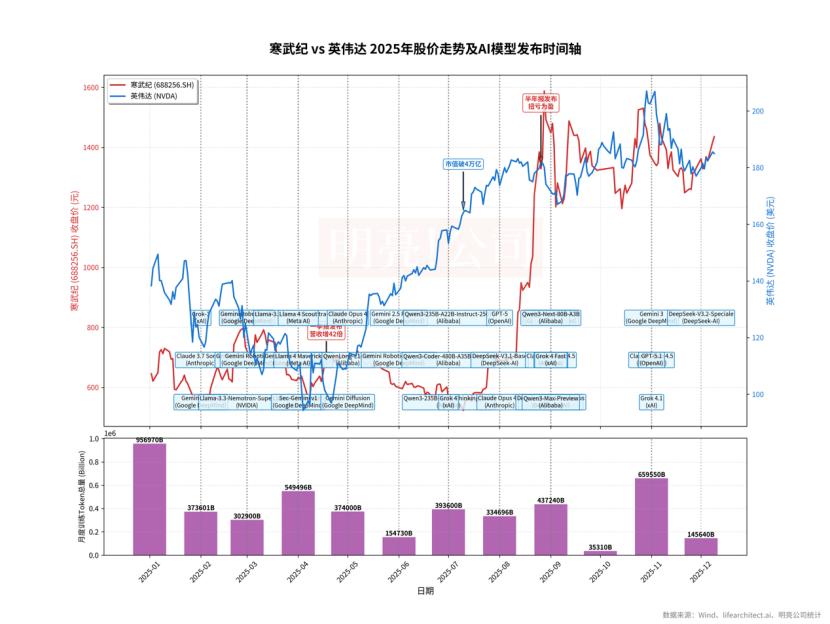
Group 1: AI Infrastructure Growth - The latest report from CMB International predicts that AI infrastructure will continue to grow strongly at least until 2026, with major overseas cloud providers' capital expenditures expected to increase by over 60% in 2024 and 2025, followed by a growth of over 30% in 2026 [1] - The market is looking for the "next Cambricon" following the rapid market capitalization growth of Cambricon (688256.SH) this year, with the recent listing of Moore Threads (688795.SH) on the STAR Market leading to significant stock price increases [1][2] Group 2: Stock Performance Comparison - Cambricon's stock price has increased by over 100% this year, driven by explosive revenue growth, with total revenue reaching 4.607 billion yuan in Q3, compared to only 185 million yuan in the same period last year [2][10] - The stock price of Cambricon began to rise significantly in early August, prior to the release of its semi-annual report, indicating that profitability was not the direct driver of its stock price increase [4] - In contrast, Nvidia's stock price has shown a divergence from Cambricon's, with Nvidia's market capitalization reaching over $5 trillion while Cambricon's market cap is approximately 588 billion yuan [4][10] Group 3: Capital Expenditure Insights - The narrative in the U.S. capital markets suggests that tech giants' capital expenditures on AI infrastructure, particularly core computing hardware, have supported the rise in AI hardware stock prices [6] - Among the top 20 companies in the S&P 500, those with significant capital expenditure increases are primarily related to AI data center assets, including energy, storage, and semiconductors [7] - The overall capital expenditure of the CSI 300 companies was approximately 2.031 trillion yuan, showing a slight decrease of 0.5% compared to last year, indicating that the data may not fully reflect the true state of AI capital expenditures in Chinese tech companies [9][10] Group 4: New Market Entrants - Newly listed companies Moore Threads and Muxi Co. reported revenues of 784.6 million yuan and 1.236 billion yuan respectively for the first three quarters, indicating they are in the early stages of commercialization but have entered a revenue-generating phase [14] - Both companies have shown a sales rate exceeding 100% in 2025, reflecting their acceleration into the commercialization phase [15] Group 5: R&D and Profitability - Moore Threads and Muxi Co. are currently operating at a loss, with net profit margins of -92.22% and -27.95% respectively, while Cambricon achieved a net profit margin of 34.81% this year [18] - The R&D expense ratios for Moore Threads and Muxi Co. are significantly higher than the average of comparable companies, indicating ongoing investment in research and development [16][17]

豆包手机助手进行AI操作手机能力调整!云计算ETF汇添富(159273)探底回升再获资金关注!谷歌VS英伟达,生死之战?
Sou Hu Cai Jing· 2025-12-05 06:44
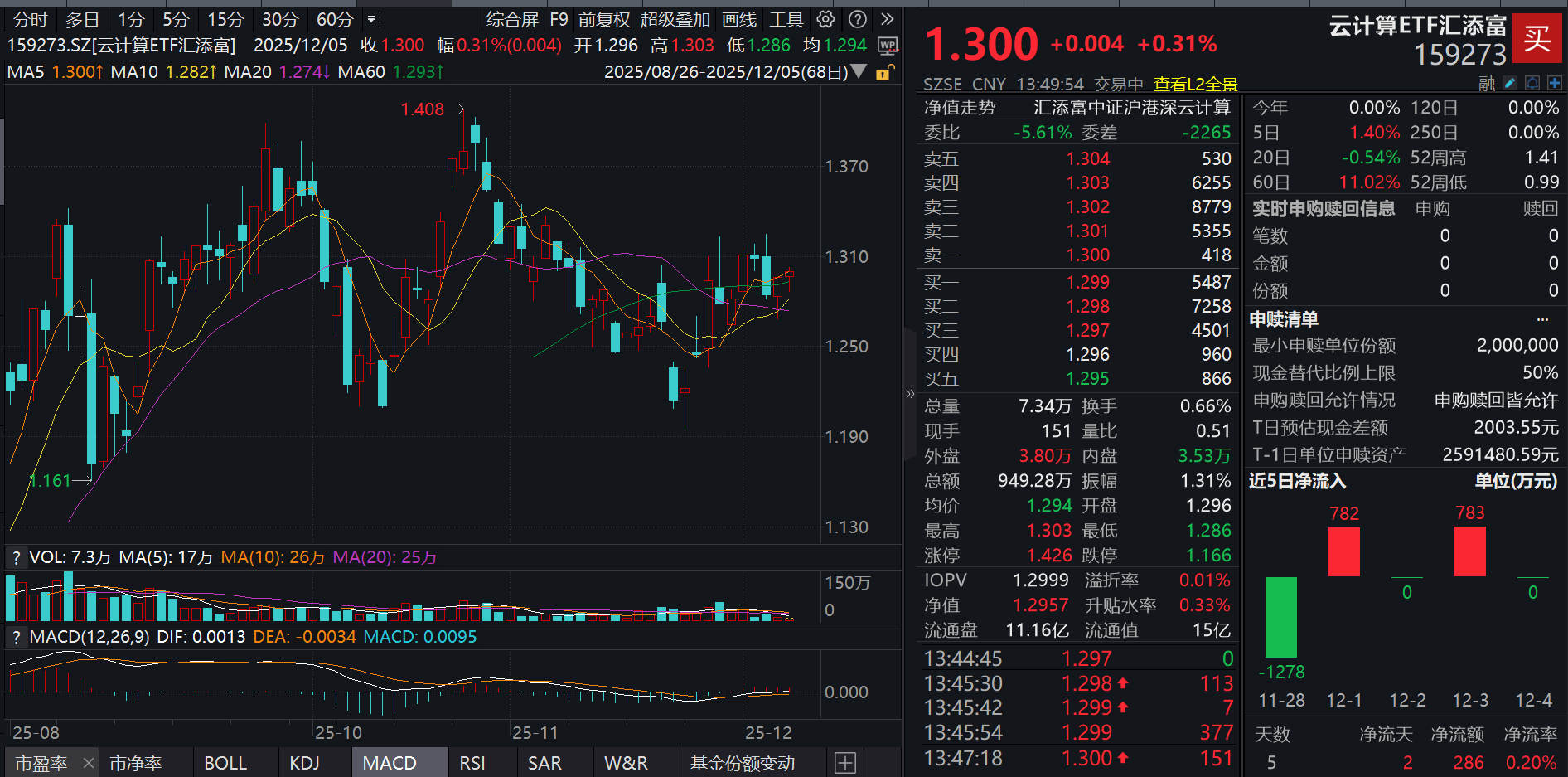
Group 1 - The "Doubao Mobile Assistant" team announced plans to regulate AI capabilities for mobile operations, including restrictions on financial and gaming applications, while seeking clearer rules through communication with app developers [2] - The cloud computing ETF Huatai-PineBridge (159273) saw mixed performance among its constituent stocks, with Keda Data and Zhongke Xingtu rising over 1%, while Donghua Software fell over 3% [2] Group 2 - Google’s TPU (Tensor Processing Unit) has reportedly outperformed OpenAI's ChatGPT 5, leading to speculation that Meta may adopt Google’s TPU over NVIDIA's GPUs [4] - The competition between Google’s TPU and NVIDIA’s GPU is viewed as a rational return to efficiency and cost considerations rather than a life-or-death struggle [4][5] - Google’s TPU is designed specifically for neural network acceleration, offering superior performance and energy efficiency compared to NVIDIA’s more flexible GPU platform [5] - Despite the advantages of Google’s TPU, NVIDIA's GPUs remain the preferred choice for many manufacturers due to their compatibility and flexibility in supporting various AI models [5][6] - The competition in chip performance is driven by increasing demands for data transmission efficiency, benefiting hardware supply chains, particularly in the optical module and PCB sectors [6] - A calculation indicates that if Google’s TPU partially replaces NVIDIA’s market share, the growth rate of the optical module sector could accelerate significantly [6]


暴赚6200倍!谁是摩尔线程的最大赢家?
华尔街见闻· 2025-12-05 04:01
Core Viewpoint - The article highlights the remarkable debut of Moore Threads on the STAR Market, showcasing the market's strong optimism for domestic high-end computing chips amid the AI wave, with a significant price surge post-IPO [1][4]. Group 1: IPO Performance - Moore Threads officially listed on the STAR Market on December 5, opening at 650 yuan, a staggering 468.78% increase from the issuance price of 114.28 yuan, peaking at 688 yuan, marking a 502% rise, with a market capitalization exceeding 270 billion yuan [1]. - Investors who acquired one lot (500 shares) at the opening price saw a floating profit of over 280,000 yuan, making it one of the most profitable new stocks of the year [1]. - The IPO attracted 267 institutions, with an offline subscription multiple of 1572 times, raising approximately 8 billion yuan, making it the largest IPO on the STAR Market this year [4][6]. Group 2: Investment and Valuation - Early investors, such as Peixian Qianyao, achieved over 6262 times return on their initial investment, creating a capital myth [3][8]. - Despite being in a loss-making state, the company has a high price-to-sales ratio of 122 times, significantly exceeding that of overseas giants like NVIDIA, indicating a market premium for its future growth potential and unique technology [4][9]. Group 3: Technology and Market Position - Moore Threads is the only domestic company capable of functionally competing with NVIDIA, utilizing its self-developed MUSA architecture to achieve breakthroughs in AI computing, graphics rendering, physical simulation, and video encoding on a single chip [5][11]. - The company aims to maintain an annual iteration speed for its full-function GPU chips and is committed to creating a comprehensive computing platform covering both cloud and edge computing [5][12]. Group 4: Future Projections and Market Growth - The company anticipates achieving profitability by 2027, with significant R&D investments reflecting its commitment to technological advancement [10]. - The global GPU market is projected to reach 3.62 trillion yuan by 2029, with China's market expected to grow rapidly, indicating a substantial opportunity for Moore Threads in the evolving computing landscape [13].

“国产GPU第一股”!摩尔线程大涨502%,中一签赚28万,早期投资者暴赚6200倍
Hua Er Jie Jian Wen· 2025-12-05 03:17
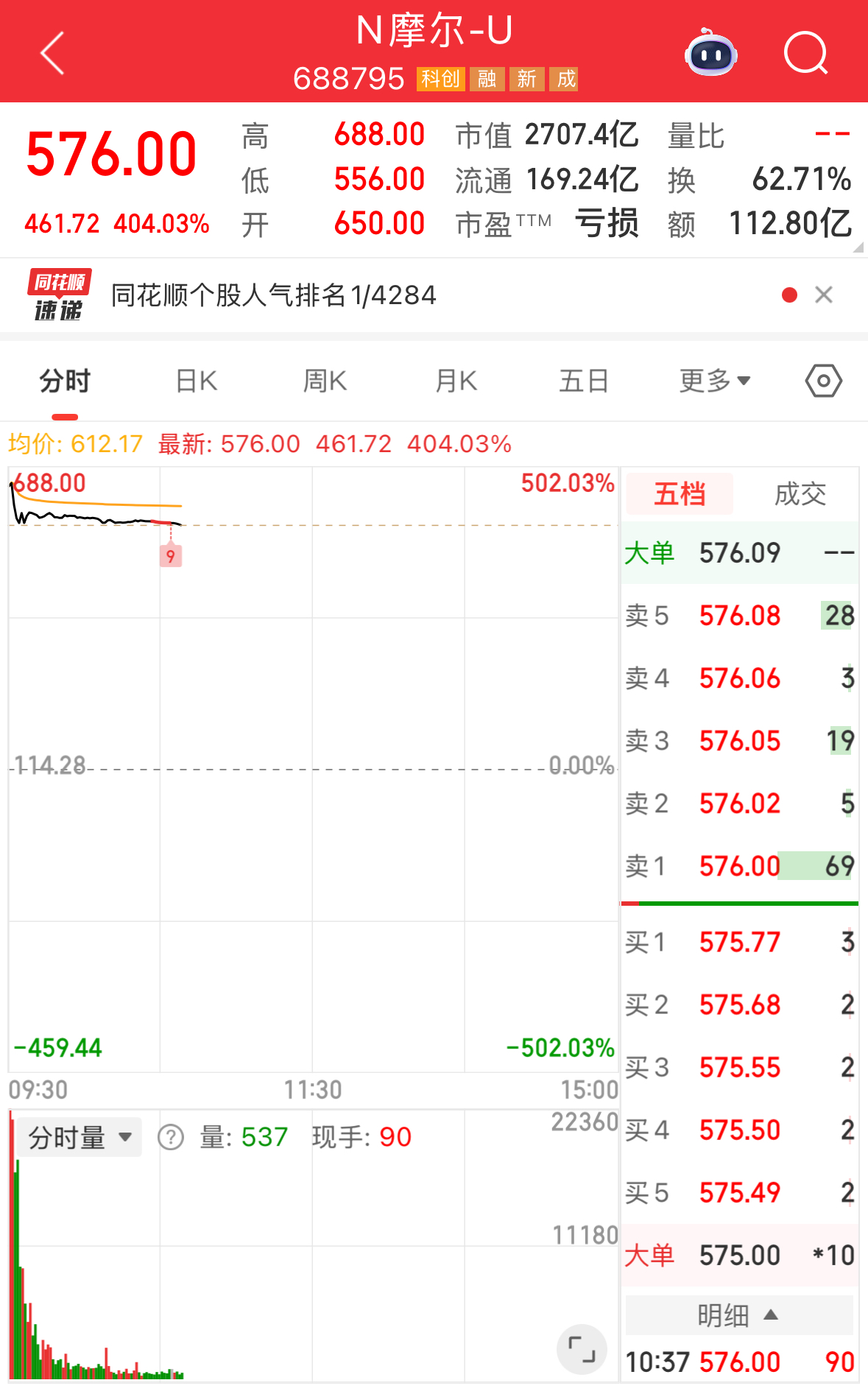
Core Viewpoint - The debut of Moore Threads on the STAR Market has sparked significant market enthusiasm, reflecting strong confidence in the future of domestic high-end computing chips amid the AI wave [1] Group 1: Market Performance - Moore Threads officially listed on the STAR Market on December 5, opening at 650 yuan, a staggering increase of 468.78% from the issuance price of 114.28 yuan [1] - The stock reached a peak of 688 yuan during trading, with a maximum increase of 502%, and its market capitalization briefly exceeded 270 billion yuan [1] - As of the latest update, the stock price is 576 yuan, representing a 404% increase [1] Group 2: Investment and IPO Details - The IPO attracted 267 institutional investors, with an offline subscription multiple of 1572 times, making it the largest IPO on the STAR Market this year, raising approximately 8 billion yuan [4][5] - Early investors, such as Peixian Qianyao, saw returns exceeding 6262 times their initial investment, highlighting the company's remarkable capital appeal [6] - The company completed its IPO process in just 158 days, showcasing a rapid pace in the capital market [5] Group 3: Financial Performance and Valuation - Despite high market enthusiasm, Moore Threads is currently operating at a loss, with projected revenues of 438 million yuan and a net loss of 1.618 billion yuan for 2024 [7] - The company has experienced rapid revenue growth, increasing from 46.1 million yuan in 2022 to 438 million yuan in 2024, but continues to face significant losses due to high R&D expenditures [7] - The company's price-to-sales ratio stands at 122 times, significantly higher than that of international GPU giants like NVIDIA, indicating a premium valuation based on future growth potential [4][7] Group 4: Technological Positioning - Moore Threads is positioned as the only domestic company capable of functionally competing with NVIDIA, utilizing its self-developed MUSA architecture to achieve breakthroughs in AI computing, graphics rendering, physical simulation, and video processing on a single chip [8][9] - The company aims to create a universal computing acceleration platform to support various AI applications and scientific research needs [9] Group 5: Future Outlook and Market Potential - The company plans to invest in three major projects through its IPO proceeds, focusing on AI integrated chips, next-generation graphics chips, and AI SoC chips to meet diverse computing needs [10] - The global GPU market is projected to reach 3.62 trillion yuan by 2029, with China's market expected to grow significantly, indicating a robust future for domestic GPU manufacturers [10]
十大概念板块,去伪存真,一个是历史性机会!
Sou Hu Cai Jing· 2025-12-02 10:00
Market Overview - The market is currently experiencing weakness, with major indices falling below the 60-day moving average, indicating a lack of upward momentum [1] - Despite a favorable monetary environment, there are signs of weakness in the real economy, leading to cautious investor sentiment [1][2] Investment Strategy - Investors are advised to stabilize their positions and avoid leveraging, focusing instead on technology and new economy sectors rather than cyclical stocks [2] - The emphasis should be on long-term opportunities in leading AI companies, as the AI and computing chip sector is seen as a historic opportunity despite potential short-term valuation risks [4][5] Technology Sector Insights - AI and computing chips are identified as transformative technologies that could significantly enhance productivity over the next 20 years [4] - Brain-computer interfaces are viewed as a bubble, with current technology only providing limited functionality for disabled individuals [5][6] - Satellite internet is recognized as a genuine opportunity due to its proven technology and demand in remote areas, particularly in China [7][8] Emerging Technologies - Blockchain is considered a bubble, with concerns over the security of cryptocurrencies like Bitcoin, which may lead to a collapse in their valuation [8] - Human-like robots and low-altitude electric manned flying vehicles are also categorized as bubbles, with significant regulatory and technical challenges hindering their development [9][10] - Quantum communication and quantum computing are still uncertain, with significant technical hurdles to overcome [10][11] Established Technologies - 3D printing is seen as having potential for growth, especially as AI lowers design barriers, making it more accessible for home use [11] - Lithium batteries, particularly solid-state batteries, are viewed as having opportunities, although traditional lithium battery technology is reaching maturity [11]

GPU与TPU的竞争新局,AI基建浪潮下的双轨增长
Xinda Securities· 2025-11-30 15:23
Investment Rating - The industry investment rating is "Positive" [2] Core Insights - The electronic sub-industry has significantly recovered, with the Shenwan Electronics secondary index showing year-to-date changes of: Semiconductors (+39.75%), Other Electronics II (+43.95%), Components (+89.82%), Optical Electronics (+5.55%), Consumer Electronics (+42.54%), and Electronic Chemicals II (+38.20%) [2][9] - North American key stocks mostly rose, with notable increases for companies like Micron Technology (+180.99%) and Intel (+102.29%) year-to-date [10] - Google's TPU v7 demonstrates cost advantages over GPU-based systems, challenging the GPU-dominated computing market. The total cost of ownership (TCO) for TPU is approximately 30%-40% lower than NVIDIA's GB200 system [2][24] - The demand for AI infrastructure is growing significantly, with NVIDIA reporting that cloud GPUs are sold out, indicating a supply-demand imbalance. TrendForce predicts over 20% year-on-year growth in global AI server shipments by 2026 [2][3] Summary by Sections Market Performance - The Shenwan Electronics secondary index has shown substantial recovery, with weekly changes for various segments: Semiconductors (+5.72%), Other Electronics II (+7.59%), Components (+8.10%), Optical Electronics (+5.23%), Consumer Electronics (+6.08%), and Electronic Chemicals II (+3.93%) [9] - Key North American stocks have shown positive performance, with significant increases for companies like Tesla (+9.99%) and Qualcomm (+2.93%) [10] Technology Competition - Google's TPU v7 has emerged as a strong competitor in the computing market, leveraging superior system-level engineering to achieve higher model performance utilization rates compared to NVIDIA GPUs [2][24] - The competition between GPU and TPU is seen as a redistribution of market share in a growing market, with both technologies expected to experience rapid growth [2] Investment Opportunities - Recommended companies to watch include: For overseas AI - Industrial Fulian, Huadian Co., Pengding Holdings, Shenghong Technology, and Shengyi Technology; For domestic AI - Cambricon, Chipone, Haiguang Information, SMIC, and Shenzhen South Circuit [3]
创50ETF(159681)涨近1%,半导体产业链领涨市场
Xin Lang Cai Jing· 2025-11-28 05:23
Group 1 - The core viewpoint of the news highlights the significant growth potential in the global semiconductor industry, particularly in the wafer foundry sector, which is expected to reach $199.4 billion by 2025, reflecting a year-on-year growth of over 25% [1] - The compound annual growth rate (CAGR) for the semiconductor industry from 2025 to 2030 is projected to be 14.3%, indicating that it will be a key driver of industry prosperity [1] - Capital expenditures from leading internet companies in China and the U.S. are expected to maintain rapid growth, with projections for 2025 reaching $430.6 billion (+65%) and $602 billion (+40%) in 2026, which will support future demand for computing chips [1] Group 2 - The ChiNext 50 Index (399673) consists of the 50 stocks with the highest average trading volume in the ChiNext market, reflecting the overall performance of well-known, large-cap, and liquid companies [2] - As of October 31, 2025, the top ten weighted stocks in the ChiNext 50 Index account for 70.15% of the index, with notable companies including CATL, Zhongji Xuchuang, and Mindray [2]





A股主要股指冲高回落 沪指微涨0.29%
Mei Ri Shang Bao· 2025-11-27 23:31
Market Overview - A-shares experienced a strong upward movement during the day but retreated in the afternoon, with the Shanghai Composite Index closing up 0.29%, while the Shenzhen Component Index and ChiNext Index fell by 0.25% and 0.44% respectively [1] - The total trading volume in the Shanghai and Shenzhen markets was 1.72 trillion yuan, a decrease of 740 billion yuan compared to the previous trading day [1] - Over 2,700 stocks rose across the market, indicating a rapid rotation of market hotspots [1] Sector Performance - The lithium battery electrolyte concept saw a rebound, with stocks like Shida Shenghua hitting the daily limit [1][6] - The computing power chip sector was active, with Saiwei Electronics rising over 15% [1] - The consumer electronics sector remained strong throughout the day, with Yunzuka Technology hitting the daily limit [1] - The paper sector showed significant gains, with an overall increase of over 2%, driven by price hikes in various paper products [4] - Other sectors such as forestry, daily chemicals, chemical products, and chemical fibers also performed well [5] Specific Company Developments - Xi'an Catering's stock surged, reaching the daily limit after the announcement of 16 measures by the Shaanxi provincial government to deepen capital market reforms [2] - The company focuses on a dual-driven strategy of "catering main business + food industry," emphasizing regional specialty cuisine and food production [3] - Major paper companies have announced price increases for various paper types, benefiting from improved demand and supply-side adjustments [4][6] - Leading electrolyte companies are experiencing a surge in orders, with some contracts extending to 2028, indicating strong future demand [7]


