贸易紧张局势

Search documents
美联储降息预期升温 国际金价再创新高
Yang Shi Xin Wen· 2025-10-17 09:12
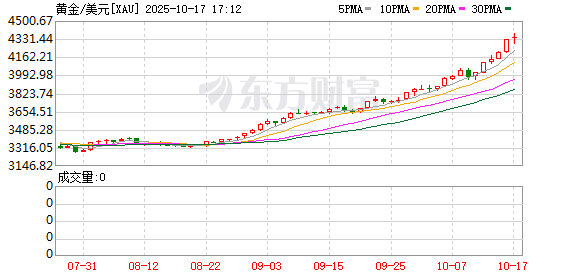
Group 1 - The core viewpoint is that the rise in gold prices is influenced by multiple factors, including increased gold purchases by central banks amid trade tensions and rising market expectations for potential interest rate cuts by the Federal Reserve [1][2]. Group 2 - On the 17th, international gold prices continued to climb, with the price exceeding $4,300 per ounce. Gold futures for December delivery on the New York Mercantile Exchange reached a peak of $4,392 per ounce during the trading session, marking a historical high [3]. - Additionally, international spot gold trading saw prices rise to nearly $4,380 per ounce on the same day, setting a new record [3].

黑色星期五,三大变数突然来袭
Zheng Quan Shi Bao· 2025-10-17 08:33
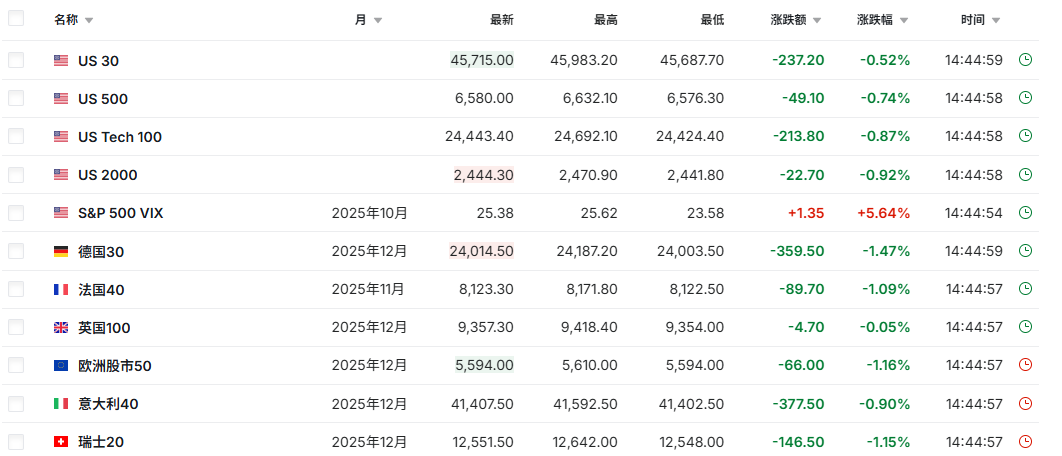
Market Overview - The A-share market experienced a significant decline on October 17, with the Shanghai Composite Index dropping over 70 points and both the STAR Market and ChiNext Index falling more than 3% [1] - The Hong Kong market also saw substantial losses, with the Hang Seng Tech Index declining over 3% [1] - Global markets were collectively bearish, with Japan's Nikkei index down over 1.4%, European stock index futures dropping over 1%, and U.S. stock index futures also declining [1][3] Key Factors Impacting the Market - Morningstar analyst Phelix Lee indicated that TSMC is unlikely to significantly increase capital expenditures next year, despite the company achieving record profits in Q3 and raising its revenue forecast for 2025 [6] - The Argentine peso has lost investor confidence, leading to a rapid exchange of pesos for U.S. dollars by the public and investors [1][6] - Concerns over U.S. regional banks have intensified, with the S&P Regional Banks Select Industry Index experiencing a 6.3% drop, marking its largest decline in over six months [7] Sector Performance - In the A-share market, sectors such as electric grid equipment, cultivated diamonds, controllable nuclear fusion, and advanced packaging saw the largest declines, with over 4,700 stocks falling [5] - Despite the current downturn, Manulife Investment Management expressed a constructive outlook for the Chinese stock market, citing a 42% increase in the MSCI China Index over the first nine months of 2025 [5] Economic Indicators - The MSCI Asia-Pacific Index fell by 1% to 222.34 points, reflecting broader regional market weaknesses [4] - Japan's economy is reportedly in a mild recovery, with expectations of accelerated growth as tariff uncertainties diminish [4]
刚刚,黄金突然跳水了!
Sou Hu Cai Jing· 2025-10-17 04:50
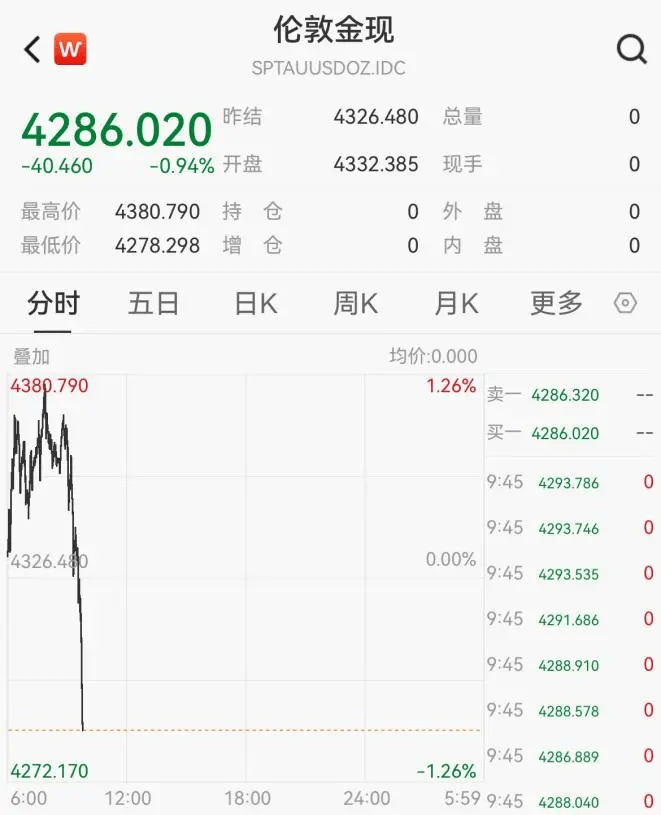
Core Points - On October 17, spot gold prices reached a historic high of $4,380 per ounce before experiencing a sharp decline, dropping $100 to below $4,280 per ounce [1] - As of the report, spot gold was priced at $4,286.02 per ounce, reflecting a daily decrease of 0.94% [1] - This week, gold prices have increased by over 8%, driven by concerns over trade tensions, ongoing U.S. government shutdown, and market expectations of increased monetary easing by the Federal Reserve before the end of the year [2] Gold Jewelry Prices - Domestic gold jewelry prices have approached 1,300 yuan per gram, with notable increases in prices from previous days [3] - Specific price changes include: Lao Miao's gold jewelry at 1,290 yuan per gram (up 42 yuan from the previous day), Zhou Shengsheng at 1,281 yuan per gram (up 36 yuan), and Chow Tai Fook at 1,279 yuan per gram (up 32 yuan) [3] - The Shanghai Gold Exchange issued a notice on October 16, urging members to enhance risk awareness and maintain market stability amid significant fluctuations in international precious metal prices [3]
黄金时间·每日论金:金价“四连阳”后或需警惕冲高回撤风险
Xin Hua Cai Jing· 2025-10-16 13:38
Group 1 - International gold prices continue to rise strongly, showing a four-day consecutive increase, indicating a strong market trend despite potential short-term pullback risks [1] - The latest Federal Reserve Beige Book reinforces market expectations for interest rate cuts in October and December, with a 97.3% probability for a 25 basis point cut in October and a 94.2% probability for another cut in December [1] - Analysts from major investment banks, including JPMorgan, suggest that gold is a more attractive store of wealth compared to AI stocks, with future price projections potentially reaching $5,000 to $10,000 [1] Group 2 - Since August, gold prices have increased by nearly $1,000, maintaining an overall upward trend, although caution is advised due to overbought conditions indicated by technical indicators [2] - Current price movements are within the range defined by the 10-day moving average and the upper Bollinger Band, with a potential resistance level at $4,239, which if broken, could lead to a target near $4,280 [2] - Despite the recent four-day increase, there is a need to be vigilant for potential pullbacks, but as long as prices do not fall below the 5-day and 10-day moving averages, any retracement could be seen as a setup for further upward movement [2]
ETO Markets 市场洞察:黄金涨到天花板了?RSI超买警报响彻市场,却仍敢冲4300?
Sou Hu Cai Jing· 2025-10-16 05:14
Core Viewpoint - The demand for safe-haven assets, particularly gold, is being driven by expectations of Federal Reserve interest rate cuts and ongoing global trade tensions [1][3]. Group 1: Federal Reserve Interest Rate Outlook - Federal Reserve Chairman Jerome Powell indicated that a sharp slowdown in hiring poses risks to the U.S. economy, suggesting the possibility of two more rate cuts this year [3]. - The market anticipates a 25 basis point rate cut at the upcoming October meeting, followed by another cut in December, and three additional cuts next year [3]. Group 2: Trade Tensions Impact - The escalation of trade tensions is expected to increase shipping costs and disrupt logistics, enhancing gold's appeal as a safe-haven asset [3]. - Analyst Fawad Razaqzada noted that renewed trade tensions provide investors with more reasons to hedge against stock market risks by allocating to gold [3]. Group 3: Market Dynamics - The market is closely monitoring speeches from Federal Reserve officials, as hawkish signals could strengthen the dollar and exert pressure on gold prices [3]. - Despite potential pullback risks, the strong upward trend in gold prices suggests that market participants do not expect a significant drop after reaching new highs [3]. Group 4: Technical Analysis - The current gold price chart shows a clear bullish trend, with prices consistently breaking historical highs and minor pullbacks [5]. - The Relative Strength Index (RSI) indicates that gold is in an overbought state, which typically suggests a phase of consolidation or slight correction may occur [5]. - Key support levels are identified at $4,117, $4,059, $4,023, and the $4,000 round number, while upward targets are set at $4,300 and $4,400 [5]. Group 5: Market Sentiment and Strategy - Gold retains upward potential due to multiple favorable factors, but investors should remain cautious of short-term volatility risks [7]. - The market will continue to look for key signals regarding gold's next phase of movement through Federal Reserve officials' speeches and developments in trade relations [7].

2025-10-16燃料油早报-20251016
Da Yue Qi Huo· 2025-10-16 03:17
Report Summary 1. Report Industry Investment Rating No investment rating information is provided in the report. 2. Core Viewpoints - International oil prices closed lower, with the International Energy Agency warning of a supply glut next year and ongoing Sino - US trade tensions, causing fuel oil to continue to be under pressure and oscillate at a low level. The spot fundamentals have relatively sufficient supply, and shipping demand is uncertain under the background of the Sino - US trade war, failing to provide upward momentum. - It is expected that FU2601 will operate in the range of 2680 - 2720, and LU2512 will operate in the range of 3150 - 3200 [3]. 3. Summary by Directory 3.1 Daily Tips - The Asian region may maintain sufficient supply in November due to high existing inventories and a continuous and stable inflow of high - sulfur goods from Russia. The recovery of high - sulfur fuel oil refining margins has curbed refinery raw material demand. The premium of Singapore's low - sulfur fuel oil terminal delivery term contracts declined in October due to sufficient inventory and insufficient demand. - The basis of Singapore high - sulfur fuel oil is 24 yuan/ton, and that of low - sulfur fuel oil is 8 yuan/ton, with the spot at par with the futures. - Singapore's fuel oil inventory in the week of October 8 was 20.619 million barrels, a decrease of 1.64 million barrels. - The price is below the 20 - day moving average, and the 20 - day moving average is downward. - High - sulfur main positions are short, with short positions increasing; low - sulfur main positions are long, with long positions increasing [3]. 3.2 Multi - and Short - Term Concerns - **Likely Positive Factors**: None mentioned. - **Likely Negative Factors**: The optimism on the demand side remains to be verified; sanctions against Russia may be intensified; Russia's fuel oil export restrictions may be extended. - **Market Drivers**: Supply is affected by geopolitical risks, and demand is neutral [4]. 3.3 Fundamental Data - **Futures Market**: The previous value of the FU main contract futures price was 2714, and the current value is 2669, a decrease of 45 or 1.66%. The previous value of the LU main contract futures price was 3216, and the current value is 3158, a decrease of 58 or 1.80%. The previous value of the FU basis was - 22, and the current value is 24, an increase of 46 or 206.75%. The previous value of the LU basis was - 8, and the current value is 8, an increase of 16 or 200.51% [5]. - **Spot Market**: The prices of Zhoushan high - sulfur and low - sulfur fuel oils remained unchanged. The price of Singapore high - sulfur fuel oil increased from 363.05 to 367.61 dollars/ton, an increase of 4.56 dollars/ton or 1.26%. The price of Singapore low - sulfur fuel oil decreased from 435.50 to 431.60 dollars/ton, a decrease of 3.90 dollars/ton or 0.90%. The price of Middle - East high - sulfur fuel oil increased from 339.50 to 344.12 dollars/ton, an increase of 4.62 dollars/ton or 1.36%. The price of Singapore diesel decreased from 630.10 to 620.96 dollars/ton, a decrease of 9.13 dollars/ton or 1.45% [6]. 3.4 Inventory Data - Singapore's fuel oil inventory on October 8 was 20.619 million barrels, a decrease of 1.64 million barrels compared to the previous period. The inventory has shown fluctuations in recent months, with an increase in some weeks and a decrease in others [3][8].
Fed's Miran sees China trade tensions as a further reason for quick interest rate cuts
CNBC· 2025-10-15 15:33
Economic Outlook and Trade Tensions - The latest impasse in U.S.-China trade talks poses new dangers to the economic outlook, making the case for rate cuts more urgent [1][2] - China's decision to restrict access to rare earth materials has escalated tensions, prompting President Trump's threat of 100% tariffs on Chinese imports [1] Policy Implications - The current trade dispute increases uncertainty in an already volatile year, with concerns that China is reneging on previously made deals [2] - Policymakers are urged to consider the introduction of new tail risks due to the trade situation [2] Interest Rate Cuts - Miran advocates for an additional 1.25 percentage points in interest rate cuts, on top of the quarter-point reduction approved in September [3] - The Federal Open Market Committee (FOMC) is expected to approve another quarter-point reduction in its upcoming meeting on October 28-29 [4] Economic Vulnerability - A restrictive policy environment makes the economy more vulnerable to shocks, necessitating a shift to a more neutral stance [4]
Tariff shock scaled back: IMF Chief Economist
Youtube· 2025-10-15 12:57
Core Insights - The current economic situation is at the modest end of the growth range, despite the impact of tariff shocks [2][4] - The effective tariff rate is slightly under 20%, down from a projected 25%, indicating a high but reduced tariff environment [3] - Growth projections for 2025 remain stable at 3.2%, with a slight expected slowdown to 3.1% next year [4] Trade Policy and Economic Impact - Trade policy uncertainty continues to pose risks, with potential flare-ups in trade relations that could harm the global economy [5][6] - A downside scenario suggests that escalating trade tensions could reduce global output by 0.3 percentage points this year and next [7] Tariff Effects on Prices - The burden of tariffs is currently being absorbed by US importers, who are reducing their margins rather than passing costs onto consumers [9][10] - Over time, it is anticipated that importers will rebuild their margins, leading to increased retail prices and price pressures in the market [10][11] - Inflation in the US is currently at 2.7%, with expectations that price pressures will continue into 2024 and 2025 [12]

美元树(DLTR.US)展望三年内每股收益年增12-15% 盘前股价应声大涨
智通财经网· 2025-10-15 12:05
Core Viewpoint - Dollar Tree Inc. (DLTR.US) expects its earnings per share to grow at an annual rate of 12-15% over the next three years, with a projected near 20% growth in fiscal year 2026 due to cost advantages [1] Group 1: Financial Performance - The company reported a same-store sales growth of 3.8% in the third quarter, surpassing analysts' average expectation of 3.7% [1] - Dollar Tree's stock price increased by over 8% in pre-market trading on Wednesday, with a year-to-date cumulative increase of 28% as of Tuesday's close [2] Group 2: Strategic Changes - Following the $1 billion sale of its underperforming Family Dollar business, Dollar Tree is shifting its strategic focus under CEO Mike Creedon [1] - The sale price of $1 billion is significantly lower than the nearly $9 billion cost incurred when the business was acquired a decade ago [1] Group 3: Management and Operational Challenges - Jefferies analysts express caution regarding Dollar Tree, noting that the company's business reforms have been "chaotic," with only 2 out of 16 executives remaining since the beginning of 2023 [2] - The company faces significant risks due to its reliance on overseas procurement from China amid escalating trade tensions [3] Group 4: Market Conditions - An increase in high-income consumer traffic has benefited the company, but rising tariffs are expected to pose a more severe challenge in the second half of the year [3] - Dollar Tree previously indicated that the benefits from price increases would gradually diminish, leading to expectations of flat profits compared to the previous period, which disappointed investors [3]

供应过剩与贸易阴云双重打压,油价跌至五个月新低
Huan Qiu Wang· 2025-10-15 07:42
Core Viewpoint - International oil prices continue to decline, hovering near a five-month low due to concerns over potential oversupply and weakening global energy demand [1][3] Group 1: Market Conditions - Brent crude futures fell by 0.19% to $62.27 per barrel, while WTI crude futures decreased by 0.17% to $58.60 per barrel, both reaching five-month lows in the previous trading session [1][3] - The International Energy Agency (IEA) warned of a possible oversupply of 4 million barrels per day by 2026, significantly exceeding previous market expectations [3] Group 2: Demand and Supply Dynamics - The ongoing trade tensions are negatively impacting global economic vitality and energy consumption forecasts, contributing to a pessimistic market sentiment [3] - Analysts are closely monitoring upcoming U.S. crude oil inventory data, with expectations of an increase of approximately 200,000 barrels for the week ending October 10 [3]