适度宽松货币政策

Search documents
国家发展改革委、市场监管总局:着力加强价格调控 促进物价合理运行
Zhong Guo Zheng Quan Bao· 2026-02-05 23:43
Core Viewpoint - The National Development and Reform Commission (NDRC) emphasizes the importance of price regulation and reform in the context of the 14th Five-Year Plan, aiming to stabilize prices and enhance the welfare of the population [1][2]. Group 1: Price Regulation and Reform - The NDRC and the State Administration for Market Regulation held a meeting to recognize advanced collectives and individuals in price work, highlighting the significance of effective price management for the upcoming 14th Five-Year Plan [1]. - The NDRC plans to strengthen price regulation, promote reasonable price movements, and ensure the supply and price stability of essential goods for the public [1][2]. Group 2: Policy Implementation - A more proactive fiscal policy and moderately loose monetary policy will be implemented, with a focus on promoting reasonable price recovery as a key consideration in monetary policy [2]. - Structural policies will include actions to boost consumption, increase urban and rural residents' income, and optimize the implementation of new policies to achieve better supply-demand balance [2]. Group 3: Market Regulation - The NDRC aims to address "involution" competition by establishing unified market regulations, standardizing behaviors of local governments and enterprises, and enhancing the market's survival of the fittest mechanism [2]. - Continuous efforts will be made to ensure the stable supply and pricing of essential goods, maintaining a comprehensive control over the production, supply, storage, and sales chain of these goods [2].
着力加强价格调控促进物价合理运行
Zhong Guo Zheng Quan Bao· 2026-02-05 20:27
Group 1 - The National Development and Reform Commission (NDRC) emphasizes the importance of price work in 2026, marking the beginning of the 14th Five-Year Plan, and aims to strengthen price regulation and promote reasonable price operations [1] - The NDRC plans to implement structural adjustments and work with relevant departments to create a policy "combination punch" to promote reasonable price recovery [1][2] - The NDRC highlights the need for comprehensive price supervision to ensure market competition order and to stabilize prices of essential goods for improving public welfare [1][2] Group 2 - The government intends to adopt a more proactive fiscal policy and moderately loose monetary policy, considering the promotion of reasonable price recovery as a key aspect of monetary policy [2] - Structural policies will focus on boosting consumption, increasing urban and rural residents' income, and optimizing the implementation of new policies to achieve better supply-demand balance [2] - Continuous efforts will be made to ensure the supply and price stability of essential goods, maintaining a comprehensive control over the entire supply chain [2]
热卷日报:震荡偏弱-20260205
Guan Tong Qi Huo· 2026-02-05 11:09
Report Industry Investment Rating - The report gives a short - term cautious and bullish rating on hot - rolled coils [6] Core Viewpoints - The hot - rolled coil futures market is oscillating weakly, with supply relatively stable and demand showing strong resilience despite a decline due to the approaching Spring Festival. The total inventory is at a high level mainly because of high - level social inventory, and there is still inventory pressure. Attention should be paid to the resumption of manufacturing operations after the Spring Festival and the inventory depletion speed [6] Summary by Directory 1. Market Review - **Futures Price**: On Thursday, the open interest of the main hot - rolled coil futures contract increased by 11,934 lots, and the trading volume was 283,875 lots, a decrease compared to the previous trading day. The intraday low was 3255 yuan, the high was 3278 yuan, and the market was oscillating weakly. In the short - term, it fell below the 5 - day, 30 - day, and 60 - day moving average lines, closing at 3263 yuan/ton, a decrease of 13 yuan or 0.40% [1] - **Spot Price**: The price of hot - rolled coils in Shanghai, a mainstream area, was reported at 3260 yuan/ton, a decrease of 10 yuan compared to the previous trading day [2] - **Basis**: The basis between futures and spot was - 3 yuan [3] 2. Fundamental Data - **Supply**: As of February 5, the weekly output of hot - rolled coils decreased by 0.05 million tons to 3.0916 million tons week - on - week and decreased by 11.03 million tons year - on - year. The current output is at a moderately high level in recent years, indicating that steel mills maintain a high production pace before the Spring Festival and production enthusiasm has increased [4] - **Demand**: As of February 5, the weekly apparent consumption decreased by 5.87 million tons to 3.0554 million tons week - on - week and decreased by 8.11 million tons year - on - year. Affected by the Spring Festival shutdown, the demand of downstream manufacturing industries has declined, but it is still at a relatively high level in recent years and shows certain resilience [4] - **Inventory**: As of February 5, the total inventory increased by 3.62 million tons to 3.592 million tons week - on - week (social inventory increased by 2.12 million tons week - on - week, and steel mill inventory increased by 1.5 million tons). The pressure is concentrated in social inventory, and the steel mill inventory is controllable, indicating inventory backlog in the distribution link and insufficient willingness of downstream buyers to purchase [4] - **Policy**: The new regulations on the export license management of steel products will cause short - term export fluctuations, increase supply, and put pressure on prices. In the long term, it will promote industrial upgrading, structural optimization, and competitiveness improvement. The central economic meeting in December proposed a proactive fiscal policy and a moderately loose monetary policy, which is beneficial to prices and industry profits, and efforts will be made to stabilize the real estate market and expand domestic demand [4][5] 3. Market Driving Factor Analysis - **Bullish Factors**: Supply contraction, demand resilience, and policy support (the 14th Five - Year Plan, infrastructure investment) [6] - **Bearish Factors**: Unexpected resumption of production by steel mills, seasonal weakening of demand, insufficient manufacturing orders, and inventory accumulation suppressing prices [6] 4. Short - term View Summary - The hot - rolled coil futures decreased in volume today. Short - term pressure is near the 30 - day moving average, and the lower support is the previous low. Adopt a cautious and bullish approach. Currently, the supply is relatively stable, and although the demand has declined mainly due to the approaching Spring Festival, it still shows strong resilience. The total inventory is at a high level mainly due to high social inventory pressure, and inventory pressure still exists. Attention should be paid to the resumption of manufacturing operations after the Spring Festival and the inventory depletion speed [6]
A股市场2026年2月投资策略报告:市场处于震荡整固阶段,结构性行情将是重点-20260205
BOHAI SECURITIES· 2026-02-05 08:28
Macro Economic Situation - Export continued to improve with a year-on-year growth of 6.6% in December 2025, driven by structural optimization and competitive advantages of high-tech products [8] - Fixed asset investment in 2025 decreased by 3.8% year-on-year, with infrastructure investment down by 2.2% and real estate investment down by 17.2% [10][12] - Manufacturing investment showed a slight increase of 0.6% year-on-year, but was affected by policy adjustments and demand fluctuations [11][12] Liquidity Environment - The Federal Reserve maintained the policy interest rate between 3.50% and 3.75% in January 2026, with expectations of potential rate cuts later in the year [24] - The People's Bank of China released trillions of yuan through reverse repos and MLF to address seasonal funding needs, maintaining a moderately loose monetary policy [23][27] Capital Market Liquidity Environment - ETFs experienced significant outflows in January 2026, indicating a shift towards stabilizing the market and reducing overheating risks [33][46] - Changes in financing rules have led to a more stable growth in financing, with the minimum margin requirement for margin trading increased from 80% to 100% [34] - The pace of stock supply has accelerated due to policies promoting direct financing, with increased IPO and refinancing activities [42][46] Market Strategy - The market is currently in a consolidation phase, with limited potential for significant upward movement due to high valuation levels and resistance from previous counter-cyclical adjustments [57] - The focus should shift towards structural opportunities as the market navigates through a vacuum of economic data and performance [57] Industry Allocation - In February 2026, attention should be given to relatively low-positioned consumer and cyclical sectors during the pre-holiday industry style convergence [61] - Opportunities in the AI sector are expected to grow due to ongoing capital investments and domestic demand for computing power [61] - The power equipment industry is anticipated to benefit from overseas photovoltaic expansion plans and significant investments from the State Grid [61]
国债期货日报:移仓进行中,国债期货全线收跌-20260205
Hua Tai Qi Huo· 2026-02-05 03:25
国债期货日报 | 2026-02-05 移仓进行中,国债期货全线收跌 市场分析 宏观面:(1)宏观政策: 12月8日政治局会议明确实施更加积极的财政政策和适度宽松的货币政策,释放宽货币 信号;中央经济工作会议提出,2026年财政政策方面继续实施更加积极的财政政策,货币方面继续实施适度宽松 的货币政策,灵活高效运用降准、降息及结构性政策工具,为"十五五"良好开局提供稳定的宏观政策环境;2026 年1月19日起,下调再贷款、再贴现等一篮子利率0.25个百分点,同时今年还存在继续降准降息的空间。(2)通胀: 12月CPI同比上升0.8%。 财政:(3)财政:2025年全年财政收支整体未达预期,收入受税收走弱与非税高基数拖累,全年一般公共预算 收入同比下降1.7%;支出节奏前置,年末力度减弱,全年完成度偏低。结构上呈现分化特征,民生支出总体稳定, 基建类支出占比下降,土地财政收入持续疲软。展望2026年,财政政策预计延续积极,强调"总量增加、结构更优", 支出力度有望加强,节奏继续前置,对稳增长形成支撑。(4)金融:2025年前12个月份社会融资规模增量累计为 35.6万亿元,比去年同期3.34万亿:12月末,M2余 ...
央行买卖国债1000亿,国债期货涨跌分化
Hua Tai Qi Huo· 2026-02-04 07:50
国债期货日报 | 2026-02-04 央行买卖国债1000亿,国债期货涨跌分化 市场分析 宏观面:(1)宏观政策: 12月8日政治局会议明确实施更加积极的财政政策和适度宽松的货币政策,释放宽货币 信号;中央经济工作会议提出,2026年财政政策方面继续实施更加积极的财政政策,货币方面继续实施适度宽松 的货币政策,灵活高效运用降准、降息及结构性政策工具,为"十五五"良好开局提供稳定的宏观政策环境;2026 年1月19日起,下调再贷款、再贴现等一篮子利率0.25个百分点,同时今年还存在继续降准降息的空间。(2)通胀: 12月CPI同比上升0.8%。 策略 单边:回购利率回落,国债期货价格震荡。 套利:关注2603基差回落。 套保:中期存在调整压力,空头可采用远月合约适度套保。 风险 流动性快速紧缩风险 财政:(3)财政:2025年全年财政收支整体未达预期,收入受税收走弱与非税高基数拖累,全年一般公共预算 收入同比下降1.7%;支出节奏前置,年末力度减弱,全年完成度偏低。结构上呈现分化特征,民生支出总体稳定, 基建类支出占比下降,土地财政收入持续疲软。展望2026年,财政政策预计延续积极,强调"总量增加、结构更优" ...
人民银行上海总部:保持全年特别是一季度融资总量合理增长、均衡投放
Bei Jing Shang Bao· 2026-02-03 08:56
北京商报讯(记者 刘四红)2月3日,人民银行上海总部官微发布消息称,近日,人民银行上海总部组 织召开上海市金融形势分析会。会议强调,要促进信贷总量合理增长、均衡投放。准确把握适度宽松货 币政策的内涵,平衡处理好量价关系,挖掘有效信贷需求,注重盘活信贷存量,综合运用多种方式为实 体经济提供有效金融支持,保持全年特别是一季度融资总量合理增长、均衡投放。 ...
央行上海总部最新部署!2026年金融重点工作明确→
Sou Hu Cai Jing· 2026-02-03 08:13
Core Insights - The People's Bank of China (PBOC) Shanghai Headquarters held a financial situation analysis meeting, discussing the financial operation of Shanghai for 2025 and planning for key financial work in 2026 [1][2] Group 1: Financial Growth and Support - The meeting emphasized promoting reasonable growth and balanced distribution of credit, focusing on effective credit demand and revitalizing existing credit to support the real economy [1] - It highlighted the importance of maintaining a reasonable growth in financing, especially in the first quarter of the year [1] Group 2: Implementation of Monetary Policies - The meeting called for strict adherence to interest rate policies and improving market interest rate pricing capabilities [2] - It encouraged the use of various structural monetary policy tools specific to Shanghai, such as "Hu Ke Special Loan" and "Cross-Border Refinance" [2] Group 3: Financial System Development - There is a focus on developing a diversified financial system that covers the entire lifecycle of technology enterprises [2] - The meeting discussed enhancing financial services for small and micro enterprises and promoting financial support for rural revitalization [2] Group 4: Financial Reform and Opening Up - The meeting stressed the need to strengthen cross-border financial service capabilities and improve the convenience of cross-border RMB business [2] - It also mentioned advancing financial reforms related to free trade zones and enhancing the construction of blockchain credit platforms [2] Group 5: Service Capability Enhancement - Continuous efforts will be made to improve payment service levels and implement a one-time credit repair policy [2]
人民银行上海总部召开上海市金融形势分析会
Xin Lang Cai Jing· 2026-02-03 07:52
Core Viewpoint - The People's Bank of China Shanghai Headquarters held a financial situation analysis meeting to discuss the financial operation of Shanghai in 2025 and to plan key financial work for 2026 [1][3]. Group 1: Financial Support and Policy Implementation - The meeting emphasized the importance of aligning thoughts and actions with the decisions of the Central Committee, focusing on supporting high-quality economic development and the construction of Shanghai as an international financial center [2][4]. - It was highlighted that there should be a reasonable growth and balanced distribution of credit, with a focus on effective credit demand and revitalizing existing credit [2][4]. - The meeting called for strict implementation of monetary policy requirements, including interest rate policies, and the effective use of structural monetary policy tools unique to Shanghai [2][4]. Group 2: Financial System and Reform - The meeting discussed the need to enhance a diversified financial system that supports the entire lifecycle of technology enterprises and promotes green finance standards [2][4]. - There is a focus on improving financial services for small and micro enterprises, rural revitalization, and exploring new financial models for the elderly care industry [2][4]. - Continuous deepening of financial reform and opening up was emphasized, including enhancing cross-border financial service capabilities and promoting blockchain credit certificate platforms [2][4].
债市开年“先抑后扬” 修复结构分化 短期震荡格局难改
Bei Jing Shang Bao· 2026-02-02 15:17
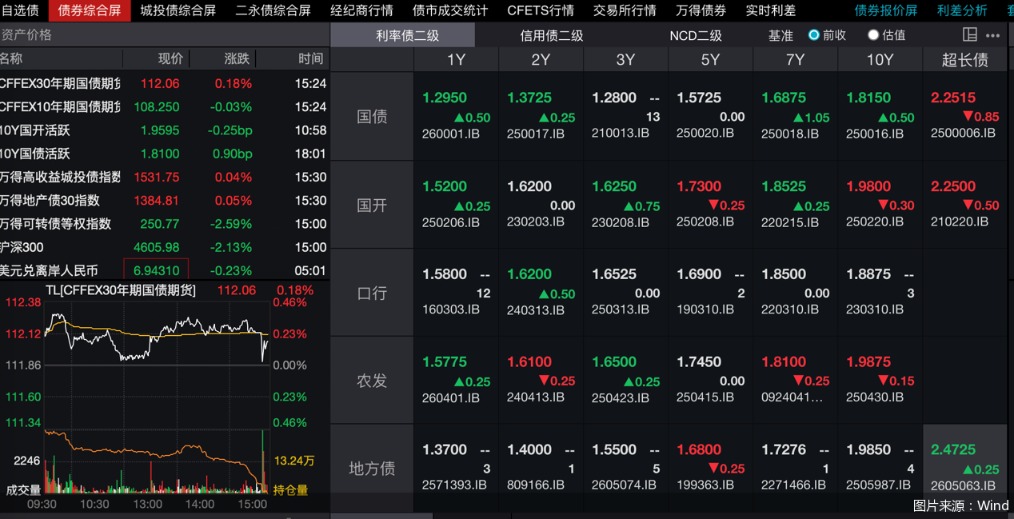
Market Overview - On the first trading day of February, financial markets continued to show volatility, with London gold prices dropping below $4,500 per ounce, experiencing an intraday decline of over 9% [1] - The A-share market saw all three major indices decline by over 2%, with more than a hundred stocks hitting the daily limit down [1] Bond Market Performance - As of February 2, major government bond yields showed mixed performance, with the 10-year government bond yield rising by 0.50 basis points to 1.8150% [3] - The 30-year government bond futures contract increased by 0.18% to 112.060, while the 10-year and 5-year contracts fell by 0.03% and 0.02%, respectively [3] - In January, the bond market experienced significant volatility, with the 10-year government bond yield peaking at 1.8985% on January 8, marking the highest level since September 2025 [3][4] Monetary Policy and Market Liquidity - The People's Bank of China (PBOC) is expected to continue implementing interest rate cuts and reserve requirement ratio reductions to support the bond market [1][10] - On February 2, the PBOC conducted a 7-day reverse repo operation of 75 billion yuan at an interest rate of 1.40%, with a net withdrawal of 755 billion yuan due to maturing repos [5] - The liquidity in the interbank market is expected to tighten temporarily as the market approaches the Spring Festival, but medium-term liquidity is projected to remain loose [5][6] Future Outlook - Analysts predict that the bond market will continue to experience fluctuations, with the 10-year government bond yield facing resistance around 1.80% [7] - The overall trend for 2026 is expected to be characterized by low interest rates, high volatility, and structural differentiation in the bond market [7][10] - The anticipated monetary policy will likely keep the interest rate increase limited, with the 10-year government bond yield expected to fluctuate between 1.6% and 2.0% [10]