
降息降准

Search documents
M2突破331万亿!居民存款“搬家”股市 8月金融市场有这些新变化
Bei Jing Shang Bao· 2025-09-12 14:31
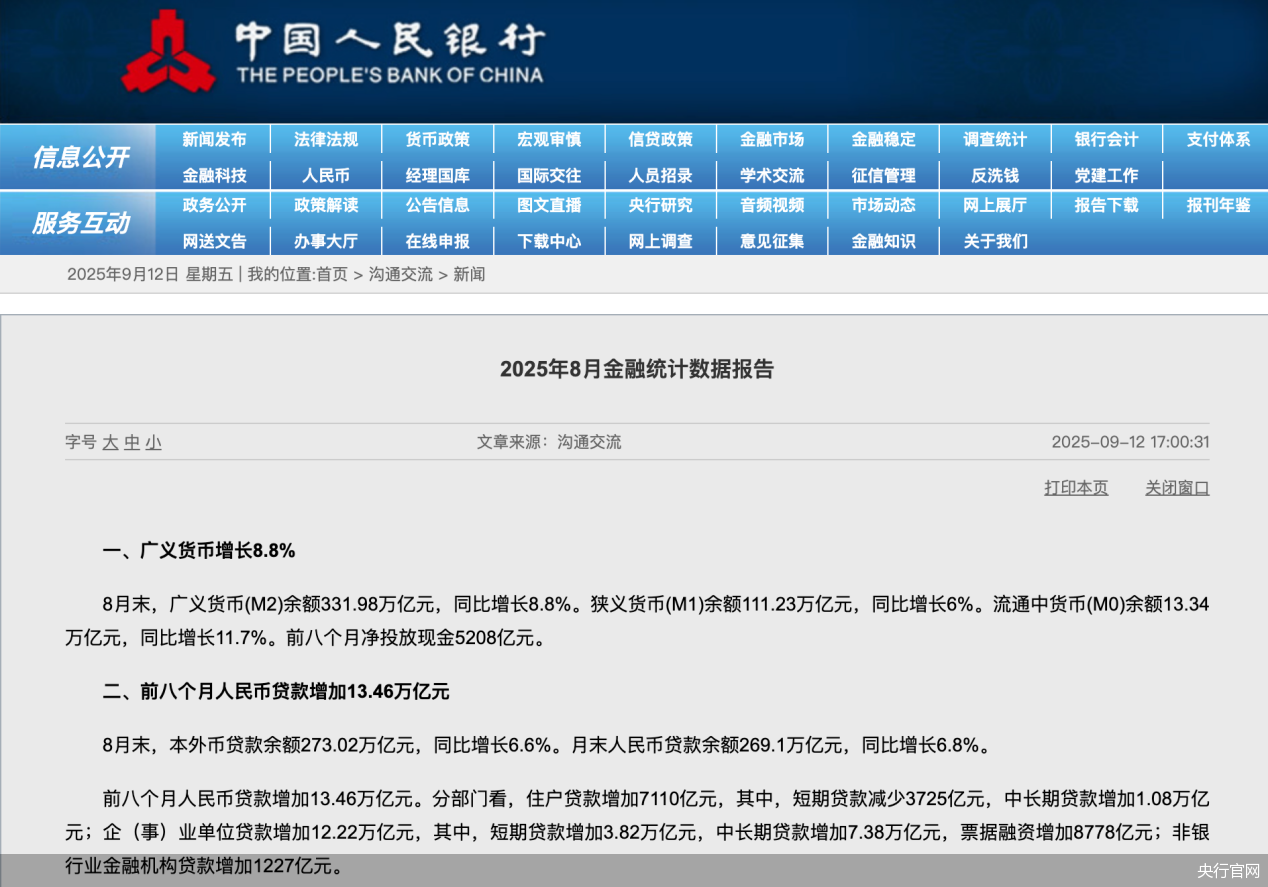
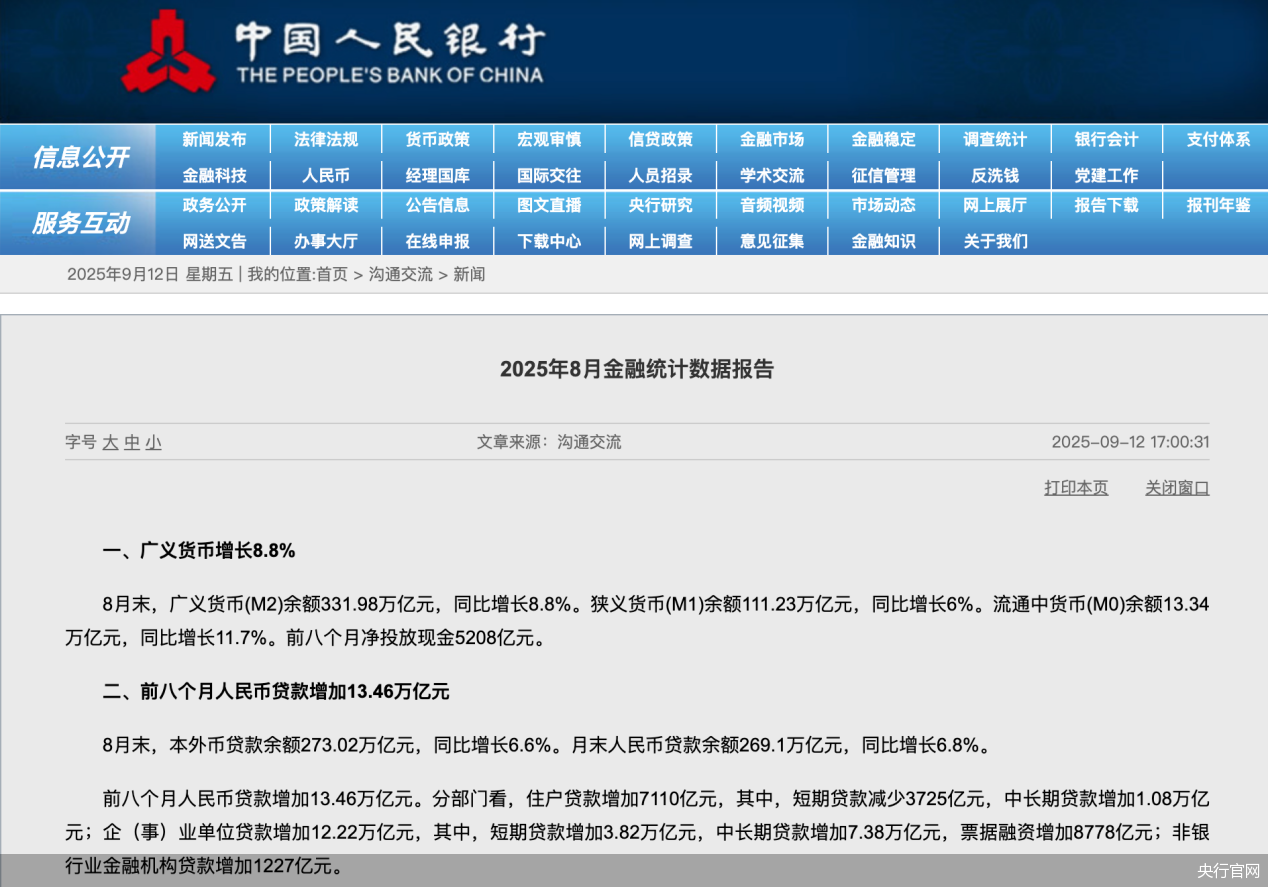
Core Insights - The latest financial data released by the People's Bank of China indicates a significant growth in broad money (M2) and social financing, with M2 reaching 331.98 trillion yuan, up 8.8% year-on-year, and social financing stock at 433.66 trillion yuan, also up 8.8% year-on-year [1][12]. Group 1: Loan Growth and Structure - As of the end of August, the balance of RMB loans stood at 269.1 trillion yuan, reflecting a year-on-year growth of 6.8% [4]. - In the first eight months of the year, RMB loans increased by 13.46 trillion yuan, with household loans rising by 711 billion yuan and corporate loans increasing by 12.22 trillion yuan [4][5]. - August saw a net increase of 590 billion yuan in RMB loans, with corporate and personal loans both experiencing growth, supported by favorable policies and seasonal consumption trends [5][7]. Group 2: Social Financing Trends - Cumulative social financing growth for the first eight months reached 26.56 trillion yuan, which is 4.66 trillion yuan more than the same period last year [8]. - In August alone, new social financing amounted to 2.57 trillion yuan, a year-on-year decrease of 463 billion yuan, primarily due to reduced RMB loans to the real economy [9]. - The issuance of special bonds for replacing local government hidden debts has provided significant funding support, with 1.9 trillion yuan issued by the end of August [9][10]. Group 3: Monetary Supply and Policy Outlook - By the end of August, M2 growth remained robust at 8.8%, driven by increased fiscal spending and a decrease in fiscal deposits [12]. - Experts anticipate that the People's Bank of China may implement a new round of interest rate cuts and reserve requirement ratio reductions in the fourth quarter, aiming to support credit growth and economic activity [13][14]. - The current monetary policy is characterized as supportive, with a focus on optimizing the structure of financial growth rather than merely increasing total volume [12][13].

M2突破331万亿!居民存款“搬家”股市,8月金融市场有这些新变化
Bei Jing Shang Bao· 2025-09-12 14:24
Group 1 - The core viewpoint of the article highlights the recovery in credit growth supported by various factors such as industry recovery, resilient exports, summer consumption peak, and real estate support policies [1][4][7] - As of August 2025, the broad money (M2) balance reached 331.98 trillion yuan, with a year-on-year growth of 8.8%, which is 2.5 percentage points higher than the same period last year [1][11] - The total social financing stock was 433.66 trillion yuan, also growing by 8.8% year-on-year, indicating a stable financing environment [1][8] Group 2 - In August, the RMB loan balance increased to 269.1 trillion yuan, reflecting a year-on-year growth of 6.8%, with a notable increase in corporate loans and personal loans [4][5] - The manufacturing sector has shown a significant recovery, with new manufacturing loans accounting for 53% of new corporate loans, a substantial increase of 33 percentage points compared to the previous year [5] - Personal loans have also seen growth due to traditional summer consumption patterns and policies promoting consumption, leading to increased loan demand [5][6] Group 3 - The social financing growth rate has shown a marginal decline, with a total increase of 26.56 trillion yuan in the first eight months of 2025, which is 4.66 trillion yuan more than the same period last year [8][9] - In August alone, new social financing amounted to 2.57 trillion yuan, a decrease of 4.63 trillion yuan year-on-year, primarily due to a reduction in loans to the real economy [9][10] - The issuance of special refinancing bonds has provided significant support for addressing hidden debts, with 1.9 trillion yuan issued by the end of August [9][10] Group 4 - The monetary supply data indicates that M1 and M0 also experienced growth, with M1 reaching a year-on-year growth of 6% and M0 growing by 11.7% [11][12] - Experts suggest that the narrowing gap between M1 and M2 indicates a shift towards more liquid deposits, which can enhance consumption and investment activities [12] - The People's Bank of China is expected to continue implementing supportive monetary policies, including potential interest rate cuts and reserve requirement ratio reductions in the fourth quarter [12][13]
中小银行再降息!存款“搬家”涌入股市?
Guo Ji Jin Rong Bao· 2025-08-21 14:41
Group 1 - The core viewpoint is that many small and medium-sized banks are reducing deposit rates due to ongoing pressure on net interest margins, with at least 11 banks announcing rate cuts since August 19, primarily in rural banks from Zhejiang and Jilin provinces, with reductions ranging from 10 to 20 basis points [1][3] - The phenomenon of "inverted" interest rates persists, where longer-term deposit rates are lower than shorter-term rates, indicating a shift in banks' strategies to manage assets and liabilities more effectively [1][4] - The current downward trend in deposit rates is expected to continue, with analysts predicting potential interest rate cuts by the central bank in the fourth quarter, which may further lower loan rates and stimulate financing demand [6][4] Group 2 - The trend of "deposit migration" is accelerating, as evidenced by a significant decrease in household deposits and an increase in non-bank sector deposits, indicating a shift of funds from traditional banks to capital markets for better returns [7][6] - The ongoing decline in deposit rates is leading to increased activity in the capital markets, with residents becoming more active investors as they seek higher yields amid low interest rates [7][6] - Banks are proactively reducing the acceptance of high-interest long-term deposits while increasing short-term deposit rates to alleviate liquidity pressures, reflecting a strategic shift in their asset-liability management [4][6]
铝:高位震荡氧化铝:横盘小涨铸造铝合金:跟随电解铝
Guo Tai Jun An Qi Huo· 2025-08-21 02:45
Report Summary 1) Industry Investment Rating - Not provided in the given content 2) Core Viewpoints - Aluminium is expected to oscillate at a high level, alumina to experience a slight upward trend in a sideways movement, and cast aluminium alloy to follow the trend of electrolytic aluminium [1] - There are expectations of a new round of interest rate cuts and reserve - requirement ratio cuts by the central bank around the beginning of the fourth quarter, which may drive the LPR quotation to decline [3] 3) Summary by Related Catalogs Futures Market - **Aluminium**: The closing price of the Shanghai Aluminium main contract was 20,535 yuan, down 10 yuan from T - 1, with a trading volume of 128,168 lots and an open interest of 228,028 lots. The LME Aluminium 3M closing price was 2,577 US dollars, up 10 US dollars from T - 1. The LME cancelled warrant ratio was 2.93% [1] - **Alumina**: The closing price of the Shanghai Alumina main contract was 3,147 yuan, up 27 yuan from T - 1, with a trading volume of 441,227 lots and an open interest of 176,803 lots [1] - **Aluminium Alloy**: The closing price of the Aluminium Alloy main contract was 20,075 yuan, down 20 yuan from T - 1, with a trading volume of 1,762 lots and an open interest of 7,889 lots [1] Spot Market - **Aluminium**: The spot premium was 20 yuan, the Shanghai Free - Trade Zone Premium was 98 US dollars, and the EU Rotterdam Aluminium Ingot Premium (MB) was 215 US dollars. The pre - baked anode market price was 5,502 yuan [1] - **Alumina**: The average domestic alumina price was 3,263 yuan, the Lianyungang CIF price was 3,275 yuan, and the Australian Alumina FOB price was 372 US dollars [1] - **Aluminium Bauxite**: The price of Australian imported trihydrate bauxite was 42 US dollars, the price of Indonesian imported bauxite was 0 US dollars, and the price of Guinean imported bauxite was 74 US dollars [1] - **Aluminium Alloy**: The theoretical profit of ADC12 was - 139 yuan, and the three - location inventory totaled 31,596 tons [1] Macroeconomic News - China's August LPR quotation remained unchanged, with the 5 - year - plus LPR at 3.5% and the 1 - year LPR at 3%. There are expectations of a new round of interest rate cuts and reserve - requirement ratio cuts by the central bank around the beginning of the fourth quarter [3] - Trump pressured the Fed, asking Fed Governor Lisa Cook to resign, but Cook refused to resign under coercion [3] Trend Intensity - Aluminium trend intensity: 0; Alumina trend intensity: 0; Aluminium Alloy trend intensity: 0. The trend intensity ranges from - 2 (most bearish) to 2 (most bullish) [3]
受银行净息差等影响 LPR连续三个月不变
Shang Hai Zheng Quan Bao· 2025-08-20 19:18
Group 1 - The latest Loan Prime Rate (LPR) remains unchanged at 3.0% for 1-year and 3.5% for over 5 years, consistent for three consecutive months, aligning with market expectations [1][2] - The stability in LPR is attributed to the steady policy interest rates and the lack of motivation for banks to lower LPR quotes due to historical low net interest margins [1][2] - The net interest margin of commercial banks is projected to decline further to 1.42% by Q2 2025, indicating ongoing pressure on banks to reduce costs for the real economy [1] Group 2 - Future monetary policy may allow for a downward adjustment of LPR, especially in light of low inflation levels and the need to stimulate domestic demand and stabilize the housing market [2] - The potential for new rounds of interest rate cuts and reserve requirement ratio reductions in the second half of the year is anticipated, which could lead to a subsequent decrease in LPR [2] - Structural monetary policies are expected to play a more significant role in reducing financing costs, with a focus on non-interest costs such as collateral and intermediary service fees [1][2] Group 3 - The implementation of a moderately accommodative monetary policy is expected to focus on improving the transmission channels of monetary policy and optimizing the marketization process of LPR [3] - The aim is to lower the overall financing costs in society while maintaining the stability of the RMB exchange rate at a reasonable level [3]
LPR连续三月持稳 四季度仍有降息空间
Bei Jing Shang Bao· 2025-08-20 16:04
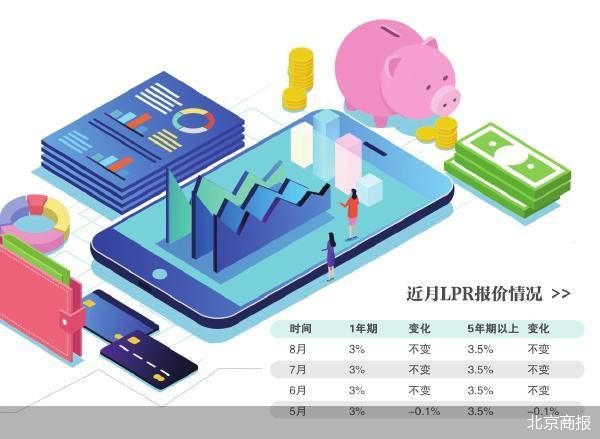
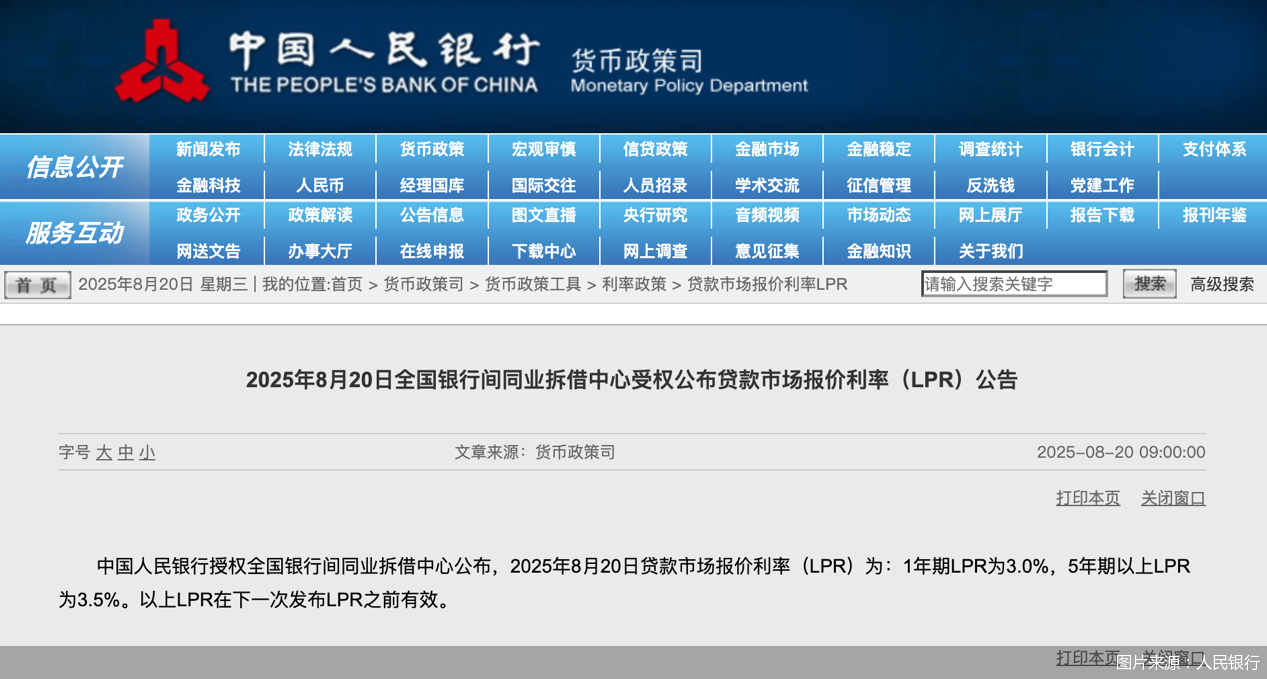
Core Viewpoint - The latest LPR (Loan Prime Rate) quotes remain unchanged, with the 1-year rate at 3% and the 5-year rate at 3.5%, reflecting stability in monetary policy and market conditions [1][3][4] LPR Stability - The LPR has remained unchanged for three consecutive months, primarily due to stable policy rates and rising market interest rates, which limit banks' motivation to lower LPR quotes [3][4] - The current LPR quotes are influenced by the unchanged 7-day reverse repo rate of 1.4% and a lack of significant downward movement in MLF rates [4][6] Bank Profitability and LPR Adjustment - Commercial banks are facing historical low net interest margins, with the latest figure at 1.42%, which has decreased by 0.01 percentage points from the previous quarter, indicating pressure on profitability [3][6] - The lack of incentive for banks to lower LPR quotes is attributed to their current profitability challenges and the stable interest rate environment [4][5] Reverse Repo Operations - The People's Bank of China (PBOC) has increased the scale of reverse repo operations, conducting a net injection of 4,975 billion yuan on August 20, 2023, to support liquidity in the banking system [6][7] - The PBOC's approach aims to maintain a balance between adequate liquidity and avoiding excessive monetary easing that could lead to inflationary pressures [7][10] Future Monetary Policy Outlook - Analysts predict potential interest rate cuts and reserve requirement ratio (RRR) reductions in the fourth quarter, which could lead to lower LPR quotes and stimulate financing demand [8][9] - The focus will remain on structural monetary policy tools to direct financial resources to key sectors, with a cautious approach to overall monetary policy [9][10] Housing Market Considerations - There is an expectation for regulatory measures to further support the housing market, potentially leading to a more significant reduction in long-term LPR quotes to alleviate high mortgage rates and stimulate demand [11]
LPR连续三个月持稳 四季度仍有降息空间
Bei Jing Shang Bao· 2025-08-20 15:21
Core Viewpoint - The latest LPR (Loan Prime Rate) quotes remain unchanged, with the 1-year rate at 3.0% and the 5-year rate at 3.5%, marking three consecutive months of stability [1][3][4]. Group 1: LPR Stability - The LPR quotes for both terms remained unchanged in August, aligning with market expectations due to stable policy rates and rising market interest rates [3][4]. - The LPR has not changed since May, following a 10 basis point reduction in response to the reverse repo rate, indicating a period of observation for policy effectiveness [4]. Group 2: Banking Sector Dynamics - Commercial banks lack the motivation to lower LPR quotes due to historically low net interest margins, which stood at 1.42% in the first half of 2025, down 0.01 percentage points from the previous quarter [4][6]. - The stability of policy rates, including the 7-day reverse repo rate at 1.4%, contributes to the lack of incentive for banks to reduce LPR quotes [4][9]. Group 3: Reverse Repo Operations - The People's Bank of China (PBOC) has increased the scale of reverse repo operations, conducting a 616 billion yuan operation on August 20, maintaining the operation rate at 1.4% [6][7]. - The net injection from these operations indicates a strategy to support credit expansion for banks and manage liquidity effectively [7]. Group 4: Future Monetary Policy Outlook - Analysts predict potential interest rate cuts in the fourth quarter, which could lead to a decrease in LPR quotes, aimed at stimulating internal financing demand [8][9]. - The PBOC is expected to continue using structural monetary policy tools to guide financial resources towards key sectors, while maintaining a stable overall liquidity environment [8][9].
LPR连续三个月持稳,四季度仍有降息空间
Bei Jing Shang Bao· 2025-08-20 12:02
Core Viewpoint - The latest LPR (Loan Prime Rate) quotes remain unchanged, with the 1-year rate at 3.0% and the 5-year rate at 3.5%, marking three consecutive months of stability [1][3] Group 1: LPR Stability - The LPR quotes for both terms remained unchanged in August, aligning with market expectations due to stable policy rates and rising market interest rates [3][4] - The LPR has not changed since May, following a 10 basis point reduction in response to the reverse repurchase rate, indicating a period of observation for policy effectiveness [4] Group 2: Bank Profitability and LPR Adjustment - Commercial banks are lacking the motivation to lower LPR quotes due to historically low net interest margins, which stood at 1.42% in the first half of 2025, down 0.01 percentage points from the previous quarter [4][5] - The stability of policy rates, including the 7-day reverse repurchase rate at 1.4%, contributes to the lack of incentive for banks to reduce LPR quotes [4][6] Group 3: Reverse Repo Operations - The People's Bank of China (PBOC) has increased the scale of reverse repurchase operations, conducting a 616 billion yuan operation on August 20, maintaining the operation rate at 1.4% [6][7] - The net injection from these operations is aimed at supporting fiscal policies and facilitating credit expansion for banks, with significant government bond issuance also influencing liquidity needs [7] Group 4: Future Monetary Policy Outlook - Analysts predict potential interest rate cuts and reserve requirement ratio reductions in the fourth quarter, which could lead to lower LPR quotes, stimulating financing demand [8][9] - The PBOC is expected to maintain a stable monetary policy while utilizing structural tools to guide financial resources to key sectors, with a focus on liquidity release to meet various market demands [9][10]
热点关注 | 8月LPR报价保持不变符合市场预期,四季度初前后有可能下调
Xin Lang Cai Jing· 2025-08-20 08:46
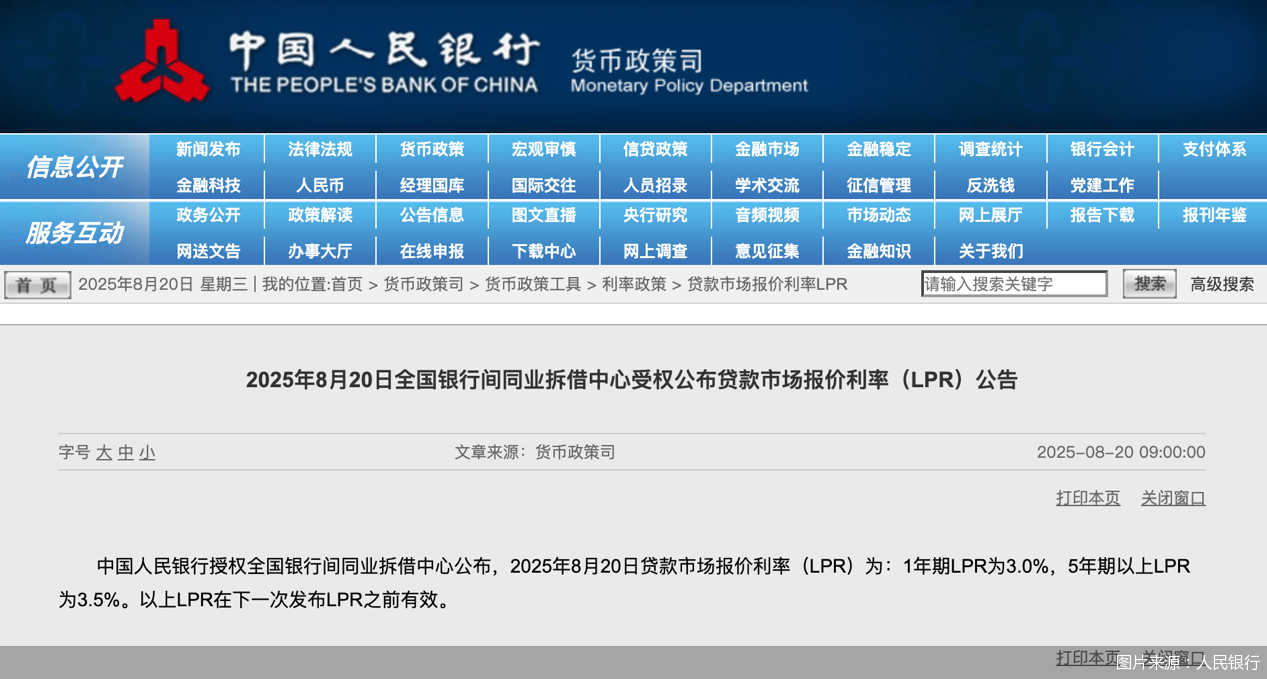
Core Viewpoint - The LPR (Loan Prime Rate) for both 1-year and 5-year terms remains unchanged at 3.0% and 3.5% respectively, aligning with market expectations and reflecting stable policy rates [1][2]. Group 1: LPR Quotation Analysis - The unchanged LPR quotations for August indicate a lack of significant changes in the pricing basis, as the central bank's 7-day reverse repurchase rate has remained stable [2]. - The continuous stability of LPR for three months is attributed to a relatively strong macroeconomic performance in the first half of the year, reducing the necessity for immediate downward adjustments [2][3]. Group 2: Future Expectations - There is potential for a downward adjustment in policy rates and LPR quotations in the fourth quarter, driven by efforts to stimulate domestic demand and stabilize the real estate market [3][4]. - The central bank may implement new rounds of interest rate cuts, which could lead to lower loan rates for businesses and households, thereby boosting internal financing demand [3]. Group 3: Real Estate Market Implications - Enhanced policies to stabilize the real estate market are anticipated, with expectations for a targeted reduction in the 5-year LPR to alleviate high mortgage rates and stimulate housing demand [4].

中国LPR连续三个月“按兵不动”
Zhong Guo Xin Wen Wang· 2025-08-20 06:38
Group 1 - The People's Bank of China (PBOC) announced that the Loan Prime Rate (LPR) for one year remains at 3.0% and for five years and above at 3.5%, unchanged for three consecutive months [1] - Analyst Pang Ming noted that the stability of the LPR aligns with market expectations, as the central bank's policy interest rates have not been adjusted since May 8, indicating a period of observation for the effects of previous financial support measures [1] - Weak credit demand from both corporate and household sectors was highlighted, suggesting that maintaining the current LPR can better support the implementation of upcoming policies aimed at stabilizing the real estate market [1] Group 2 - Chief Macro Analyst Wang Qing indicated that the LPR's stability is due to a relatively strong macroeconomic performance in the first half of the year, reducing the immediate need for a downward adjustment [1] - Wang Qing also mentioned that future economic data may show a decline, and there is potential for a decrease in policy rates and LPR in the fourth quarter to support domestic demand and stabilize the real estate market [2]