非税收入

Search documents
全国财政收入增速由负转正
第一财经· 2025-08-19 13:12
Core Viewpoint - The article highlights that the national narrow fiscal revenue growth has turned positive, reflecting a stable improvement in the economy [3][4]. Fiscal Revenue Overview - In the first seven months of this year, the national general public budget revenue reached 135,839 billion yuan, with a year-on-year growth of 0.1% [3]. - The revenue growth rate has shown a decline this year, but the rate of decline is gradually narrowing, with July's revenue growth reaching a new high of 2.6% [3][4]. Tax Revenue Analysis - National tax revenue for the first seven months was 110,933 billion yuan, a year-on-year decrease of 0.3%, but the decline is narrowing [4]. - In July, tax revenue was 18,018 billion yuan, showing a year-on-year increase of 5%, marking a continuous recovery since April [4]. - The overall tax revenue growth rate remains lower than the economic growth rate, which was 5.3% in the first half of the year [4]. Specific Tax Types Performance - Major tax types showed improvement: domestic value-added tax increased by 3%, domestic consumption tax by 2.1%, and personal income tax by 8.8% [5]. - Corporate income tax decreased by 0.4%, but the decline was significantly less than in the first half of the year [5]. - Land value-added tax and deed tax saw double-digit declines due to a sluggish real estate market [5]. Non-Tax Revenue Trends - Non-tax revenue for the first seven months was 24,906 billion yuan, with a year-on-year growth of 2%, significantly lower than the previous year's 12% [6]. - Government fund revenue, primarily from land sales, decreased by 0.7% to 23,124 billion yuan [7]. Fiscal Expenditure Insights - General public budget expenditure reached 160,737 billion yuan, with a year-on-year increase of 3.4%, supporting economic stability [8]. - Social security, education, and health expenditures grew by 9.8%, 5.7%, and 5.3% respectively, exceeding the average growth rate [8]. Government Fund Expenditure - Government fund budget expenditure expanded significantly to 54,287 billion yuan, a year-on-year increase of 31.7%, directed towards major project construction and new sectors [9].


一文读懂前7月财政数据:财政收入增速由负转正
Di Yi Cai Jing· 2025-08-19 10:47
Group 1 - The overall fiscal revenue is recovering, supported by increased government bond issuance, while fiscal expenditure remains robust [1][6] - In the first seven months of the year, the national general public budget revenue reached 135839 billion yuan, with a year-on-year growth of 0.1% [2] - The tax revenue for the same period was 110933 billion yuan, showing a slight decline of 0.3% year-on-year, but the decline is narrowing [2][4] Group 2 - The growth rate of tax revenue has not kept pace with economic growth, which was 5.3% in the first half of the year [2][3] - Major tax categories showed improvement, with domestic value-added tax increasing by 3%, domestic consumption tax by 2.1%, and personal income tax by 8.8% [4] - Non-tax revenue grew by 2% to 24906 billion yuan, significantly lower than the previous year's growth of 12% [5] Group 3 - Government fund budget revenue was 23124 billion yuan, down 0.7% year-on-year, with land use rights revenue declining by 4.6% [6] - Fiscal expenditure for the first seven months was 160737 billion yuan, up 3.4%, with social security and education spending growing above average [6][7] - Government fund budget expenditure surged by 31.7% to 54287 billion yuan, primarily directed towards major project construction [7]
财政部:1-7月全国一般公共预算收入135839亿元,同比增长0.1%!税收收入110933亿元,同比下降0.3%;非税收入24906亿元,同比增长2%
Ge Long Hui· 2025-08-19 08:26
Summary of Key Points Core Viewpoint - The Ministry of Finance reported that from January to July, the national general public budget revenue reached 1,358.39 billion yuan, reflecting a year-on-year growth of 0.1% [1] Revenue Breakdown - Total tax revenue amounted to 1,109.33 billion yuan, showing a year-on-year decline of 0.3% [1] - Non-tax revenue was recorded at 249.06 billion yuan, which represents a year-on-year increase of 2% [1] Central vs Local Revenue - Central government general public budget revenue was 585.38 billion yuan, indicating a year-on-year decrease of 2% [1] - Local government general public budget revenue reached 773.01 billion yuan, marking a year-on-year growth of 1.8% [1]
财政部:1—7月全国一般公共预算收入135839亿元,同比增长0.1%
Sou Hu Cai Jing· 2025-08-19 08:16
Core Insights - The Ministry of Finance reported that from January to July, the national general public budget revenue reached 135,839 billion yuan, reflecting a year-on-year growth of 0.1% [1] - Tax revenue amounted to 110,933 billion yuan, showing a year-on-year decline of 0.3%, while non-tax revenue was 24,906 billion yuan, indicating a year-on-year increase of 2% [1] - Central government budget revenue was 58,538 billion yuan, down 2% year-on-year, while local government budget revenue increased by 1.8% to 77,301 billion yuan [1]
X @外汇交易员
外汇交易员· 2025-08-19 08:08
Government Revenue - China's national general public budget revenue increased by 0.1% year-on-year to 13583.9 billion CNY from January to July [1] - National tax revenue decreased by 0.3% year-on-year to 11093.3 billion CNY from January to July [1] - Non-tax revenue increased by 2% year-on-year to 2490.6 billion CNY from January to July [1] - From January to June, national general public budget revenue decreased by 0.3% year-on-year to 11556.6 billion CNY [4] - From January to June, national tax revenue decreased by 1.2% year-on-year to 9291.5 billion CNY [4] - From January to June, non-tax revenue increased by 3.7% year-on-year to 2265.1 billion CNY [4] Specific Tax Revenue - Stamp tax increased by 20.7% year-on-year to 255.9 billion CNY from January to July, with securities transaction stamp tax increasing by 62.5% year-on-year to 93.6 billion CNY [2] - Stamp tax increased by 19.7% year-on-year to 195.3 billion CNY from January to June, with securities transaction stamp tax increasing by 54.1% year-on-year to 78.5 billion CNY [5] Land Revenue - Revenue from the transfer of state-owned land use rights decreased by 4.6% year-on-year to 1695 billion CNY from January to July [3] - Revenue from the transfer of state-owned land use rights decreased by 6.5% year-on-year to 1427.1 billion CNY from January to June [6] Government Expenditure - National general public budget expenditure increased by 3.4% year-on-year to 16073.7 billion CNY from January to July [3] - Expenditure on social security and employment increased by 9.8% year-on-year to 2762.1 billion CNY from January to July [3]
财政收入延续增长凸显我国经济韧性
Jin Rong Shi Bao· 2025-08-08 07:59
财政部近日发布的数据显示,今年前4个月,全国一般公共预算收入80616亿元,同比下降0.4%, 降幅较一季度收窄0.7个百分点;全国一般公共预算支出93581亿元,同比增长4.6%,完成预算的 31.5%,支出进度为2020年以来同期最快。 1至4月,全国非税收入15060亿元,同比增长7.7%,主要是多渠道盘活资产等带动。4月份,非税 收入增速进一步降至1.7%。对此,温彬表示,今年以来,非税收入增速持续放缓,主要是随着化债资 金落实到位,地方政府财政状况有所好转,对资产盘活的依赖度下降。 国盛证券首席经济学家熊园表示,4月份,一般财政收入增速进一步抬升,税收收入增速由负转 正,四大税种中个税收入改善是主要支撑,其余税种走弱,可能与入库节奏有关。另外,国有资产盘活 较难持续,非税收入增速为去年3月份以来最低水平。 具体到4月份,一般公共预算收入同比增长1.9%,增速较上月加快1.6个百分点。其中,税收收入增 速加快4.1个百分点至1.9%,非税收入增速放缓4.3个百分点至1.7%;一般公共预算支出同比增长5.8%, 增速较上月加快0.1百分点。 中央财经大学教授温来成在接受《金融时报》记者采访时表示,今年前 ...

上半年财政收入数据的几个不寻常
Sou Hu Cai Jing· 2025-07-30 05:16
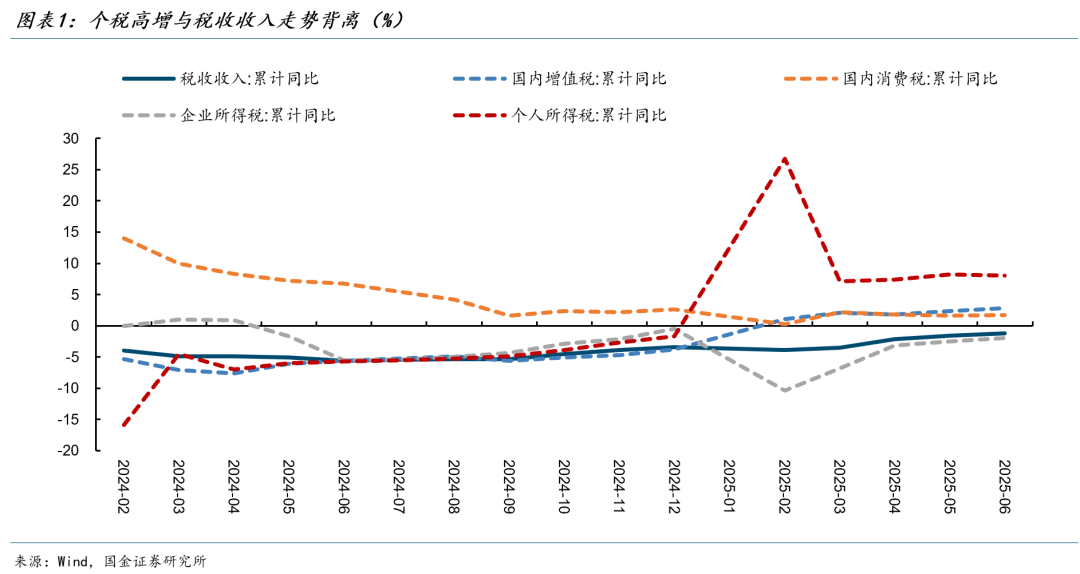
Group 1 - The core viewpoint of the articles highlights the significant increase in individual income tax (IIT) revenue, which is primarily attributed to improved tax collection efficiency and enforcement, rather than an increase in residents' disposable income [1][5][10] - In the first half of the year, individual income tax revenue grew by 8% year-on-year, while urban residents' per capita disposable income only increased by 4.7%, indicating a disparity between income growth and tax revenue [5][10] - The increase in individual income tax is mainly driven by high-income earners, with those earning over 1 million yuan annually contributing over 50% of the total IIT revenue, despite representing only 1% of the total filers [5][10] Group 2 - The divergence between value-added tax (VAT) and corporate income tax (CIT) is notable, with VAT revenue increasing by 2.8% while CIT revenue decreased by 1.9% in the first half of the year [12][13] - This divergence is attributed to "involution" competition leading to increased revenue without corresponding profit growth, as well as one-time factors affecting CIT collection early in the year [12][13] - The overall corporate income tax revenue was negatively impacted by a reduction in tax payments from central financial enterprises, which accounted for a significant portion of the decline [13] Group 3 - Non-tax revenue experienced a decline, with a year-on-year growth of only 3.7% in the first half of the year, and a negative growth rate observed since May [17][18] - The slowdown in non-tax revenue growth is linked to diminishing support from the monetization of state-owned assets and improvements in the business environment leading to reduced administrative fees and penalties [17][18] - The revenue from state-owned resource asset usage, which constitutes a significant portion of non-tax revenue, is expected to face challenges as easily monetizable assets have already been utilized [18]
上半年财政收入数据的几个不寻常(国金宏观张馨月)
雪涛宏观笔记· 2025-07-30 01:55
Group 1 - The core viewpoint of the article highlights that the significant increase in individual income tax (IIT) is primarily due to improved tax collection efficiency and enforcement, while the divergence between value-added tax (VAT) and corporate income tax (CIT) is mainly influenced by one-time factors at the beginning of the year. Additionally, the negative shift in non-tax revenue reflects improvements in the business environment [1][3][11]. Group 2 - In the first half of the year, national tax revenue reached 9.29 trillion yuan, showing a year-on-year decline of 1.2%, with VAT, CIT, and consumption tax growth rates at 2.8%, -1.9%, and 1.7% respectively. Despite weak growth in overall tax revenue, IIT saw a notable increase of 8% year-on-year [3][6]. - The growth in IIT is not aligned with improvements in residents' disposable income, which only increased by 4.7%. High-income earners contribute significantly to IIT, with those earning over 1 million yuan accounting for over 50% of the total IIT collected [6][10]. - The increase in IIT is attributed to several factors, including the full implementation of the "Golden Tax" Phase IV, which enhances tax collection efficiency through data integration and analysis, and the implementation of the Common Reporting Standard (CRS) for overseas income reporting [8][10]. - The rise in stock transfers and employee stock incentives, particularly in high-income cities like Beijing and Shanghai, has also contributed to the increase in IIT. In the first half of the year, Beijing's IIT revenue grew by 7.8% [10]. - The growth in dividend income from listed companies, with a total dividend payout of nearly 2.4 trillion yuan, has further supported the increase in IIT [10]. Group 3 - The divergence between VAT and CIT is unusual, with VAT growing by 2.8% while CIT declined by 1.9%. This divergence is attributed to "involution" competition leading to increased revenue without corresponding profit growth, as well as one-time factors affecting CIT collection early in the year [11][12]. - The decline in non-tax revenue, which reached 2.27 trillion yuan with a year-on-year growth of only 3.7%, is primarily due to reduced support from the monetization of state-owned assets and improvements in the business environment leading to lower administrative fees and penalties [15][16][17].

2025年6月财政数据点评:如何看待上半年财政形势?
EBSCN· 2025-07-27 12:36
Revenue Analysis - The cumulative year-on-year growth rate of national general public budget revenue from January to June 2025 is -0.3%, unchanged from the previous value[1] - The cumulative year-on-year growth rate of general public budget expenditure is +3.4%, down from +4.2%[1] - Government fund budget revenue shows a cumulative year-on-year growth rate of -2.4%, improving from -6.9% previously[1] Tax Revenue Insights - In June, tax revenue shows a year-on-year growth of +1.04%, an improvement compared to May[3] - The domestic consumption tax in June increased by +1.96%, while the vehicle purchase tax rose by +5.99%, indicating a positive contribution from automotive consumption[4] - The corporate income tax grew by +2.73%, reflecting a low base effect, but remains lower than the growth rate of value-added tax[4] Government Fund Performance - Government fund budget revenue in June increased significantly by +20.8%, recovering from -8.1% the previous month, driven by land sales[25] - The expenditure of government funds in June surged by +79.2%, compared to +8.8% in the previous month, with land-related expenditures showing a year-on-year growth of +5.9%[25] Expenditure Trends - General public budget expenditure growth in June is +0.38%, a decrease of 2.25 percentage points from the previous month[15] - Infrastructure-related expenditure in June fell by -8.80%, while social security and health expenditures also saw declines[15] - The completion rate for general public budget revenue from January to June is 48.8%, lower than the average of the past five years[15]
【广发宏观吴棋滢】6月财政数据简评
郭磊宏观茶座· 2025-07-26 11:34
Core Viewpoint - The overall performance of public finance in the first half of 2025 is stable, with a slight decline in revenue growth, indicating the need for continued improvement in tax and government fund income through PPI and land market enhancements [5][23]. Group 1: Public Finance Revenue - In the first half of 2025, public finance revenue showed a cumulative year-on-year decline of 0.3%, slightly lower than the previous year's growth of 1.3% [1][6]. - Tax revenue decreased by 1.2% year-on-year, an improvement compared to last year's decline of 3.4%, while non-tax revenue growth significantly slowed from 25.4% last year to 3.7% this year [1][8]. - The decline in non-tax revenue is attributed to a high base last year and a reduced reliance on non-tax income by the government [1][6]. Group 2: Monthly Performance - In June, tax revenue increased by 1.0% year-on-year, slightly higher than the previous value, while non-tax revenue fell by 3.7%, indicating an expanded decline [2][9]. - Domestic value-added tax and corporate income tax recorded year-on-year increases of 5.0% and 2.7%, respectively, contributing positively to June's fiscal revenue growth [2][11]. - The equipment manufacturing industry, modern services, and cultural sports entertainment sectors showed strong tax performance, reflecting the economic recovery in these areas [2][11]. Group 3: Fiscal Expenditure - Narrow fiscal expenditure in June saw a year-on-year decline of 0.4%, down from 2.6% previously, influenced by a decrease in non-tax revenue and a lull in infrastructure funding [3][12]. - Technology spending led the expenditure categories with an 18.1% year-on-year increase, while infrastructure-related expenditures showed weak performance, particularly in transportation and agriculture [3][14]. - The overall expenditure progress for the first half of the year was at 47.6%, indicating a slower pace compared to previous years, with expectations for acceleration in the second half [3][13]. Group 4: Government Fund Income - Government fund income in the first half of 2025 decreased by 2.4% year-on-year, primarily due to continued weakness in the land market, with land transfer income down 6.5% [4][19]. - In June, government fund budget revenue surged by 20.8%, marking a significant increase, although July data showed a notable decline, raising questions about the sustainability of this recovery [4][19]. - Government fund budget expenditure rose sharply by 79.2% year-on-year, largely driven by the issuance of special bonds, indicating a significant increase in overall fiscal spending [4][20].