
AI药物研发

Search documents
谷歌"全栈"反击,强势夺回AI主导权!
美股IPO· 2025-11-25 10:17
Core Viewpoint - Huatai Securities believes that Google is making a strong comeback with its self-developed TPU v7p chip and the Gemini model, establishing a full-stack AI ecosystem that enhances its competitive position in the market [1][3]. Cloud Business Growth - The TPU has driven a 34% growth in Google's cloud business, second only to Azure, with cloud revenue reaching $15.2 billion in Q3 [8]. - Google's cloud market share increased from 18.6% to 19.3% year-over-year, showcasing its competitive edge against AWS and Oracle [8]. AI Ecosystem and User Engagement - Google is building a self-sufficient ecosystem from chip (TPU v7p) to model (Gemini 3.0) to applications (search and Waymo), which is expected to translate into financial returns [3]. - Gemini has reached 650 million monthly active users, and the AI Overviews service has served over 2 billion users, indicating strong user engagement [11]. Search and Advertising Strength - Google's search market share has rebounded to over 90%, supported by robust advertising cash flow that funds AI investments [10][13]. - The advertising business, empowered by Gemini, shows strong monetization potential, providing a stable cash flow for ongoing capital expenditures [13]. Technological Advancements - The TPU v7p chip, with an FP8 computing power of 4.5 PF, directly competes with Nvidia's B300 chip, showcasing Google's technological leadership [7]. - Google has initiated TPU deployment to third-party cloud service providers, opening new growth avenues [7]. Future Projections - Huatai Securities has raised Google's target price to $380, indicating over an 18% upside potential, corresponding to a 30x PE ratio for 2026 [4][15]. - Revenue forecasts for Google have been adjusted upwards, with expected revenue of approximately $405.2 billion in 2025 and net profit of $131.5 billion [14].



以“创新+国际化”双引擎 开启中国药企进阶新篇章
Zheng Quan Shi Bao· 2025-11-24 00:21
Core Insights - The Chinese pharmaceutical industry is transitioning from "generic following" to "innovation leading," with 704 original innovative drugs expected from Chinese companies in 2024, ranking first globally [2][3] - Zhang Yingjun, Chairman of Dongyangguang Pharmaceutical, emphasizes that the industry is entering a "golden decade" driven by innovation and internationalization, supported by continuous policy empowerment [2][3] Industry Overview - The Chinese pharmaceutical sector is experiencing a strategic opportunity period centered on innovation and internationalization, particularly after the implementation of the "7.22" clinical data verification policy [2] - The full-chain support system for the pharmaceutical industry is being established, with innovative drugs consistently included in government work reports [2] Company Strategy - Dongyangguang Pharmaceutical is committed to source innovation, with a research pipeline covering various technologies such as small molecules, antibodies, small nucleic acids, ADCs, and cell therapies [2][3] - The company's research strategy has shifted from "Me-too" and "Fast-follow" to pursuing "BIC (Best in Class)" and "FIC (First in Class)" [2] Research and Development - Dongyangguang Pharmaceutical has nearly 50 research pipelines, with over 10 in registration or key clinical stages, showcasing potential products like the functional cure for hepatitis B and new drugs for IPF [3] - The company has developed six AI models to enhance drug discovery capabilities, with the first AI-driven small molecule drug entering clinical trials, showing promising initial data [3] Internationalization Efforts - The company's international strategy includes a diversified approach, such as "License-out" agreements and promoting self-developed products in Europe and the U.S., with the expectation of launching insulin glargine in the U.S. by Q1 2026 [4] - Dongyangguang Pharmaceutical has established a global sales network, with over 60 overseas formulations approved and leading market share in certain products [4] Future Outlook - The company aims to become a leading comprehensive pharmaceutical company through innovation, internationalization, and sustainability, targeting over 20 billion yuan in revenue and 5 billion yuan in profit within five years [4] - The progression of Chinese pharmaceutical companies is fundamentally about the global recognition and validation of innovative value, with Dongyangguang Pharmaceutical actively participating in this historical process [4]
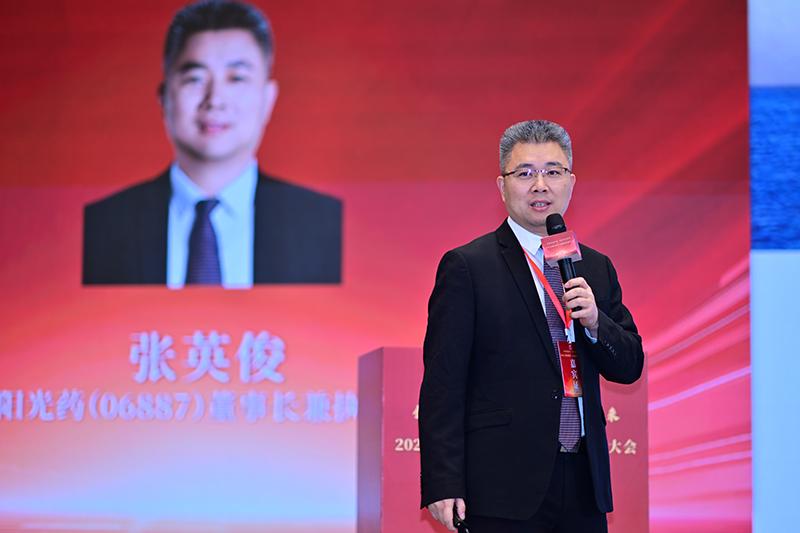
东阳光药董事长张英俊: 以“创新+国际化”双引擎开启中国药企进阶新篇章
Zheng Quan Shi Bao· 2025-11-23 21:51
Core Insights - The Chinese pharmaceutical industry is transitioning from "generic following" to "innovation leading," with 704 original innovative drugs expected from Chinese companies in 2024, ranking first globally [2] - The chairman of Dongyang Sunshine Pharmaceutical, Zhang Yingjun, emphasizes that the industry is entering a "golden decade" driven by innovation and internationalization, supported by favorable policies [2][3] - Dongyang Sunshine is focusing on source innovation, with a diverse R&D pipeline that includes small molecules, antibodies, small nucleic acids, ADCs, and cell therapies [2][3] Industry Trends - The Chinese pharmaceutical sector is experiencing a strategic opportunity period centered on innovation and internationalization, as highlighted by Zhang Yingjun at the 2025 Greater Bay Area Technology and Financial Innovation Development Conference [2] - The industry is benefiting from a supportive policy environment, including integration into ICH and continuous inclusion of innovative drugs in government work reports [2] Company Strategy - Dongyang Sunshine has shifted its R&D strategy from "Me-too" and "Fast-follow" to pursuing "BIC" (Best-in-Class) and "FIC" (First-in-Class) drugs [2] - The company currently has nearly 50 projects in the pipeline, with over 10 in registration or key clinical stages, showcasing differentiated advantages and international competitiveness [2] Technological Innovation - The company is leveraging AI technology, having developed six AI models for drug discovery, with its first AI-driven small molecule drug, HEC169584, entering clinical trials [3] - Dongyang Sunshine has established multiple core technology platforms to address significant unmet clinical needs, such as solid tumor treatment and hepatitis B cure [3] Internationalization Efforts - The internationalization strategy of Dongyang Sunshine is multifaceted, involving "License-out" agreements and plans for self-marketing products in Europe and the U.S. [3] - The company aims to have its insulin product approved in the U.S. by Q1 2026, potentially becoming the first domestically produced insulin to enter the U.S. market [3] Future Goals - Dongyang Sunshine aims to become a leading comprehensive pharmaceutical company focused on "innovation + internationalization + sustainability," targeting over 20 billion yuan in revenue and 5 billion yuan in profit within five years [4] - The company plans to launch over 10 new products and achieve more than five global collaborations in the same timeframe [4] Industry Perspective - Zhang Yingjun states that the advancement of Chinese pharmaceutical companies is fundamentally about the global recognition and validation of innovative value [5] - The company is actively participating in and leading this historic process through its dual focus on innovation and internationalization [5]

东阳光药董事长张英俊: 以“创新+国际化”双引擎 开启中国药企进阶新篇章
Zheng Quan Shi Bao· 2025-11-23 21:38
Industry Overview - The Chinese pharmaceutical industry is transitioning from "generic following" to "innovation leading," with 704 original innovative drugs expected from Chinese companies in 2024, ranking first globally [1] - The industry is entering a "golden decade" following the new clinical data verification policy implemented on July 22, with continuous policy support fostering a comprehensive support system for the pharmaceutical sector [1] Company Strategy - Dongyangguang Pharmaceutical is focusing on source innovation, with a research pipeline that includes small molecules, antibodies, small nucleic acids, ADCs, and cell therapies [1] - The company's R&D strategy has shifted from "Me-too" and "Fast-follow" to pursuing "BIC" (Best-in-Class) and "FIC" (First-in-Class) [1] - Dongyangguang currently has nearly 50 research pipelines, with over 10 in registration or key clinical stages, showcasing differentiated advantages and international competitiveness in products like the hepatitis B functional cure drug and new IPF drug [1] Technological Innovation - The company is leveraging the AI revolution by developing six AI models that enable a full-chain drug discovery capability, with the first AI-driven small molecule drug entering clinical trials [2] - Dongyangguang has established multiple core technology platforms, focusing on addressing significant unmet clinical needs such as solid tumor treatment and hepatitis B cure [2] Internationalization Strategy - The internationalization strategy of Dongyangguang is diversified, involving "License-out" agreements for overseas rights and promoting self-developed products in Europe and the U.S. [2] - The company anticipates that its insulin product will be approved in the U.S. by Q1 2026, potentially becoming the first domestically produced insulin to enter the U.S. market [2] - Dongyangguang has built a global sales network, with over 60 approved overseas formulations and a leading market share for azithromycin tablets in Germany [2] Future Outlook - The company aims to become a leading comprehensive pharmaceutical company through innovation, internationalization, and sustainability, targeting over 20 billion yuan in revenue and 5 billion yuan in profit within five years [3] - Dongyangguang plans to launch over 10 new products and achieve more than five global collaborations in the same timeframe [3] - The progression of Chinese pharmaceutical companies is fundamentally about the global recognition and validation of innovation value [3]
和铂医药20251117
2025-11-18 01:15
Summary of Conference Call Notes Company and Industry Overview - **Company**: 和铂医药 (HaploMed) and its subsidiary 诺纳生物 (Nona Bio) - **Industry**: Biopharmaceuticals, focusing on innovative drug development and clinical research Key Points and Arguments Nona Bio's Strategic Positioning - Nona Bio aims to provide integrated delivery services, differentiating itself from traditional CROs by offering comprehensive solutions rather than fragmented services [2][5] - The company has four key technology platforms: 1. HMI humanized transgenic mouse platform 2. ADC/RDC/AOC delivery systems 3. Novel in vivo CAR systems 4. AI research platform [2][6] Future Expansion Plans - Nona Bio plans to expand from the Discovery phase to CMC and clinical concept validation stages over the next three years [3][8] - Collaborations with top GLP and CDMO companies are intended to enhance capabilities in GLP and high-end formulation development [3][8] AI Integration in Drug Development - AI is a crucial part of Nona Bio's strategy, with plans to establish an AI innovation center in Shanghai to enhance drug discovery efficiency [7][10] - The company aims to utilize accumulated high-quality data to improve antibody discovery processes [7][10] Clinical Development of 4,003 Project - The 4,003 project, a Treg cell-clearing therapy, has shown significant efficacy in preclinical studies, demonstrating a potency 100 times greater than the control group [2][21] - In clinical trials for MSS colorectal cancer, the objective response rate (ORR) was 34.8%, with a 12-month overall survival (OS) rate of 84% [3][22] Market Potential and Unmet Needs - Colorectal cancer (CRC) represents a significant market opportunity, with approximately 1.9 million new cases globally each year, and 95% of patients being MSS CRC [33][34] - The 4,003 project addresses unmet needs in MSS CRC, where current treatments are limited [22][34] Safety and Efficacy of 4,003 - The safety profile of 4,003 is comparable to existing checkpoint inhibitors, with manageable adverse events primarily at grade 1 or 2 [23][24] - The project is positioned to explore further indications beyond colorectal cancer, maximizing its therapeutic potential [25][26] Competitive Landscape - Nona Bio's 4,003 project is distinct from traditional CTLA-4 therapies, focusing on Treg cell clearance rather than blocking CTLA-4 function [27][28] - The company is actively seeking partnerships to enhance the development and commercialization of HBM 403, retaining rights in key markets like China [29] Financial Projections - Nona Bio aims to achieve normalized revenue of 1 billion RMB by 2028, with projected growth rates of 50%-80% in 2026-2027 [12][19] Workforce Expansion - The company plans to double its workforce by 2026 and again by 2028 to support business growth [16] Additional Important Insights - Nona Bio's unique advantage lies in its ability to generate high-quality data through its proprietary platforms, enhancing AI model training and drug discovery efficiency [14][15] - The company does not currently have plans for a separate IPO and focuses on its core competencies in preclinical stages [35][36]
IPO周报 | 摩尔线程启动科创板IPO发行;宇树科技完成A股上市辅导
Sou Hu Cai Jing· 2025-11-16 17:34
Group 1: IPO Developments - Moer Technology has officially launched its IPO process on the Sci-Tech Innovation Board, with plans to issue shares on November 24, 2023, marking the emergence of China's first domestic GPU stock [2] - The company focuses on the independent research and development of full-function GPUs and has achieved significant technological breakthroughs in AI computing acceleration and graphics rendering [2][3] - Yushu Technology has completed its domestic listing guidance and will soon submit its prospectus, specializing in high-performance robots and robotic components [4][5] Group 2: Company Performance and Market Position - Moer Technology has released four generations of GPU architecture chips since 2021, with products achieving performance levels comparable to international standards, such as the MTT S80 graphics card nearing the performance of NVIDIA's RTX 3060 [3] - Yushu Technology's revenue structure indicates that approximately 65% of sales come from quadruped robots, with a strong focus on research and education applications [5] - Tuda Technology has become the first global supplier to achieve mass production of automotive-grade LiDAR solutions, delivering over 181,131 units in the first three quarters of the year, reflecting a 7.7% year-on-year growth [6] Group 3: Financial Data and Growth - Insilico Medicine has reported revenue growth from $30.15 million in 2022 to an estimated $85.83 million in 2024, with a significant improvement in gross margin from 63.4% to 90.4% over the same period [8] - The company has narrowed its net loss from $222 million in 2022 to $17.1 million in 2024, indicating a dual-engine business model's effectiveness [8] - Tuda Technology has achieved a gross margin of 12.9% in the first five months of the year, with expectations of positive gross margins for four consecutive quarters starting from Q4 2024 [6]
高交会院士论坛举办 名家热议生物医药创新浪潮
Zhong Guo Xin Wen Wang· 2025-11-16 05:26
中新网深圳11月16日电 (记者索有为)正在举行的第二十七届中国国际高新技术成果交易会(简称"高交 会")上,高交会院士论坛——深圳创新药发展论坛暨重大项目签约活动举办,汇聚多位海内外院士、产 业领袖及创投精英等家热议生物医药创新浪潮。 此次论坛以"AI赋能向新而行"为主题,由深圳理工大学主办。深圳理工大学党委书记朱迪俭表示,作为 一所新型研究型大学,深圳理工大学正打通从基础研究到产业转化的全链条,也让拔尖创新人才加速成 长,该校将持续以科学家精神与特区精神为引领,在学科交叉中突破创新,在产教融合中赋能产业,为 大湾区国际科技创新中心建设与人类健康事业贡献坚实力量。 深圳市发展和改革委员会党组书记、主任郭子平表示,深圳持续推动生物医药产业高质量发展,不仅成 立市级药械产业办公室、出台系列支持政策,还建设了深圳医学科学院,布局多个国家级平台,设立超 百亿元产业基金,发力AI药物研发等新赛道。 论坛上,深圳理工大学围绕科研协作、人才培养等方面与深圳层次智慧生物、宁波酶赛生物、南京汉卫 公共卫生研究院、内蒙古自治区第四医院、深圳市百盈慈善基金会等企业、医疗机构、基金会完成8个 重大项目签约,以城校共融、开放办学等举 ...
Recursion Pharmaceuticals (NasdaqGS:RXRX) FY Conference Transcript
2025-11-11 14:02
Recursion Pharmaceuticals FY Conference Summary Company Overview - **Company**: Recursion Pharmaceuticals (NasdaqGS:RXRX) - **Event**: Second annual Guggenheim Healthcare Innovation Conference - **Date**: November 11, 2025 - **Key Speakers**: Najat Khan (incoming CEO), Ben Taylor (CFO) Key Points Leadership Transition - Najat Khan will take over as CEO starting January 1, 2026, marking a planned transition to enhance company leadership continuity [2][3] - Chris, the outgoing CEO, will remain on the board as chair and serve as an executive advisor [2] Strategic Focus and Evolution - The company is transitioning from exploring AI's potential in drug discovery to demonstrating proof of impact [2][4] - Emphasis on increasing shareholder value and patient impact through a strengthened pipeline and strategic partnerships [5][6] Partnerships and Collaborations - Significant partnerships with Roche and Sanofi, with milestones worth approximately $300 million per program [5][6] - Collaboration with MIT and use of advanced supercomputing capabilities to enhance data analysis [9][10] - Over $500 million in partnership inflows, indicating strong investor interest and validation of the platform [12][13] Pipeline and Therapeutic Areas - Focus on four therapeutic areas: oncology, rare diseases, neuroscience, and gastrointestinal oncology [24] - Intentional targeting of novel and challenging drug targets in oncology, including RBM39 and CDK7 [25][26] - Development of a comprehensive clinical development platform for patient selection and trial acceleration [27] CDK7 Inhibitor Development - CDK7 inhibitors show manageable gastrointestinal toxicity with a 7% discontinuation rate and no severe adverse events [29] - Early signs of efficacy observed in monotherapy, with ongoing combination studies in ovarian cancer [31] Financial Position and Future Outlook - Cash position reported at nearly $800 million, sufficient to fund operations through year-end 2027 without additional financing [41] - Anticipation of at least $100 million in partner inflows by year-end 2026, with multiple clinical milestones expected [42][43] Integration with Exscientia - Successful integration of technology platforms with a focus on operational efficiency, achieving a 35% reduction in expenses [17][18] - Retention of cultural and operational capabilities from both legacy companies [19][20] Upcoming Milestones - Key upcoming events include data readouts for the FAP program, which has shown significant polyp burden reduction in trials [36][43] - Continued focus on rapid decision-making regarding pipeline programs to optimize capital allocation [43] Conclusion Recursion Pharmaceuticals is positioned for growth with a strong leadership transition, strategic partnerships, and a robust pipeline focused on innovative therapeutic areas. The company aims to leverage its AI-driven platform to deliver differentiated therapeutics while maintaining a solid financial foundation.

晶泰控股高开近4% 晶泰AI平台成功开发生发“双子星”新分子 获得关键国际认证
Zhi Tong Cai Jing· 2025-11-11 01:33
Core Viewpoint - Jingtai Holdings (02228) has successfully developed and validated two innovative topical active ingredients for hair loss prevention and growth, leveraging its industry-leading AI molecular discovery platform, marking its entry into the consumer health sector [1] Group 1: Product Development - The two active ingredients developed are small molecule Remeanagen (XTP-118) and peptide AquaKine (XTP-016), both of which have successfully passed the INCI registration in the United States [1] - The combined formulation product Groland has also received FDA registration, indicating regulatory approval for market entry [1] Group 2: Strategic Partnerships - Jingtai's wholly-owned subsidiary Ailux has entered into a multi-target strategic cooperation and platform licensing agreement with Eli Lilly, with a total agreement value of up to $345 million, including several million dollars in upfront payments and milestone payments [1] - This partnership aims to accelerate the discovery and development of bispecific antibodies across multiple therapeutic areas, utilizing Ailux's proprietary platform and AI antibody research capabilities [1] - This collaboration follows a previous $250 million agreement between Jingtai Technology and Eli Lilly for AI small molecule drug development [1]
恒瑞医药(600276):“创新+出海”快速推动全球化
Xin Lang Cai Jing· 2025-11-10 06:30
Core Viewpoint - The company's performance is driven by the high-quality growth from innovative drug releases and accelerated overseas expansion, achieving a revenue of 23.188 billion yuan in the first three quarters of 2025, a year-on-year increase of 14.85%, and a net profit attributable to the parent company of 5.751 billion yuan, up 24.50% year-on-year [1] Group 1: Financial Performance - In Q3 alone, the company achieved a revenue of 7.427 billion yuan, a year-on-year increase of 12.72%, with a net profit of 1.301 billion yuan, up 9.53% year-on-year [1] - The high-speed growth in performance is attributed to two main factors: continuous realization of innovative drug research results and accelerated external licensing cooperation, contributing to upfront payments and milestone revenues [1] Group 2: Innovation Pipeline - The company continues to strengthen growth driven by innovation, with the approval of the first domestic EZH2 inhibitor and the first self-developed oral triple compound for diabetes in Q3, which will accelerate sales potential as these products are launched [1] - A total of 13 new drug applications were accepted by NMPA in the first three quarters, with 8 applications in Q3, including significant progress on the GLP-1/GIP dual-target weight loss drug HRS9531 [1] - The company is enhancing its research pipeline across various therapeutic areas, including oncology, metabolic and cardiovascular diseases, immune and respiratory diseases, and neuroscience [1] Group 3: Business Development and Collaborations - The company is accelerating its global presence through business development (BD) transactions and self-research overseas, with over 800 million USD in overseas licensing upfront payments in the first three quarters [2] - In Q3, the company secured three external licensing agreements, including a 500 million USD upfront payment with GSK for 12 innovative drugs, and additional agreements with Glenmark and BraveheartBio totaling 180 million and 65 million USD upfront payments, respectively [2] - The strong independent research and development capabilities position the company to lead the wave of domestic innovative drugs going overseas [2] Group 4: Earnings Forecast and Investment Recommendations - Due to the continuous overseas expansion of innovative drugs and exceeding expectations in licensing income, the company's EPS forecasts for 2025-2027 have been raised to 1.32, 1.51, and 1.72 yuan, respectively [3] - Based on the PE valuation method and comparable company valuation levels, a target price of 78.52 yuan is set for 2026, maintaining a "buy" rating [3]
