
PMI

Search documents
Democrats Threaten US Shutdown After Latest Minneapolis Killing | Daybreak Europe 01/26/2026
Bloomberg Television· 2026-01-26 08:56
>> LIVE FROM LONDON, THIS IS "BLOOMBERG DAYBREAK: EUROPE." ALL NECESSARY MEASURES. THE YEN EXTENDS GAINS AFTER JAPAN'S PRIME MINISTER SAYS THE GOVERNMENT STANDS READY TO STOP THE CURRENCY SLIDE WITH SIGNS OF POSSIBLE BACKING FROM THE UNITED STATES. GOLD BREAKS ABOVE THE $5,000 ANNOUNCE LEVEL FOR THE FIRST TIME AS GEOPOLITICAL UNCERTAINTY FUELS INVESTOR FLIGHT FROM SOVEREIGN BONDS OUT OF THE DOLLAR.PLUS, DEMOCRATS THREATENED TO BLOCK A SPENDING PASSAGE AMONG ESCALATING TENSIONS IN MINNESOTA, RISKING A PARTIA ...


期货市场交易指引2026年01月26日-20260126
Chang Jiang Qi Huo· 2026-01-26 02:44
期货市场交易指引 2026 年 01 月 26 日 | | 宏观金融 | | --- | --- | | ◆股指: | 中长期看好,逢低做多 | | ◆国债: | 震荡运行 | | | 黑色建材 | | ◆焦煤: | 短线交易 | | ◆螺纹钢: | 区间交易 | | ◆玻璃: | 观望 | | | 有色金属 | | ◆铜: | 观望或轻仓滚动持多 | | ◆铝: | 建议加强观望 | | ◆镍: | 建议观望 | | ◆锡: | 区间交易或前期多单止盈 | | ◆黄金: | 区间交易 | | ◆白银: | 偏强运行 | | ◆碳酸锂: | 区间震荡 | | | 能源化工 | | ◆PVC: | 区间交易 | | ◆烧碱: | 暂时观望 | | ◆纯碱: | 暂时观望 | | ◆苯乙烯: | 区间交易 | | ◆橡胶: | 区间交易 | | ◆尿素: | 区间交易 | | ◆甲醇: | 区间交易 | | ◆聚烯烃: | 偏弱震荡 | | | 棉纺产业链 | | ◆棉花棉纱: | 震荡调整 | | ◆苹果: | 震荡偏弱 | | ◆红枣: | 震荡偏弱 | | | 农业畜牧 | | ◆生猪: | 反弹滚动空机会 ...
【每周经济观察】:法国制造业PMI升至近四年新高——海外周报第124期-20260125
Huachuang Securities· 2026-01-25 10:09
宏观研究 证 券 研 究 报 告 【每周经济观察】 法国制造业 PMI 升至近四年新高——海外 周报第 124 期 ❖ 核心观点: 1、重要数据回顾:①美国 1 月标普全球制造业 PMI 回升,第三季度实际 GDP 环比折年率终值为 4.4%,ADP 周度新增就业人数下滑。②日本 12 月出口增 速不及预期。③欧元区 1 月 ZEW 经济景气指数回升,1 月制造业 PMI 初值 回升,法国制造业 PMI 升至近四年新高的 51。 2、美国基本面高频:①景气上行的有:地产(房贷申请数量继续回升)、物价 (大宗价格回升、美国汽油零售价回升)、就业(续请失业金回落)。②景气下 行的有:WEI 指数(经济景气下行)、消费(红皮书商业零售同比边际回落)、 就业(初请失业金人数回升)。 3、美国流动性高频:①美国和欧元区金融条件收紧。②离岸美元流动性:日 元兑美元流动性改善,欧元兑美元流动性恶化。 ❖ 一、过去一周重要数据回顾 美国经济活动指数回落。1 月 17 日当周,美国 WEI 指数升至 2.34%,上周为 2.4 。 上周为-0.03%。 ❖ 三、需求 1、美国红皮书商业零售同比增速边际回落。1 月 16 日当周 ...
下周影响市场重要资讯前瞻:将有3只新股发行 1月PMI数据将公布 这些投资机会靠谱
Xin Lang Cai Jing· 2026-01-25 07:05
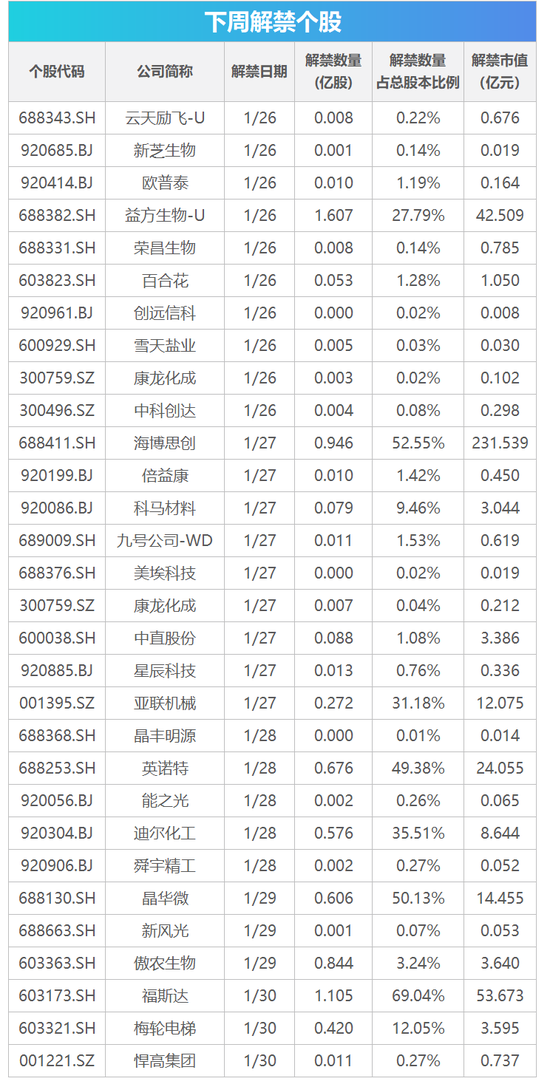
Economic Indicators - The January PMI data will be released on January 31, with December's PMI at 50.1%, an increase of 0.9 percentage points, marking a return to the expansion zone after eight months below 50% [1][10]. Monetary Policy - The Federal Reserve is expected to announce its interest rate decision next week, with a 95% probability that rates will remain unchanged during the January meeting [2][10]. - Citic Securities believes that the criminal investigation into Powell will not pressure the Fed into aggressive rate cuts, predicting a pause in rate cuts for January [2][10]. Central Bank Operations - The central bank conducted a reverse repo operation of 11,810 billion yuan this week, with a net injection of 2,295 billion yuan after 9,515 billion yuan matured [3][11]. - Next week, 11,810 billion yuan in reverse repos will mature, with specific maturities scheduled throughout the week [3][11]. Stock Market Developments - Over 40 billion yuan in market value of restricted shares will be unlocked next week, with January 27 being the peak day for unlocks [4][12]. - The top three companies by unlock market value are Haibo Sichuang (231.54 billion yuan), Fostar (53.67 billion yuan), and Yifang Bio-U (42.51 billion yuan) [4][12]. New Stock Opportunities - Three new stocks will be issued next week: Beixin Life on January 26, and Linping Development and Electric Science Blue Sky on January 30 [7][14]. - The subscription details for the new stocks include a price of 17.52 yuan for Beixin Life and subscription limits for the other two stocks [8][15].


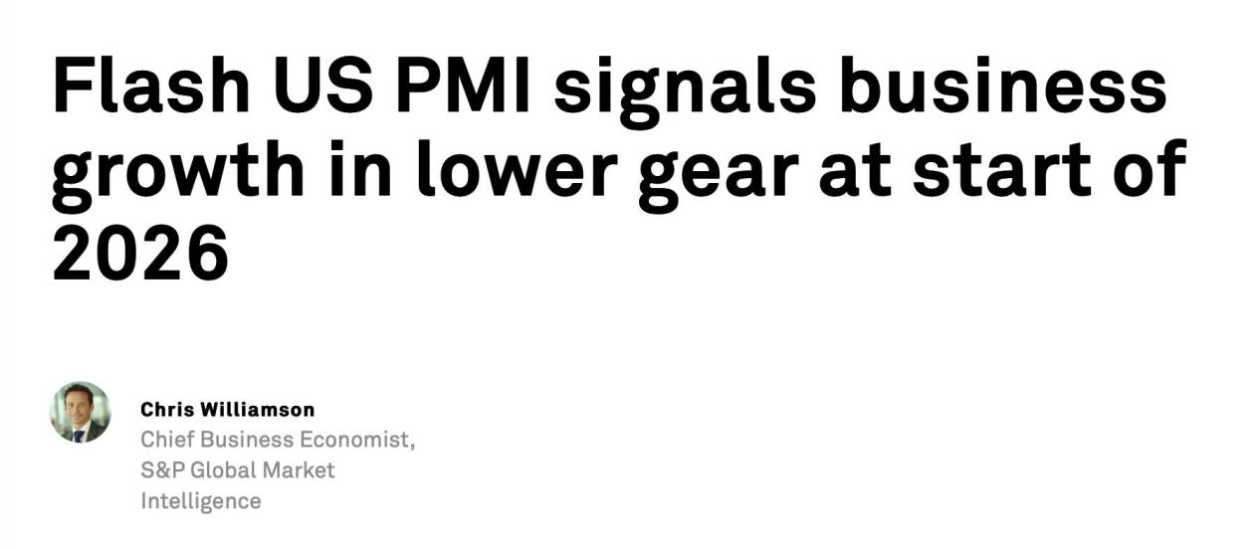
标普PMI数据显示美国1月商业活动增速放缓
Huan Qiu Wang· 2026-01-25 01:43
【环球网财经综合报道】当地时间本周五,标普全球公布的最新PMI报告显示,美国商业活动在2026年1月虽保持增长态势,但扩张速度较2025年下半年显 著降温。数据显示,尽管制造业增长加快并反超服务业,但受出口下滑拖累,两大行业的新订单增长近期均出现放缓迹象,加之就业增长几近停滞,释放出 美国经济开局动能减弱的信号。 具体数据显示,美国1月标普全球制造业PMI初值录得51.9,略高于12月的51.8但微低于市场预期的52;服务业PMI初值持平于12月的52.5,同样略低于预期 的52.9;综合PMI初值为52.8,虽较上月微升,但亦低于预期的53。 标普报告显示,虽然产出端出现一定韧性,但需求端的疲软引发关注。新订单指数虽从12月的50.8回升至52.2,但整体增速仍处于偏弱水平,出口下滑成为 主要拖累因素。标普全球市场财智首席商业经济学家Chris Williamson分析认为,当前的新增业务增长率令人担忧地偏弱,强化了一季度经济增长可能不及 预期的信号。据调查估算,12月和1月美国的年化GDP增速约为1.5%,低于去年秋季的扩张节奏。 就业市场方面呈现出令人失望的表现。1月就业人数基本保持不变,延续了12月的 ...

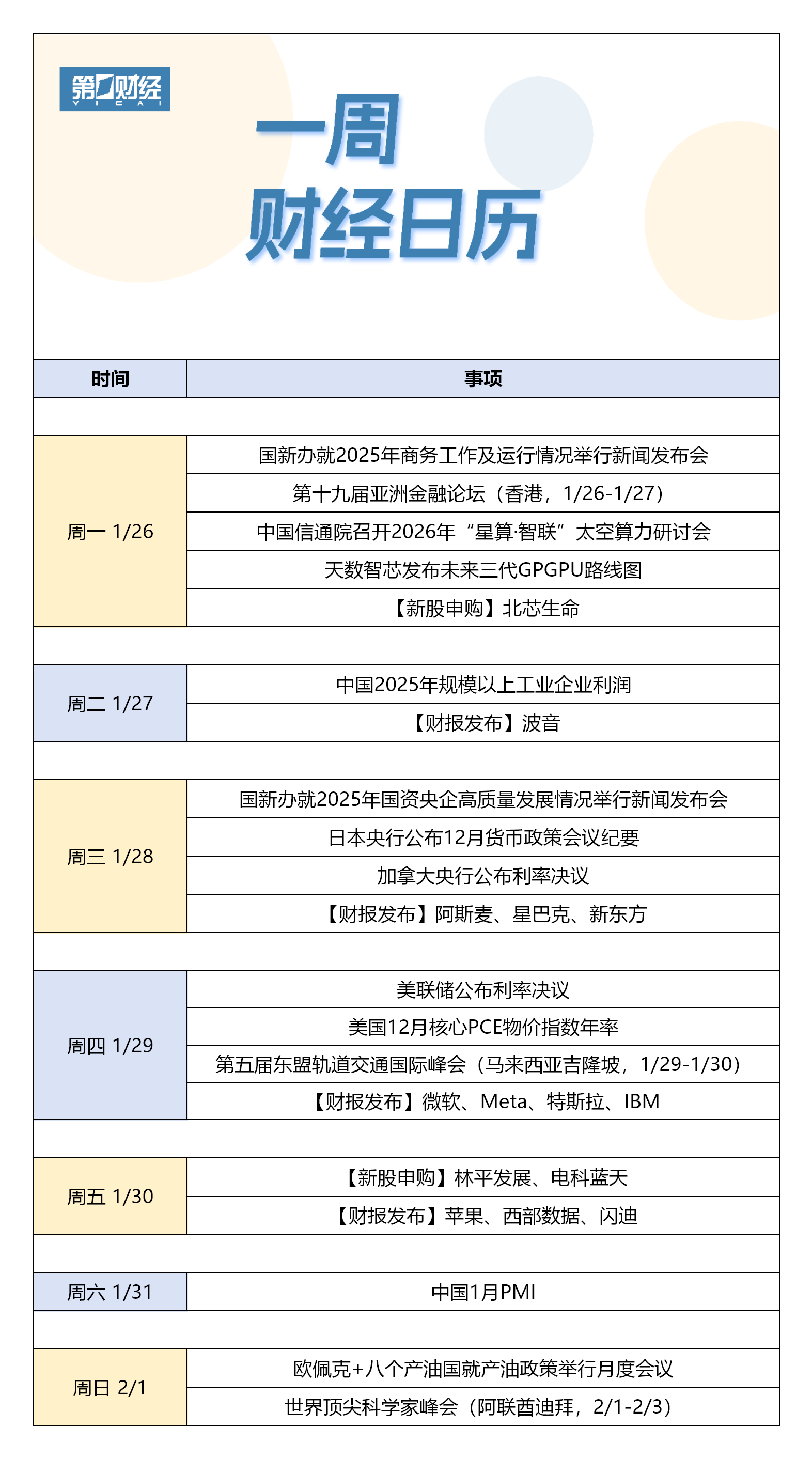
【下周财经日历】1月26日-2月1日
Di Yi Cai Jing· 2026-01-24 12:19
Group 1 - The National Development and Reform Commission of China is focusing on high-quality development of state-owned enterprises by 2025 [1] - The 19th Asian Financial Forum is scheduled to take place in Hong Kong [1] - The China Academy of Information and Communications Technology will hold the "Star Computing and Intelligent Connection" conference in 2026 [1] Group 2 - The Bank of Japan announced its monetary policy for December [2] - The Bank of Canada will announce its interest rate decision [2] - Major companies such as ASML and Starbucks are set to release their financial reports [2] Group 3 - The Federal Reserve will announce its interest rate decision [2] - The U.S. core PCE price index for December will be released [2] - The 5th ASEAN Rail Transit International Summit will be held in Malaysia [2] Group 4 - New stock subscriptions for Linping Development and Electric are scheduled [2] - Major companies including Apple and Western Digital will release their financial reports [2] - China's PMI for January will be published [2] Group 5 - OPEC+ and eight oil-producing countries will discuss oil production policies [2] - The World Summit of Leading Scientists will take place in Dubai, UAE [2]
US Stocks Mixed; Dow Falls Over 200 Points - Direct Digital Holdings (NASDAQ:DRCT), Movano (NASDAQ:MOVE)
Benzinga· 2026-01-23 15:25
Market Overview - U.S. stocks experienced mixed trading, with the Dow Jones index falling by 0.46% to 49,158.56, while the NASDAQ rose by 0.19% to 23,481.32 and the S&P 500 increased by 0.03% to 6,915.27 [1] - Energy shares saw a gain of 1.3%, while financial stocks dipped by 0.8% on the same day [1] Company Earnings - SLB Limited reported fourth-quarter revenue of $9.745 billion, a 5% increase from the previous year, surpassing analyst estimates of $9.547 billion [2] - Diluted GAAP earnings per share for SLB were 55 cents, down from 77 cents a year earlier, while diluted EPS excluding charges and credits was 78 cents, down from 92 cents a year earlier but above the 74-cent estimate [2] Stock Movements - Movano Inc. shares surged by 150% to $17.43 following the announcement of a long-term NVIDIA H200 GPU deployment [8] - Direct Digital Holdings, Inc. saw its shares increase by 103% to $4.6999 [8] - TryHard Holdings Limited shares rose by 92% to $1.3501 [8] - Aptera Motors Corp. shares dropped by 45% to $1.3350 after announcing a $9 million public offering [8] - Erayak Power Solution Group Inc. shares fell by 40% to $1.6309 due to a business update on market demand trends [8] - The OLB Group, Inc. shares decreased by 30% to $0.6050 after announcing a $1.3 million registered direct offering [8] Economic Indicators - The University of Michigan's consumer sentiment index increased to 56.4 in January from a preliminary reading of 54.0 and December's 52.9 [9] - The S&P Global services PMI remained unchanged at 52.5 in January [9] - The S&P Global composite PMI rose to 52.8 in January from 52.7 in the previous month [9] - The S&P Global manufacturing PMI increased to 51.9 in January from December's 51.8 [9]


US Stocks Mixed; Dow Falls Over 200 Points
Benzinga· 2026-01-23 15:25
Company Performance - SLB Limited (NYSE:SLB) reported fourth-quarter revenue of $9.745 billion, a 5% increase from the previous year, exceeding analyst estimates of $9.547 billion [2] - Diluted GAAP earnings per share (EPS) were 55 cents, down from 77 cents a year earlier, while diluted EPS excluding charges and credits was 78 cents, down from 92 cents a year earlier but above the 74-cent estimate [2] Stock Movements - Movano Inc. (NASDAQ:MOVE) shares surged 150% to $17.43 following the announcement of a long-term NVIDIA H200 GPU deployment [8] - Direct Digital Holdings, Inc. (NASDAQ:DRCT) shares increased by 103% to $4.6999 [8] - TryHard Holdings Limited (NASDAQ:THH) shares rose by 92% to $1.3501 [8] - Aptera Motors Corp. (NASDAQ:SEV) shares fell 45% to $1.3350 after announcing a $9 million public offering [8] - Erayak Power Solution Group Inc. (NASDAQ:RAYA) shares dropped 40% to $1.6309 following a business update on market demand trends [8] - The OLB Group, Inc. (NASDAQ:OLB) shares decreased by 30% to $0.6050 after announcing a $1.3 million registered direct offering [8] Economic Indicators - The University of Michigan's consumer sentiment index increased to 56.4 in January from a preliminary reading of 54.0 and December's reading of 52.9 [9] - The S&P Global services PMI remained unchanged at 52.5 in January [9] - The S&P Global composite PMI rose to 52.8 in January from 52.7 in the previous month [9] - The S&P Global manufacturing PMI increased to 51.9 in January from December's reading of 51.8 [9]

经济修复平稳 政策加力支持中小企业发展
Jing Ji Guan Cha Wang· 2026-01-23 14:43
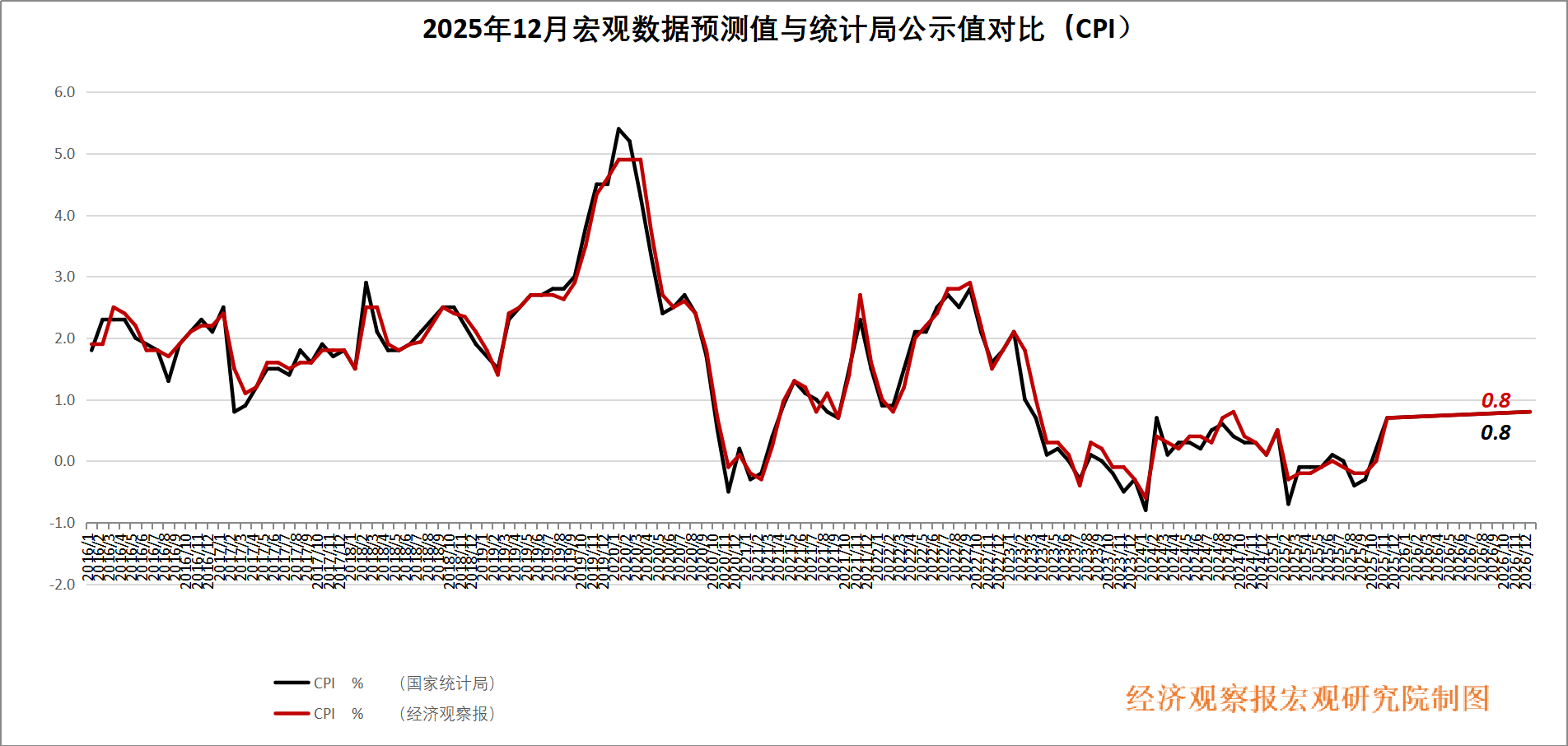
Core Viewpoint - The macroeconomic data for December 2025 indicates a stable recovery in the economy, with rising prices in non-ferrous metals, a return of the manufacturing PMI to the expansion zone, and growth in medium to long-term corporate loans. However, the economic environment for small and medium-sized enterprises remains challenging, and the real estate market continues to exert significant downward pressure on prices and investments [1]. Group 1: Inflation and Price Indices - The Consumer Price Index (CPI) increased from 0.7% to 0.8% year-on-year, with food CPI rising 1.1% year-on-year, marking a continuous five-month growth [4][2]. - The Producer Price Index (PPI) improved from -2.2% to -1.9% year-on-year, reflecting a narrowing decline in industrial product prices due to rising raw material costs and the impact of policies aimed at reducing excess capacity [7][5]. Group 2: Manufacturing and Investment - The Manufacturing Purchasing Managers' Index (PMI) rose from 49.2% to 50.1%, indicating a return to expansion for large enterprises, while small enterprises remain in a contraction zone [10][8]. - Fixed asset investment decreased by 3.8% year-on-year, with real estate investment down 17.2%, while equipment renewal investment grew by 11.8%, supported by policy initiatives [14][11]. Group 3: Credit and Money Supply - New RMB loans totaled 910 billion yuan in December, with medium to long-term corporate loans increasing by 330 billion yuan, driven by recent policy financial tools [17][15]. - The M2 money supply growth rate rose to 8.5% year-on-year, indicating a significant rebound, primarily due to a reduction in non-bank deposits [20][18].
英国经济2026年喜迎“开门红”,PMI全线超预期引关注
Jin Rong Jie· 2026-01-23 14:10
据金吾财讯消息,英国1月标普全球综合PMI初值从去年12月的51.4跃升至53.9,显著高于市场预期 的51.5,创下2024年4月以来最快增速。服务业表现尤为亮眼,商业活动指数升至54.3(前值51.4);制 造业PMI同样攀升至51.6(前值50.6),达到17个月高点。这是过去四个月中第三次出现新订单增长, 主要受出口销售改善推动。 03 经济增速与前景评估 标普全球首席商业经济学家克里斯·威廉姆森指出,1月份的PMI初值数据"预示着稳健的季度GDP增 长,可能接近0.4%"。这一评估显示,英国经济在2026年初呈现稳健增长态势。 威廉姆森进一步指出,尽管服务业仍然是增长的主要引擎,特别是金融服务业和科技行业。 01 超出预期的经济扩张 英国2026年1月的经济表现远超市场预期。综合PMI初值53.9,不仅远超51.5的市场预期,也是自 2024年4月以来的最高水平。 服务业PMI的迅猛增长尤其令人瞩目。从12月的51.4飙升至54.3,这一跃升幅度展现了服务业强劲 的扩张势头。 制造业也展现出了坚实的复苏迹象。制造业PMI从50.6进一步改善至51.6,连续第四个月保持在荣 枯线以上,并达到了自202 ...