自由现金流

Search documents
本周操盘攻略:关税“风暴”即将落地
Wind万得· 2025-03-30 22:34
// 市场要闻 // 国有大行重磅官宣。 3月30日下午,中国银行、中国建设银行、交通银行发布公告称,董事会通过 了向特定对象发行A股股票条件的议案。其中,建设银行拟引入财政部战略投资,募资总额不超过 人民币1050亿元。交通银行拟定增募资不超过1200亿元,发行对象为财政部、中国烟草和双维投 资,其中财政部拟认购金额为1124.2亿元。募资均用于补充核心一级资本。中国银行拟向特定对象 发行A股股票,募集资金总额不超过1650亿元。 社保基金重仓这些股票。 随着上市公司年报密集披露,作为长线资金代表的社保基金 2024 年末重 仓股及持股变动情况浮出水面。 Wind数据显示,截至3月28日,已有938家上市公司披露了2024年年报,其中有133家上市公司(包含2 家未披露年报但已披露2024年末十大流通股东上市公司)的前十大流通股东中出现了社保基金的身影。 2024年四季度,社保基金新进29只个股的前十大流通股东序列,同时对40只个股的持股数量增加。 自由现金流 ETF 近期成为基金行业的一大焦点。 在挖掘基金重仓股上只看净利润不看现金流的策 略,使得许多基金经理在过去三年间积累了大量有关忽视自由现金流的"苦 ...


公募争相布局!自由现金流ETF为何火了?
券商中国· 2025-03-29 23:23
自由现金流ETF近期成为基金行业的一大焦点。 易方达基金指数研究部总经理庞亚平表示,在研究公司投资价值时,自由现金流是投资者最关注的财务指 标之一。从历史数据来看,过去十年,A股自由现金流比率高的公司股价走势不断创新高,高自由现金流 比率组合具有较为显著的超额收益。 在挖掘基金重仓股上只看净利润不看现金流的策略,使得许多基金经理在过去三年间积累了大量有关忽视 自由现金流的"苦难记忆"。业内人士强调,表面的净利润指标往往具有迷惑性,而自由现金流指标却是评 估股票经营底色的核心依据。 券商中国记者注意到,有港股新消费龙头以高达14亿元年度净利润,吸引多位年轻的A股基金经理重仓买 入,但因这些基金经理大多忽视该股是否符合自由现金流指标,该基金重仓股14亿元的年度净利润背后, 是其完全不符合自由现金流定义,该股现金流长期为负,且有高达18亿元的净流出,从而使得该股在18 个月时间内股价暴跌95%后爆雷,并停牌一年至今,其中有上海一位公募基金经理因此下岗。 多位基金经理对此认为,股票市场长期牛股的形成基本都与自由现金流指标相关,这样的公司往往在商业 模式和竞争壁垒上的可持续性较强,而且资本配置效率较高,不会盲目地进行资 ...

顺丰控股(002352):利润及现金流维持高增,看好盈利效率带来的价值提升
Xinda Securities· 2025-03-29 12:31
Investment Rating - The investment rating for the company is "Buy" [1] Core Views - The company has shown steady growth in domestic business and has opened up opportunities in international markets [2] - The company's profitability and cash flow have maintained high growth, indicating an improvement in profit efficiency and value enhancement [2][3] - The company plans to increase its cash dividend payout ratio, reflecting a commitment to shareholder returns [8] Financial Performance Summary - In 2024, the company achieved total revenue of 284.42 billion yuan, a year-on-year increase of 10.07%, and a net profit attributable to shareholders of 10.17 billion yuan, up 23.51% year-on-year [3][10] - The company's net profit margin for 2024 was approximately 3.58%, an increase of 0.39 percentage points year-on-year [3] - The express delivery and large parcel segment generated revenue of approximately 200.16 billion yuan, a year-on-year increase of 7.10%, with a net profit of approximately 10.98 billion yuan, up 29.91% [4] - The instant delivery segment saw revenue of approximately 9.01 billion yuan, a year-on-year increase of 22.24%, with net profit doubling to approximately 132 million yuan [5] - The supply chain and international segment reported revenue of approximately 74.00 billion yuan, a year-on-year increase of 17.72%, but a net loss of approximately 1.32 billion yuan [5] Capital Expenditure and Cash Flow - The peak period for capital expenditure has passed, with 2024 capital expenditure at 9.9 billion yuan, a decrease of 27% year-on-year [6] - Operating cash flow for 2024 was 32.2 billion yuan, an increase of 21% year-on-year, and free cash flow rose by 70% to 22.3 billion yuan [7] Dividend Policy - The company plans to distribute a cash dividend of 4.4 yuan per 10 shares for the 2024 fiscal year, with an expected total dividend payout of approximately 4.1 billion yuan, representing a payout ratio of about 40% [8] Earnings Forecast - The company is expected to achieve net profits of 11.91 billion yuan, 14.26 billion yuan, and 16.85 billion yuan for 2025, 2026, and 2027, respectively, with year-on-year growth rates of 17.1%, 19.8%, and 18.1% [9]

自由现金流指数牛在哪里?
雪球· 2025-03-29 02:45
Core Viewpoint - The article emphasizes that 2025 will be a pivotal year for the A-share ETF market, particularly focusing on "free cash flow" ETFs, which are expected to gain significant traction and popularity among investors [3][4]. Group 1: Free Cash Flow ETFs - The launch of the E Fund's free cash flow ETF (code: 159222) on March 24, 2025, marks the beginning of a new investment trend, with management fees set at a competitive 0.15% plus 0.05% for custody [3]. - Historical performance of free cash flow ETFs shows a remarkable annualized return of over 20% from 2022 to 2024, significantly outperforming the broader market, which had returns of less than 8% [7]. - The National Index of Free Cash Flow (code: 980092) has unique compilation rules that exclude financial and real estate sectors, focusing on companies with sustainable operational capabilities [9]. Group 2: Index Compilation Rules - The index requires companies to have positive operating cash flow for the past three years, ensuring financial sustainability and avoiding companies with inflated profits [11]. - A stability assessment is conducted based on the past 12 quarters of ROE, eliminating the most volatile 10% of companies to enhance long-term stability [11]. - The final index is composed of the top 100 companies ranked by free cash flow rate, combining both quantity and quality of cash flow [11]. Group 3: Market Context and Comparisons - The article draws parallels between the A-share market and the U.S. market, noting that free cash flow is a relatively new concept in both, with the first cash flow ETF in the U.S. launched in 2016 [15]. - The free cash flow factor is positioned as a valuable selection criterion, supported by academic research indicating its ability to generate excess returns, especially during market downturns [18]. - The industry distribution of the National Index of Free Cash Flow shows significant overweights in sectors like automotive, non-ferrous metals, and household appliances compared to other indices [20][22]. Group 4: Investment Strategy and Outlook - The article suggests that while the National Index of Free Cash Flow may perform well in the long term, it could underperform the overall A-share market in the short term, requiring a mindset geared towards gradual wealth accumulation [27][31]. - The index is viewed as a stabilizing component in a diversified investment portfolio, akin to high-dividend indices, providing lower volatility and superior long-term returns [31].

主要现金流指数对比研究
雪球· 2025-03-27 07:52
Group 1 - The article discusses the upcoming issuance of a series of ETFs focused on free cash flow, tracking indices such as the China Securities Cash Flow Index, the CSI 300 Cash Flow Index, the CSI 800 Cash Flow Index, and the National Securities Cash Flow Index [2] - The China Securities All Index Free Cash Flow Index selects 100 listed companies with high free cash flow rates to reflect the overall performance of companies with strong cash flow generation capabilities [2] - The CSI 300 Free Cash Flow Index selects 50 companies from the CSI 300 Index that have high free cash flow rates, aiming to represent the performance of companies with strong cash flow generation within the CSI 300 sample [3] Group 2 - The CSI 800 Free Cash Flow Index selects 50 companies from the CSI 800 Index with high free cash flow rates, reflecting the performance of companies with strong cash flow generation within the CSI 800 sample [4] - The National Securities Free Cash Flow Index is designed to reflect the price changes of listed companies with high and stable free cash flow levels on the Shanghai and Shenzhen Stock Exchanges, enriching index investment tools [5] Group 3 - The base date for the three China Securities cash flow indices is December 31, 2013, with a base point of 1000, and they have been running for 11.3 years [6] - The current values and annualized returns for the indices are as follows: - All Index Cash Flow Price Index at 4419.86 points, annualized return of 14.05% - CSI 300 Cash Flow Price Index at 2911.58 points, annualized return of 9.92% - CSI 800 Cash Flow Price Index at 4294.83 points, annualized return of 13.76% - National Securities Cash Flow Index at 4683.24 points, annualized return of 12.48% [7] - The historical returns of the cash flow indices are impressive, with annualized returns around 18% for all but the CSI 300 Cash Flow Index, which may be due to a limited sample size after excluding the financial and real estate sectors [7] Group 4 - The article notes that the newly issued indices may exhibit historical fitting, which is unavoidable, and emphasizes that evaluating an index should prioritize its compilation rules, component structure, and inherent stability over historical returns [8]

市场回归谨慎叙事,红利加强版——现金流ETF(159399)吸金超12亿元
Mei Ri Jing Ji Xin Wen· 2025-03-27 02:22
Core Viewpoint - The market is returning to a cautious narrative, with a focus on high free cash flow strategies, particularly highlighted by the cash flow ETF (159399), which has attracted over 1.2 billion yuan in net inflows since its launch [1] Group 1: Cash Flow ETF Performance - The cash flow ETF (159399) has seen continuous net inflows since its launch on February 27, with a total exceeding 1.2 billion yuan as of March 26, bringing its current scale to over 2.7 billion yuan, making it the largest in its category [1] - The ETF closely tracks the FTSE China A-Share Free Cash Flow Focus Index, reflecting the performance of stocks with ample free cash flow, which is a key indicator of a company's profitability and financial health [1] Group 2: Historical Performance and Composition - The FTSE Cash Flow Index has shown outstanding long-term performance, with an annualized return exceeding 20% and a cumulative increase of 602.17% since the base date of December 31, 2013, significantly outperforming the CSI 300 and the CSI Dividend Index [2] - The ETF excludes financial and real estate sectors, selecting 50 stocks with "sufficient cash flow," making it more concentrated compared to other indices, and features a significant proportion of state-owned enterprises [2] Group 3: Dividend Mechanism and Investor Appeal - The cash flow ETF (159399) has a "monthly assessment of dividends" mechanism, with its first dividend announced on March 11, amounting to 0.1%, enhancing the investment experience for investors [3] - Given the volatility in tech stocks, the cash flow ETF (159399) is positioned as a stable and growth-oriented investment option, appealing to investors looking for a balanced asset allocation [3]
自由现金流ETF(159201)近10日净流入超9.4亿元,资金抢筹低费率高性价比产品
Mei Ri Jing Ji Xin Wen· 2025-03-27 02:21
Group 1 - The core viewpoint of the news highlights the significant inflow of funds into the Free Cash Flow ETF (159201), which has seen a net inflow of over 940 million yuan in the past 10 days, indicating strong investor interest in low-fee, high-value products [1][2] - The Free Cash Flow ETF has demonstrated a remarkable growth in scale, increasing from 694 million yuan at the time of listing to 2.45 billion yuan, representing a growth of over 250% [1] - The National Certificate Free Cash Flow Index has shown outstanding long-term performance, with a cumulative increase of 633.08% and an annualized return of 20.45% since December 31, 2013, outperforming other major free cash flow indices [1] Group 2 - Goldman Sachs' research team predicts further fundamental-driven increases in Chinese stocks following a 20% rise this year, indicating a positive outlook for the market [2] - The Free Cash Flow ETF offers the lowest fee structure in the market, with a management fee of 0.15% and a custody fee of 0.05%, enhancing long-term returns for investors [2]
公募基金新发市场迎“暖春”,这类产品成新爆点
券商中国· 2025-03-26 04:26
Core Viewpoint - The public fund market is experiencing a new wave of issuance, with a significant increase in equity products and a positive trend of "volume and quality rising together" as of March 23, 2025 [1] Group 1: Fund Issuance Trends - As of March 23, 2025, the new fund issuance scale has exceeded 220 billion, with equity products showing a notable increase in proportion [1] - From March 24 to 28, 20 new funds are set to be issued, with 14 of them being equity funds, accounting for 70% of the total [3] - The issuance of passive index funds remains dominant, with 10 out of 20 new products being such funds, including multiple free cash flow theme ETFs [3] Group 2: Free Cash Flow Theme ETFs - Free cash flow theme funds have emerged as a highlight, with institutions like E Fund, Yinhua, and Huabao accelerating their layouts [3] - Existing free cash flow ETFs from Guotai and Huaxia have attracted significant capital, with sizes of 2.515 billion and 1.911 billion respectively [3] - A total of 27 institutions are currently involved in this theme, with 28 products awaiting approval, indicating a competitive issuance environment [3] Group 3: Active Management Funds - Active management funds are also gaining traction, with new products launched by Xinyuan Fund and Fortune Fund, reflecting differentiated competition strategies [4] - Nearly 300 active equity funds have reached historical net value highs, boosting investor interest [4] Group 4: Market Dynamics - As of March 21, 2025, the issuance of equity funds has surpassed 40%, with a year-on-year growth of over 100% [5] - The average subscription days for new products have decreased, indicating improved market efficiency, with 26% of new funds ending their fundraising early [5] - The recovery in the new fund issuance market is closely linked to deeper capital market reforms and a shift in investor mindset towards long-term allocation [6]

高盛:予中国石油化工股份(00386)“中性”评级 目标价4.50港元
智通财经网· 2025-03-26 02:41
Core Viewpoint - Goldman Sachs assigns a "Neutral" rating to Sinopec (00386, 600028.SH) with a target price of HKD 4.50, citing expected weak free cash flow due to declining refining margins and oversupply in the chemical market [1] Group 1: Financial Performance - Sinopec's fourth-quarter performance in refining, sales, and chemical sectors fell short of expectations, with EBITDA 19% lower than Goldman Sachs' forecast due to higher operational costs [2] - The company's gross profit met expectations, but overall performance was impacted by lower-than-expected profit margins across multiple business segments [2] Group 2: Dividend and Cash Flow - The dividend payout ratio for 2024 is expected to remain around 71%, consistent with 2023, leading to a 17% year-on-year decline in earnings per share dividends [3] - Despite a projected positive free cash flow in 2024 after two years of negative results, the free cash flow yield of 1.3% is below Goldman Sachs' expectation of 5% due to lower earnings and high capital expenditures [3] - Capital expenditures for 2024 are expected to be 11% higher than Goldman Sachs' forecast, with a slight decrease of 1% compared to 2023, and a projected capital expenditure of RMB 164.3 billion for 2025, which is 6% above expectations [3]

博时基金关于自由现金流ETF的观点
Xin Lang Ji Jin· 2025-03-24 07:48
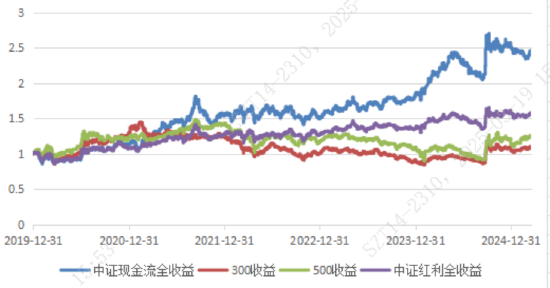
博时基金关于自由现金流ETF的观点 自由现金流是企业在扣除必要资本开支后能够自由支配的现金。对上市公司而言,现金流可灵活应 用于资本开支、并购重组、债务偿还、分红回购等不同情形,便利企业在扩大业务规模、优化财务结 构、股东回报、市值管理等不同经营策略之间进行选择。 我们认为,充足的自由现金流是企业持续健康发展的重要保障,也是衡量企业财务健康状况和投资 价值的重要指标之一,是评价上市公司投资价值的重要指标之一。 为了给国内投资者提供类似优秀的投资工具,中证指数公司发布了中证全指现金流指数。该指数选 取100只自由现金流率较高的上市公司证券作为指数样本,以反映现金流创造能力较强的上市公司证券 的整体表现,具有以下重要特征: 一是市值方面,对比中证全指,中证全指现金流指数大市值股票权重占比更高,整体呈现出大市值 特征,同时对中小市值股票也进行了一定敞口暴露。 二是行业分布方面,中证现金流指数偏好配置周期、消费和制造等商业模式成熟、竞争格局稳定的 行业,经营业绩的确定性和稳定性相对更为占优。 三是盈利方面,近3年中证现金流指数ROE水平稳定且显著高于沪深300、中证全指等主流宽基指 数,使用自由现金流指标筛选出的股票 ...