
可再生能源

Search documents
酉立智能(920007):新股介绍光伏支架部件小巨人,布局全球
HUAXI Securities· 2025-09-30 09:29
Investment Rating - The report assigns a "Buy" rating for the company, predicting that the stock price will outperform the Shanghai Composite Index by 15% or more within the next six months [37]. Core Insights - The company, Youli Intelligent, is recognized as a "little giant" specializing in the photovoltaic bracket industry, focusing on the research, production, and sales of core components [1][2]. - The domestic photovoltaic power station installation continues to expand, with the photovoltaic bracket market expected to exceed 25 billion yuan [2]. - The company's international layout has led to a steady increase in market share, becoming a major supplier for NEXTracker in non-US markets [2][30]. - The company has established a comprehensive competitive advantage through parallel design, research, and manufacturing systems, enhancing product precision and reliability [3][31]. Summary by Sections Industry Overview - The global photovoltaic market is rapidly expanding, with an expected increase in new installations to approximately 390 GW in 2023, a year-on-year growth of 69.56% [8][9]. - China's photovoltaic market has become the largest globally, with a projected market size of 210 billion yuan in 2023 and 253 billion yuan in 2024 [10][22]. - The global photovoltaic bracket market is anticipated to grow significantly, driven by the increasing demand for tracking brackets, which are expected to see a compound annual growth rate (CAGR) of 27.4% from 2023 to 2027 [17][21]. Company Overview - Youli Intelligent has achieved revenues of 433 million yuan, 658 million yuan, and 729 million yuan for the years 2022, 2023, and 2024, respectively, with year-on-year growth rates of 12.78%, 51.96%, and 10.84% [1][27]. - The company has a strong international presence, with overseas revenue accounting for 88.19%, 73.06%, and 78.72% from 2022 to 2024 [2][30]. - The company has developed a range of core components for photovoltaic brackets, including the Torque Tube (TTU), Bearing Assembly (BHA), and Installation Structure Components (URA) [24][25]. Financial Performance - The company's net profit attributable to shareholders is projected to grow from 42 million yuan in 2022 to 90 million yuan in 2024, with growth rates of 185.55%, 85.27%, and 15.19% respectively [1][27]. - In the first half of 2025, the company reported revenues of 481 million yuan, reflecting a year-on-year increase of 29.47% [1][27]. Competitive Advantages - The company has established a robust research and development framework, with increasing R&D investment from 5.07 million yuan in 2022 to 12.13 million yuan in 2024, representing 1.66% of revenue [32]. - The company holds 11 invention patents and 50 utility model patents, demonstrating its commitment to innovation and quality [32].
绿色能源科技集团(00979.HK)2025财年净亏约1600万港元 同比扩大11.9%
Ge Long Hui· 2025-09-29 13:48
Core Viewpoint - Green Energy Technology Group (00979.HK) reported a revenue of approximately HKD 68.9 million from continuing operations for the fiscal year 2025, representing a year-on-year decrease of about 2.7%. The net loss attributable to shareholders was approximately HKD 16 million, an increase of 11.9% year-on-year, with a basic and diluted loss per share of HKD 0.0118 [1] Revenue and Profitability - The decrease in revenue and margin profit was primarily due to the decline in the renewable energy segment's performance during the fiscal year 2025 [1] - The group recorded impairment losses on property, plant, and equipment related to its plastic recycling business in fiscal year 2025, which were not present in fiscal year 2024 [1] Operational Challenges - The surge and volatility in international freight costs led to the cancellation of some orders from renewable energy customers in Europe [1] - The gross margin of the renewable energy segment was eroded due to rising raw material procurement costs and local transportation costs [1] Segment Performance - The performance of the construction waste and processing services business, as well as the plastic recycling/metal waste business in Germany, deteriorated due to increased employee and energy costs [1]
中经资料:巴基斯坦证券市场一周回顾 (2025.09.22 - 2025.09.26)
Zhong Guo Jing Ji Wang· 2025-09-29 09:04
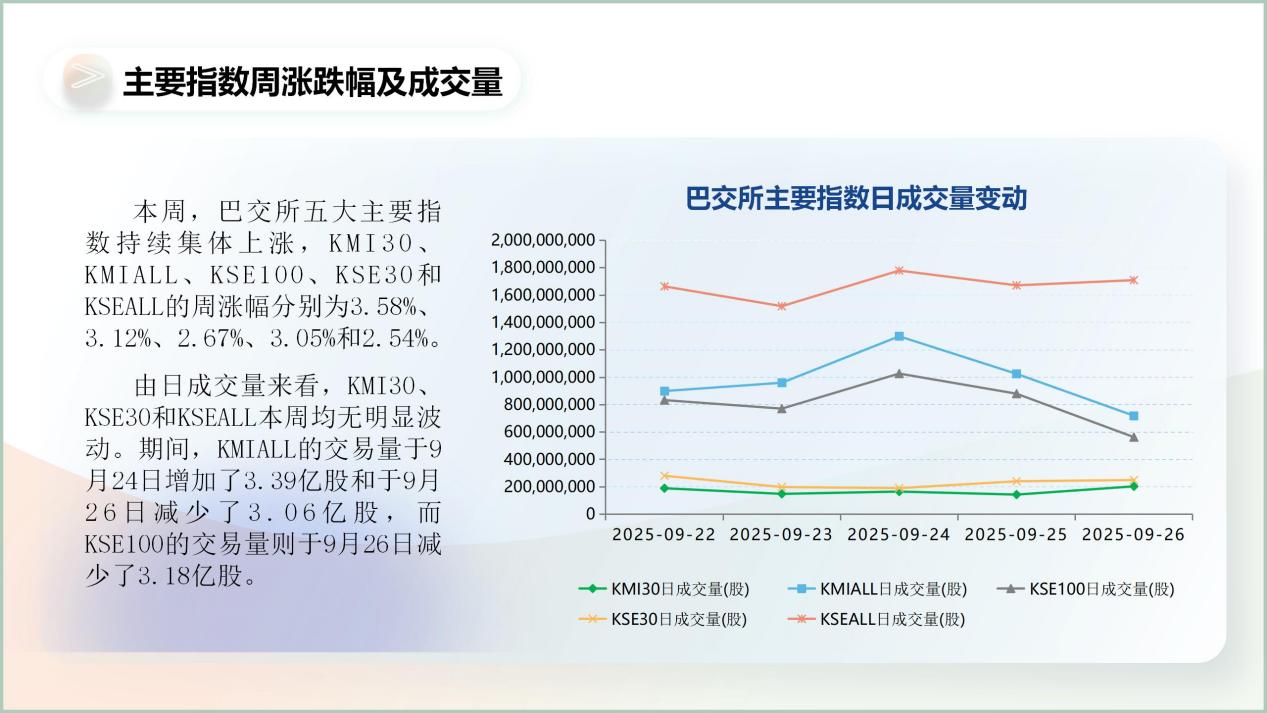
Group 1: Capital Market Regulation - The Pakistan Stock Exchange (PSX) signed a memorandum of understanding with the Securities and Exchange Commission of Pakistan (SECP) to enhance oversight of the capital market, allowing SECP direct access to PSX's new monitoring system [7] Group 2: Poverty and Economic Reform - The World Bank reported that Pakistan's poverty rate decreased from 64.3% in 2001-2002 to 21.9% in 2018-2019 but is expected to rise to 25.3% in 2023-2024, calling for continuous, people-centered reforms to protect vulnerable families and expand access to basic services [7] Group 3: Debt Restructuring and Financing - The Pakistani government signed a debt restructuring and financing agreement worth approximately 1.225 trillion PKR with 18 banks, including 659.6 billion PKR for restructuring existing loans and 565.4 billion PKR for new financing to settle overdue payments to power producers [8] Group 4: Pharmaceutical Industry Growth - Pakistan's pharmaceutical exports reached a record high of 457 million USD in the last fiscal year, marking a 34% year-on-year increase, the highest growth in 20 years [8] Group 5: Cryptocurrency Regulation - Pakistan officially launched a licensing program for cryptocurrency exchanges, inviting global service providers to apply for licenses under a new framework that includes strict KYC requirements [9] Group 6: Climate Financing and Renewable Energy - The Prime Minister of Pakistan called for international climate financing commitments, highlighting the impact of recent monsoon rains on over 5 million people and announcing plans to increase renewable energy's share in the energy mix to 62% by 2035 [9] Group 7: Infrastructure Development - A high-level meeting was held to plan key infrastructure projects connecting the Middle East, Central Asia, and China, with a joint working group established to propose an executable project list [10]

云南能投:2025年度累计获得国家可再生能源电价附加资金补助6.18亿元
Xin Lang Cai Jing· 2025-09-29 08:36
Core Viewpoint - The company has received a total of 27.0044 million yuan in renewable energy price supplementary funds from Yunnan Electric Power Company, which will positively impact its cash flow and operational efficiency [1] Financial Impact - The total amount of supplementary funds received by the company for the fiscal year 2025 has reached 618 million yuan [1] - The supplementary funds will help reduce accounts receivable and improve the efficiency of fund utilization [1] - The recognition of subsidy funds has already been accounted for in the corresponding year's electricity revenue, indicating that the receipt of these funds will not significantly affect the current year's profit and loss [1]

从中非贸易强劲增长看国际贸易格局之变
Sou Hu Cai Jing· 2025-09-29 06:11
Core Insights - The strong growth of China-Africa trade is attributed to shared historical experiences and missions, with significant increases in trade volumes and diversification of trade products [1][2][3] - China's imports from Africa's least developed countries reached $39.66 billion, a year-on-year increase of 10.2%, highlighting Africa's growing importance in China's overall foreign trade [1] - The shift in Africa's trade focus from traditional partners in Europe to China is seen as a natural evolution due to changing global economic dynamics [2][3] Trade Growth Factors - The deepening political and economic ties between China and Africa have led to a natural increase in trade, with China's stable economic growth further facilitating this process [2][3] - The diversification of Africa's export products, including higher value-added goods, is essential for sustaining trade growth and economic development [4][6] - The introduction of "innovative financing" by China aims to enhance Africa's trade capabilities and promote sustainable development, countering narratives of "debt traps" [4][6] Investment Trends - Chinese investments in Africa have evolved from labor-intensive sectors to high-tech and financial services, reflecting changes in both economies' structures [3][4] - The emphasis on manufacturing cooperation is crucial, as Africa possesses advantages in hosting Chinese manufacturing capabilities, which can drive bilateral trade growth [6][7] Challenges and Opportunities - Africa's reliance on external partners for 84% of its trade underscores the need for enhanced intra-African trade to support growth in trade with China [8][9] - The necessity for skill development in Africa is highlighted, as improving production and processing capabilities can lead to higher value exports and economic stability [9][10] - The impact of geopolitical factors, such as U.S. tariff policies, on global trade dynamics necessitates strategic adjustments and collaboration among Southern countries [12][13] Future Directions - Strengthening trade capacity and negotiation skills in African countries is essential for balancing trade growth with China and enhancing understanding of market demands [10][11] - The African Continental Free Trade Area (AfCFTA) is positioned as a critical element in fostering regional trade and should be integrated into broader China-Africa cooperation frameworks [14][15]
美银美林:电价上涨带来居民抵制,美国数据中心面临挑战,太阳能和储能将是短期关键
美股IPO· 2025-09-29 00:18
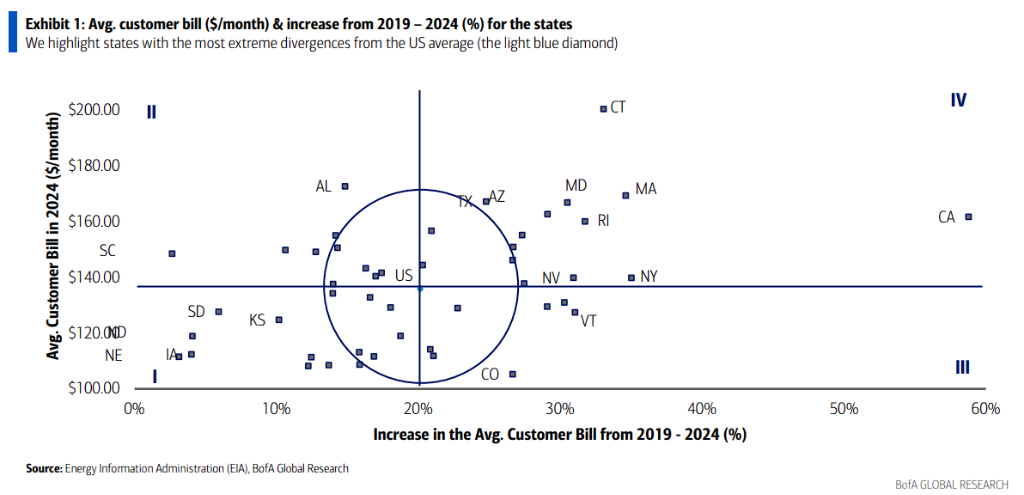
Core Viewpoint - The construction boom of AI data centers is driving a significant increase in electricity demand, leading to rising electricity prices and creating a dual challenge of "power scarcity" and "community opposition" in the U.S. [1][3][5] Group 1: Electricity Price Surge - The capacity price in the PJM interconnection has skyrocketed from $2.2 billion in the 2023/2024 delivery year to $16.1 billion in the 2026/2027 delivery year [7] - Capacity prices in the PJM "rest of market" region surged from $29 per megawatt-day in the 2024/2025 delivery year to $269 per megawatt-day in the 2025/2026 delivery year, marking an increase of over five times within a year [7][8] - This price surge has resulted in average electricity bills for residents in the PJM region increasing by 18% to 25% [8][10] Group 2: Community and Regulatory Response - At least 12 states in the U.S. are considering new policies to ensure data centers bear the costs of their electricity consumption to avoid passing these costs onto consumers [3][11] - Local policymakers are under pressure to create special rate structures that internalize the costs associated with data centers, indicating a shift in policy focus [11][12] - Community opposition, driven by concerns over rising electricity costs, water resource consumption, and noise pollution, is becoming a significant barrier to data center projects [13][14] Group 3: Energy Solutions - Solar and energy storage technologies accounted for 80% of the new electricity generation capacity in the U.S. in 2024, making them key solutions for meeting the rising electricity demand [4][16] - Natural gas is expected to play a crucial role in providing stable power in the short term, while nuclear energy is viewed as a long-term solution beyond the 2030s [18][19] - Major tech companies like Microsoft, Amazon, and Google are exploring agreements with nuclear energy firms to directly supply power to their data centers [19]

光伏十年复盘
2025-09-28 14:57
Summary of the Solar Industry Conference Call Industry Overview - The solar photovoltaic (PV) industry in China has undergone three key phases: subsidy-driven growth, grid parity, and policy support, significantly increasing the share of renewable energy generation and domestic installed capacity [2][5][12]. Key Points and Arguments - **Market Growth and Policy Impact**: The introduction of large-scale renewable energy projects, such as the desert wind and solar base projects, has significantly boosted renewable energy generation in China [2]. - **International Market Dynamics**: The U.S. has increased its investment tax credit (ITC) to 30%, reflecting its commitment to renewable energy, despite trade barriers against Chinese products [2][6]. - **Technological Advancements**: The shift from multi-crystalline to mono-crystalline silicon has reshaped the market, with companies like LONGi Green Energy emerging as leaders. The TOPCon technology, led by JinkoSolar, is accelerating the phase-out of PERC technology [2][7][11]. - **Future Demand Projections**: By 2050, solar energy is expected to account for 50% of renewable energy generation, driven by government investment plans [2][9]. Industry Challenges - **Overcapacity and Price Wars**: The industry is currently facing challenges related to overcapacity and price wars, necessitating further policy support to stabilize prices [4][20]. - **Global Market Fluctuations**: The global PV market has seen a surge in demand since 2020, but the industry must navigate the impacts of international trade policies and competition [15][17]. Technological Developments - **Battery Technology Evolution**: The transition from PERC to TOPCon technology is significant, with companies like LONGi and Aiko leading in new battery technologies. However, the current overcapacity may hinder the profitability of these advancements [10][11][21]. - **Material Costs**: The prices of key materials such as silicon, glass, and encapsulants have risen due to increased demand and supply chain constraints [15][16]. Market Forecasts - **Installed Capacity Predictions**: Global installed capacity is projected to reach 610 GW by 2025, with a year-on-year growth of 13%. However, domestic demand may face pressure in 2026 due to policy changes [19]. - **Long-term Growth Outlook**: The solar market is expected to maintain a growth rate of 10%-15% in the coming years, with a stable domestic demand anticipated post-2026 [19]. Conclusion - The solar PV industry is poised for significant growth driven by technological advancements and supportive policies. However, challenges such as overcapacity and international trade dynamics must be addressed to ensure sustainable profitability and market stability [20].
电价上涨带来居民抵制,美国数据中心面临挑战,太阳能和储能将是短期关键
Hua Er Jie Jian Wen· 2025-09-28 11:57
Core Insights - The construction of data centers in the U.S. is facing a dual challenge of power scarcity and community opposition, exacerbated by rising electricity prices driven by increased demand from these centers [1][6][8] Group 1: Electricity Price Surge - The capacity price in the PJM interconnection has skyrocketed from $2.2 billion in the 2023/2024 delivery year to $16.1 billion in the 2026/2027 delivery year, indicating a significant increase in electricity costs [3] - Capacity prices in the PJM "rest of market" area surged from $29 per megawatt-day in the 2024/2025 delivery year to $269 per megawatt-day in the 2025/2026 delivery year, marking a more than fivefold increase within a year [3] - This surge in electricity prices has resulted in an average bill increase of 18% to 25% for residents in the PJM region [3][6] Group 2: Policy Responses and Community Resistance - At least 12 states are considering new policies to ensure data centers bear the full costs of their electricity consumption, aiming to prevent the financial burden from falling on ordinary consumers [1][7] - Local policymakers are under pressure to create special rate structures that internalize the costs associated with data centers, reflecting a significant policy shift [7] - Community opposition, driven by concerns over rising electricity costs, water resource depletion, and noise pollution, is increasingly becoming a threat to data center projects [8][9] Group 3: Energy Solutions - Short-term solutions to the electricity demand crisis include solar and energy storage, which accounted for 80% of new generation capacity in the U.S. in 2024 [2][10] - The U.S. Energy Information Administration (EIA) reported that 48.6 GW of new capacity was added, with approximately 80% coming from solar and storage [10] - In the long term, natural gas and nuclear energy are viewed as essential components for ensuring stable power supply, with large tech companies exploring direct power agreements with nuclear energy providers [10][14]

专访|世界生物圈保护区大会提供与中国合作机遇——访马来西亚国立大学名誉教授穆什丽法
Xin Hua She· 2025-09-28 00:44
Core Insights - The fifth World Biosphere Reserve Congress held in Hangzhou, China, provided a platform for global experts, particularly from China, to engage with Malaysian researchers, enhancing international collaboration opportunities for young scholars [1][2] Group 1: Event Overview - The congress was the first of its kind held in Asia and saw participation from a wide range of UNESCO member countries, marking it as the most inclusive event to date [1] - Discussions at the congress focused on the positive impacts of biosphere reserves on communities and the need for diverse governance solutions for underperforming reserves [1] Group 2: Opportunities for Collaboration - The event highlighted the potential for strengthening cooperation with Chinese experts to advance the conservation efforts at Lake Chini, Malaysia's second-largest natural freshwater lake, which is a critical habitat for endangered species [2] - The congress showcased modern technological approaches to biosphere reserve issues, which could attract more participants and raise awareness of related topics [2] Group 3: Ecological and Agricultural Insights - Malaysia's Lake Chini has faced complex challenges, and the research team has established a systematic database to inform policy-making, focusing on key species and water quality [2] - The congress provided insights into China's advancements in renewable energy, particularly solar technology, which could aid in the green transformation of Lake Chini [3] - The importance of agriculture in the relationship between humans and biospheres was emphasized, with hopes to learn from China's practices to improve crop yields for local smallholder farmers in Malaysia [3]
《越南科技创新法》将于10月1日起生效
Shang Wu Bu Wang Zhan· 2025-09-26 16:20
越南科技部部长阮孟雄表示,该法将越共中央政治局关于推进科技创新和国家数字化转型突破发展 的第57号决议具体化,是一份以知识与创造力建设强盛国家的"宣言"。科技部副部长黎春定认为,该法 充分彰显越南破解长期制约科技创新与数字化转型发展制度瓶颈坚定决心,为支持全面创新、推动科研 与市场深度融合提供了法律框架。在企业发挥核心作用背景下,该法落地后有望涌现更多具有竞争力 的"越南制造"科技产品,带动越南企业更深入融入全球价值链。 "创新"首次正式纳入法律,与"科学"和"技术"并列。如果说科技侧重于新知识和技术研发,那么创 新则涵盖了从构想、试验到商业化的全过程,并强调全社会广泛参与。企业首次在法律条款中拥有独立 章节。该法鼓励企业利用自身资源和国家支持,大规模投资研发。 (原标题:《越南科技创新法》将于10月1日起生效) 该法不仅弥补了以往制度不足,更确立了一种全新思路:充分激发全社会创新创造活力,以企业为 核心,支持科研成果商业化并构建数字化基础。凭借诸多创新性、突破性举措,新法有望成为越南在融 入国际社会新阶段加速发展、提升国家竞争力的重要推动力。 越通社9月26日报道,《越南科技与创新法》将于10月1日起生效, ...