
跨境支付

Search documents
罕见利好!“跨境支付”第一龙头沉睡3年!拟10转40派10获批,有望10元到38元!
Sou Hu Cai Jing· 2025-06-24 13:23
Industry Overview - Cross-border payments are reshaping international trade and personal consumption at an unprecedented speed, driven by globalization [1] - Innovations in payment methods, from traditional bank wire transfers to emerging blockchain technology, are optimizing efficiency and costs, injecting new vitality into global economic integration [1] Technological Advancements - Emerging payment methods like blockchain technology and digital currencies show significant potential in the cross-border payment sector [3] - Blockchain technology enables direct settlement through distributed ledgers and smart contracts, bypassing traditional multi-tiered banking systems, significantly reducing payment time and costs [3] Recent Developments - The launch of the "Cross-border Payment Pass" on June 22 marks the interconnectivity of the mainland and Hong Kong rapid payment systems [3] - This system allows residents to conveniently conduct real-time cross-border remittances in RMB and HKD using mobile numbers or bank accounts, with most transactions exempt from fees [3] Potential Companies - Lakala is one of the first third-party payment companies in China to obtain cross-border payment licenses, holding full licenses for cross-border RMB payments and Hong Kong MSO, supporting cross-border payments in over 100 countries [6] - New Guodu holds a European payment license and its smart POS terminals support real-time settlement in 36 currencies, with overseas market revenue accounting for 38% [6] - Sifang Jingchuang participates in the mBridge project for multi-central bank digital currency, enabling real-time exchange between digital RMB and Euro, HKD [6] - Changliang Technology provides cross-border payment system development, testing, and operation services for banks, assisting clients in connecting to SWIFT and CIPS systems [7] Unique Investment Opportunity - A specific company possesses both "cross-border foreign currency payment license" and "cross-border RMB payment license," enabling two-way cross-border settlement for imports and exports [8] - This company serves 14 banks across different countries, with cross-border business revenue accounting for 31% [9] - Recent shareholder numbers have sharply decreased, indicating a concentrated shareholding structure, with significant trading volume and bullish technical indicators suggesting a favorable entry point for investment [9]


香港金管局“降温”稳定币
21世纪经济报道· 2025-06-24 12:21
Core Viewpoint - The Hong Kong Monetary Authority (HKMA) emphasizes the need for a cautious and objective approach towards stablecoins, highlighting the importance of regulatory measures and the high standards for issuing licenses [1][4]. Summary by Sections Definition and Purpose of Stablecoins - Stablecoins are defined as virtual assets aimed at maintaining a relatively stable value against certain assets, typically currencies, such as the HK Dollar stablecoin (HKDR) which is pegged 1:1 to the HKD [3]. - They are not considered investment or speculative tools but rather payment instruments utilizing blockchain technology, lacking appreciation potential [3]. Regulatory Framework and Licensing - The HKMA plans to issue only a limited number of licenses initially, with a focus on applicants having real application scenarios [5][7]. - The first batch of sandbox participants included three issuers, and entry into the sandbox does not guarantee future licensing [6][8]. - The licensing process will be stringent, considering the risks associated with stablecoin issuance and the need for user protection [6][8]. Compliance and Market Considerations - From a compliance perspective, stablecoin issuers must demonstrate capabilities in asset management, price stability mechanisms, and risk control [8]. - Market sustainability for stablecoin issuers is influenced by user scale, application scenarios, and financial resources [8]. - Applicants must provide feasible business plans that address economic and financial pain points while ensuring compliance and operational sustainability [8].

喜娜AI速递:今日财经热点要闻回顾|2025年6月24日
Sou Hu Cai Jing· 2025-06-24 11:21
Group 1 - The brokerage sector led a significant rally in the A-share market on June 24, with Guosheng Jin控 reaching the daily limit and other stocks like Xiangcai Co. showing strong performance, driven by multiple factors including overseas market recovery and expectations of interest rate cuts from the Federal Reserve [2][3] - The macroeconomic landscape included the release of the "Internet Platform Enterprises Tax Information Reporting Regulations" and a call from the Ministry of Foreign Affairs to de-escalate the Israel-Iran conflict, contributing to a heightened market risk appetite [2] - Investment opportunities were identified in sectors such as brain-computer interfaces, cross-border payments, and carbon fiber, reflecting a diverse range of interests among investors [2] Group 2 - On June 24, Trump announced a complete ceasefire agreement between Israel and Iran, which led to a significant drop in international oil prices and a rise in U.S. stock markets, as investor sentiment improved regarding the Middle East situation [3][5] - Citic Securities highlighted the increasing global military expenditure driven by geopolitical tensions, suggesting a focus on military metal sectors such as titanium and high-temperature alloys, which are expected to see demand growth [3] - The People's Bank of China and six other departments issued guidelines to support and expand consumption, proposing 19 key measures aimed at enhancing consumer capacity and optimizing the consumption environment [3] Group 3 - Highfields Capital and other investment institutions expressed interest in acquiring Starbucks' China operations, with the transaction estimated at $5 to $6 billion, potentially leading to cost optimization amid local brand competition [4] - A concentration of shares in several stocks was noted, with 22 stocks experiencing a decline in shareholder numbers by over 10%, indicating potential for greater price appreciation as institutional investors show interest [4] - The significant drop in oil prices may open a window for interest rate cuts, with the Federal Reserve's July meeting being closely monitored for potential policy shifts [4][5]
抄底!抄底!
Zhong Guo Ji Jin Bao· 2025-06-24 07:14
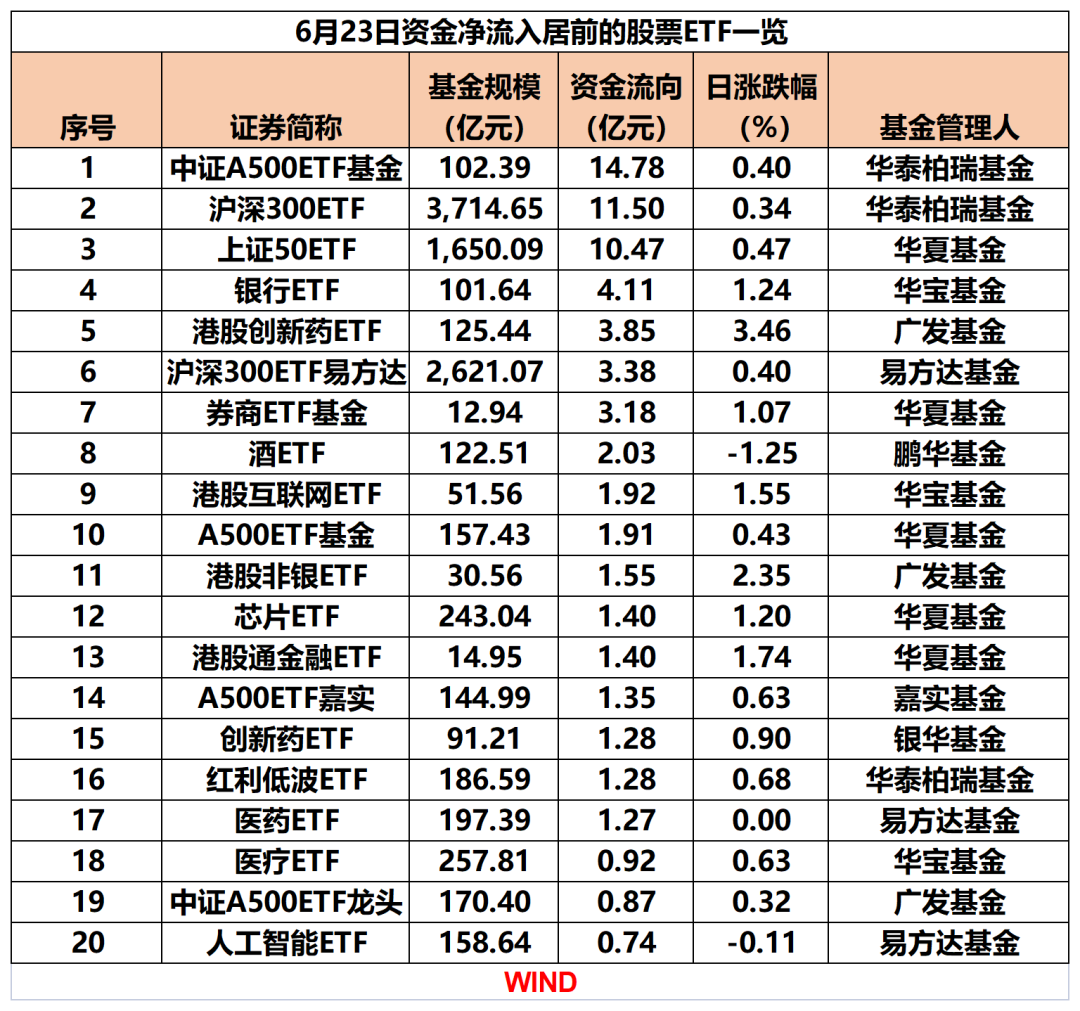
Core Viewpoint - On June 23, the stock ETF market experienced a significant inflow of over 5 billion yuan, with major indices like the CSI A500, CSI 300, and SSE 50 leading the inflow, while popular thematic ETFs such as consumption, coal, semiconductor, military industry, and information technology saw outflows [1][3]. Summary by Category Market Performance - The market showed a rebound with the Shanghai Composite Index leading the gains, particularly in sectors like cross-border payments, port shipping, military information technology, and oil and gas [3]. - The overall net inflow for stock ETFs (including cross-border ETFs) reached 51.8 billion yuan, bringing the total market size to 3.51 trillion yuan [3]. ETF Inflows and Outflows - Broad-based ETFs saw a net inflow of 29.5 billion yuan, while strategy-style ETFs experienced a net outflow of 2.71 billion yuan [3]. - The top five inflow sectors on June 23 included: - CSI A500 Index: net inflow of 20.5 billion yuan - CSI 300 Index: net inflow of 16.0 billion yuan - SSE 50 Index: net inflow of 11.1 billion yuan - Banking sector: net inflow of 5.6 billion yuan - Pharmaceutical sector: net inflow of 5.0 billion yuan [3][4]. Leading Fund Companies - E Fund's ETF had a latest scale of 626.07 billion yuan, increasing by 2.78 billion yuan, with the CSI 300 ETF seeing a net inflow of 340 million yuan and the pharmaceutical ETF 130 million yuan [3]. - Huaxia Fund's ETFs, including the SSE 50 ETF and credit bond ETF, recorded net inflows of 1.047 billion yuan and 661 million yuan, respectively [4]. Top Performing ETFs - The top five ETFs by net inflow on June 23 were: 1. CSI A500 ETF: 1.478 billion yuan 2. CSI 300 ETF: 1.150 billion yuan 3. SSE 50 ETF: 1.047 billion yuan 4. Banking ETF: 411 million yuan 5. Hong Kong Innovative Drug ETF: 385 million yuan [5]. ETFs with Significant Outflows - The ETFs with the highest net outflows included: 1. CSI 1000 ETF: -570 million yuan 2. Sci-Tech 50 ETF: -355 million yuan 3. ChiNext ETF: -275 million yuan [6]. Market Outlook - The market is expected to return to a fundamental-driven trend, influenced by growth expectations and policy dynamics, with a focus on "dividend + technology" strategies [6][7]. - The low interest rate environment and weak economic recovery are seen as favorable for dividend strategies, particularly in the Hong Kong stock market [7].
抄底!抄底!
中国基金报· 2025-06-24 07:08
【导读】单日股票 ETF 资金净流入超 50 亿元 中国基金报记者 曹雯璟 6 月 23 日,三大指数低开高走,数字货币、跨境支付等概念轮番演绎。股票 ETF (含跨境 ETF )整体资金净流入超 50 亿元,其中,中证 A500 指数、沪深 300 指数、上证 50 指数 等相关宽基 ETF 产品成为 " 吸金 " 主力, 消费、煤炭、半导体、军工、信创等热门主题 ETF 产品资金净流出居前。 单日股票 ETF 资金净流入超 50 亿元 6 月 23 日,市场震荡反弹,沪指领涨,跨境支付、港口航运、军工信息化、油气等板块涨幅 居前。 股票 ETF (含跨境 ETF )整体资金净流入 51.8 亿元,最新规模达 3.51 万亿元。 从大类型来看,宽基 ETF 净流入居前,达 29.5 亿元;策略风格 ETF 净流出居前,达 2.71 亿元。规模变化方面,宽基 ETF 规模上升 123.88 亿元。 具体到指数和板块维度, 6 月 23 日,流入前 5 板块为中证 A500 指数(净流入 20.5 亿 元)、沪深 300 指数(净流入 16.0 亿元)、上证 50 指数(净流入 11.1 亿元)、银行板 块(净 ...
跨境支付通正式上线 内地和香港居民可随时随地跨境转账
Ren Min Ri Bao Hai Wai Ban· 2025-06-24 06:47
人民日报海外版记者 徐佩玉 记者从中国人民银行获悉,跨境支付通于6月22日正式上线。在跨境支付通的支持下,内地和香港 居民可随时随地跨境转账,资金实时到账。 跨境支付通,是指将中国内地快速支付系统与其他货币当局的快速支付系统连接,制定配套政策安 排,为中国内地居民与境外居民间提供高效、便捷、安全的跨境支付服务。快速支付系统是为用户快速 支付进行清结算的零售类金融基础设施,与传统支付系统相比,其具有运行时间长以及收款人资金实时 到账的特点。 相比传统跨境汇款,与香港间的跨境支付通有哪些优势?记者了解到,与香港间的跨境支付通有效 缩短了跨境汇款链路,提高了跨境汇款效率,从技术上支持参与机构为用户提供体验更好的跨境汇款服 务。一是支持用户通过参与机构的手机银行、网上银行等渠道,依托手机号码、银行账户等,线上发起 内地与香港间人民币和港币的跨境汇款;二是支持经常项目项下一定金额内的便利化汇款实时到账;三 是相关支付基础设施直接对接,减少中间环节,降低跨境汇款成本。 中国人民银行有关负责人表示,近年来,内地和香港的经贸合作、人员往来更加紧密,内地与香港 金融管理部门顺应趋势,推出了沪港通、债券通、跨境理财通、互换通等金 ...
建信期货股指日评-20250624
Jian Xin Qi Huo· 2025-06-24 03:11
请阅读正文后的声明 报告类型 股指日评 日期 2025 年 6 月 24 日 研究员:聂嘉怡(股指) 021-60635735 niejiayi@ccb.ccbfutures.com 期货从业资格号:F03124070 研究员:何卓乔(宏观贵金属) 18665641296 hezhuoqiao@ccb.ccbfutures.com 期货从业资格号:F3008762 研究员:黄雯昕(宏观国债集运) 021-60635739 huangwenxin@ccb.ccbfutures.com 期货从业资格号:F3051589 宏观金融团队 #summary# 每日报告 一、行情回顾与后市展望 1.1 行情回顾: 6 月 24 日,万得全 A 放量上涨,开盘后一路震荡上行,超 8 成个股飘红,指 数现货方面,沪深 300、上证 50、中证 500、中证 1000 收盘分别上涨 0.29%、0.41%、 0.51%、1.31%,中小盘股表现更优。指数期货表现强于现货,IF、IH、IC、IM 主 力合约分别收涨 0.68%、0.74%、0.70%、1.01%(按前一交易日收盘价为基准计算)。 | 表1:股指期货、现货行情数据 ...
每日投行/机构观点梳理(2025-06-23)
Jin Shi Shu Ju· 2025-06-24 01:58
Group 1: Oil Market Insights - Goldman Sachs indicates that if Iran disrupts the Strait of Hormuz, Brent crude oil prices could spike to $110 per barrel, with a potential increase to $90 per barrel if Iranian oil supply decreases by 1.75 million barrels per day [1] - The report from Mitsubishi UFJ highlights that the Philippine peso, South Korean won, and Thai baht are more susceptible to rising oil prices, with a $10 per barrel increase potentially reducing Asia's current account positions by 0.2% to 0.9% of GDP [3] - Panmure Liberum warns that if the Strait of Hormuz is closed, stock markets could face a decline of 10% to 20%, with significant inflationary impacts similar to those seen in 2022 [4] Group 2: Currency and Economic Outlook - HSBC analysts express concerns over the uncertainty of U.S. policies, suggesting that the dollar may face further depreciation, with the euro expected to rise to 1.20 against the dollar by Q4 [2] - The report from Saxo Bank notes that countries heavily reliant on oil imports, such as India and Thailand, will face multiple challenges including rising energy costs and currency depreciation [2] Group 3: Investment Trends - Bank of America reports a growing interest in Japanese stocks as investors seek diversification due to high valuations in U.S. equities, despite ongoing trade uncertainties between the U.S. and Japan [2] - Citic Securities highlights the transformation of traditional cross-border payment systems, suggesting potential growth for participating banks amid a reshaping of the payment landscape [5]




九部门发文支持黄金产业高质量发展;互联网平台企业涉税报送新规落地丨盘前情报
2 1 Shi Ji Jing Ji Bao Dao· 2025-06-24 00:39
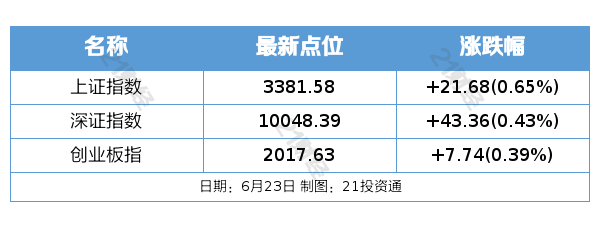
昨日A股 6月23日,市场全天震荡反弹,沪指领涨。截至收盘,沪指涨0.65%,深成指涨0.43%,创业板指涨 0.39%。沪深两市全天成交额1.12万亿,较上个交易日放量549亿。 盘面上,市场热点快速轮动,个股涨多跌少,全市场超4400只个股上涨。从板块来看,稳定币概念股再 度大涨,优博讯等涨停。港口航运股维持强势,宁波海运等涨停。固态电池概念股震荡走高,金龙羽等 涨停。板块方面,跨境支付、港口航运、军事工业信息化、油气等板块涨幅居前,白酒等少数板块下 跌。 | 名称 | 最新点位 | 、 涨跌幅 | | --- | --- | --- | | 上证指数 | 3381.58 | +21.68(0.65%) | | 深证指数 | 10048.39 | +43.36(0.43%) | | 创业板指 | 2017.63 | +7.74(0.39%) | | | 日期:6月23日 制图:21投资通 | | 隔夜外盘 纽约股市三大股指6月23日上涨。截至当天收盘,道琼斯工业平均指数比前一交易日上涨374.96点,收 于42581.78点,涨幅为0.89%;标准普尔500种股票指数上涨57.33点,收于6025.17点 ...
财信证券晨会纪要-20250624
Caixin Securities· 2025-06-24 00:21
Market Overview - The A-share market showed a positive trend with the Shanghai Composite Index closing at 3381.58, up by 0.65% [2] - The Shenzhen Component Index and the ChiNext Index also experienced gains of 0.43% and 0.39% respectively, while the North Star 50 Index rose by 1.54% [2][7] - The overall market sentiment was characterized by a rebound, particularly in the coal and port shipping sectors [9][10] Valuation Metrics - As of the latest data, the price-to-earnings (PE) ratio for the Shanghai Composite Index is 12.11, while the price-to-book (PB) ratio stands at 1.25 [3] - The ChiNext Index has a significantly higher PE ratio of 26.44 and a PB ratio of 3.69, indicating a premium valuation compared to the broader market [3][8] - The overall market valuation metrics suggest a mixed sentiment, with some sectors appearing overvalued while others remain attractive [8] Company Dynamics - Baiotai (688177.SH) has signed a licensing and commercialization agreement with SteinCares for its BAT2406 injection in Brazil and Latin America, with a total transaction value of up to $10 million [30] - Warner Pharmaceutical (688799.SH) received approval for its raw material drug listing application, indicating positive developments in its product pipeline [32] Industry Trends - The electric power industry reported a significant increase in installed capacity, with solar power capacity growing by 56.9% year-on-year [29] - The humanoid robot industry is gaining traction, highlighted by the first professional exhibition in Hangzhou, showcasing advancements and trends in robotics [26] - Tesla has initiated paid trial operations for its autonomous taxi service in Texas, marking a significant step in the development of autonomous driving technology [24]