双碳战略

Search documents
顺络电子(002138) - 2025年11月11日投资者关系活动记录表
2025-11-13 01:04
Group 1: Business Outlook - The company has a strong market position in the mobile communication sector and other consumer markets, benefiting from a recovering overall consumption market [2][3] - The company has established strategic partnerships with major domestic and international mobile manufacturers, enhancing its market share in the consumer electronics sector [2][3] Group 2: AI Data Center Development - The AI data center is a key strategic market for the company, focusing on high-precision and high-power density technologies [3] - The company provides a comprehensive product solution for AI server clients, covering various power supply needs, and has seen rapid growth in orders, especially from overseas [3] Group 3: Tantalum Capacitor Advantages - The company has developed a new series of tantalum capacitors suitable for various applications, including communications, consumer electronics, AI data centers, automotive electronics, and industrial control [3][4] - Tantalum capacitors meet the high reliability and stability requirements of automotive electronics and are recognized by major clients in high-end consumer electronics [4] Group 4: SOFC Business Progress - The company has entered the solid oxide fuel cell (SOFC) market through a joint venture, focusing on high-temperature fuel cell technology [4] - The company is optimistic about the new energy industry and aims to contribute to the long-term development of the solid oxide fuel cell sector [4] Group 5: Product Pricing Stability - The company's electronic components maintain a competitive edge comparable to global leaders, with a stable pricing structure due to strong product performance and long-term client relationships [4]

骆驼股份低压锂电业务增长近两倍 2025年前三季整体营收超121亿
Chang Jiang Shang Bao· 2025-11-12 23:44
Core Viewpoint - Camel Group (骆驼股份) is experiencing steady growth in its low-voltage lithium battery business, showcasing innovative products at the 2025 EICMA in Milan, Italy, and reporting significant financial performance improvements in recent quarters [2][3]. Financial Performance - For the first three quarters, the company reported a net profit attributable to shareholders of approximately 619 million yuan, a year-on-year increase of 26.95% [3][4]. - The operating cash flow for the same period was about 266 million yuan, reflecting a substantial year-on-year growth of 9278.8% [2]. - The total revenue for the first three quarters reached 12.142 billion yuan, marking a 7.14% increase compared to the previous year [3]. Product Development - The company has launched a new series of 64V and 76.8V lithium batteries aimed at the growing low-speed electric vehicle market, emphasizing long endurance, fast charging, and high safety [3]. - The newly showcased motorcycle starting lithium battery features high discharge rates and stability in extreme cold, ensuring reliable vehicle start-up [2]. Market Strategy - Camel Group is focusing on a dual technology path and comprehensive product coverage, with over 400 varieties and specifications of low-voltage lead-acid and lithium batteries to meet diverse power needs [3]. - The company is actively transitioning towards low-voltage lithium battery production while maintaining its lead-acid battery business [5][6]. Challenges and Adjustments - The significant decline in net profit for the third quarter is attributed to multiple factors, including reduced exchange gains and lower gross margins in the recycled lead business due to increased competition [4]. - The company plans to adjust its production and sales rhythm for recycled lead and focus on high-value-added products to enhance cost efficiency and stabilize its supply chain [4]. Future Outlook - The low-voltage lithium battery sales have seen a remarkable increase of over 30 times since 2025, driven by the rapid development of the new energy vehicle industry [5][7]. - The company aims to continue expanding its low-voltage lithium battery business through innovation, capacity expansion, and market development, while also enhancing its profit margins [6][7].


新能源将与新兴产业融合互促发展
Bei Jing Shang Bao· 2025-11-12 15:47
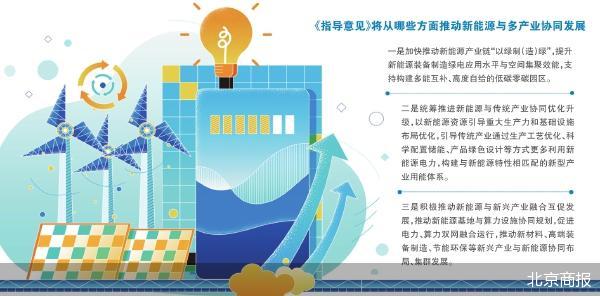
Core Viewpoint - The National Energy Administration has released guidelines to promote the integrated development of renewable energy, aiming for significant improvements in reliability and market competitiveness by 2030, supporting a comprehensive green transition in China's economic and social development [1][3]. Group 1: Integrated Development of Renewable Energy - By 2030, integrated development will become a key approach for renewable energy, enhancing reliability and market competitiveness [1]. - The guidelines emphasize the need to shift from "single-point development" to "system integration," planning and constructing wind, solar, storage, and grid systems as a cohesive unit [4]. - The focus is on creating a new ecosystem that promotes new industries through renewable energy, particularly in regions rich in renewable resources [3][4]. Group 2: Multi-Dimensional Development - The guidelines propose three main strategies: accelerating multi-dimensional integrated development of renewable energy, promoting collaboration with various industries, and encouraging diversified non-electric utilization of renewable energy [3][6]. - In resource-rich areas, there will be an emphasis on enhancing the green application of renewable energy equipment and optimizing the layout of major infrastructure [3][6]. - The integration of renewable energy with emerging industries such as new materials and high-end equipment manufacturing is encouraged to foster cluster development [3][7]. Group 3: Addressing System Consumption Pressure - The guidelines address the increasing pressure on the system to absorb renewable energy, advocating for optimized layouts and collaborative operations with traditional industries [6]. - It suggests guiding high-energy-consuming industries to areas abundant in renewable resources to achieve local consumption [6]. - Advanced grid technologies will be adopted to enhance the controllability and optimization of various renewable energy sources [6][7]. Group 4: Heating Applications and Energy Efficiency - The guidelines propose orderly advancement in the application of renewable energy for heating, particularly in industries with high thermal demands [7]. - It encourages the development of multi-energy coupling comprehensive energy supply stations using renewable energy as the main source [7]. - The integration of geothermal energy and other renewable sources with existing heating systems is also highlighted to improve efficiency [7].
新能源升级版来了!国家能源局发文,集成融合发展撬动新产业
2 1 Shi Ji Jing Ji Bao Dao· 2025-11-12 11:04
Core Viewpoint - The National Energy Administration has issued guidelines to promote the integrated development of renewable energy, emphasizing multi-dimensional integration, collaboration with various industries, and diversified non-electric utilization of renewable energy [1][2][5]. Group 1: Renewable Energy Development - Since the "14th Five-Year Plan," China's renewable energy sector has achieved significant growth, surpassing thermal power in installed capacity, marking a new development phase [2]. - The guidelines aim to create a more resilient, efficient, and sustainable renewable energy development model, addressing key issues such as high ratio consumption and high-quality development [2][5]. - By 2030, integrated development will become a crucial approach for renewable energy, enhancing reliability and market competitiveness, supporting a comprehensive green transition in the economy [5][6]. Group 2: Integration and Collaboration - The guidelines propose a structured action framework focusing on "integrated development," which includes breaking the limitations of wind and solar resources through collaboration with other energy types [5]. - The integration aims to convert renewable energy's resource advantages into industrial and economic benefits, synchronizing energy transition with industrial upgrades [5][6]. - Priority will be given to regions with high renewable energy penetration for integrated project construction, encouraging tailored implementation plans based on local resources and industrial characteristics [6]. Group 3: Smart and Emerging Industries - The guidelines highlight the importance of "intelligent" empowerment in fostering new industrial clusters, promoting the synergy between renewable energy bases and computing facilities [7]. - The integration of "power networks" and "computing networks" is encouraged to expand intelligent development scenarios, particularly in manufacturing regions [7]. - New business models such as green electricity direct connection and smart microgrids are proposed to create low-carbon parks, enhancing local load stability and supporting industrial upgrades [7]. Group 4: Non-Electric Utilization - A significant focus of the guidelines is on promoting diversified non-electric utilization of renewable energy, particularly in sectors like transportation, chemicals, and textiles [8]. - The development of green hydrogen and ammonia, as well as renewable heating applications, is emphasized as a key breakthrough direction for integrating supply and consumption [8]. - The guidelines support the construction of hydrogen-based energy industries and the exploration of renewable heating models in various scenarios, aiming to reduce reliance on the main power grid [8].
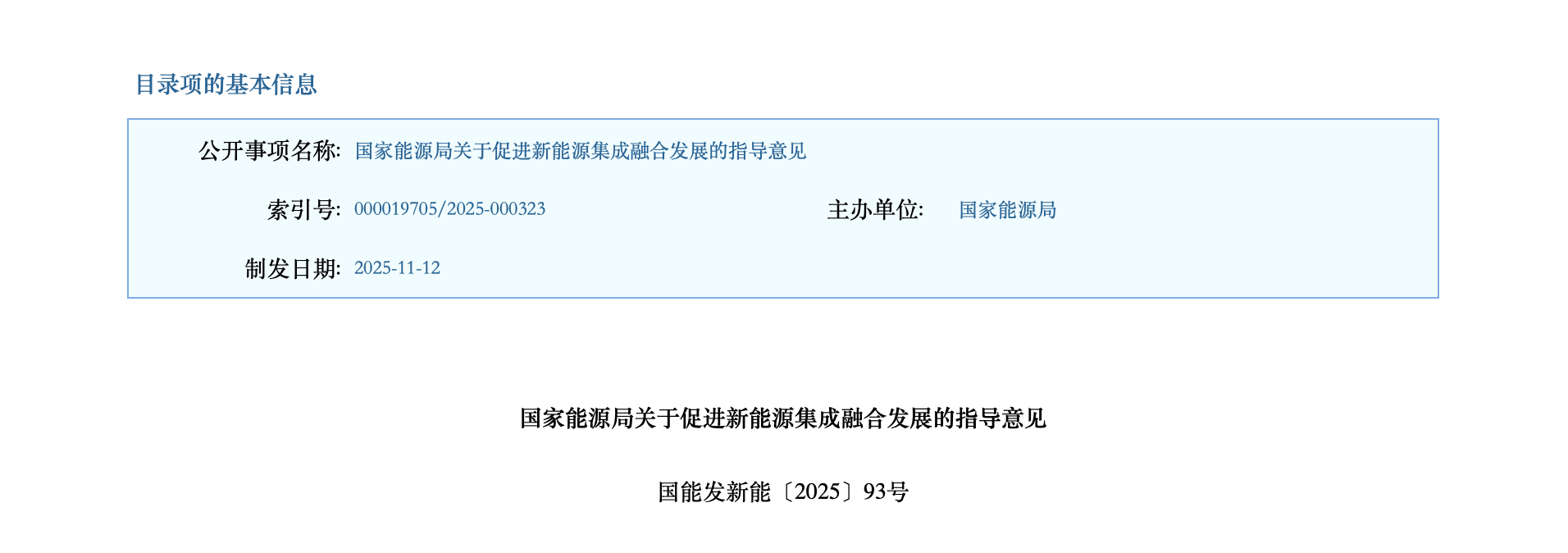
国家能源局:优化“沙戈荒”储能比例,探索新能源集成融合项目纳入容量补偿
中关村储能产业技术联盟· 2025-11-12 08:17
Core Viewpoint - The article emphasizes the importance of integrated and collaborative development in the renewable energy sector, aiming for significant improvements in reliability and market competitiveness by 2030, which will support a comprehensive green transition in the economy and society [6][7]. Group 1: Overall Requirements - The guidance is aligned with Xi Jinping's thoughts and aims to implement the new development philosophy, focusing on system integration and one-time development to enhance the reliability and stability of energy supply [7]. - By 2030, integrated development will become a key approach in renewable energy, significantly enhancing its reliability and market competitiveness [7]. Group 2: Accelerating Multi-Dimensional Integrated Development - The article calls for optimizing the power structure and energy storage configuration of renewable energy bases, encouraging the use of thermal power and new storage technologies to enhance collaboration between renewable and coal power [9]. - It supports the establishment of 100% renewable energy bases in suitable regions and promotes the integrated development of water, wind, and solar energy [9][10]. Group 3: Promoting Integrated Operation of Renewable Energy - Continuous improvement in the accuracy of renewable energy power forecasting and the adoption of advanced grid technologies are encouraged to enhance the controllability of renewable energy [12]. - The article advocates for the integration of renewable energy with energy storage systems and the exploration of substantial joint operations with other power sources to improve market competitiveness [12]. Group 4: Promoting Synergistic Development with Multiple Industries - The guidance suggests enhancing the green manufacturing capabilities of the renewable energy industry and promoting the integration of renewable energy with traditional industries to optimize energy consumption and reduce costs [13][14]. - It encourages the development of new energy industries, such as green hydrogen and ammonia, in resource-rich areas, promoting the establishment of comprehensive industrial bases [16]. Group 5: Strengthening Organizational Support - The article emphasizes the need for coordinated project construction and management, encouraging local energy authorities to enhance collaboration and ensure the smooth execution of renewable energy projects [19]. - It also highlights the importance of optimizing investment and development management processes for renewable energy integration projects [20].

聚力制造业“固本强基” 推动泰州海陵冲击“千亿主城”
Yang Zi Wan Bao Wang· 2025-11-12 07:19
Core Viewpoint - The news highlights the achievements and future plans of the Hailing District in Taizhou, focusing on the implementation of the "Industrial Strong District" strategy during the 14th Five-Year Plan and the ambition to become a "Thousand Billion Main City" in the upcoming 15th Five-Year Plan [1]. Group 1: Industrial Development - The Hailing District aims to achieve an industrial output value of 61 billion yuan and an industrial added value of 9.05 billion yuan in 2024, showcasing the resilience and vitality of its industrial economy [1]. - The district has strengthened its industrial capabilities by aligning with the provincial "1650" industrial system and focusing on advanced manufacturing clusters [1]. Group 2: Key Industries - The "New" sector includes new energy and new materials, with a focus on seizing opportunities from the "dual carbon" strategy, exemplified by the introduction of key enterprises like TaiZhou Longi [2]. - The automotive and motorcycle parts industry has over 100 related enterprises, with a scale nearing 10 billion yuan, indicating a vibrant sector with traditional companies exploring new transformation directions [2]. - The smart home and appliance industry is represented by LG Electronics, which has become the largest refrigerator production base for LG outside Korea, fostering a cluster of over 30 supporting enterprises [2]. - The digital economy is evolving from technology research and development to application scenarios, attracting quality projects and nurturing benchmark companies like YunYong Electronics [2]. Group 3: Innovation and Transformation - The Hailing District is committed to building a robust innovation ecosystem by integrating technology and industrial innovation, focusing on a "cultivation-transformation-upgrade" model [3]. - The district emphasizes the importance of infrastructure development, result transformation, and innovation to stimulate growth and enhance the capabilities of enterprises [3].
中国华能、中国中化、中国大唐、中国华电、中核集团、中国石油……能源央企加快向雄安集聚
中国能源报· 2025-11-12 04:04
Core Viewpoint - The article highlights the accelerated gathering of energy state-owned enterprises (SOEs) in Xiong'an New Area, driven by supportive services and the need for transformation towards clean energy and integrated energy services [1][3]. Group 1: Energy SOEs Migration - Major energy SOEs such as China Huaneng and China Sinochem have relocated their headquarters to Xiong'an New Area, while others like China Datang and China Huadian are fast-tracking their headquarters construction [1][3]. - Over 100 secondary and tertiary subsidiaries or innovative business units of energy SOEs have established operations in Xiong'an, indicating a significant shift in the energy industry landscape [3]. Group 2: Clean Energy Projects - The Hebei Huadian Xiong'an Wild Park 3MW distributed photovoltaic project is the first initiative by China Huadian in Xiong'an, showcasing a blend of zero-carbon education and landscape integration [3]. - The project has generated over 4.5 million kilowatt-hours of electricity, providing stable clean energy support while harmonizing with the natural scenery [3]. Group 3: Market-Oriented Service Innovations - Xiong'an New Area has implemented innovative market-oriented service measures to streamline the decision-making process for SOEs, establishing regular strategic department meetings to enhance communication [5]. - A comprehensive service system has been created to support the entire lifecycle of SOE projects, integrating various policies into a dedicated service package for the energy industry [5].




2025年中国海上风电基础结构行业补贴政策、产业链、市场规模、代表企业经营现状及发展趋势研判:受益于海风行业发展,市场规模有望达到118亿元[图]
Chan Ye Xin Xi Wang· 2025-11-12 01:30
Core Insights - The global offshore wind foundation market is experiencing robust growth, with a projected market size of 31.9 billion yuan in 2024 and an expected increase to 42.4 billion yuan in 2025 [1][8] - The monopile foundation segment dominates the market, accounting for 81.19% of the total market size in 2024 and is expected to decrease to 71.70% by 2025 [1][8] - China's offshore wind power industry is poised for explosive growth, with an anticipated new installed capacity of 5.62 GW in 2024 and 7.7 GW in 2025 [6][9] Offshore Wind Foundation Industry Definition and Classification - Offshore wind foundations are critical structures that support wind turbines and connect to the tower, categorized into monopile, jacket, suction bucket, and floating foundations [2][4] - Monopile foundations are the most widely used and hold a significant market share in the offshore wind sector [10] Industry Development Environment - Subsidy Policies - China's offshore wind power has entered a crucial development phase, with various provinces setting ambitious installation targets for the 14th Five-Year Plan, totaling 57.99 GW [4][6] Current Industry Status - The global offshore wind foundation market is driven by energy transition and carbon neutrality goals, with a new installed capacity of 8 GW in 2024 and an expected 16.3 GW in 2025 [6][8] - In China, the offshore wind foundation market is projected to reach 8.9 billion yuan in 2024 and 11.8 billion yuan in 2025 [9][10] Industry Value Chain - The upstream of the offshore wind foundation industry includes raw materials like steel, flanges, and cables, while the midstream focuses on design, manufacturing, and installation [10] - The downstream involves operation and maintenance services for offshore wind farms, catering to developers and operators [10] Competitive Landscape - Major companies in the offshore wind foundation sector include Jiangsu Haili Wind Power Equipment Technology Co., Ltd., Dajin Heavy Industry Co., Ltd., and Tiensun Wind Power [10][11] - Haili Wind Power is a leading player in the domestic market, focusing on monopile and tower production [11][12] - Dajin Heavy Industry has a significant market presence in Europe, with a market share increase from 18.5% in 2024 to 29.1% in the first half of 2025 [12] Industry Development Trends - The offshore wind foundation maintenance is transitioning from experience-driven to data-driven and intelligent approaches, enhancing operational efficiency and safety [14] - Future developments will focus on smart, unmanned, and sustainable solutions as nearshore resources become saturated [14]





投资中国 绿色低碳产业对接活动成功举办
Shang Wu Bu Wang Zhan· 2025-11-11 14:31
Core Insights - The event "Investment in China: Green Low-Carbon Industry Matching Activity" was successfully held during the 8th China International Import Expo, aiming to implement the national "dual carbon" strategy and promote international cooperation in the green low-carbon industry [1] - The Chinese government emphasizes the importance of foreign investment in the green low-carbon sector, highlighting the country's role in the global green transition and the opportunities it presents for foreign enterprises [1] - The event featured discussions on policies, technical paths, and experiences related to zero-carbon park development, showcasing the collaborative efforts between government and industry [2][3][4] Group 1 - The event was organized by the Ministry of Commerce, with participation from nearly 50 representatives from Fortune 500 companies, multinational corporations, and leading domestic enterprises [1] - The Ministry of Commerce's official stated that the green low-carbon industry has become a significant growth point for foreign investment in China, which has a complete industrial chain and vast market space [1] - The event included a policy interpretation session where the National Development and Reform Commission discussed the "1+N" policy framework supporting zero-carbon park construction [2] Group 2 - The session featured insights from various experts on the technical paths and evaluation standards for ecological industrial park construction, emphasizing the need for carbon emission monitoring and resource recycling [2] - Representatives from different economic and technological development zones shared their experiences in transitioning to zero-carbon practices and the challenges they face [3] - A roundtable discussion involved executives from multinational companies and domestic enterprises, focusing on zero-carbon park planning, energy management, and green finance, facilitating a deeper understanding of market opportunities [4]

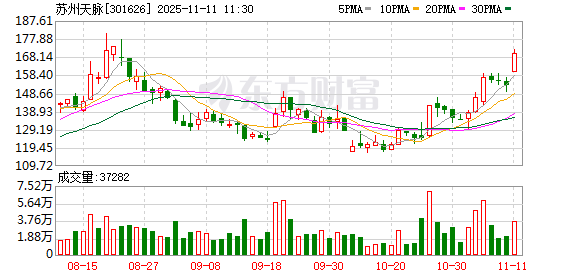
苏州天脉导热散热产品智能制造基地开工奠基 加码高端均温板散热市场
Zheng Quan Ri Bao· 2025-11-11 03:37
Core Insights - Suzhou Tianmai Thermal Technology Co., Ltd. has commenced the construction of a new intelligent manufacturing base for thermal dissipation products with a total planned investment of 1.7 billion yuan, aimed at enhancing its market position in the high-end thermal dissipation sector [2] - The new base will focus on increasing the production capacity of high-end uniform temperature plates and will incorporate advanced automation production equipment and digital management systems [2][3] - The project is expected to produce 30 million high-end uniform temperature plates annually upon reaching full capacity [2] Company Overview - Suzhou Tianmai has over 18 years of experience in the thermal dissipation field, offering a diversified product matrix that includes heat pipes, uniform temperature plates, thermal pads, and phase change materials [3] - As of September 2025, the company and its subsidiaries have obtained a total of 100 authorized patents, including 17 invention patents, showcasing significant technological achievements [3] Industry Impact - The establishment of the new base is anticipated to drive collaborative development within the regional industrial chain and inject new momentum into the intelligent manufacturing industry cluster in Suzhou's Wuzhong District [3] - The company aims to contribute to the green upgrade of the technology industry through innovation-driven development [3]