
科技金融

Search documents
平安银行深耕科技金融赛道 从信贷投放到生态赋能全周期护航
Xin Hua Cai Jing· 2025-12-11 11:44
Core Viewpoint - The article highlights the acceleration of policy dividends transforming into robust momentum for the development of the technology innovation industry, emphasizing the importance of financial institutions in supporting the real economy and fostering new productive forces [1]. Group 1: Financial Support for Technology Enterprises - Ping An Bank has deepened its technology finance operations, serving 28,900 technology enterprise clients as of September 2025, a 9.5% increase from the previous year, with a technology loan balance of 297.53 billion yuan, up 6.6% [1]. - The bank provided a 17 million yuan working capital loan to Shenzhen "Yan Yi New Materials," which was later increased to 200 million yuan to support the company's expansion as it ramped up production and faced increased demand for raw materials [2]. - For Shandong Luch New Materials, Ping An Bank offered a comprehensive credit of 30 million yuan and approved a project loan of 175 million yuan to support the company's growth during a critical period [3]. Group 2: Comprehensive Financial Services - Ping An Bank is building a diversified financial service system that aligns with the full lifecycle financing needs of technology enterprises, moving beyond just funding to include supply chain coordination and operational support [4]. - The bank is also focusing on cross-border financing and settlement services to support companies like Luch New Materials as they expand into international markets [4]. - For mature technology enterprises like Zhuhai Jianfan Group, Ping An Bank is providing integrated financial solutions that encompass corporate, retail, and industrial services to meet their complex financial needs [5]. Group 3: Strategic Initiatives and Policy Support - The joint issuance of policies by seven departments aims to strengthen the technology finance system, with 275,400 technology SMEs receiving loan support by the end of Q3 2025, achieving a loan approval rate of 50.3%, an increase of 2.8 percentage points year-on-year [6]. - The "14th Five-Year Plan" emphasizes building a modern industrial system and highlights the importance of technology finance as a strategic task [6]. - Ping An Bank plans to elevate technology finance to a strategic position within the bank, focusing on sectors such as biomedicine, high-end manufacturing, and new materials, to drive innovation and support technology enterprises in overcoming challenges [7].

40.8亿元 中科创星先导创业投资基金完成终关募集
Zheng Quan Ri Bao Wang· 2025-12-11 11:16
Core Viewpoint - Zhongke Chuangxing Technology Investment Co., Ltd. has successfully raised a total of 4.08 billion yuan for its Zhongke Chuangxing Pioneer Venture Capital Fund, focusing on early-stage investments in hard technology sectors, with 46 investments completed to date [1][5]. Group 1: Fundraising and Partnerships - The fund's first closing was completed on July 16, with 19 limited partners (LPs) including notable institutions such as the National SME Development Fund and Ant Group, reflecting strong recognition of long-term investment in hard technology [2][3]. - The addition of new LPs like Taibao Capital and Fudan University’s Innovation Fund enhances the fund's ability to address the funding gap in early-stage hard technology projects and facilitates direct connections between research outcomes and capital markets [2][3]. Group 2: Investment Strategy and Performance - The fund has made 46 investment decisions within six months of its first closing, with over 90% of these investments targeting early-stage projects, particularly those emerging from research institutions and universities [5][6]. - Investment focus areas include artificial intelligence, biotechnology, and disruptive technologies such as quantum computing and controlled nuclear fusion, positioning the fund at the forefront of technological innovation [6][7]. Group 3: Ecosystem Development - Zhongke Chuangxing is committed to building a nurturing ecosystem for hard technology innovation, having established a public technology service platform for optoelectronic chip packaging and testing [7][8]. - The company has successfully incubated six unicorns and numerous specialized enterprises, demonstrating its role as a significant incubator and accelerator in Beijing's hard technology sector [7][8]. Group 4: Future Outlook - The fund aims to leverage its successful fundraising to cultivate more "from 0 to 1" hard technology champion enterprises, contributing to China's global competitiveness in the hard technology industry [9].

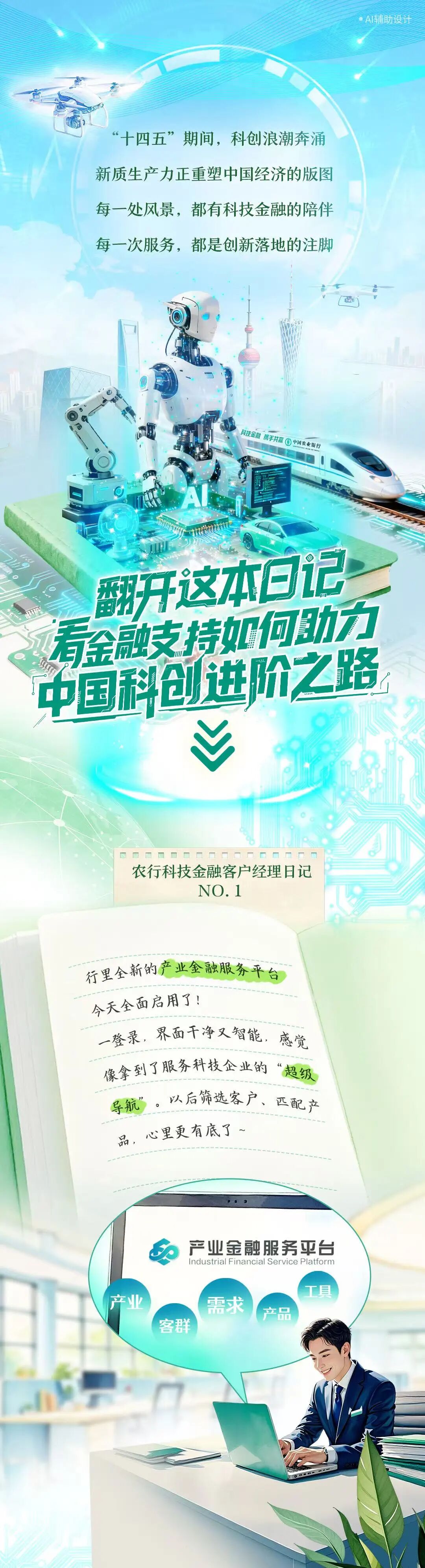
数说“十四五”成绩单,看金融之笔如何绘就科技新图景
2 1 Shi Ji Jing Ji Bao Dao· 2025-12-11 10:44
Core Viewpoint - The article highlights the rapid development of China's technology-driven economy during the "14th Five-Year Plan" period, emphasizing the role of financial services in supporting innovation and the growth of technology enterprises [1][6][26]. Group 1: Industry Development - During the "14th Five-Year Plan," China's robotics industry is accelerating, with the country expected to account for two-thirds of global robot patent applications by 2024 [6]. - Over 100,000 specialized and innovative small and medium-sized enterprises (SMEs) have been added since the beginning of the "14th Five-Year Plan," totaling over 140,000, with more than 14,600 recognized as "little giant" enterprises [11]. - The annual growth rate of loans to technology SMEs has exceeded 20% during the "14th Five-Year Plan" period [18]. Group 2: Financial Services Initiatives - Agricultural Bank of China (ABC) has established a dedicated credit service system for technology enterprises, focusing on diverse financial needs and a comprehensive evaluation system based on future repayment capabilities [6][26]. - As of September 2025, ABC has collaborated with over 70% of the "little giant" enterprises, with a total technology loan balance exceeding 4.7 trillion yuan [15][12]. - ABC has issued 8.255 billion yuan in "Kejie Loan" to 2,175 technology SMEs, providing timely financial support for their development [18]. Group 3: Policy Support - The People's Bank of China and other ministries have jointly established a policy tool for technology innovation and technological transformation re-loans, aimed at supporting early-stage and growth-stage technology SMEs [21]. - By September 2025, ABC has provided approximately 24 billion yuan in funding support to over 10,000 enterprises on the re-loan list, effectively reducing financing costs for technology enterprises [22].


现代化新广东,金融正在场
盐财经· 2025-12-11 10:30
Group 1 - The article emphasizes Guangdong's role as a pioneer in reform and opening up, focusing on the integration of technological and industrial innovation to build a modern industrial system and promote high-quality development [2] - The article highlights the importance of financial support in facilitating technological advancements and the transformation of industries, particularly through the example of Guangdong Stanno Intelligent Equipment Co., which has benefited from innovative financing solutions [4][6] - The Construction Bank of Guangdong Province has actively engaged in providing financial resources to key industries, with a focus on technology-driven enterprises, resulting in significant loan disbursements and support for modernization projects [9] Group 2 - The article discusses the impact of financial products like "High-Quality Technology Quick Loan" on companies facing funding challenges, showcasing a case where a loan led to a 23% increase in production efficiency [7] - It mentions the bank's efforts to support the manufacturing sector, with over 3,000 billion yuan in loans allocated to manufacturing enterprises, and highlights specific projects that have improved energy efficiency and reduced costs [9] - The article outlines the bank's initiatives to stimulate consumer spending through various financial products and promotional activities, contributing to economic growth and enhancing consumer experiences [12][15] Group 3 - The article details the bank's commitment to rural development and agricultural modernization, with significant loan allocations to support local agricultural enterprises and infrastructure projects [18][20] - It highlights the bank's role in promoting the integration of agriculture, culture, and tourism, which has led to increased income for local farmers and the establishment of modern agricultural practices [19] - The bank's financial services have expanded to cover a wide range of sectors, ensuring comprehensive support for both urban and rural development, with a focus on enhancing living conditions and economic opportunities [20]

数说“十四五”成绩单,看金融之笔如何绘就科技新图景
21世纪经济报道· 2025-12-11 10:13
Core Viewpoint - The article emphasizes the rapid development of China's technology-driven economy during the "14th Five-Year Plan" period, highlighting the role of financial services in supporting innovation and the growth of technology enterprises [1][5][27]. Group 1: Development of Technology Enterprises - During the "14th Five-Year Plan," China's robot industry is accelerating, with the number of robot patent applications expected to account for two-thirds of the global total by 2024 [5]. - Over 100,000 specialized and innovative small and medium-sized enterprises (SMEs) have been added since the beginning of the "14th Five-Year Plan," with a total exceeding 140,000, including over 14,600 "little giant" enterprises [9]. - As of September 2025, Agricultural Bank of China (ABC) has collaborated with over 70% of these specialized and innovative "little giant" enterprises [9]. Group 2: Financial Services for Technology Enterprises - ABC has established a dedicated credit service system for technology enterprises, focusing on diverse financial needs and building a comprehensive evaluation system centered on future repayment capabilities [5]. - The annual growth rate of loans to technology SMEs has exceeded 20% during the "14th Five-Year Plan" period [17]. - By September 2025, ABC has issued "Kejie Loans" totaling 8.255 billion yuan to 2,175 technology SMEs [17]. Group 3: Supportive Policies and Initiatives - The People's Bank of China and other ministries have jointly established a policy tool for technology innovation and technological transformation re-loans, aimed at supporting early-stage and growth-stage technology SMEs [21]. - As of September 2025, ABC has provided approximately 24 billion yuan in funding support to over 10,000 enterprises on the re-loan list, effectively reducing financing costs for technology enterprises [22]. Group 4: Future Outlook - ABC aims to continue enhancing the breadth, depth, and warmth of its technology financial services, contributing to high-level technological self-reliance and modernization in China [27].
上海科创金融联盟全体会议发布多项成果
Xin Lang Cai Jing· 2025-12-11 09:31
Group 1 - The Shanghai Science and Technology Innovation Financial Alliance held its annual meeting for 2025, with participation from various government and financial institutions [1][3] - The People's Bank of China, Shanghai Municipal Government, and other departments jointly issued a notice to promote the "Shanghai Science and Technology Credit" initiative, encouraging financial institutions to use "Science and Technology Points" as a key evaluation metric for corporate innovation capabilities [1][3] - At the meeting, banks in Shanghai launched related products under the "Shanghai Science and Technology Credit" initiative and presented 26 typical cases of technology finance, covering seven areas of practice exploration [1][3] Group 2 - The Shanghai Science and Technology Innovation Financial Alliance is enhancing a multi-participant, win-win operational mechanism and has organized various technology finance activities to support high-quality development of "gazelle" and "unicorn" enterprises [2][4] - The People's Bank of China, Shanghai Headquarters, will continue to guide the alliance in exploring new technology finance products and services, contributing to Shanghai's goal of becoming a globally influential technology innovation hub [2][4] - The meeting emphasized the importance of collaboration among alliance members for information sharing, resource complementarity, and business synergy [2][4]
学习宣贯党的二十届四中全会精神 书写金融强国“理财答卷”
2 1 Shi Ji Jing Ji Bao Dao· 2025-12-11 09:08
兴银理财深刻认识到,要深刻理解把握"十五五"时期经济社会发展的战略任务和重大举措,对标对表重 大部署,找准工作着力点,将学习成果转化为发展共识与行动合力。 党的二十届四中全会将"高质量发展取得显著成效"作为"十五五"时期经济社会发展的主要目标之首,而 发展新质生产力是实现这一目标的核心路径。银行理财是连接金融与实体的重要纽带,做好以科技金融 为首的金融"五篇大文章"更是培育新质生产力的重要支撑。发展新质生产力是推动高质量发展、赢得大 国博弈战略主动的内在要求,也为新时代金融工作划定了核心赛道、指明了实践路径。 (原标题:学习宣贯党的二十届四中全会精神 书写金融强国"理财答卷") 党的二十届四中全会系统擘画了未来五年国家发展的宏伟蓝图,更为金融行业高质量发展提供了根本遵 循、注入了强劲动力。 迅速掀起学习热潮,凝聚发展共识 兴银理财将学习宣贯全会精神作为当前和今后一个时期的重大政治任务,精心部署组织多形式、分层 级、全覆盖的学习宣传。公司党委组织召开党委扩大会议专题学习,各支部通过"三会一课"、主题党日 等多种形式开展学习。同时,公司党委组织召开党外人士座谈会,与群众代表和民主党派员工代表共同 学习研讨,并将全 ...

践行金融“五篇大文章”:平安融易以“三省”服务精准滴灌江苏实体经济
Cai Fu Zai Xian· 2025-12-11 09:01
Core Viewpoint - The article emphasizes the role of finance as a vital engine for the economy, highlighting the importance of developing various types of finance, including technology finance, green finance, inclusive finance, pension finance, and digital finance, to support the real economy and innovation [1] Group 1: Financial Services Innovation - Ping An Rongyi focuses on serving national strategies by advancing financial "five major articles" through technological innovation and personalized services [1] - The company utilizes AI, big data, and blockchain to create a "technology + finance" dual-drive model, enhancing service efficiency and promoting intelligent and scenario-based financial services [1] - The service philosophy of "saving worry, time, and money" integrates cutting-edge technology throughout the service process, aiming for a win-win vision of inclusive finance [1] Group 2: Support for Small and Micro Enterprises - Ping An Rongyi employs a "three savings" service concept to provide full-cycle financing support for small and micro enterprises, exemplified by a case where a client received 747,000 yuan in financing during peak sales seasons [2] - The company’s AI-driven "Xingyun 2.0" system allows 95% of small micro clients to obtain loans within 1.3 hours, significantly reducing processing time and enhancing decision-making accuracy [2] - Digital risk control and intelligent credit assessment align financing services with the growth pace of enterprises, showcasing the effectiveness of digital inclusive finance [2] Group 3: Green Finance Initiatives - Traditional industries are under pressure to transform, with a case study highlighting a client transitioning from plastic recycling to green plant cultivation, supported by a 250,000 yuan loan from Ping An Rongyi [3] - The company actively supports small micro enterprises in green transformation through flexible and efficient financial services, reflecting its social responsibility in promoting environmental sustainability [4] - Ping An Rongyi's offline consulting team focuses on key sectors such as clean energy and infrastructure upgrades, providing tailored financial support to meet the funding needs of small micro enterprises [4] Group 4: Future Directions - The company aims to deepen green finance innovation to contribute to the "dual carbon" goals and high-quality development, maintaining its commitment to serving small micro enterprises [4] - Ping An Rongyi will continue to integrate the "three savings" service concept into professional engagements, ensuring precise financial support reaches critical areas of the economy [4] - The company is dedicated to leveraging technology and personalized service to assist small micro enterprises in achieving sustainable growth, contributing to the modernization of China's financial landscape [4]
为何他们这么早,就敢于押注“杭州六小龙”?
Jin Rong Shi Bao· 2025-12-11 07:53
Core Viewpoint - The article highlights the journey of Yundongchu, a robotics company, from a university lab to becoming a leader in the quadruped robot sector in China, emphasizing the role of financial support in its growth and innovation ecosystem [1][2]. Company Overview - Yundongchu, established in 2017, has achieved an 85% market share in the power inspection sector and over 90% in emergency firefighting, with operations in 34 provinces and 44 countries [1]. - The company faced significant challenges post-B round financing, including long order payment cycles and cash flow issues due to mismatched payment terms with suppliers [2]. Financial Support Mechanism - Hangzhou Bank provided a crucial 5 million yuan credit loan to Yundongchu, which was pivotal for the company's survival during tough times [2]. - The bank's approach involved assessing the company's technology and team reliability, akin to an investor's perspective, to ensure the company's sustainability [2]. Innovative Financing Models - The "Zheke United Loan" model was introduced to address the challenges of traditional bank lending, focusing on shared information, risk-sharing, resource complementarity, and policy coordination among banks [3][4]. - This model allows for higher credit limits for leading companies like Yundongchu, with loan ceilings exceeding 50 million yuan and up to 200 million yuan for star projects [4]. Broader Financial Ecosystem - Since the launch of the "Zheke United Loan," 27 banks in Zhejiang have participated, providing a total of 10.87 billion yuan in loans to 197 enterprises [5]. - The article discusses various regional initiatives across China aimed at enhancing financial support for technology and innovation, including the "Common Growth Plan" in Anhui and "Instrument Loans" in Jiangsu [7][8]. Future Directions - The financial landscape is evolving, with a shift from traditional lending to a more integrated approach that includes diverse financial products and services tailored to the needs of technology enterprises [10][11]. - The role of financial institutions is transforming from mere fund providers to partners in innovation, emphasizing the importance of collaboration between policy, finance, and technology [11].

中国进出口银行北京分行赴中关村机器人产业创新中心开展现场教学
Zhong Guo Jin Rong Xin Xi Wang· 2025-12-11 07:48
Group 1 - The core viewpoint of the news emphasizes the importance of integrating technology and finance to enhance the service capabilities of national strategies and promote the development of new productive forces [1][2] - The Beijing branch of the China Export-Import Bank organized a field study at the Zhongguancun Robot Industry Innovation Center to deepen understanding of the robotics industry and its innovation ecosystem [1] - Participants observed various types of robots and learned about the integration of soft and hard technologies, as well as the current status of key component breakthroughs and applications in multiple scenarios [1] Group 2 - The field study is part of the Beijing branch's initiative to strengthen professional capacity building by linking theory with practice [2] - The immersive learning experience helped employees clarify the intrinsic relationship between technological innovation and industrial development, enhancing their professional judgment in high-tech industries [2] - The Beijing branch plans to convert the learning outcomes into specific strategies for optimizing financial services, focusing on the characteristics of technology-based enterprises and providing high-quality policy-based financial support [2]
