
产业升级

Search documents
格隆汇2026下注中国十大核心资产之万华化学
Ge Long Hui· 2026-01-05 10:52
Core Viewpoint - Wanhua Chemical has been selected as a core asset in the chemical industry for the "Betting on China" initiative, driven by a recovery in the global chemical sector and strong growth potential in emerging industries such as new energy vehicles and semiconductors [1] Industry Background - The global chemical industry is expected to enter a recovery phase by the end of 2025, with net profit growth projected at 15%-20% in 2026, significantly benefiting leading companies like Wanhua Chemical [2] Key Opportunities in 2026 - The MDI industry is set for an upswing, with global MDI capacity at 8.5 million tons and demand at 8.2 million tons in 2025, leading to enhanced pricing power for Wanhua Chemical [3] - Emerging materials are expected to see explosive growth, with global demand for lithium iron phosphate exceeding 10 million tons and significant opportunities in semiconductor materials and bio-based materials [3] - Wanhua's global presence, with over 50% of revenue from overseas, positions it well to benefit from international demand recovery and pricing strategies [3] Fundamental Analysis - Wanhua Chemical has diversified its business beyond traditional cyclical reliance, achieving stable growth through its "three-horsepower" strategy [4] - The polyurethane segment generated revenue of 55.14 billion yuan in the first three quarters of 2025, maintaining a high gross margin of 26% [4] - The petrochemical segment has become the largest business unit, with revenue of 59.32 billion yuan, benefiting from cost reductions and raw material efficiency [5] - The emerging materials segment, contributing 23.81 billion yuan, includes high-value products that reduce cyclical dependency [5] Core Competitiveness - Wanhua Chemical's leadership is supported by four key barriers: advanced technology, scale advantages, a complete industrial chain, and a global footprint [6] - The company holds leading positions in MDI and TDI production, with a global market share exceeding 30% in MDI [6] Investment Appeal - Wanhua Chemical's current P/E ratio of 19.29 is below the average for global chemical leaders, indicating significant valuation recovery potential [7] - Projected net profit for 2026 is expected to reach 18-20 billion yuan, driven by growth across all business segments [7] - The company represents a dual opportunity for investment, combining cyclical recovery with growth potential in emerging sectors [7]

中上协发布丨2025年A股上市公司市值表现报告:5469家A股上市公司总市值123万亿元
Xin Lang Cai Jing· 2026-01-05 09:37
Overall Market Performance - In 2025, the A-share market saw a significant increase, with the Shanghai Composite Index rising from 3351.76 points at the beginning of the year to 3968.84 points by year-end, reflecting an 18.4% year-on-year growth [4][18] - The total number of A-share listed companies reached 5469 by the end of 2025, with a total market capitalization of 123 trillion yuan, marking a 22.5% increase for existing companies compared to the previous year [4][18] - The average price-to-book ratio of A-share companies increased from 3.3 at the beginning of the year to 4.4 by year-end, indicating a steady rise in market valuation [4][18] Industry Performance - Technology-driven industries, particularly high-tech manufacturing and scientific research, experienced substantial market capitalization growth, with total market values increasing by 33.3% and 32.1% respectively [5][18] - Nearly half of the listed companies in manufacturing and scientific research sectors reported a return on equity (ROE) greater than 5%, providing a solid foundation for valuation support [5][18] - Private technology companies showed remarkable performance, with an overall market capitalization growth of 37.0%, increasing their share of the A-share market from 33.6% to 37.5% [5][18] Company-Specific Performance - The top 150 companies by absolute market capitalization growth included major players such as Agricultural Bank of China, Industrial Fulian, and Contemporary Amperex Technology, indicating strong performance across various sectors [20] - The financial sector, represented by companies like Agricultural Bank and Industrial Bank, played a significant role in the overall market growth, reflecting investor confidence in the banking industry [21] - Companies in the manufacturing sector, such as Industrial Fulian and Contemporary Amperex Technology, demonstrated significant market value increases, highlighting the sector's contribution to the overall market performance [21]







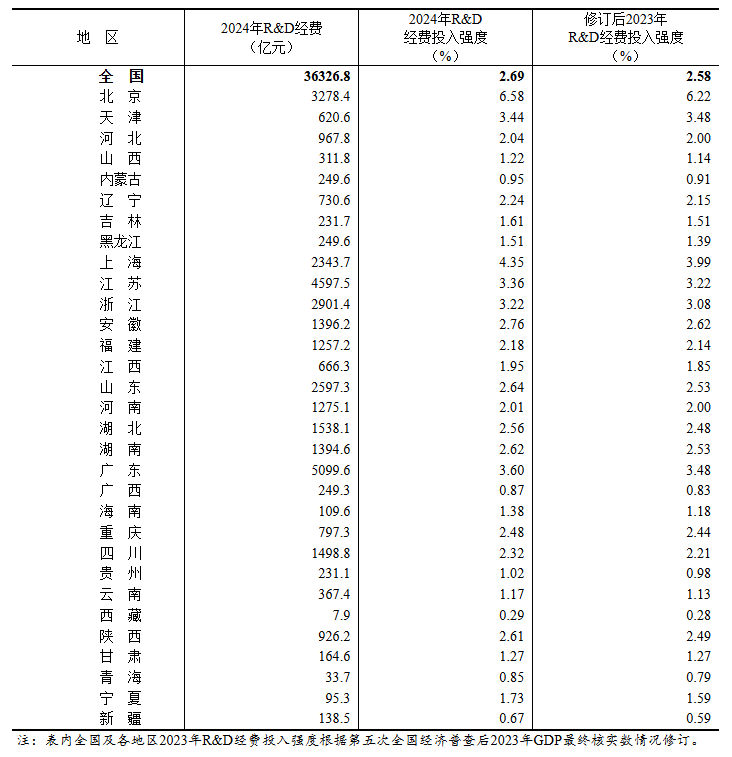
广东研发经费“九连冠” :投入破5000亿,强度超欧盟
2 1 Shi Ji Jing Ji Bao Dao· 2026-01-05 08:21
| | 2024年R&D经费 | 2024年R&D 经费投入强度 | 修订后2023年 R&D经费投入强度 | | | --- | --- | --- | --- | --- | | 地 区 | (亿元) | | | | | | | (%) | (%) | | | 全 国 | 36326.8 | 2.69 | | 2.58 | | 北 京 | 3278.4 | 6.58 | | 6.22 | | 天 津 | 620.6 | 3.44 | | 3.48 | | 河 北 | 967.8 | 2.04 | | 2.00 | | 山 西 | 311.8 | 1.22 | | 1.14 | | 内蒙古 | 249.6 | 0.95 | | 0.91 | | 辽 宁 | 730.6 | 2.24 | | 2.15 | | 吉 林 | 231.7 | 1.61 | | 1.51 | | 黑龙江 | 249.6 | 1.51 | | 1.39 | | 上 海 | 2343.7 | 4.35 | | 3.99 | | 江 苏 | 4597.5 | 3.36 | | 3.22 | | 浙 江 | 2901.4 | 3.22 | ...
力促产业升级共谋区域发展,京苏两地业内人士在扬州深度研讨“苏超”运营
Yang Zi Wan Bao Wang· 2026-01-05 07:58
Core Insights - The meeting held by Yangzhou Canal Cultural Investment Group on January 4 aims to integrate event economy with regional development through the "Su Chao" football event [2][3] - The event attracted 15 participating companies focusing on eight core areas including ticket sales, advertising sponsorship, on-site markets, cultural and creative development, external expansion, traffic creation, halftime shows, and integrated development [2] Group 1: Event and Economic Development - The "Su Chao" event is positioned not just as a football match but as a catalyst for industrial upgrades and regional collaboration [2] - Companies like Beijing Yuanlong Yatu Cultural Communication Co., Ltd. plan to leverage the "Su Chao" event to develop popular cultural products that can stimulate the local economy [2] Group 2: Local Business Engagement - Local enterprises such as Yangzhou Classic Advertising Media Co., Ltd. and Xintian Advertising Media Co., Ltd. express strong confidence in the "Su Chao" event, aiming to explore its commercial value through deep cooperation [3] - The "Su Chao" event is expected to promote deep integration across multiple industries, creating new market opportunities for local businesses, including the plush toy sector [3] Group 3: Strategic Cooperation and Operational Standards - A consensus was reached among participating companies and the Canal Cultural Investment Group on the importance of high operational standards for the "Su Chao" event [3] - Six key characteristics were identified for successful operation: openness, professionalism, inclusiveness, compliance, sustainability, and predictability [3]

国家发改委:长江经济带已成为中国科技资源最富集区域之一
Zhong Guo Xin Wen Wang· 2026-01-05 07:52
Core Insights - The Yangtze River Economic Belt has become one of the most resource-rich and innovative regions in China, driven by significant advancements in technology and industry [1][2] Group 1: Innovation and Technology - The National Development and Reform Commission (NDRC) has established three technology innovation centers and eight national laboratories along the Yangtze River, focusing on key technologies in artificial intelligence, quantum information, integrated circuits, and life sciences [1] - Key innovation hubs such as Hefei Quantum Avenue, Wuhan Optics Valley, and the Chengdu-Chongqing Science City are accelerating development in the tech sector [1] Group 2: Industrial Upgrading - The Yangtze River Economic Belt has cultivated 41 national-level advanced manufacturing clusters and 30 strategic emerging industry clusters, accounting for 51% and 45% of the national totals, respectively [1] - The automotive industry is projected to see significant growth, with electric vehicle production in Shanghai, Jiangsu, Zhejiang, Anhui, and Chongqing expected to exceed one million units each by 2025, forming a comprehensive supply chain across the region [1] Group 3: Green Transformation - The NDRC has initiated 24 national carbon peak pilot cities and parks, along with 14 zero-carbon parks, to promote green transformation in the Yangtze River Economic Belt [2] - The region, which accounts for about one-third of the country's energy consumption and carbon emissions, contributes nearly half of the national GDP, highlighting its role as a leader in ecological priority and green development [2] - Future efforts will focus on accelerating the green transformation of traditional industries and fostering the growth of green low-carbon industries tailored to local conditions [2]
锚定新质生产力 20余省份差异化破局
Bei Jing Shang Bao· 2026-01-05 06:53
Core Viewpoint - The article emphasizes the importance of "new quality productivity" as a driving force for China's economic transformation, focusing on digitalization and green transition in traditional industries, while strategic emerging industries become growth engines for the future [1][5][8]. Group 1: New Quality Productivity - New quality productivity integrates technological innovation, industrial upgrading, and green transformation, serving as a core strategy for regions to break free from traditional paths and create competitive advantages [1][5]. - The "14th Five-Year Plan" and the "15th Five-Year Plan" highlight the need for localities to develop new quality productivity tailored to their unique resources and industrial foundations [1][5]. Group 2: Technological Innovation - Regions recognize the critical role of technological innovation in fostering new quality productivity, with plans to enhance innovation capabilities across various provinces [5][6]. - Beijing aims to strengthen independent innovation capabilities, targeting cutting-edge fields like artificial intelligence and quantum technology, while other provinces focus on specific technological advancements [5][6]. Group 3: Strategic Emerging Industries - The development of strategic emerging industries and future industries is a primary vehicle for building new quality productivity, with a focus on sectors like artificial intelligence, biomedicine, and new energy [6][7]. - Provinces like Guangdong and Anhui are actively creating large-scale industry clusters in these strategic sectors, moving away from a "big and complete" industrial approach to a more competitive and focused strategy [6][7]. Group 4: Traditional Industry Transformation - The transformation of traditional industries through intelligent and digital upgrades is seen as essential for revitalizing existing sectors and enhancing competitiveness [7][10]. - Provinces are implementing initiatives to leverage digital technologies for traditional industries, with a strong emphasis on green and low-carbon development [7][10]. Group 5: Regional Differentiation - The principle of "developing according to local conditions" is crucial for the differentiated development of new quality productivity, avoiding homogenization and encouraging unique regional paths [9][10]. - Eastern coastal provinces focus on high-end manufacturing and innovative industries, while central and western provinces leverage their resource advantages for industrial upgrades [9][10]. Group 6: Innovation Ecosystem - The article discusses the importance of creating a robust innovation ecosystem that connects technology, industry, and finance, with various provinces establishing high-level innovation platforms [14][15]. - Collaborative efforts between enterprises, educational institutions, and research organizations are emphasized to enhance the integration of education, technology, and talent [15][19]. Group 7: Future Industries - There is a strong focus on future industries such as low-altitude economy, quantum technology, and next-generation communication, which are seen as key areas for long-term growth and innovation [16][17]. - These future-oriented initiatives are expected to lay the groundwork for new growth points and ensure sustainable development over the next five years and beyond [16][17].

北京剑指前沿领域!新质生产力成“必答题”,20余省份如何破局?
Bei Jing Shang Bao· 2026-01-05 06:50
Core Viewpoint - The article emphasizes the importance of "new quality productivity" as a core driver for economic transformation and high-quality development in China, underpinned by regional differentiation based on local resources and industrial foundations [1][2]. Group 1: New Quality Productivity - New quality productivity integrates technological innovation, industrial upgrading, and green transformation, becoming a key strategy for regions to break away from traditional growth paths and establish competitive advantages [1][5]. - The "14th Five-Year Plan" and subsequent directives highlight the need for localities to develop new quality productivity tailored to their unique resources and industrial bases, fostering a unified yet differentiated approach across provinces [1][2]. Group 2: Technological Innovation - There is a consensus among provinces on the critical role of technological innovation in cultivating new quality productivity, with many regions prioritizing the enhancement of innovation capabilities [2][5]. - Specific initiatives include Beijing's focus on AI and quantum technology, Shanghai's development of a global innovation hub, and Hubei's commitment to becoming a national technology innovation center [2][3]. Group 3: Strategic Emerging Industries - The article notes a strategic focus on clusters of emerging industries such as AI, biomedicine, integrated circuits, and renewable energy, with provinces like Guangdong aiming to create trillion-yuan industry clusters [3][4]. - Regions are shifting from broad industrial bases to developing competitive advanced manufacturing clusters that leverage local strengths [3][4]. Group 4: Traditional Industry Transformation - The transformation of traditional industries through intelligent and digital upgrades is highlighted as a key measure to stimulate new quality productivity [4][5]. - Provinces like Liaoning and Jilin are implementing initiatives to enhance traditional sectors through digital technologies, aiming to improve core competitiveness [4][5]. Group 5: Regional Differentiation - The principle of "developing according to local conditions" is crucial for fostering differentiated strategies that avoid homogenization and encourage unique development paths [6][9]. - Eastern coastal provinces are focusing on high-end manufacturing, while central and western regions are leveraging their resource advantages to develop specialized industries [6][7][8]. Group 6: Innovation Ecosystem - The article discusses the importance of creating a robust innovation ecosystem that connects technology, industry, and finance, with many provinces establishing high-level innovation platforms [10][11]. - Collaborative efforts between enterprises, universities, and research institutions are emphasized to enhance the integration of education, technology, and talent [11][12]. Group 7: Future Industries - There is significant enthusiasm for laying the groundwork for future industries, with terms like low-altitude economy and quantum technology frequently appearing in regional plans [12][13]. - These initiatives are seen as strategic foresight to ensure sustainable growth and competitiveness in the long term [12][13]. Group 8: Legal and Policy Framework - The article highlights the need for a supportive legal and policy environment to facilitate the transformation of new quality productivity into a core driver of high-quality development [14]. - Recommendations include enhancing legal protections for innovation, improving market mechanisms, and creating a conducive ecosystem for technological advancement [14].
欧洲金融机构和业内人士看好中国经济增长前景
Xin Hua Wang· 2026-01-05 06:38
多家欧洲金融机构日前发布研究报告认为,在宏观政策支持、完备产业体系以及不断激活经济发展新动 能的共同作用下,中国经济有望在2026年保持稳定增长,在全球主要经济体中展现出较强韧性。 近期,英国渣打银行在其2026年全球经济展望报告中上调了对中国经济增长的预期。报告认为,贸易环 境阶段性缓和与出口市场多元化将继续对中国出口增长形成支撑。2026年中国经济增长主要动力将更多 来自科技驱动的投资、生产率的提升以及力度更大的扩大内需政策。财政和货币政策都将继续支持经济 增长,为中国经济转型提供支撑。 法国兴业银行认为,2026年,宏观政策和结构性改革将成为支撑中国经济增长的重要因素。同时,中国 在绿色技术和先进制造等创新领域的持续投入也将为未来增长注入动力。 谈及全球资本格局与中国的吸引力,法国巴黎资产管理公司高级市场策略师罗念慈对记者表示,全球资 本流动重心正向新兴市场特别是亚洲地区转移。在此过程中,外资对中国的关注点正从传统的制造与出 口能力,转向其高科技、数字化进程以及庞大的内需市场。中国持续推进的产业升级与构建以国内大循 环为主体、国内国际双循环相互促进的新发展格局,正为市场注入长期信心。 (责任编辑:朱赫) ...
共话中国经济新机遇丨综述:欧洲金融机构和业内人士看好中国经济增长前景
Xin Hua Wang· 2026-01-05 06:35
新华社贝尔格莱德1月5日电 综述:欧洲金融机构和业内人士看好中国经济增长前景 新华社记者金丹依 多家欧洲金融机构日前发布研究报告认为,在宏观政策支持、完备产业体系以及不断激活经济发展新动 能的共同作用下,中国经济有望在2026年保持稳定增长,在全球主要经济体中展现出较强韧性。 近期,英国渣打银行在其2026年全球经济展望报告中上调了对中国经济增长的预期。报告认为,贸易环 境阶段性缓和与出口市场多元化将继续对中国出口增长形成支撑。2026年中国经济增长主要动力将更多 来自科技驱动的投资、生产率的提升以及力度更大的扩大内需政策。财政和货币政策都将继续支持经济 增长,为中国经济转型提供支撑。 法国兴业银行认为,2026年,宏观政策和结构性改革将成为支撑中国经济增长的重要因素。同时,中国 在绿色技术和先进制造等创新领域的持续投入也将为未来增长注入动力。 荷兰国际集团分析认为,中国经济在2026年有望实现稳定增长。该机构指出,随着中国近年来在人工智 能、机器人等领域取得突破,科技与创新正在成为中国经济增长的关键动能。 一些欧洲金融机构分析师同样看好2026年中国经济增长前景。德意志银行中国区首席经济学家熊奕接受 新华社 ...
华塑控股定增引国资增配 宏泰集团全额认购锁定三年
Zheng Quan Ri Bao Wang· 2026-01-05 04:37
Core Viewpoint - Huashu Holdings plans to raise up to 600 million yuan through a private placement to enhance liquidity and repay interest-bearing debts, with Hubei Hongtai Group as the sole subscriber, reflecting long-term confidence in the company's development [1][2] Group 1: Fundraising Details - The private placement will issue 208 million shares at a price of 2.88 yuan per share, accounting for no more than 30% of the company's total share capital [1] - Hubei Hongtai Group will fully subscribe to the shares in cash and commit to not transferring the shares for 36 months post-issuance [1] Group 2: Strategic Implications - The transaction constitutes a related party transaction, as Hubei Hongtai Group holds 57.52% of the controlling shareholder, Hubei Asset Management [1] - Post-transaction, Hubei Hongtai Group will directly hold 16.26% of Huashu Holdings, increasing the voting rights controlled by Hubei Provincial Finance Department from 29.08% to 40.61% [1] Group 3: Industry Insights - Huashu Holdings is focusing on electronic equipment manufacturing and carbon emission management, leveraging its subsidiaries to expand into electronic information display terminals and carbon emission governance [2] - Experts suggest that the involvement of Hubei Hongtai Group represents a deep resource integration within the state-owned system, optimizing Huashu Holdings' capital structure while avoiding equity dilution [2] - The cash infusion is expected to significantly enhance Huashu Holdings' net assets and reduce its debt ratio, while the three-year lock-up period emphasizes a long-term investment perspective [2]
