
两新政策

Search documents
新能源汽车产销量双超1600万辆
Xin Lang Cai Jing· 2026-01-15 10:10
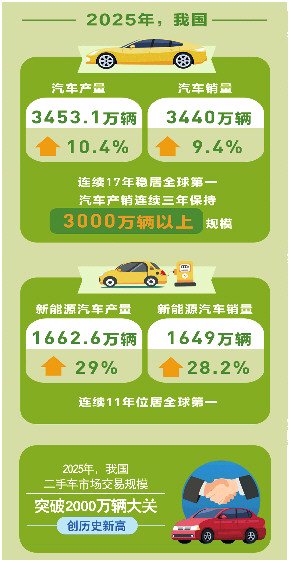
"我国汽车行业继续展现出强大的发展韧性和活力,多项指标再创新高,实现'十四五'圆满收官。"中汽协 会副秘书长陈士华说,2025年,"两新"政策加力扩围,企业新品密集上市,终端需求持续释放,汽车产销实现 超预期增长。 对外贸易呈现较强韧性 1月14日,中国汽车工业协会发布数据显示,2025年,我国汽车产销量均突破3400万辆,再创历史新高。新能 源汽车产销量均超1600万辆,新能源汽车国内新车销量占比突破50%。 汽车产销连续三年保持 3000万辆以上规模 具体来看,2025年,我国汽车产销分别完成3453.1万辆和3440万辆,同比分别增长10.4%和9.4%,连续17年稳 居全球第一。汽车产销连续三年保持3000万辆以上规模。 新动能加快释放,新能源汽车产销分别完成1662.6万辆和1649万辆,同比分别增长29%和28.2%,连续11年位 居全球第一。 交易规模突破2000万辆 2025年,我国二手车市场交易规模突破2000万辆大关,创历史新高。 中国汽车流通协会副会长罗磊介绍,2025年二手车市场呈现跨区域流通趋势持续强化、新能源二手车占 比持续提升、二手车交易均价趋于稳定、库存管理水平持续优化四大特征 ...

中汽协:2025年汽车总销量增速超预期 自主乘用车市占率近七成
Jing Ji Guan Cha Wang· 2026-01-15 04:08
Core Insights - In 2025, China's automotive industry is projected to achieve a total production and sales volume of 34.53 million and 34.40 million vehicles, respectively, representing year-on-year growth of 10.4% and 9.4%, significantly exceeding the initial forecast of 3% [2] - The export of automobiles reached 7.10 million units, marking a year-on-year increase of 21.1%, also outperforming early expectations [2] - The domestic market saw a slowdown in growth in Q4 2025, particularly in December, where domestic sales declined significantly [2][3] Domestic Market Performance - In 2025, domestic sales of automobiles reached 27.30 million units, reflecting a year-on-year increase of 6.7%, while traditional fuel vehicle sales fell by 4% to 13.43 million units [3] - December 2025 saw domestic sales drop to 2.52 million units, a month-on-month decrease of 6.7% and a year-on-year decline of 15.6% [3] - The passenger vehicle segment achieved production and sales of over 30 million units, with year-on-year growth of 10.2% and 9.2% [3] New Energy Vehicle (NEV) Insights - NEV exports reached 2.62 million units in 2025, doubling year-on-year, while traditional fuel vehicle exports decreased by 2% to 4.48 million units [2] - The penetration of NEVs in the passenger vehicle market is notable, with sales of NEVs priced below 150,000 yuan showing significant growth [3] - In 2025, NEVs accounted for 50.8% of domestic vehicle sales, with NEV passenger vehicles making up 54% of passenger vehicle sales [6] Commercial Vehicle Market - The commercial vehicle market experienced growth in both domestic demand and exports, with total production and sales of 4.26 million and 4.30 million units, respectively, reflecting year-on-year growth of 12% and 10.9% [5] - NEV commercial vehicles saw a domestic sales increase of 63.7%, reaching 871,000 units [6] Future Projections - The China Automotive Industry Association forecasts total vehicle sales to reach 34.75 million units in 2026, with NEV sales projected at 1.90 million units, a year-on-year increase of 15.2% [7] - The focus for the industry is shifting towards high-quality development rather than just volume growth, emphasizing efficiency and competitive order [7]
黑色金属专场-2026年年度策略会议-恒中有变-观复顺时
2026-01-15 01:06
黑色金属专场 - 2026 年年度策略会议 · 恒中有变,观复 顺时 20260114 摘要 2025 年房地产市场疲软,投资、销售和新开工面积大幅下降,对钢材 需求形成拖累,一线城市房价下跌加剧市场情绪冲击。 预计 2026 年房地产政策以稳定为主,但内生动能不足,主要指标延续 下降趋势,房地产用钢需求预计下降 10%左右,但边际影响减小。 2025 年基建投资增速不及预期,今年预计基建投资增速在 5%左右,用 钢需求与去年基本持平,对钢材需求形成一定支撑。 制造业整体表现优于建筑业,两新政策和反内卷政策有望推动 PPI 回升, 改善工业企业利润,预计 2026 年制造业用钢需求增长约 2%。 钢材出口大幅上升,预计全年出口接近 1.2 亿吨,创历史新高,但面临 反倾销调查和贸易摩擦加剧等挑战,2026 年出口增速可能放缓。 2026 年国内粗钢产量预计下降约 1%,供应总体偏宽松,炉料价格中枢 下移,吨钢利润可能边际修复,整体供需格局偏宽松,以震荡筑底为主。 预计 2026 年铁矿石全球供应增量约 4,200 万吨,中国进口增量保持高 位,但国内需求可能下滑,港口库存将继续累积,61 指数均价约 92 美 ...
我国汽车产销量连续17年全球第一
Xin Lang Cai Jing· 2026-01-14 20:45
(来源:经济参考报) 具体来看,新能源汽车方面,2025年在政策利好、供给丰富和基础设施持续改善等多重因素共同作用 下,新能源汽车持续增长,产销量突破1600万辆,分别完成1662.6万辆和1649万辆,同比分别增长29% 和28.2%,新能源汽车新车销量达到汽车新车总销量的47.9%,较去年同期提高7个百分点。出口方面, 2025年企业愈加重视海外市场开拓,中国品牌国际竞争力持续提升,全年汽车出口达到709.8万辆,同 比增长21.1%。 1月17日,记者在中国汽车工业协会(以下简称"中汽协")获悉,2025年汽车产销量再创历史新高,连 续17年稳居全球第一。 中汽协数据显示,2025年,汽车产销分别完成3453.1万辆和3440万辆,同比分别增长10.4%和9.4%,高 于年初预期。汽车产销连续三年保持3000万辆以上规模。 中汽协副秘书长陈士华表示,2025年,汽车行业顶住贸易保护和全球产业链重构等外部压力,克服技术 攻关难题、行业内卷等多重挑战,展现出强大的发展韧性和活力,实现了产业规模与发展质量双提升。 加上"两新"政策加力扩围,行业实现平稳过渡与有序衔接,企业新品密集上市,终端需求持续释放,全 年 ...
车市2025|再创新高,中国汽车产销突破3400万辆!
Bei Ke Cai Jing· 2026-01-14 14:57
Core Insights - In 2025, China's automotive industry achieved production and sales exceeding 34 million units, maintaining its position as the world's largest market for 17 consecutive years [1][5] - The automotive sector's revenue surpassed 10 trillion yuan, with significant growth in electric vehicles and smart technologies [1] - The market is expected to remain stable in 2026, with total sales projected to reach 34.75 million units [2][22] Production and Sales Performance - In 2025, total automotive production reached 34.53 million units, while sales were 34.40 million units, marking year-on-year increases of 10.4% and 9.4% respectively [5] - Passenger vehicle sales surpassed 30 million units for the first time, reaching 30.27 million units, with a year-on-year growth of 10.2% [5] New Energy Vehicles (NEVs) - NEV production reached 1.66 million units in 2025, with sales of 1.649 million units, reflecting year-on-year growth of 29% and 28.2% respectively [11] - NEVs accounted for 47.9% of total new car sales, with domestic sales of NEVs reaching 54% [11] Export Growth - In 2025, China's automotive exports reached 7.098 million units, a year-on-year increase of 21.1% [17] - NEV exports doubled to 2.615 million units, showcasing the competitive edge of Chinese brands in international markets [18] Policy Impact - The "Two New" policies significantly boosted demand, with over 11.5 million vehicles replaced under the trade-in program, nearly 60% of which were NEVs [7] - Upcoming policy changes in 2026 include a reduction in the vehicle purchase tax and adjustments to subsidy structures, which are expected to support continued market growth [21] Market Outlook - The automotive market is projected to grow steadily, with 2026 sales expected to reach 34.75 million units, a 1% increase from 2025 [22] - The passenger vehicle market is anticipated to see a slight increase to 30.25 million units, while commercial vehicles are expected to grow by 4.7% to 4.5 million units [22] Industry Trends - The automotive industry is experiencing a shift towards AI integration and smart technologies, with a focus on creating "AI-driven intelligent vehicles" [22][23] - The competitive landscape is expected to consolidate, with a few leading suppliers dominating the market [22]
中汽协:预计2026年汽车总销量为3475万辆 同比增长1%
Zhong Zheng Wang· 2026-01-14 11:21
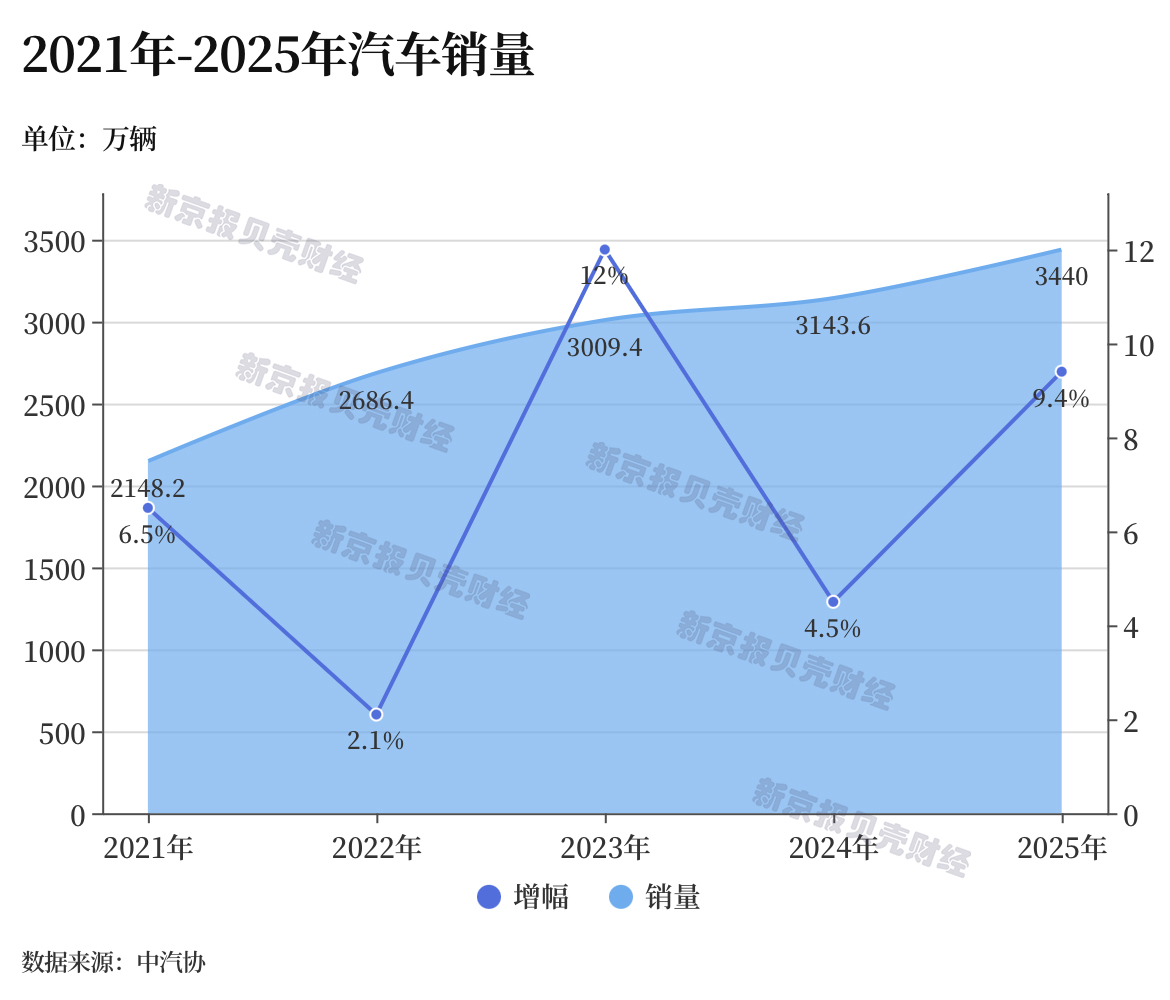
中证报中证网讯(记者 李嫒嫒)1月14日,中汽协副秘书长陈士华在协会月度数据发布会上表示,预计 2026年汽车总销量3475万辆,同比增长1%。其中,新能源汽车销量为1900万辆,同比增长15.2%。 陈士华分析称,2026年有多重利好因素助力汽车市场发展。2026年是"十五五"开局之年,促消费依然是 重点工作之一。"两新"政策持续优化实施,已实现平稳过渡与有序衔接,政策更加注重提质增效。同 时,在多方共同努力下,综合整治"内卷式"竞争成效显现;企业积极开拓海外市场,持续挖掘增长潜 力。 ...
汽车产销连续17年稳居全球第一!中汽协:2026年预计微增1%
证券时报· 2026-01-14 11:12
Core Viewpoint - The Chinese automotive industry has shown significant growth during the "14th Five-Year Plan" period, with production and sales exceeding 30 million units for three consecutive years, and revenue surpassing 10 trillion yuan, establishing a leading position globally in electric and intelligent vehicles [1][2]. Group 1: Industry Performance - In 2025, the cumulative production and sales of automobiles are projected to reach 34.53 million and 34.40 million units, respectively, representing year-on-year growth of 10.4% and 9.4%, maintaining a historical high and leading the world for 17 consecutive years [1]. - Domestic automobile sales are expected to reach 27.30 million units in 2025, a year-on-year increase of 6.7%, while traditional fuel vehicle sales are projected to decline by 4% to 13.43 million units [1][2]. Group 2: Export Growth - In 2025, total automobile exports are anticipated to exceed 7 million units, reaching 7.098 million units, with a year-on-year growth of 21.1%. New energy vehicle exports are expected to double to 2.615 million units, while traditional fuel vehicle exports may decline by 2% to 4.483 million units [2]. - Chery is projected to export 1.344 million units in 2025, a year-on-year increase of 17.4%, while BYD's exports are expected to reach 1.054 million units, marking a significant growth of 140% compared to 2024 [2]. Group 3: Future Outlook - For 2026, the total automobile sales are forecasted to reach 34.75 million units, reflecting a modest year-on-year growth of 1%. Passenger vehicle sales are expected to be 30.25 million units, up 0.5%, while commercial vehicle sales may increase by 4.7% to 4.5 million units [4]. - New energy vehicle sales are projected to reach 19 million units in 2026, representing a year-on-year growth of 15.2%, with exports expected to reach 740,000 units, a growth of 4.3% [4].

补贴不缺席,降价不含糊!新年车市油电各显神通
Xin Lang Cai Jing· 2026-01-13 11:33
Core Viewpoint - The automotive market in Beijing is experiencing a strong start in January 2026, driven by the "Two New" policy and various promotional strategies from manufacturers [2][14]. Group 1: Market Dynamics - The national level subsidies for vehicle purchases are confirmed, and consumers can apply for both national and manufacturer-specific subsidies, making car purchases more attractive [3][14]. - Various promotional strategies, including cash subsidies, financial policies, and price reductions, are igniting a surge in car purchases for January [5][16]. - The China Automobile Dealers Association reported a rise in the automotive consumption index, indicating a potential recovery in the market for January 2026 [19]. Group 2: Subsidy Policies - Different brands have varying promotional policies, but overall, there are significant cash subsidies and financial incentives available until January 31 [5][16]. - Local "Two New" policy details have been clarified in several provinces, allowing consumers to apply for subsidies, while Beijing's local policy is still pending [7][18]. - Manufacturers like Li Auto and Aion are offering additional subsidies on top of national ones, ranging from 5,000 to 10,000 yuan [18]. Group 3: Consumer Behavior - Consumers are becoming more rational in their purchasing decisions, with many accepting the reduction in subsidies for new energy vehicles [20]. - The new policies are expected to boost the market before the Spring Festival, with a longer promotional period compared to previous years [20]. - The competition between fuel vehicles and new energy vehicles is intensifying, with fuel vehicles seeing significant price reductions to attract buyers [10][12]. Group 4: Future Trends - The penetration rate of new energy vehicles is projected to reach 75% by 2030, driven by competitive product offerings and user experience [21]. - Traditional fuel vehicles are expected to experience a temporary sales boost due to aggressive discounting strategies from brands like BMW and Volvo [10][21].
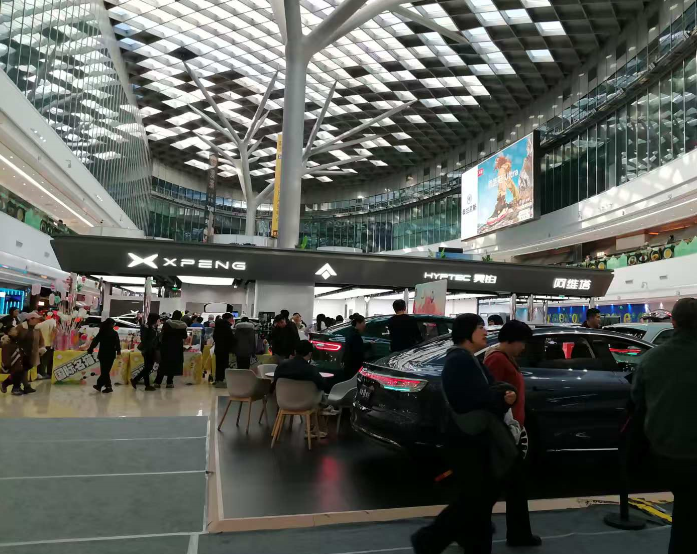
央地联动,汽车促消费火热开局
Zhong Guo Qi Che Bao Wang· 2026-01-13 09:50
Core Viewpoint - The recent announcement by the National Development and Reform Commission and the Ministry of Finance regarding the implementation of a large-scale equipment update and consumer goods trade-in policy in 2026 aims to stimulate automobile consumption and promote economic growth in the new year [2][3]. Group 1: Policy Details - The new policy supports the scrapping and replacement of vehicles, providing subsidies for personal consumers who scrap their cars and purchase new energy vehicles or fuel-efficient cars with an engine size of 2.0 liters or less [3]. - Subsidies include 12% of the purchase price (up to 20,000 yuan) for new energy vehicles and 10% (up to 15,000 yuan) for fuel-efficient cars [3]. - The policy emphasizes a shift from broad subsidies to more targeted support, focusing on high-quality products and environmentally friendly vehicles [4]. Group 2: Market Impact - The timely introduction of the new policy is expected to positively influence the automobile market, leading to a growth in sales during the first quarter of 2026 [5]. - The policy aims to stabilize new car consumption and mitigate the impact of previous funding shortages that affected the market in late 2025 [5]. - Local governments are actively implementing their own trade-in policies, enhancing the overall consumer incentives for automobile purchases [8]. Group 3: Local Government Initiatives - Various provinces, including Jiangxi and Hebei, have announced their own consumer goods trade-in policies, focusing on automobile consumption as a key area for 2026 [8]. - Local authorities are granted more autonomy to determine subsidy categories and standards, allowing for tailored approaches to stimulate local automobile markets [8]. Group 4: Manufacturer Responses - In addition to government policies, manufacturers are introducing diverse promotional strategies, including tax subsidies and financing options, to attract consumers [11]. - Many automotive brands are offering limited-time promotions, such as tax rebates and cash discounts, to enhance sales during the initial months of 2026 [12]. - The combination of government and manufacturer incentives is expected to drive a significant increase in automobile sales, with reports of high consumer engagement during promotional events [12].

【好评中国】“两新”政策撬动的不只是消费更是升级
Xin Lang Cai Jing· 2026-01-13 09:25
Group 1 - The core viewpoint of the articles highlights the acceleration of China's new "Two New" policy, which focuses on large-scale equipment updates and the replacement of consumer goods, stimulating market vitality and driving a consumption boom in 2026 [1][2][3] - The "Two New" policy is shifting from a focus on scale to a more precise allocation of resources, emphasizing intelligent and green consumption trends, including the addition of smart glasses to the subsidy list for consumer goods [1] - The policy aims to enhance economic growth and promote social health, with local governments actively utilizing central policy tools to support the implementation of the "Two New" policy, resulting in a significant increase in sales volume of covered products [1][2] Group 2 - Data shows that from January to October 2025, rural consumer goods retail sales reached 5.5 trillion yuan, growing by 4.6%, which is 0.4 percentage points higher than urban growth [2] - The "Two New" policy is designed to benefit both consumers and enterprises, with a focus on improving the quality of life and enhancing consumer experience, particularly among younger demographics who value emotional and cultural connections [3] - The optimization of the "Two New" policy is expected to further invigorate market vitality, contributing to a robust and diverse economic landscape in China [3]