
制造业PMI

Search documents
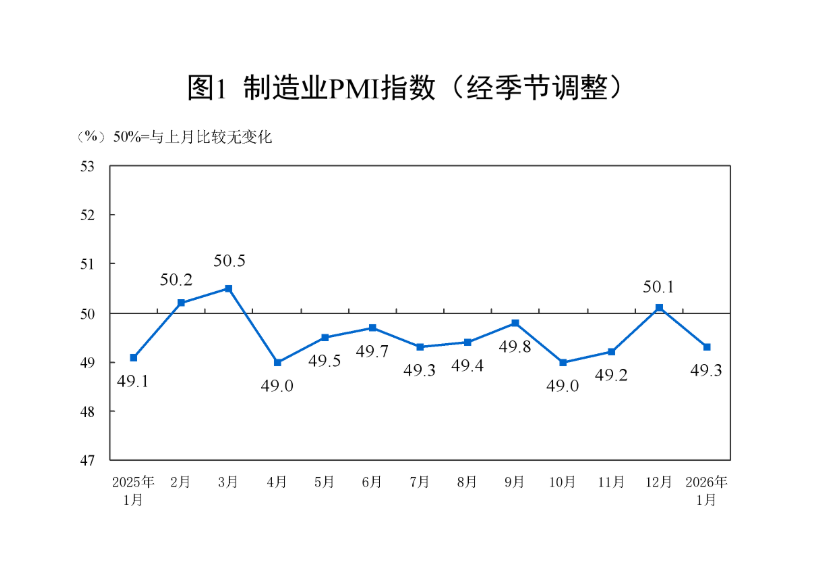
1月制造业PMI回落至49.3%,超3成企业反映利润下降
Di Yi Cai Jing· 2026-01-31 03:39
Core Viewpoint - The manufacturing sector in China is experiencing a decline in economic activity, as indicated by the drop in the Purchasing Managers' Index (PMI) below the growth threshold, reflecting insufficient market demand and the need for stronger economic recovery measures [1][4][6]. Manufacturing Sector - The manufacturing PMI for January is reported at 49.3%, a decrease of 0.8 percentage points from the previous month, indicating fluctuations in manufacturing operations [4]. - New orders index fell to 49.2%, down 1.6 percentage points, suggesting a tightening of market demand [4]. - The production index remains in the expansion zone at 50.6%, but has decreased by 1.1 percentage points, indicating a slowdown in manufacturing production growth [5]. - The prices of raw materials and finished products are rising, with the raw material purchase price index at 56.1% and the factory price index at 50.6%, marking the first time in nearly 20 months that the factory price index has risen above the critical point [5][6]. - Over 34% of manufacturing companies reported a decline in profits, highlighting concerns regarding profitability amid rising raw material costs [6]. Non-Manufacturing Sector - The non-manufacturing business activity index is at 49.4%, down 0.8 percentage points, with the construction sector experiencing a significant decline [9]. - The service sector remains relatively stable, with a slight decrease in the service business activity index to around 49.5% [10]. - The service industry shows optimistic expectations, with a business activity expectation index of 57.1%, indicating a positive outlook for the upcoming Spring Festival consumption [10].

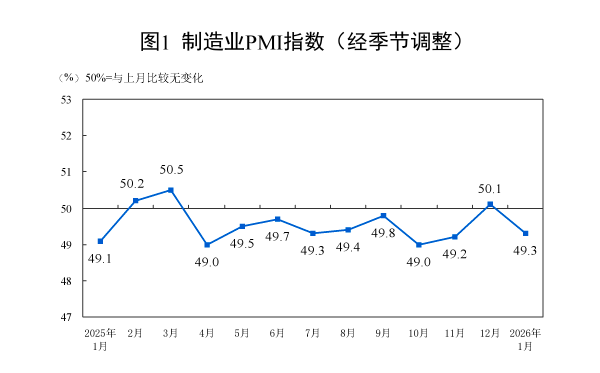
国家统计局:1月制造业PMI为49.3% 景气水平较上月下降 生产继续保持扩张
Guo Jia Tong Ji Ju· 2026-01-31 01:42
Group 1: Manufacturing PMI Overview - In January 2026, the Manufacturing Purchasing Managers' Index (PMI) was reported at 49.3%, a decrease of 0.8 percentage points from the previous month, indicating a tightening in market demand while production continues to expand [1][5] - The production index stood at 50.6%, remaining above the critical point, suggesting ongoing expansion in manufacturing production despite a decline in new orders index to 49.2% [5][6] - High-tech manufacturing PMI was recorded at 52.0%, indicating a sustained positive trend, while equipment manufacturing PMI was at 50.1%, also in the expansion zone [7] Group 2: Non-Manufacturing PMI Overview - The Non-Manufacturing Business Activity Index was reported at 49.4%, down 0.8 percentage points from the previous month, reflecting a general decline in non-manufacturing sector activity [3][8] - The service sector's business activity index was at 49.5%, with financial services and capital market services showing high activity levels above 65.0%, while the real estate sector dropped below 40.0% [8] - The construction sector's business activity index fell to 48.8%, a significant decrease of 4.0 percentage points, indicating a notable decline in construction activity [8] Group 3: Comprehensive PMI Insights - The Comprehensive PMI Output Index was at 49.8%, down 0.9 percentage points from the previous month, suggesting a slowdown in overall business activities [3][9] - The manufacturing production index and non-manufacturing business activity index contributed to the comprehensive PMI, recorded at 50.6% and 49.4% respectively [9]
有色金属数据日报-20260127
Guo Mao Qi Huo· 2026-01-27 04:38
Report Industry Investment Rating - Not provided Core Viewpoints - The U.S. January S&P Global Manufacturing PMI preliminary value was 51.9, with employment sub - index hitting a new low since last year but still expanding for six consecutive months, and output reaching the highest level since August 2025. The EU Commission plans to extend the suspension period of anti - tariff measures against the U.S. [2] - For copper, the dollar index is under pressure, which is positive for the non - ferrous sector. However, the spot market has sufficient supply, demand is cautious, and LME inventory accumulation may suppress prices. Short - term copper prices will fluctuate. [2] - For aluminum, the macro - sentiment warms up, but industrial drivers are limited, and domestic inventory accumulates. The price is expected to fluctuate. [2] - For zinc, geopolitical tensions are rising, and the macro - sentiment is volatile. The domestic processing fee is at a low level, smelting profit is inverted, and production is expected to decline. Zinc prices will follow the sector to fluctuate. [2] - For nickel, the Fed's interest - rate cut expectation is stable. Indonesia's nickel - related policies and supply - side disturbances may affect prices. Short - term nickel prices are high, and in the long - term, high global inventories may suppress prices. It is recommended to go long on dips in the short - term. [2] Summary of Relevant Catalogs Price Indicators - LME non - ferrous metal futures prices showed various changes, such as copper at $12,921.5 with a 2.28% change and nickel at $18,705 with a 3.71% change. SHFE prices also had different changes, like aluminum at 23,990 yuan/ton with a - 0.31% change and nickel at 145,380 yuan/ton with a 2.81% change. [1] Inventory Indicators - LME non - ferrous metal inventories and their changes varied. For example, LME copper inventory was 170,525 tons with a 26.05% change, and LME zinc inventory was 111,325 tons with an 11.43% change. SHFE inventories also had different trends, such as SHFE aluminum inventory increasing from 141,725 tons to 197,053 tons with a 6.01% change. [1][2] Ascending and Descending Water Indicators - LME and SHFE non - ferrous metal ascending and descending water showed different changes. For example, SHFE copper's ascending and descending water changed from - 66.1 yuan/ton to 16.78 yuan/ton with an - 82.8 change. [2] Price - to - Price Ratio Indicators - The current price - to - price ratios of non - ferrous metals and their changes were presented. For example, the copper price - to - price ratio was 7.84 with a 7.81% change, and the zinc price - to - price ratio was 7.51 with a - 1.05% change. [2] Near - month to Continuous Third - month Spread Indicators - The current spreads of SHFE non - ferrous metals and their changes were shown. For example, the copper spread changed from - 290 yuan/ton to - 950 yuan/ton with a - 660 change. [2]
法国制造业PMI升至近四年新高——海外周报第124期
一瑜中的· 2026-01-25 15:18
Core Viewpoint - The article discusses the recent economic data and trends in the US, Japan, and the Eurozone, highlighting the mixed signals in economic activity, employment, and financial conditions [1]. Group 1: Important Data Review - The US January S&P Global Manufacturing PMI has rebounded, with the final Q3 GDP growth rate at 4.4% [11][13]. - Japan's December export growth was below expectations, with a year-on-year increase of 5.1% compared to an expected 6.1% [11][14]. - The Eurozone's January ZEW Economic Sentiment Index has improved, and the manufacturing PMI has also increased, with France's manufacturing PMI reaching a nearly four-year high of 51 [11][14]. Group 2: US Economic Activity - The US WEI index fell to 2.34% for the week ending January 17, down from 2.40% the previous week [4][16]. - The German WAI index rose to 0.06% for the week ending January 18, up from -0.03% [5][16]. Group 3: Demand - The US Redbook retail sales year-on-year growth rate has marginally decreased to 5.5% for the week ending January 16, down from 5.7% [6][18]. - The US mortgage loan rate increased to 6.09% as of January 22, up from 6.06% the previous week, while the MBA market composite index rose to 397.2, a 14.1% increase from the previous week [6][23]. Group 4: Prices - Commodity prices have rebounded, with the RJ/CRB commodity price index at 312.24, a 3.4% increase from the previous week [7]. - The US gasoline retail price rose to $2.70 per gallon on January 19, an increase of 1.3% from the previous week [40]. Group 5: Employment - The ADP weekly job additions have decreased, with a four-week cumulative total of 46,000 jobs as of December 6, down from 70,000 the previous week [8][27]. - Initial jobless claims rose to 200,000 for the week ending January 17, up from 199,000 the previous week [29]. - The INDEED job vacancy index fell to a weekly average of 105.3 for the week ending January 9, down from the previous week's average [34]. Group 6: Financial Conditions - Financial conditions in the US and Eurozone have tightened, with the Bloomberg Financial Conditions Index for the US at 0.812, down from 0.848 the previous week [9][45]. - Offshore dollar liquidity has improved for the yen against the dollar, while it has worsened for the euro against the dollar [9][48]. - The 10-year government bond yield spread between the US and Eurozone has narrowed, with the spread at 132.3 basis points as of January 22, down from 134.6 basis points [10][51].

【每周经济观察】:法国制造业PMI升至近四年新高——海外周报第124期
Huachuang Securities· 2026-01-25 10:50
Economic Data Review - The US January S&P Global Manufacturing PMI rose to 51, indicating expansion, while the Q3 actual GDP annualized growth rate was finalized at 4.4%[1] - Japan's December export growth was below expectations at 5.1%, compared to the forecast of 6.1%[10] - The Eurozone's January ZEW Economic Sentiment Index increased to 40.8, and France's Manufacturing PMI reached a near four-year high of 51[10] US Economic Indicators - The WEI index for the US decreased to 2.34% from 2.48%[15] - The US Redbook retail sales year-on-year growth marginally fell to 5.5% from 5.7%[17] - The 30-year mortgage rate in the US rose to 6.09% from 6.06% the previous week, while the MBA Market Composite Index increased by 14.1% to 397.2[21] Employment Trends - ADP's weekly job additions fell to 46,000, down from 70,000 the previous week[26] - Initial jobless claims in the US rose to 200,000 from 199,000 the prior week, while continuing claims decreased to 1.849 million[30] - The INDEED job vacancy index showed a slight decline, averaging 105.3, down 0.5% from the previous week[34] Price Movements - The RJ/CRB Commodity Price Index increased by 3.4% to 312.24, while US gasoline prices rose to $2.70 per gallon, up 1.3% from the previous week[36] Financial Conditions - Financial conditions in the US and Eurozone tightened, with the Bloomberg Financial Conditions Index for the US dropping to 0.812 from 0.848[43] - Offshore dollar liquidity showed improvement for the yen against the dollar, while the euro's liquidity worsened[46] - The 10-year US-EU bond yield spread narrowed to 132.3 basis points from 134.6 basis points[48]
【环球财经】黄金、白银再创历史新高 国际白银价格突破100美元大关
Xin Hua Cai Jing· 2026-01-24 02:07
Group 1: Gold and Silver Market - The February 2026 gold futures price on the New York Commodity Exchange closed at $4983.00 per ounce, with an increase of 1.42% [1] - Continued safe-haven demand and chart-based buying, along with strong bullish technical indicators, are driving gold and silver prices higher [1] - International gold prices are approaching $5000 per ounce, while silver prices have surged past $100 per ounce, both reaching historical highs [1] Group 2: Economic Indicators and Monetary Policy - The Bank of Japan raised its inflation expectations, leading to an increase in short-term bond yields, while long-term bond pressures are easing after significant sell-offs earlier in the week [1] - The Bank of Japan maintained its policy interest rate at 0.75% and adjusted four out of six inflation expectations in its latest quarterly outlook report, indicating potential future increases in borrowing costs [1] - Mixed economic data was released, with the University of Michigan's consumer confidence index for January 2026 at 56.4, up from 52.9 in December but down from 71.7 in January 2025 [2] - The preliminary services PMI for January was reported at 52.5, unchanged from December, while the manufacturing PMI slightly improved to 51.9 from 51.8 in December [2]
欧元区1月制造业PMI初值为49.4
Mei Ri Jing Ji Xin Wen· 2026-01-23 22:39
每经AI快讯,1月23日消息,欧元区1月制造业PMI初值为49.4,预估49.1,前值48.8。 (文章来源:每日经济新闻) ...
美国1月标普全球制造业PMI初值 51.9,前值51.8
Mei Ri Jing Ji Xin Wen· 2026-01-23 14:57
Group 1 - The core point of the article indicates that the preliminary value of the US January S&P Global Manufacturing PMI is 51.9, slightly below the expected 52 and up from the previous value of 51.8 [1] - The preliminary value of the US January S&P Global Composite PMI is reported at 52.8, which is lower than the expected 53 and slightly higher than the previous value of 52.7 [1] - The preliminary value of the US January S&P Global Services PMI stands at 52.5, which is also below the expected 52.8 and unchanged from the previous value of 52.5 [1]
法国1月制造业PMI初值51,高于预期
Jin Rong Jie· 2026-01-23 08:38
Group 1 - The core point of the article indicates that France's manufacturing PMI for January is at 51, which is above the expected 50.5 and slightly lower than the previous value of 50.7 [1] - The services PMI for January is reported at 47.9, which is below the expected 50.5 and lower than the previous value of 50.1, indicating a contraction in the services sector [1] - The composite PMI for January stands at 48.6, which is below the expected 50 and lower than the previous value of 50, suggesting a general slowdown in economic activity [1]
印度1月制造业PMI初值为56.8,预估为56.0,前值为55.0
Mei Ri Jing Ji Xin Wen· 2026-01-23 05:08
每经AI快讯,1月23日消息,印度1月制造业PMI初值为56.8,预估为56.0,前值为55.0。 ...