
大模型

Search documents
雷军回应小米大模型火了,罗福莉宣布新模型将开源
程序员的那些事· 2026-03-19 09:47
Core Insights - The "Hunter Alpha" model launched anonymously on OpenRouter and quickly became the most called model in a single day, maintaining its top position for a week, indicating strong market interest and performance [1] - Xiaomi officially claimed the model as its flagship base model MiMo-V2-Pro, which has generated significant buzz in the tech community [1] - Xiaomi's model leader, Luo Fuli, announced the training process of the new model and revealed plans for it to be open-sourced, suggesting a commitment to transparency and community engagement [3] Group 1 - The "Hunter Alpha" model's rapid rise in usage highlights its superior performance compared to expectations [1] - Xiaomi's strategic positioning of MiMo-V2-Pro as a flagship model reflects its ambition in the AI space [1] - The decision to open-source the new model may enhance collaboration and innovation within the developer community [3]



独家丨地平线敲定征程 7 目标算力,舱驾一体产品命名 “星空”
晚点Auto· 2026-03-19 08:49
Core Viewpoint - Horizon Robotics is preparing to launch its next-generation intelligent driving chip series, the Journey 7 (J7), with the highest performance version, J7P, expected to significantly surpass NVIDIA's Thor-X in computing power, aiming for mass production in 2027 [3][5]. Group 1: Chip Development and Strategy - The J7 product planning is primarily driven by the algorithm team, marking a shift from being a chip supplier to an integrated solution provider [5]. - The J7 will utilize Horizon's fourth-generation BPU architecture, "Riemann," and aims to compete directly with Tesla's AI5 chip [5]. - The C7H chip, developed in partnership with Volkswagen, will also be based on the Riemann architecture and is designed for the J7, utilizing a 3-4 nm process with an AI computing power of 500-700 TOPS [5]. Group 2: Market Dynamics and Competition - The evolution of vehicle models is accelerating, with parameters expanding from millions to billions, necessitating next-generation high-end driving chips that can adapt to new algorithm models [6]. - Current high-end driving chips are primarily designed for modular algorithms and early-stage end-to-end models, with a typical development cycle of 3-4 years [6]. - The actual bottlenecks in vehicle chips are not just theoretical computing power but also memory bandwidth, data transfer efficiency, and inference accuracy [7]. Group 3: Future Projections and Requirements - The industry anticipates that achieving L3 autonomous driving will require computing power between 500-1000 TOPS by 2025, while L4 may require up to 2000 TOPS by 2030 [7][8]. - Huawei's president of intelligent driving products indicated that transitioning from L2 to L4 may require a 3-5 times increase in investment, with vehicle computing power needing to rise from hundreds to 1500-2000 TOPS [8]. - The focus is shifting towards optimizing the integration of chips, compilers, and models to enhance efficiency rather than solely increasing peak computing power [9]. Group 4: Operational Challenges - Horizon Robotics faces competitive pressure as it attempts to convert more automakers into clients while some of these clients are becoming competitors [9]. - Maintaining production schedules and cash flow is critical for Horizon, especially as it ramps up production of its J6 series while preparing for the next generation [9].

邀请函|国泰海通“大模型与OpenClaw”海外科技线下沙龙
国泰海通证券研究· 2026-03-19 07:22
Group 1 - The article discusses the upcoming seminar hosted by Guotai Junan Securities focusing on the evolution of large models and OpenClaw technology trends [1] - The seminar features prominent speakers, including Luo Xuan, co-founder and COO of Yuanshi Intelligent, who has extensive experience in natural language processing and robotics [1] - The event aims to explore how the open-source agent movement, represented by OpenClaw and Token Factory, is reshaping the value distribution structure in AI [1]


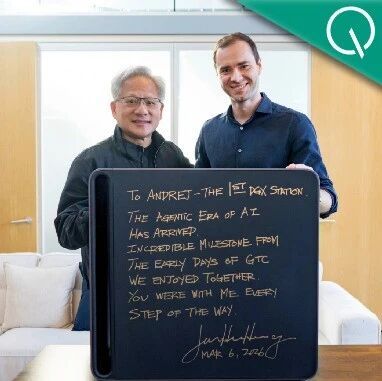
英伟达首台DGX GB300,老黄亲自登门送给他
量子位· 2026-03-19 07:09
Core Viewpoint - The article discusses the significance of NVIDIA's CEO Jensen Huang personally delivering the first DGX Station (GB300) to Andrej Karpathy, highlighting the rise of individual developers in the AI era and the importance of computational power in the ongoing AI model competition [1][9][58]. Group 1: Delivery of DGX Station - Huang's delivery of the DGX Station to Karpathy symbolizes a milestone in the AI era, marking the emergence of personal developers as key players [1][9]. - This event is reminiscent of Huang's previous deliveries, such as the first DGX-1 to OpenAI, which played a crucial role in the deep learning revolution [8][39]. - The DGX Station (GB300) is designed for individual developers, providing data center-level AI computing power in a compact form [28][30]. Group 2: Significance of Individual Developers - Karpathy is recognized as a representative of individual developers, transforming AI from a corporate domain to a system manageable by individuals [17][19]. - His recent work focuses on creating systems that allow a single person to complete the entire process from idea to product [18][19]. - The choice of Karpathy for this delivery underscores the shift towards distributed computing and the importance of individual contributions in the AI landscape [58][61]. Group 3: Technical Specifications of DGX Station - The DGX Station (GB300) features 748GB of unified memory and 20 PFLOPS of computing power, enabling the execution of large-scale AI models [30]. - It allows seamless migration of local projects to cloud environments, addressing the need for continuous AI operation [31][32]. - The system is tailored for developing and running AI agents, reflecting the growing trend of personal AI applications [24][34]. Group 4: Broader Implications for the Industry - Huang's actions signal a strategic move by NVIDIA to position itself as a foundational supplier in the AI model competition, emphasizing the necessity of computational resources [50][56]. - The article suggests that the future of AI development will increasingly rely on individual developers rather than large organizations, as computational power becomes more accessible [58][61]. - NVIDIA is also enhancing its infrastructure for AI agents, indicating a comprehensive approach to support developers from hardware to software [34][36].

雷军官宣全球开发者热议的“神秘模型”,小米“AI路线图”逐步明晰
硬AI· 2026-03-19 02:37
Core Viewpoint - Xiaomi has officially claimed the "mysterious model" previously speculated to be DeepSeek V4, launching the MiMo-V2-Pro model with over 1 trillion parameters, ranking eighth globally, and demonstrating significant cost advantages. Goldman Sachs supports this move, stating Xiaomi is entering the AI results realization phase, solidifying its position as a "physical AI leader" [2][9]. Group 1: Model Launch and Features - Xiaomi has released three flagship models: MiMo-V2-Pro, MiMo-V2-Omni, and MiMo-V2-TTS, marking a significant step in its AI development [5][9]. - MiMo-V2-Pro is designed for high-intensity agent work scenarios, featuring over 1 trillion total parameters and a context window of 1 million tokens, ranking eighth in the Artificial Analysis Intelligence Index [10][13]. - MiMo-V2-Omni integrates multimodal understanding capabilities, achieving performance levels that meet or exceed competitors like Gemini 3 Pro and GPT-5.2 [11][13]. Group 2: Performance and Cost Efficiency - MiMo-V2-Pro's operational cost for completing the Intelligence Index test is $348, which is 36% lower than GLM-5 and 90% lower than Claude Sonnet 4.6 [16]. - The model has been optimized for agent scenarios, demonstrating superior tool invocation and multi-step reasoning capabilities, ranking at the top in global evaluations [17]. Group 3: Strategic Roadmap and Future Directions - Xiaomi's AI roadmap includes a systematic approach to converting R&D investments into tangible results, with previous releases like the Xiaomi-Robotics-0 model and the miclaw AI system [20]. - Future goals for the models include enhancing complex reasoning for MiMo-V2-Pro, achieving continuous intent planning for MiMo-V2-Omni, and expanding language capabilities for MiMo-V2-TTS [21]. Group 4: Financial Outlook and Valuation - Goldman Sachs projects Xiaomi's R&D spending will reach 40 billion RMB by 2026, impacting short-term profits but potentially leading to long-term value reassessment [23]. - Despite a forecasted decline in net profit for 2026, Goldman Sachs maintains a "buy" rating with a target price of HKD 41, reflecting Xiaomi's potential as a leader in self-developed AI and operating systems [23].

神秘霸榜模型现真身:小米MiMo-V2 Pro,国内首个万亿参数+1M上下文,为Agent而生!
机器之心· 2026-03-19 01:25
Core Insights - The article reveals that Xiaomi has launched two new large models, Hunter Alpha and Healer Alpha, which have performed exceptionally well on the OpenRouter platform, with Hunter Alpha ranking first on the trend chart and third on the weekly chart [1][2][3]. - Xiaomi plans to invest over 16 billion yuan in AI this year, indicating a strong commitment to the field [4]. - The flagship model, MiMo-V2-Pro, has shown outstanding performance in long text and agent invocation stability, ranking ninth globally and third domestically on the Artificial Analysis leaderboard [6][7]. Model Specifications - MiMo-V2-Pro (Hunter Alpha) features 1,021 billion parameters and 42 billion active parameters, focusing on complex tasks [8]. - MiMo-V2-Omni (Healer Alpha) is a multimodal model designed for rapid inference and low-latency scenarios [8]. - MiMo-V2-TTS is the first model capable of both singing and human-like speech synthesis [8]. Performance Metrics - MiMo-V2-Pro has achieved top-tier performance on the PinchBench evaluation standard, designed for AI agents [11]. - Feedback from the developer community suggests that Hunter Alpha's performance in complex agent orchestration is comparable to Claude 4.6 [12]. Practical Applications - MiMo-V2-Pro has demonstrated capabilities in coding, research report generation, and identifying trending topics, showcasing its versatility in real-world applications [14][16][20]. - The model can autonomously complete complex workflows and long-term task planning without human intervention, achieving high precision in external tool invocation [38]. Competitive Positioning - MiMo-V2-Pro's API is now open to developers, priced at one-fifth of Claude Opus 4.6, with a promotional week of free access to encourage adoption [40]. - The model has been integrated into Xiaomi's core business and ecosystem, enhancing AI capabilities from mere conversation to system-level execution [42]. Future Developments - Xiaomi's Core team plans to iteratively improve the MiMo-V2 series models, aiming for enhanced reasoning and long-term task planning capabilities [44].

山东极视角科技股份有限公司(H0335) - 聆讯后资料集(第一次呈交)
2026-03-18 16:00
香港聯合交易所有限公司與證券及期貨事務監察委員會對本聆訊後資料集的內容概不負責,對其準 確性或完整性亦不發表任何意見,並明確表示概不就因本聆訊後資料集全部或任何部分內容而產生 或因倚賴該等內容而引致的任何損失承擔任何責任。 Shandong Extreme Vision Technology Co., Ltd.* 山東極視角科技股份有限公司 (「本公司」) (於中華人民共和國註冊成立之股份有限公司) 的聆訊後資料集 警告 本聆訊後資料集乃根據香港聯合交易所有限公司(「聯交所」)及證券及期貨事務監察委員會(「證 監會」)的要求而刊發,僅用作提供資訊予香港公眾人士。 本聆訊後資料集為草擬本,其內所載資訊並不完整,亦可能會作出重大變動。 閣下閱覽本文件, 即代表 閣下知悉、接納並向本公司、本公司的聯席保薦人、整體協調人、顧問或包銷團成員 表示同意: 倘於適當時候向香港公眾人士提出要約或邀請,有意投資者務請僅依據與香港公司註冊處處長 註冊的本公司招股章程作出投資決定;招股章程的文本將於發售期內向公眾人士提供。 * 僅供識別使用。 (a) 本文件僅為向香港公眾人士提供有關本公司的資料,概無任何其他目的;投資者不應根據 ...
TENCENT(00700) - 2025 Q4 - Earnings Call Transcript
2026-03-18 13:00
Financial Data and Key Metrics Changes - Total revenue for Q4 2025 was RMB 194.4 billion, up 13% year-on-year [34] - Gross profit increased to RMB 108.3 billion, reflecting a 19% year-on-year growth [34] - Non-IFRS operating profit was RMB 69.5 billion, up 17% year-on-year [36] - Non-IFRS net profit attributable to equity holders was RMB 64.7 billion, also up 17% year-on-year [36] - Overall gross margin improved to 56%, up 3 percentage points year-on-year [37] Business Line Data and Key Metrics Changes - Value-added services (VAS) revenue was RMB 90 billion, up 14% year-on-year, with social network revenue growing 3% to RMB 31 billion [25] - Domestic games revenue increased by 15% year-on-year, driven by titles like Delta Force and Valorant [26] - International games revenue surged by 32% year-on-year, primarily from Supercell's titles and PUBG Mobile [26] - Marketing services revenue rose 17% year-on-year to RMB 41 billion, benefiting from improved ad targeting and AI enhancements [30] - Fintech and business services revenue was RMB 61 billion, up 8%, with fintech services growing by a single-digit percentage [31] Market Data and Key Metrics Changes - Video Accounts total time spent increased over 20% due to upgraded recommendation algorithms [3] - The international games business surpassed $10 billion in annual revenue for the first time [4] - Tencent Cloud achieved RMB 5 billion adjusted operating profit, reflecting improved earnings despite revenue headwinds [23] Company Strategy and Development Direction - The company aims to leverage AI as a transformational force across its core businesses, enhancing user engagement and operational efficiency [6][11] - Investments in AI products are expected to double in 2026, funded by increasing earnings from core businesses [20] - The strategy includes strengthening existing businesses with AI before expanding into new AI products [11] Management's Comments on Operating Environment and Future Outlook - Management expressed confidence that revenue growth may outpace profit growth in 2026 due to increased investments in AI [46] - The company is actively recruiting top AI talent and increasing compute resources to address GPU constraints [49] - Management believes that AI will provide significant long-term returns, similar to the trajectory of Tencent Cloud [58] Other Important Information - The company plans to propose an annual dividend of HKD 5.3 per share, reflecting an 18% year-on-year increase [41] - Free cash flow for Q4 2025 was RMB 34 billion, increasing over six times year-on-year [39] Q&A Session Questions and Answers Question: How should we think about profit margins in relation to AI investments? - Management indicated that revenue could grow faster than profit in 2026 due to increased AI investments, which are seen as opportunities for expanding user value [46] Question: How is the company prioritizing resources in light of GPU and AI talent constraints? - Management stated that they have built a strong AI talent team and are actively provisioning more compute resources, focusing on HunYuan and new AI products [49][50] Question: What is the assessment of ROI for AI investments? - Management noted that they have already seen good ROIs from AI applications in existing businesses and expect new AI products to generate attractive returns over time [58]

百度推动大模型与搜推业务融合
第一财经· 2026-03-18 06:31
Group 1 - The core point of the article is the appointment of He Jingzhou to lead the Baidu APP R&D Center, which aims to integrate large model technology with search and recommendation services [1] - The restructuring within Baidu's Mobile Ecosystem Group (MEG) includes the merging of PC and mobile search operations, now overseen by Li Xiaowan [1] - The previous head, Zhao Seqi, left the position for personal reasons, indicating potential changes in leadership dynamics within the company [1] Group 2 - The rotation of He Jingzhou is expected to enhance the application of cutting-edge technologies like large models in core business areas such as search and recommendation [1] - The establishment of the Baidu APP R&D Center and the Quality Assurance Center reflects Baidu's commitment to improving user experience and operational efficiency [1]

GenAI系列报告之72:OpenClaw会引领Agent元年吗?
Shenwan Hongyuan Securities· 2026-03-17 14:53
Investment Rating - The report maintains a positive outlook on the Agent technology sector, indicating a favorable investment rating for 2026, which is seen as a critical year for the commercialization of Agent technology [3][4]. Core Insights - OpenClaw is identified as a pivotal product that signifies the transition of AI from "conversational assistants" to "digital employees," enabling seamless integration into daily communication tools and automating high-frequency tasks [3][5]. - The maturity of Agent technology is not limited to individual products but represents a comprehensive software system innovation, with products like OpenClaw and Claude Cowork marking a significant shift towards "execution intelligence" [3][4]. - The report argues that Agent technology creates new opportunities in the enterprise software sector rather than replacing existing software, redefining the value distribution of software through task optimization and process automation [3][4]. Summary by Sections 1. Changes in Agent Technology in 2026 - The evolution of Agent products is highlighted, with a shift from traditional AI applications relying on graphical user interfaces to the emergence of digital employees capable of executing complex tasks [14][15]. - OpenClaw and Claude Cowork are noted for their ability to handle cross-platform tasks and integrate deeply into business processes, representing a new height in commercial Agent products [15][26]. 2. Will Models Consume Software? - The report challenges the notion that large models will "consume" software, suggesting that the core demands of enterprises, such as data compliance and process execution, are being revalued, benefiting high-frequency entry platforms [6][69]. 3. Beneficial Directions for Agent Technology - Key areas benefiting from Agent technology include: - Office software and collaboration platforms as core entry points, with companies like Kingsoft Office and Yonyou Network identified as potential beneficiaries [3][4]. - The demand for sandbox technology driven by enterprise security, with companies like Sangfor Technologies highlighted [3][4]. - B-end software platforms experiencing structural growth through the integration of Agent technology, with companies like Dingjie Zhizhi and TaxFriend noted [3][4]. - The explosion of token consumption driven by Agent applications, enhancing the efficiency of cloud computing providers [3][4]. - The formation of competitive advantages in the ToC sector through complex scenario Agents [3][4].