红利投资

Search documents
投资进化论丨红利资产可以作为底仓品种长期配置吗?
Sou Hu Cai Jing· 2025-11-25 05:45
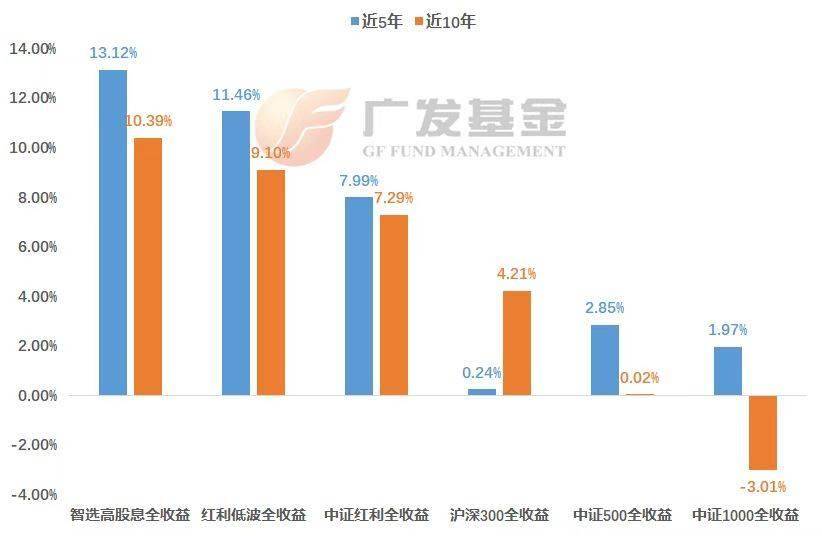
Core Viewpoint - The dividend style has emerged as a market highlight, gaining renewed attention from investors despite a lackluster performance in the first three quarters of the year. Over a longer time frame of 5 to 10 years, dividend indices have outperformed many mainstream A-share broad indices [1][4]. Summary by Sections Dividend Asset Performance - Dividend indices have shown strong annualized returns over the past 5 and 10 years, outperforming several broad market indices [1][4]. - The annualized return for the dividend indices is calculated using total return indices, which better reflect the actual returns investors can achieve [4]. Reasons for Considering Dividend Assets as Core Holdings - **Inherent Advantage in Yield Structure**: Dividend assets generate returns from dividends, capital gains, and reinvestment, providing a dual income structure [5][6]. - **Steady Growth**: Companies that consistently pay dividends typically have strong profit growth and cash flow, leading to potential capital appreciation [7][8]. - **Current Favorable Environment**: With global economies entering a rate-cutting cycle and dividend yields of 4% to 6% compared to a 1.8% yield on 10-year government bonds, dividend assets are increasingly attractive [13]. Investment Strategy and Selection - Investors are advised to focus on companies with a strong dividend-paying history and robust cash flow to avoid "dividend traps" [14]. - The "Smart Select High Dividend Index" uses forward-looking metrics to identify companies with a strong willingness and ability to pay dividends, enhancing selection timeliness and sustainability [15]. Historical Performance of Dividend Indices - The "Smart Select High Dividend Total Return Index" has shown a cumulative increase of approximately 161% over the past 10 years, with an annualized return of 10.39%, outperforming traditional dividend indices [16]. Conclusion - Dividend assets have demonstrated solid historical returns and resilience against market downturns, making them suitable for conservative investors seeking stable returns. For aggressive investors, incorporating dividend assets into a diversified portfolio can help mitigate overall volatility [16].

红利风向标 | 权益风险偏好回落,市场风格或逐步转向红利与低位蓝筹
Xin Lang Ji Jin· 2025-11-24 01:12
Group 1 - The latest dividend yield for the S&P Dividend ETF is 4.92% as of November 25, 2021 [1] - The S&P China A-Share Dividend Opportunity Index has shown a one-year return of 8.85% [1] - The annualized volatility for the S&P Dividend ETF is reported at 11.70% [1] Group 2 - The S&P Hong Kong Stock Connect Low Volatility Dividend Index has achieved a one-year return of 29.00% [2] - The annualized volatility for the S&P Hong Kong Stock Connect Low Volatility Dividend Index is 12.14% [2] - The latest dividend yield for the A500 Low Volatility Dividend ETF is 4.18% [2] Group 3 - The MACD golden cross signal has formed, indicating a positive trend for certain stocks [4]

标普红利ETF(562060):攻守兼备的底仓配置利器
Xin Lang Ji Jin· 2025-11-21 09:52
Core Insights - The article emphasizes the importance of dividend-paying companies as a foundation for investment portfolios, providing steady cash flow and resilience against market volatility [3] - The S&P Dividend ETF is highlighted as a unique offensive dividend product, combining characteristics of "dividend + small-cap + industry diversification," offering both growth potential and defensive high-yield assets [4] Summary by Categories Dividend Performance - The latest dividend yield of the index is 5.18%, which is higher than mainstream dividend indices, indicating a focus on dividend stability and profitability [7] - The S&P A-Share Dividend Opportunity Index has achieved a year-to-date increase of nearly 15%, ranking first among mainstream dividend indices in the A-share market [8] Industry Insights - The top three industries contributing to the index are: - Banking: 16.58% - Machinery: 11.02% - Light Industry Manufacturing: 8.68% [5] Comparative Analysis - The article provides a comparative analysis of various dividend indices, showing the S&P A-Share Dividend Index with a yield of 5.18% and a year-to-date return of 14.95%, alongside other indices like the Central Enterprise Dividend Index and the CSI 300 Dividend Index [9][10]

红利风向标 |银行板块逆市上涨,红利价值持续凸显
Xin Lang Ji Jin· 2025-11-21 01:02
Group 1 - The latest dividend yield for the S&P China A-Share Dividend Opportunity Index is 4.92% as of November 21, 2025 [1] - The performance of the S&P China A-Share Dividend Opportunity Index shows a weekly decline of 2.39% and a yearly increase of 11.49% [1] - The annualized volatility of the index is reported at 11.47% [1] Group 2 - The S&P Hong Kong Stock Connect Low Volatility Dividend Index has a recent weekly increase of 0.27% and a yearly increase of 30.80% [2] - The annualized volatility for this index stands at 12.10% [2] - The A500 Low Volatility Dividend ETF shows a weekly increase of 0.28% and a yearly increase of 6.85% [2] Group 3 - The China Securities 800 Low Volatility Dividend Index has a recent weekly increase of 0.23% and a yearly increase of 4.46% [2] - The annualized volatility for this index is reported at 9.55% [2] - The performance of the indices is compared against the Shanghai Composite Index, which has shown various fluctuations [2]

一则寓言 藏着A股市场被忽视的投资真相
Zhong Guo Zheng Quan Bao· 2025-11-20 09:20
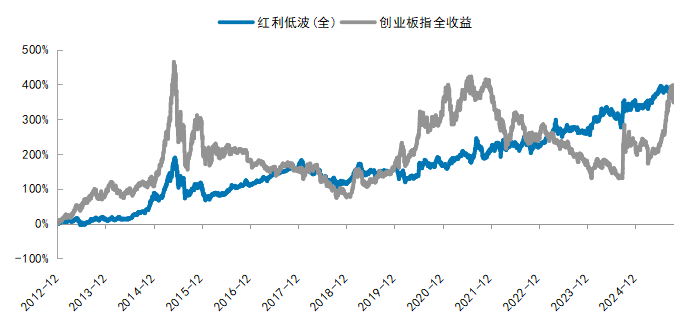
Core Viewpoint - The increasing demand for wealth management among residents highlights the importance of asset allocation, which can help investors balance returns and risks, respond rationally to market fluctuations, and achieve long-term investment goals [2] Group 1: Investment Strategies - The comparison between the "dividend low-volatility index" and the "growth enterprise board index" illustrates a long-term alignment in returns, emphasizing the value of different investment styles over time [9][10] - Dividend investment is often perceived as lacking growth potential, yet its stability and consistent returns can be advantageous in the long run [14][15] - The disciplined approach of dividend indices, focusing on sustainable dividend payments and valuation safety, provides a unique advantage in the A-share market [16] Group 2: Growth vs. Dividend Investment - Growth investments, while capturing market trends, often come with high volatility and uncertainty, making them challenging for many investors [21][22] - The essence of dividend strategies lies in their suitability for ordinary investors, prioritizing stability and disciplined investment over speculative gains [24] - The long-term performance of dividend strategies does not necessarily indicate superiority over growth investments; rather, it reflects a better fit for certain investment profiles [24] Group 3: Investor Mindset - The choice between being a "shooting star" or a "constant star" in investment reflects different approaches to wealth accumulation, with dividend strategies offering a more stable path to long-term returns [25][27] - The wisdom of slow and steady investment, as opposed to chasing rapid gains, is emphasized as a more sustainable approach to wealth management [26]

一则寓言,藏着A股市场被忽视的投资真相
Zhong Guo Zheng Quan Bao· 2025-11-20 08:44
Core Viewpoint - The increasing demand for wealth management among residents highlights the importance of asset allocation, which helps investors balance returns and risks while achieving long-term investment goals [1] Group 1: Investment Styles - The long-term cumulative return comparison between the dividend low-volatility index and the ChiNext index shows a convergence in performance over time, indicating a significant shift in market dynamics [2][4] - Dividend investing is often perceived as slow and lacking growth narratives, but this "slow" nature is actually a foundation for long-term stability and performance [6][8] - Growth investing, characterized by rapid changes and high volatility, often leads to significant risks and uncertainties, making it challenging for investors to maintain positions during market fluctuations [12][13] Group 2: Investment Strategies - The essence of dividend strategies lies not in being superior to growth strategies, but in their suitability for ordinary investors who prefer stability over speculation [14][15] - Dividend investment focuses on disciplined approaches, emphasizing the importance of reinvesting dividends and maintaining a steady investment rhythm, which can lead to substantial long-term gains [15][16] - The choice between being a "shooting star" or a "constant star" in investing reflects the different approaches to wealth accumulation, with dividend strategies offering a more stable path for long-term investors [16][18]
小红日报 | 沪指三连阴,资金积极布局红利!标普红利ETF(562060)标的指数收跌1.17%
Xin Lang Ji Jin· 2025-11-19 01:09
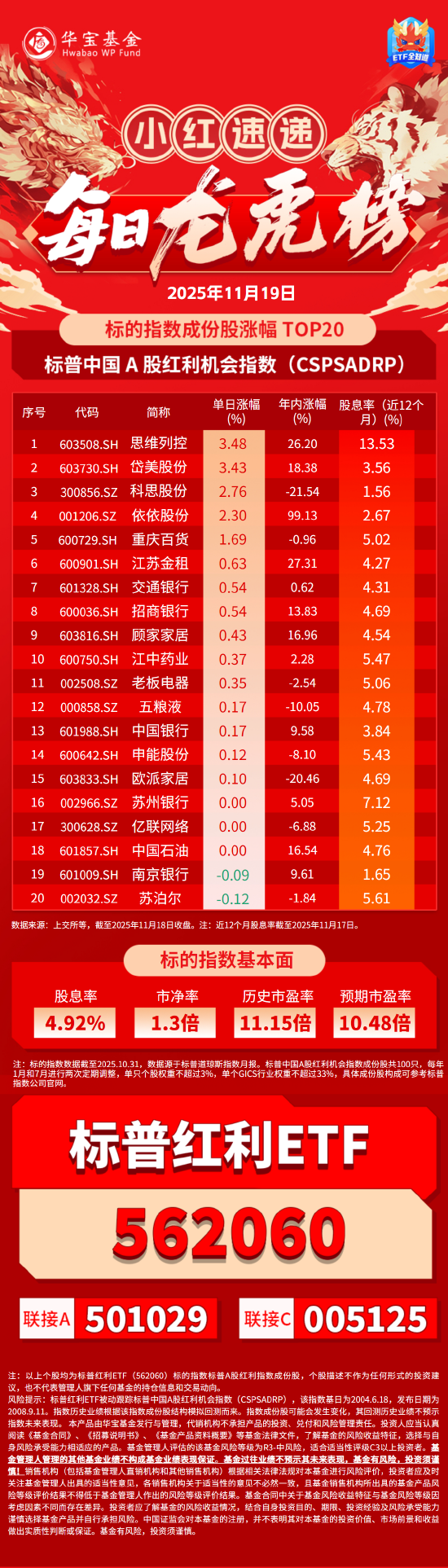
Core Insights - The article highlights the top-performing stocks in the S&P China A-Share Dividend Opportunity Index, showcasing significant daily and year-to-date gains along with dividend yields [1] Group 1: Stock Performance - The top stock, Siwei Liekong (603508.SH), experienced a daily increase of 3.48% and a year-to-date increase of 26.20%, with a dividend yield of 13.53% [1] - Dai Mei Co., Ltd. (603730.SH) saw a daily rise of 3.43% and an 18.38% increase year-to-date, with a dividend yield of 3.56% [1] - Yiyi Co., Ltd. (001206.SZ) had a remarkable year-to-date increase of 99.13%, despite a daily rise of only 2.30% and a dividend yield of 2.67% [1] Group 2: Dividend Yields - Jiangsu Jinxiang (600901.SH) reported a dividend yield of 4.27% with a year-to-date increase of 27.31% [1] - China Bank (601988.SH) has a dividend yield of 3.84% and a year-to-date increase of 9.58% [1] - China Petroleum (601857.SH) maintains a dividend yield of 4.76% with a year-to-date increase of 16.54% [1]





年底行情深度解析,跨年行情的“黄金周期”应该如何布局?
Sou Hu Cai Jing· 2025-11-14 07:59
Core Viewpoint - The market is experiencing an upward trend with the Shanghai Composite Index breaking a 10-year high at 4030.40 points, leading to discussions on whether investors should switch sectors as the year-end approaches [1] Market Trends - The market is currently in a policy vacuum period, with strong sectors like semiconductors, AI, and chips showing lackluster performance recently [1] - Historical patterns indicate that value stocks such as banks, non-bank financials, and food and beverage sectors have a win rate exceeding 70% during the year-end period (November-December) [3] - The banking sector saw a 9.36% increase in December 2024, while technology sectors like computers and electronics gained a 15% increase in January 2023 [3] Sector Performance - The Consumer sector, particularly the liquor segment, has shown strong performance despite pressure from fundamentals after the third-quarter reports [1] - The China Securities Dividend Index tends to perform well before year-end, indicating a potential shift in market focus [1] Investment Strategies - Two key investment tracks are highlighted: 1. **Cyclical Recovery in Undervalued Industries**: Traditional industries are seeing improvements in supply-demand dynamics, with sectors like white goods, engineering machinery, and commercial vehicles being identified as having global competitive advantages [6] 2. **Defensive High-Dividend Strategies**: High-dividend assets are viewed as a stabilizing force in investment portfolios, particularly in uncertain market conditions [10] Fund Performance - The China Securities Major Consumer Index has nearly doubled in size since 2023, with the Huatai-PineBridge China Securities Major Consumer ETF leading with a scale exceeding 20 billion [7] - The demand for long-term dividend investments remains strong, driven by the ongoing asset shortage in the banking sector [11] Index and Fund Recommendations - The S&P Hong Kong Stock Connect Low Volatility Dividend Index and the Hang Seng High Dividend Low Volatility Index are recommended for investors seeking stable growth and risk diversification [12][13]
2025投资即将收官,下一站去哪?
中国基金报· 2025-11-13 01:02
Group 1 - The core viewpoint of the article emphasizes the importance of identifying relative certainty in investment opportunities amidst market fluctuations, with a positive long-term outlook for A-shares and a focus on dividend assets as essential investment options [1][2][3]. Group 2 - In a low interest rate environment, dividend assets exhibit significant advantages due to their high dividend yields, making them attractive to investors seeking better returns [2][3]. - The 10-year government bond yield has fallen below 1.9%, leading to a decline in returns for interest rate-sensitive products, prompting investors to explore dividend investments [3]. - The dividend yield of the CSI Dividend Index and the CSI Hong Kong Stock Connect High Dividend Investment Index stands at 4.29% and 5.75%, respectively, both higher than the Shanghai Composite Index and the Hang Seng Index [3][5]. Group 3 - Dividend assets have shown excellent long-term performance, with the CSI Dividend Index increasing by 465.17% since 2005, significantly outperforming the Shanghai Composite Index and the Shenzhen Component Index during the same period [7][10]. - The performance of the CSI Dividend Index from 2020 to 2025 shows fluctuations, with returns of 3.49%, 13.37%, -5.45%, 0.89%, 12.31%, and -3.07%, compared to the Shanghai Composite Index's returns of 13.87%, 4.80%, -15.13%, -3.70%, 12.67%, and 2.76% [10]. Group 4 - The article highlights the launch of the Jianxin Dividend Select Mixed Fund, which focuses on dividend assets, aiming for a stock allocation of 60-95% and investing at least 80% of non-cash fund assets in dividend-related stocks [10][11]. - The fund will adopt a quantitative investment strategy, utilizing a quantitative stock selection framework and factor models for portfolio construction, emphasizing quality and growth while considering volatility and valuation for timing [11]. - The fund will be managed by Jiang Yanze, who has a master's degree in financial engineering and 10 years of experience in the securities industry [11].

红利板块持续走强 机构关注46只低位优质股
Zheng Quan Shi Bao· 2025-11-12 18:40
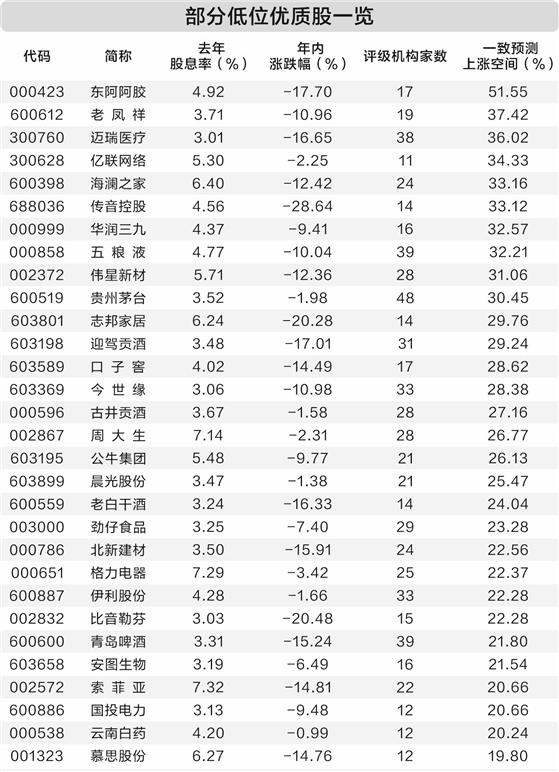
Core Viewpoint - The A-share market is showing a clear preference for dividend stocks, with significant price increases in major companies like China Petroleum and Agricultural Bank, indicating a strong trend towards dividend-paying stocks [2][3][4]. Group 1: Dividend Stock Performance - The dividend sector, including oil, banking, and coal, has outperformed other sectors since November, with notable gains in the index [2][4]. - Agricultural Bank's A-shares reached a historical high of 8.65 yuan per share, while its H-shares also saw a significant increase, reflecting strong investor interest [3]. - Major weight stocks like China Petroleum have shown significant price movements, contributing to the overall rise in the dividend sector [4]. Group 2: Institutional Interest in Low-Valued Dividend Stocks - Analysts suggest focusing on low-valued dividend stocks with stable dividend expectations, with 46 stocks meeting criteria such as a dividend yield over 3% and a decline in stock price this year [5]. - Stocks with the highest dividend yields include Fuanna at over 8%, and others like Sophia, Gree Electric, and Zhou Dasheng with yields exceeding 7% [5]. - Guizhou Moutai has the highest institutional ratings, with 48 institutions covering it, followed by Wuliangye and Qingdao Beer, each with over 30 ratings [5]. Group 3: Future Dividend Expectations - Guizhou Moutai plans to distribute cash dividends amounting to at least 75% of its net profit annually from 2024 to 2026, with distributions occurring twice a year [6]. - Ganyuan Food has announced a similar plan, committing to distribute at least 70% of its distributable profits annually, contingent on certain conditions [6]. Group 4: Heavy Holdings by Social Security and Insurance Funds - Among the 46 stocks, 10 have a projected price increase potential exceeding 30%, including Dong'e Ejiao and Maijie Medical [7]. - Eleven stocks have received significant attention from social security and insurance funds, with Wei Xing's holdings exceeding 8% and others like Anji Food and Chuanxin Beer over 3% [7].