
适度宽松货币政策

Search documents
辽宁2025年社会融资增量创七年新高 金融“五篇大文章”贷款余额超1.7万亿元
Sou Hu Cai Jing· 2026-01-31 10:46
Core Insights - The People's Bank of China Liaoning Branch reported a steady growth in financial operations in 2025, emphasizing the implementation of a moderately loose monetary policy to support the real economy and enhance the business environment [1] Group 1: Financial Performance - The total social financing scale in Liaoning reached 348.2 billion yuan in 2025, the highest for the same period in nearly seven years [1] - The balance of RMB loans was 5.32 trillion yuan, with an increase of 121.9 billion yuan since the beginning of the year [1] - New loans to enterprises reached 153.8 billion yuan, the highest in five years, while household operating loans grew by 14.94% year-on-year [1] Group 2: Monetary Policy Tools - The Liaoning Branch utilized structural tools such as re-loans for agriculture and small businesses, injecting approximately 77 billion yuan into the market, leading to about 370 billion yuan in loans from financial institutions [2] - The interest rates for newly issued corporate loans in December decreased by 2.48 percentage points compared to the end of 2020, with inclusive small and micro loan rates down by 2.71 percentage points [2] Group 3: Foreign Exchange Management - The level of foreign exchange management facilitation improved, with 174 new facilitated enterprises and a 25.3% year-on-year increase in facilitated payment amounts [2] - The implementation of capital project reforms saw 350 new cross-border investment and financing projects established [2] Group 4: Financial Market Development - The issuance scale of debt financing tools for non-financial enterprises reached 66.173 billion yuan, with an average interest rate of 2.21%, saving over 300 million yuan in interest costs for enterprises [3] - The bond market saw significant growth, with the number of participating institutions increasing to six and transaction amounts growing nearly twofold to 11.413 billion yuan [3] Group 5: Credit Services - The "one-time credit repair" policy was effectively implemented, resulting in an average daily query volume of about 8,000 credit reports, peaking at over 13,000 [3] - The focus remains on enhancing financial services for the real economy, optimizing credit structures, and expanding financial market functions in 2026 [3]
人行辽宁省分行:多渠道为实体经济提供“真金白银”
Xin Hua Cai Jing· 2026-01-31 01:49
Core Viewpoint - The People's Bank of China Liaoning Branch is committed to implementing a moderately loose monetary policy to support the real economy and promote high-quality development, effectively utilizing various monetary policy tools to provide substantial financial support to the economy and reduce overall financing costs. Group 1: Financing Growth - The People's Bank of China Liaoning Branch has guided financial institutions to meet the effective financing needs of the real economy, resulting in an increase of 121.9 billion RMB in new loans in 2025, with a year-on-year growth of 2.35% in loan balance [1] - Among the new loans, six major state-owned banks contributed 102.2 billion RMB, with a year-on-year growth of 4.2%, while joint-stock banks added 4.53 billion RMB, which is an increase of 31.1 billion RMB compared to the previous year [1] Group 2: Credit Structure Optimization - The People's Bank of China Liaoning Branch has utilized various structural monetary policy tools to guide funds towards key areas and weak links, deploying approximately 77 billion RMB in central bank funds through tools like re-loans for technological innovation and consumer services, which has stimulated financial institutions to issue around 370 billion RMB in various loans [2] - Future plans include establishing special quotas such as "Le Gou Loan" and "Silver Hair Loan" to support loans for consumer services and the elderly care industry, ensuring comprehensive coverage of re-loans for agriculture and small enterprises in key areas [2] Group 3: Sustainable Interest Rate Environment - The People's Bank of China Liaoning Branch aims to optimize the interest rate environment as a crucial part of improving the business environment, continuously guiding a steady decline in overall financing costs and strengthening the supervision of interest rate policies to maintain market competition [2] - In December, the interest rates for newly issued corporate loans and inclusive micro-loans decreased by 248 basis points and 271 basis points, respectively, compared to the end of 2020, demonstrating significant effectiveness in reducing financial burdens on the real economy [2]
宏观杠杆率持续上升 结构优化成调控关键
Zhong Guo Jing Ying Bao· 2026-01-30 04:35
Core Viewpoint - The macro leverage ratio in China is projected to rise to 302.4% by the end of 2025, indicating a significant increase in debt levels relative to nominal GDP, necessitating structural optimization of leverage to support economic growth effectively [1][2]. Summary by Sections Macro Leverage Ratio Trends - The macro leverage ratio increased by 0.1 percentage points from 302.3% at the end of Q3 2025 to 302.4% at the end of Q4 2025. For the entire year, it rose by 11.7 percentage points, driven by low debt growth in the household and corporate sectors, while government debt expanded significantly [2]. - By the end of 2025, the debt balances of non-financial enterprises, households, and government sectors grew by 7.8%, 0.5%, and 17.0% respectively, leading to a total debt balance increase of 8.2%, while nominal GDP only grew by 4.0% [2]. Sectoral Contributions to Leverage Ratio - The rise in the macro leverage ratio was primarily driven by the corporate and government sectors, while the household sector continued to reduce its leverage. Factors such as the adjustment in the real estate market and slow income growth led households to decrease debt and increase savings [3]. - Government investment projects and a recovering corporate financing demand, supported by proactive fiscal policies, contributed to the increase in debt levels in the corporate and government sectors [3]. Future Outlook and Policy Recommendations - The monetary policy in 2026 is expected to maintain a moderately loose stance, which may lead to continued growth in corporate and government debt, putting upward pressure on the macro leverage ratio. However, this could be offset by an increase in nominal GDP growth [4]. - Recommendations for optimizing leverage structure include supporting financing for private SMEs and technology firms, while controlling the debt expansion of state-owned enterprises. This approach aims to stabilize the leverage ratio in the household sector and promote sustainable economic growth [5][6]. - The government is encouraged to increase fiscal spending in social welfare areas, which could enhance consumer spending potential. For instance, a 1% interest subsidy on household loans could reduce interest burdens significantly and stimulate consumption growth [6].
总量稳 结构优 成本降 金融有力支持全省经济回升向好
Xin Lang Cai Jing· 2026-01-30 00:01
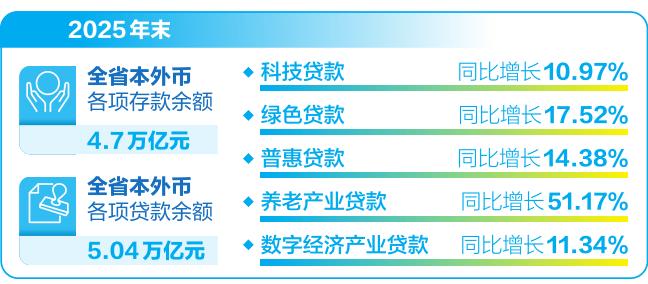
"从投向看,贷款行业结构持续优化。"人民银行云南省分行有关负责人分析,2025年末,基础设施业中 长期贷款余额1.59万亿元,同比增长7.1%;不含房地产业的服务业中长期贷款余额1.56万亿元,同比增 长5.77%;制造业中长期贷款余额1670.89亿元,同比增长4.4%。 金融"五篇大文章"贷款总量快速增长。2025年末,全省金融"五篇大文章"贷款余额1.81万亿元,同比增 长13.26%。其中,科技贷款同比增长10.97%,绿色贷款同比增长17.52%,普惠贷款同比增长14.38%, 养老产业贷款同比增长51.17%,数字经济产业贷款同比增长11.34%,均高于各项贷款增速。 贷款利率稳中有降,2025年,全省新发放贷款加权平均利率为3.5%,同比下降54个BP。其中,新发放 企业贷款加权平均利率为3.35%,同比下降41个BP;新发放个人住房贷款加权平均利率为3.06%,同比 下降42个BP,各类贷款利率均处于历史低位。 2025年以来,人民银行云南省分行精准实施适度宽松的货币政策,扎实做好金融"五篇大文章",强化逆 周期调节,综合运用多种货币政策工具服务实体经济高质量发展,推动云南省金融运行总体延续总 ...

2025年山东省金融运行呈现“量稳、价降、面扩”的良好态势
Zhong Guo Fa Zhan Wang· 2026-01-27 07:53
Core Viewpoint - The People's Bank of China Shandong Branch is focused on implementing a moderately loose monetary policy and enhancing financial support in key areas to foster economic growth in Shandong Province by 2025 [1] Financial Performance - Financial indicators in Shandong Province show stable growth, with social financing scale, loans, and deposits reaching CNY 25.9 trillion, CNY 16.3 trillion, and CNY 19.0 trillion respectively, marking year-on-year growth of 9.0%, 8.2%, and 9.1%, outpacing national averages [2] - Financing costs have decreased, with a reduction in policy interest rates leading to annual savings of CNY 16.9 billion for businesses and residents. The average interest rate for new corporate loans was 3.57%, down 0.19 percentage points year-on-year, while personal housing loans averaged 3.05%, down 0.01 percentage points [2] - The coverage of loans has expanded, with 310,000 enterprises receiving loan support by the end of December, an increase of 33,000 from the beginning of the year [2] Credit Structure Optimization - The balance of corporate loans reached CNY 10.9 trillion, growing by 12.6% year-on-year, which is 4.4 percentage points higher than the overall loan growth rate. The increase in corporate loans for the year was CNY 1.2 trillion, a record high for the same period [3] - Structural monetary policy tools have been effectively utilized, with over CNY 190 billion in loans issued for technological innovation and carbon reduction initiatives [3] - Loans in the "Five Major Articles" sector reached CNY 6.7 trillion, growing by 15.6% year-on-year, accounting for 78.9% of the total loan increase [3] Investment and Consumption - Investment efforts have intensified, with loans for fixed assets and infrastructure reaching CNY 4.2 trillion and CNY 4.9 trillion respectively, growing by 10.2% and 14.0% year-on-year [4] - Consumer finance has improved, with medium- and long-term consumer loans (excluding personal housing loans) reaching CNY 448.03 billion, up 10.9% year-on-year, and household medium- and long-term operating loans at CNY 586.23 billion, up 9.8% [4] Foreign Trade and Investment - Measures to support foreign trade and investment have been robust, with pilot business transactions totaling CNY 93.3 billion, a 35% increase year-on-year [5] - The use of cross-border RMB has expanded, with cross-border RMB transactions reaching CNY 1.5 trillion from January to November, a 16.2% increase year-on-year [6] Future Outlook - The People's Bank of China Shandong Branch plans to continue implementing a moderately loose monetary policy, enhancing financial support for green, low-carbon, and high-quality development, and ensuring effective financial services for the real economy [6]
中原观察丨拉满进度条 拼出好开局
He Nan Ri Bao· 2026-01-26 23:42
Group 1 - The core message emphasizes the urgency and determination to achieve economic growth in the new year, highlighting the importance of the first quarter as a critical period for setting the tone for the entire year [1][2] - In the previous year, Henan province achieved a GDP growth rate of 5.6%, with a first-quarter growth rate of 5.9%, indicating a challenging environment for maintaining steady growth in the current year [1][2] - Key economic indicators from last year include an 8.4% increase in industrial added value, a 13.3% rise in industrial investment, and a 14.1% growth in total import and export value, showcasing a stable and improving development trend [2] Group 2 - The government plans to continue implementing proactive fiscal policies and moderately loose monetary policies to support consumption and major projects, which are crucial for the first quarter [2] - The first quarter is identified as a key period for policy implementation, fund allocation, and project applications, making it essential for achieving a good start to the year [2] - There is a call for local officials and departments to enhance their sense of urgency and take proactive actions to seize policy opportunities and maximize outcomes [2][3]
破140万亿元后,“十五五”如何开启新一轮增长?
Sou Hu Cai Jing· 2026-01-26 06:57
Economic Stability and Progress - China's economy is showing resilience and stability, with a projected GDP growth of 5% by 2025, marking a significant milestone as the total economic output surpasses 140 trillion yuan [1] - The country has made notable advancements in technology and innovation, ranking 10th in the global innovation capability index and maintaining the top position in the Nature Index for scientific leadership [1] - The development of new productive forces is evident, with over 35,000 basic-level smart factories and a significant number of advanced and excellent-level factories established, reflecting a strong trend in industrial upgrading [1] Foreign Trade Resilience - Despite challenges from external tariffs, China's foreign trade has shown unexpected growth, particularly in exports to non-U.S. countries, with strong performance in sectors like integrated circuits, automobiles, and medical devices [2] - The export growth indicates a clear trend of upgrading the industrial value chain, although domestic demand remains weak compared to supply [2] Macroeconomic Policy Implementation - The central economic work conference emphasizes the need for proactive macroeconomic policies to achieve effective qualitative improvements and reasonable quantitative growth in the economy [3] - The goal for 2035 is to reach a per capita GDP of over $20,000, necessitating a doubling of the economic total from 2020 levels, which requires sustained annual growth rates above 4.5% during the 15th Five-Year Plan [3] Fiscal and Monetary Policy - The conference calls for a more active fiscal policy, maintaining necessary levels of fiscal deficit and debt while optimizing expenditure structures to support strategic national initiatives [4] - A moderately loose monetary policy is to be continued, focusing on stabilizing economic growth and ensuring reasonable price recovery, with an emphasis on maintaining liquidity and supporting key sectors [5] Supply and Demand Balance - The focus on expanding domestic demand and enhancing the domestic market is crucial, with initiatives aimed at boosting consumption and investment through government-led projects [6] - The government aims to increase public service spending to alleviate household burdens and stimulate consumption, particularly in the service sector [6] Investment and Innovation - Government investment is expected to play a significant role in driving growth, particularly in major infrastructure projects and social welfare initiatives [7] - Emphasis is placed on technological innovation, with plans to enhance the capabilities of key innovation centers in major urban areas, thereby improving China's position in the global innovation landscape [8] Structural Reforms - Structural reforms are necessary to address supply-demand imbalances, including the establishment of a unified national market and improvements in the tax system to incentivize local consumption [9] - Accelerating the urbanization of rural populations is identified as a key strategy to boost consumption and expand domestic demand [9]
格林大华期货早盘提示:钢材-20260126
Ge Lin Qi Huo· 2026-01-26 02:53
1. Report Industry Investment Rating - Not provided in the given content 2. Core View - On Thursday, rebar and hot-rolled coils closed up, and also closed up during the night session. The supply of five major steel products this week was 819,590 tons, with a week-on-week increase of 0.38 thousand tons. The total inventory of five major steel products was 1,257,080 tons, with a week-on-week increase of 10,070 tons and a growth rate of 0.8%. The weekly consumption of five major products was 809,520 tons, among which the consumption of building materials decreased by 0.8% week-on-week and the consumption of plates decreased by 2.6% week-on-week. Near the end of the year, steel mills' winter storage policies are being released one after another, but downstream winter storage willingness is average, with most holding a cautious attitude and the winter storage volume decreasing compared to last year. The current market's psychological winter storage price is concentrated at 3,000 - 3,100 yuan/ton, which is relatively close to the current spot price level. Short-term long positions can be attempted, but it is expected that the upside space is limited, and stop-loss should be set. The support level of the rebar main contract is 3,050, and the pressure level is 3,200 [1] 3. Summary by Relevant Catalogs 3.1 Market Review - On Thursday, rebar and hot-rolled coils closed up, and also closed up during the night session [1] 3.2 Important Information - In December 2025, the production of new energy vehicles was 1.791 million, a year-on-year increase of 8.7%; from January to December, the production was 16.524 million, a year-on-year increase of 25.1% [1] - In December 2025, China's raw coal production was 437.035 million tons, a year-on-year decrease of 1.0%; the cumulative production from January to December was 4.831782 billion tons, a year-on-year increase of 1.2%. From the provincial data, from January to December 2025, the cumulative year-on-year growth rates of raw coal production in Shanxi, Inner Mongolia and Shaanxi were 2.1%, -1.0% and 2.9% respectively [1] - On January 22, 2026, the latest data from the National Bureau of Statistics showed that in December 2025, China's excavator production was 37,305 units, a year-on-year increase of 20.8%. In the whole year of 2025, China's excavator production was 379,643 units, a year-on-year increase of 16.6% [1] - In 2026, the People's Bank of China will continue to implement a moderately loose monetary policy, taking promoting stable economic growth and reasonable recovery of prices as important considerations for monetary policy. There is still some room for reserve requirement ratio cuts and interest rate cuts this year [1] - This week, the supply of five major steel products was 819,590 tons, a week-on-week increase of 0.38 thousand tons; the total inventory of five major steel products was 1,257,080 tons, a week-on-week increase of 10,070 tons and a growth rate of 0.8%; the weekly consumption of five major products was 809,520 tons, among which the consumption of building materials decreased by 0.8% week-on-week and the consumption of plates decreased by 2.6% week-on-week [1] 3.3 Market Logic - This week, the supply of five major steel products was 819,590 tons, remaining unchanged week-on-week. The variety structure of steel production has differentiated this period, mainly with an increase in building materials production and a decrease in plate and coil production. The total inventory of five major steel products this week was 1,257,080 tons, with a week-on-week increase of 10,070 tons and a growth rate of 0.8%. The total inventory of five major products has rebounded this week, and the inventory changes of building materials and plates have differentiated, with building materials showing inventory accumulation and plates showing inventory reduction. Building materials accumulated 14,870 tons of inventory, and plates reduced inventory by 4,800 tons. In terms of consumption, the weekly consumption of five major products this week was 809,520 tons, among which the consumption of building materials decreased by 0.8% week-on-week and the consumption of plates decreased by 2.6% week-on-week. The consumption structure of building materials and plates among the five major products remained the same this week. Near the end of the year, steel mills' winter storage policies are being released one after another. The downstream winter storage willingness is average, with most holding a cautious attitude and the winter storage volume decreasing compared to last year. The current market's psychological winter storage price is concentrated at 3,000 - 3,100 yuan/ton, which is relatively close to the current spot price level [1] 3.4 Trading Strategy - Short-term long positions can be attempted, but it is expected that the upside space is limited, and stop-loss should be set. The support level of the rebar main contract is 3,050, and the pressure level is 3,200 [1]
金融行业周报:降息降准仍有空间,宁波兴业25年营收回暖-20260126
Ping An Securities· 2026-01-26 01:49
Investment Rating - The report maintains a "Strong Buy" rating for Ningbo Bank and Industrial Bank, expecting their stock prices to outperform the CSI 300 Index by over 20% within the next six months [38]. Core Insights - The People's Bank of China (PBOC) Governor Pan Gongsheng indicated that there is still room for interest rate cuts and reserve requirement ratio (RRR) reductions, with a commitment to continue a moderately loose monetary policy in 2026 [9][10]. - Ningbo Bank reported a year-on-year revenue growth of 8.01% and a net profit growth of 8.13% for 2025, with significant increases in intermediary business income by 30.72% and total assets growing by 16.11% [12]. - Industrial Bank's revenue and net profit showed slight increases of 0.24% and 0.34% respectively, with total assets surpassing 11 trillion yuan and a stable non-performing loan (NPL) ratio of 1.08% [12][13]. - The report highlights a recovery in bank holdings by active management funds, with a slight increase in the proportion of bank sector holdings to 1.06%, indicating potential for further investment [22]. Summary by Sections Monetary Policy - Pan Gongsheng emphasized the need for a flexible and effective use of monetary policy tools, including interest rate cuts and RRR reductions, to ensure liquidity remains ample and aligns with economic growth expectations [9][10]. Bank Performance - Ningbo Bank's strong performance is characterized by a low NPL ratio of 0.76% and a high provision coverage ratio of 373%, indicating robust risk management [12]. - Industrial Bank's performance is stable, with a focus on maintaining asset quality and a solid provision coverage ratio of 228% [12][13]. Market Trends - The banking sector saw a slight increase in active fund holdings, suggesting a potential recovery in investor confidence and interest in bank stocks [22]. - The report notes that the banking, securities, insurance, and fintech indices experienced declines, with the banking index down by 2.70% [23].


光大期货:1月26日黑色系日报
Xin Lang Cai Jing· 2026-01-26 01:12
Economic Overview - The People's Bank of China will continue to implement a moderately loose monetary policy in 2026, focusing on promoting stable economic growth and reasonable price recovery, with room for further interest rate cuts and reserve requirement ratio reductions this year [4][15]. - China's GDP is projected to grow by 5.0% in 2025, reaching 140.19 trillion yuan, with industrial added value increasing by 5.9% and retail sales growing by 3.7% [4][15]. Steel Production and Demand - In 2025, China's crude steel production is expected to be 96.081 million tons, a decrease of 4.4% year-on-year, while steel production will increase by 3.1% to 144.612 million tons [4][15]. - The total steel inventory reached 12.5708 million tons, with a week-on-week increase of 100,700 tons, indicating a mixed supply structure with an increase in construction materials and a decrease in sheet materials [5][16]. Market Performance - The capacity utilization rate of iron-making furnaces in 247 steel mills was 85.51%, a slight increase of 0.03 percentage points from the previous week, with a profitability rate of 40.69%, up by 0.86 percentage points [5][16]. - The production of rebar increased by 92,500 tons to 1.9955 million tons, while hot-rolled steel production slightly decreased to 6.206 million tons, down by 25,500 tons week-on-week [6][18]. Price Trends - The current market for rebar is characterized by rising supply but weak demand, leading to a continuation of seasonal weakness in prices, with expectations of narrow fluctuations in steel prices [6][17]. - The trading strategy for rebar is set within a short-term range of 3,100 to 3,200 yuan per ton, while hot-rolled steel is expected to range between 3,250 and 3,350 yuan per ton [8][19]. Alloy Market Insights - The alloy supply remains low with minimal changes in production, and the demand from steel mills is stable, leading to expectations of a continued oscillation in prices [9][20].
