国产替代

Search documents
2026年Q1 NAND闪存价格环比涨幅超40%,AI算力需求爆发带动半导体设备、存储赛道景气度上行
Mei Ri Jing Ji Xin Wen· 2026-02-04 03:23
Group 1 - The semiconductor materials and equipment theme index on the STAR Market has seen a decline of 0.95% as of February 4, 2026, with mixed performance among constituent stocks [1] - The semiconductor equipment ETF, Huaxia, has decreased by 0.74%, with a latest price of 1.88 yuan, while the STAR Market semiconductor ETF has dropped by 0.96%, priced at 1.75 yuan [1] - The trading volume for the STAR Market semiconductor ETF was 3.21 billion yuan, with a turnover rate of 3.99%, indicating significant liquidity [1] Group 2 - The latest net outflow for the STAR Market semiconductor ETF is 227 million yuan, but over the past five trading days, there has been a net inflow of 389 million yuan, averaging 77.86 million yuan per day [2] - Counterpoint's report indicates that NAND flash prices are expected to rise by over 40% this quarter due to reduced consumer-grade capacity by major manufacturers to meet the growing demand from AI servers [2] - The price of low-end 128GB PC SSDs has increased by 50%, reflecting the tightening supply in the NAND market [2] Group 3 - AI computing demand is driving the semiconductor equipment and storage sectors upward, with ASML expected to see steady growth in 2025 due to significant technological barriers in EUV lithography [3] - Samsung Electronics and SK Hynix are benefiting from tight supply and rising prices in the storage chip market, while continuing to advance high-end storage product development [3] - The domestic semiconductor equipment and storage industry presents investment opportunities, particularly in the context of the AI revolution and ongoing technological advancements [3]
鲁股观察 | 1.09亿收购越南公司,道恩股份再收购
Xin Lang Cai Jing· 2026-02-04 03:18
Core Viewpoint - Daon Co., Ltd. is actively pursuing globalization through strategic acquisitions, enhancing its position in the polymer composite materials industry, particularly in Southeast Asia [2][3]. Group 1: Acquisition Details - Daon Co., Ltd. announced plans to acquire a plastic compound business unit in Vietnam for approximately $1.5737 million (about 109 million RMB), marking a significant step in its global expansion strategy [2]. - The target business, part of Hwaseung Chemical Vietnam Co., Ltd., reported revenue of $1.2576 million and a net profit of $449,000 for the first half of 2025, indicating solid profitability [2]. - This acquisition follows a previous announcement to acquire 80% of Ningbo Aisikai Synthetic Rubber Co., Ltd. for 516 million RMB, with a total transaction value of approximately 581 million RMB [3]. Group 2: Strategic Importance - The acquisition is aimed at localizing production in response to key customers shifting their supply chains to Southeast Asia, which will help reduce logistics costs and improve delivery times [3]. - Daon Co., Ltd. emphasizes that this move is crucial for strengthening customer relationships and enhancing order acquisition capabilities [3]. Group 3: Market Position and Innovation - Daon Co., Ltd. is recognized as a leading player in the domestic rubber and plastic industry, focusing on thermoplastic elastomers (TPV) and modified plastics [8]. - The company has developed a high-end tire barrier material, DVA, which has significant commercial potential and is expected to capture a substantial market share in the tire industry [7]. - DVA's market potential is estimated to generate 2.4 billion RMB in revenue if it achieves a 10% penetration rate in China's annual tire production of 1.2 billion units [7].



国内GaN龙头英诺赛科向谷歌批量供货,科创半导体ETF(588170)近2周规模增长5.55亿元领先同类,半导体设备ETF华夏(562590)最新规模达27.57亿元
Mei Ri Jing Ji Xin Wen· 2026-02-04 03:16
Group 1: Market Performance - The Shanghai Stock Exchange's Sci-Tech Innovation Board semiconductor materials and equipment index decreased by 0.85%, with component stocks showing mixed performance [1] - The semiconductor equipment ETF Huaxia (562590) fell by 0.47%, with a latest price of 1.89 yuan [1] - The Sci-Tech semiconductor ETF (588170) experienced a decline of 0.85%, with a latest price of 1.75 yuan [1] Group 2: Fund Flows - The latest net outflow for the Sci-Tech semiconductor ETF was 227 million yuan, while it had a net inflow of 389 million yuan over the past five trading days [2] - The Huaxia semiconductor equipment ETF had a net outflow of 109 million yuan, with a total net inflow of 64.74 million yuan over the past ten trading days [2] Group 3: Company Developments - InnoSilicon, a domestic leader in GaN technology, has begun bulk shipments of its GaN-based power chips to Google, marking its entry into the data center market [2] - InnoSilicon's GaN power chips improve power efficiency, reduce energy consumption, and lower operational costs, aligning with global tech giants' demands for energy efficiency and sustainability [2] - The company is collaborating with major power manufacturers and server ODMs to create a comprehensive GaN data center power supply solution ecosystem [2] Group 4: Industry Insights - The semiconductor equipment and materials industry is a key area for domestic substitution, characterized by low domestic replacement rates and high ceilings for domestic substitution [3] - The industry is expected to benefit from the semiconductor demand driven by the AI revolution, expansion, technological restructuring, and advancements in lithography technology [3] - The Sci-Tech semiconductor ETF and its associated funds track the semiconductor materials and equipment index, focusing on hard tech companies in the semiconductor sector [3][4]
黄仁勋台北“夜宴”:2026年仍将是AI供应链极度吃紧的一年?
经济观察报· 2026-02-04 02:34
Core Viewpoint - The year 2026 is expected to be "extremely tight" for the industry, with a significant surge in demand for high bandwidth memory (HBM) and advanced packaging, making computing power a key term in the capital market [1][16]. Group 1: Industry Insights - Huang Renxun, CEO of NVIDIA, highlighted the challenges in producing the new generation AI chip architecture, Blackwell, in 2025, and indicated that the supply chain will be "extremely tight" in 2026 [3]. - The dinner gathering included key executives from major AI supply chain companies, with a combined market value exceeding $5 trillion, indicating the scale and importance of the AI industry [2]. - TSMC is expected to significantly increase its CoWoS (Chip on Wafer on Substrate) capacity from 35,000 pieces per month in 2024 to over 65,000 pieces in 2025, with NVIDIA accounting for over 60% of the demand [5]. Group 2: Company Performance - Victory Technology (胜宏科技) anticipates a substantial increase in net profit for 2025, projected between 4.16 billion to 4.56 billion RMB, representing a year-on-year growth of 260.35% to 295.00% [7]. - Industrial Fulian (工业富联) expects a net profit of 35.1 billion to 35.7 billion RMB for 2025, an increase of 119 million to 125 million RMB from the previous year, reflecting a growth of 51% to 54% [8]. - Cambrian (寒武纪) forecasts a revenue of 6 billion to 7 billion RMB for 2025, marking a year-on-year growth of 410.87% to 496.02%, indicating its first annual profit since establishment [14]. Group 3: Market Dynamics - The demand for high-density interconnect (HDI) boards is surging due to the increased data throughput requirements of AI servers, with Victory Technology positioned to capitalize on this trend [8]. - The emergence of domestic chip companies like Cambrian and the recent IPOs of several GPU firms indicate a shift towards domestic alternatives in the computing power market, driven by the limitations of NVIDIA's high-end chips [15]. - The rapid growth of companies in the optical module sector, such as Zhongji Xuchuang, reflects the increasing demand for high-speed optical modules driven by GPU performance improvements [11].



未知机构:长江电子杨洋团队精测电子减持点评不利因素释放完毕看好量检测龙头26年订单-20260204
未知机构· 2026-02-04 02:00
Summary of Key Points from Conference Call Records Company and Industry Involved - The company discussed is **精测电子 (Jingce Electronics)**, a leader in the measurement and testing industry - The industry focus is on **semiconductor equipment**, particularly in the field of **量检测 (measurement and testing)** Core Insights and Arguments - **Shareholder Reduction Plans**: The company announced a shareholder reduction plan where key stakeholders, including **武汉精至 (Wuhan Jingzhi)**, the secretary, and the financial officer, plan to reduce their holdings by a total of **77.83 million shares**, **1.04 million shares**, and **1.23 million shares** respectively, which represent **0.28%**, **0.0037%**, and **0.0044%** of the total share capital. Additionally, shareholder **陈凯 (Chen Kai)** plans to reduce his holdings by **5 million shares**, accounting for **1.79%** of the total share capital. Chen Kai is noted as a founding member who has stepped down from executive roles [1][1][1] - **Impact of Shareholder Reduction**: The reduction is viewed as a normal financial need for the fund and is not expected to affect the company's actual control or strategic direction. The short-term emotional fluctuations in the market may provide a buying opportunity for long-term investors [1][1][1] - **Market Dynamics**: The global leader in the measurement field, **KLA**, holds nearly **60%** of the market share and is facing supply constraints due to policy pressures and shortages of key components. This situation is expected to accelerate the domestic substitution trend in China [2][2][2] - **Growth Prospects**: As a domestic leader, **精测电子** is anticipated to achieve significant growth in the coming years, particularly in **明暗场设备 (bright and dark field equipment)** and **先制程 (advanced processes)**. By **2026**, the company is expected to see high growth in **长鑫 (Changxin)** and achieve breakthroughs in **长存 (Changcun)**, with advanced equipment orders expected to materialize in three regions [2][2][2] Other Important but Possibly Overlooked Content - The reduction in shareholding by key stakeholders is framed within the context of normal market behavior, suggesting that investors should not overreact to such announcements [1][1][1] - The emphasis on domestic capabilities and the potential for accelerated growth in the face of international supply constraints highlights a strategic shift towards self-sufficiency in the semiconductor equipment sector [2][2][2]
未知机构:海外持续景气叠加国产替代提速继续看多洁净室260118-20260204
未知机构· 2026-02-04 01:50
Summary of Conference Call Notes Industry and Company Involved - **Industry**: Semiconductor and Construction - **Key Companies**: TSMC (Taiwan Semiconductor Manufacturing Company), Micron, Samsung, Intel, Longxing Technology, SMIC (Semiconductor Manufacturing International Corporation), and others Core Points and Arguments 1. **Impact of AI on Semiconductor Capital Expenditure**: The rise of AI is driving increased capital expenditure in the semiconductor industry, which in turn affects the construction sector, particularly in cleanroom construction and IDC (Internet Data Center) bidding areas. This demand surge is attributed to the global tech industry's growth, especially in AI [1][2] 2. **Significant Capital Expenditure by TSMC**: TSMC's capital expenditure is projected to reach $40.9 billion in 2025 and $56 billion in 2026, marking a historical high. This reflects a broader trend of increased capital spending among major semiconductor firms [4][12] 3. **Global Semiconductor Investment Trends**: The semiconductor industry is experiencing a significant increase in capital expenditure, with major players like TSMC, Samsung, and Intel leading the charge. The U.S. and Taiwan have reached trade agreements that will facilitate a $250 billion investment in the semiconductor supply chain [4][12] 4. **Cleanroom and IDC Construction Opportunities**: Analysts recommend focusing on cleanroom construction and IDC bidding as these areas are expected to see high demand due to the tech industry's growth. Companies like China Energy Construction and Sensen Da A are highlighted for their advantages in IDC construction and cloud computing services [2][19] 5. **Challenges in the Construction Industry**: The construction sector faces challenges such as labor shortages, trade tensions, and the need for overseas subsidiaries. However, the industry is expected to benefit from increased demand driven by global manufacturing trends and resource security capital expenditure [3][11] 6. **Investment in IDC and Cloud Infrastructure**: Major internet companies and telecom operators in China are accelerating investments in IDC and cloud infrastructure, with Alibaba planning to invest 380 billion RMB in AI over the next three years. This trend is expected to continue into 2026 [19][20] 7. **Market Dynamics and Valuation Trends**: The cleanroom industry is viewed as a significant investment opportunity, with a focus on stock price positions, order expectations, and customer bidding forecasts rather than just performance metrics. The current market dynamics suggest a potential for valuation increases driven by industry trends [8][16] 8. **Domestic Semiconductor Companies' Growth**: Domestic semiconductor firms like Longxing Technology and SMIC are in a critical phase of expansion and technological upgrades, with capital expenditures expected to grow. The market is increasingly focusing on these companies due to their growth potential [14][15] Other Important but Possibly Overlooked Content - **Trade Agreements and Tariffs**: The U.S. has reduced tariffs on Taiwanese semiconductor products from 20% to 15% as part of a trade agreement, which is expected to facilitate investment in the semiconductor sector [12] - **Focus on Cleanroom and IDC Construction**: The emphasis on cleanroom and IDC construction reflects a broader trend in the construction industry, where demand is increasingly driven by technological advancements rather than traditional construction metrics [8][10] - **Emerging Companies in the IDC Space**: Companies like China Telecom's subsidiary and Sensen Da A are positioned as key players in the IDC construction and cloud computing sectors, indicating a shift in investment focus towards these emerging firms [17][18]
齐翔腾达:8000吨高性能催化新材料项目进入试运行阶段
Zhong Guo Zheng Quan Bao· 2026-02-04 01:37
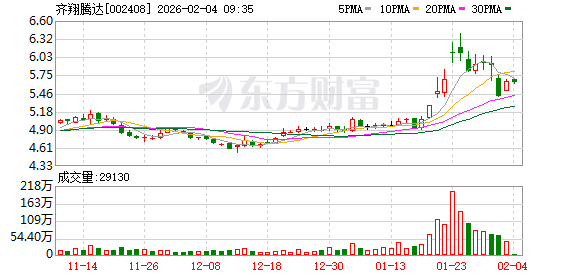
Group 1 - The company announced that its subsidiary, Shandong Qilu Keli Chemical Research Institute Co., Ltd., has successfully completed the construction of an 8,000 tons/year high-performance catalytic new materials project, which has now entered the trial operation phase [2] - The completion of this project is expected to significantly enhance the company's self-supply capability in the high-end catalytic materials sector, strengthen the resilience of the industrial chain, and solidify its technological moat [2] - The project is anticipated to improve the company's long-term profit center due to the high added value of its products and the accelerating trend of domestic substitution in the industry, while also providing crucial catalytic support for the green and low-carbon transformation of the chemical industry [2] Group 2 - The project was approved by the company's board of directors in August 2025 [3] - The main business of the company includes chemical manufacturing and foreign trade [4]

2026年中国四氟化碳行业理化性质、市场规模、重点企业及发展趋势分析:高纯替代与新兴领域需求双轮驱动,行业进入国产替代关键窗口期[图]
Chan Ye Xin Xi Wang· 2026-02-04 01:30
Industry Overview - The Chinese tetrafluoromethane (CF₄) industry is currently undergoing a phase of technological upgrades and market expansion, with a projected market size of approximately 2.079 billion yuan in 2024, representing a year-on-year growth of 7.44% [1][7] - The domestic low-temperature distillation-adsorption coupling process is maturing, improving the first-pass yield of 6N-grade products and narrowing the technology gap with international giants to a single purity level, laying a solid foundation for domestic substitution [1][7] - The demand for high-purity CF₄ is rapidly increasing due to the continuous expansion of downstream emerging industries such as semiconductors, photovoltaics, and panels [1][7] Industry Chain - The upstream of the CF₄ industry chain includes raw materials such as hydrofluoric acid, methanol, fluorine gas, carbon sources, and electricity, as well as production equipment like fluorocarbon reactors and distillation towers [4] - The midstream involves the production and manufacturing of CF₄, while the downstream applications are primarily in semiconductor, flat panel display, photovoltaic, and optical fiber manufacturing processes [4] Market Dynamics - The price of hydrofluoric acid, a core raw material for CF₄ production, is expected to reach 11,873 yuan per ton by the end of 2025, reflecting an increase of 8.87% year-on-year, driven by tightening supply and mining policies [5] - The production capacity of integrated circuits in China is projected to reach approximately 484.3 billion pieces by 2025, with a year-on-year growth of 7.28%, which will drive the demand for electronic-grade CF₄ in etching and wafer cleaning processes [7] Key Enterprises - The competitive landscape of the CF₄ industry is characterized by a concentration of leading firms driven by technology, with companies like Kemet, Fujian Del Technology, and Huate Gas rapidly emerging [8] - Huate Gas, established in 1999, has achieved high-purity CF₄ mass production and has been certified by major semiconductor clients, covering top global semiconductor companies [9] - Fujian Yongjing Technology, founded in 2007, focuses on fluorochemical production and has a capacity of 600 tons/year, utilizing advanced purification technologies [10] Future Trends - The growth of the CF₄ industry is primarily driven by the semiconductor and photovoltaic sectors, with increasing purity requirements pushing CF₄ products from mainstream 5N (99.999%) to 6N and beyond [12] - The competition in the industry is shifting towards a concentration of leading firms, with a focus on technological and capital advantages, as smaller firms face significant survival challenges [13] - Environmental regulations are expected to drive technological innovations in the industry, with a focus on green production processes and the development of efficient end-of-pipe treatment and recycling technologies [14]


海外看中国:消费恢复呈结构性分化
HTSC· 2026-02-04 01:21
Investment Rating - The report maintains an "Overweight" rating for the food and beverage industry [9] Core Insights - The report highlights a structural differentiation in consumer recovery across various segments, with high-end consumption showing signs of recovery while mid-range and mass-market segments lag behind [1] - Foreign brands are facing challenges due to weak demand and a trend towards "de-branding," which has led to overall performance pressure [1] - Companies achieving growth are primarily relying on their own brand strength and channel strategies [1] Alcoholic Beverages - The overseas spirits giants are experiencing performance pressure in China, with Pernod Ricard and Diageo reporting significant declines in sales [2][13] - Diageo's management remains cautious, expecting continued challenges in the market, particularly in the white liquor segment [2][14] - Rémy Cointreau's sales in China have stabilized, but internal performance shows structural differentiation [2][15] Dairy Products - Foreign brands in the dairy sector, particularly in milk beverages and nutritional products, are performing well due to strong brand management and product innovation [3][22] - The market for dairy products is expected to continue growing, especially in segments like low-temperature fresh milk and cheese [3][32] - The high import dependency in certain dairy categories presents opportunities for domestic alternatives [3][32] Soft Drinks - The soft drink industry is experiencing varied performance across segments, with carbonated drinks under pressure while energy drinks and sugar-free tea are expanding [4][33] - Coca-Cola and PepsiCo maintain high market shares in carbonated drinks but face increasing competition from local brands [4][33] - Monster's sales in China are growing rapidly, indicating a positive outlook for the energy drink segment [4][44] Beer - The beer market is under pressure due to weakened dining demand, with Budweiser experiencing a significant decline in sales [5] - Carlsberg has stabilized its performance through product adjustments, while Heineken benefits from partnerships with local brands [5] Snacks - The snack sector is seeing a weak recovery, with foreign brands struggling against local competitors [6] - Mondelez has managed to maintain steady growth in China through localized marketing strategies [6] Condiments - Foreign condiment brands are focusing on improving product value and adapting to changing consumer preferences [7] - The market is shifting towards value-oriented consumption, prompting companies to adjust their strategies [7]





咖啡机第一股,来了
Xin Lang Cai Jing· 2026-02-04 00:10
Core Insights - Gemilai, a domestic coffee machine brand, has submitted an IPO application to list on the Hong Kong Stock Exchange, aiming to capitalize on the booming coffee market in China [2] - The Chinese coffee market is projected to grow from approximately 39 billion yuan in 2018 to about 188 billion yuan by 2025, with a compound annual growth rate (CAGR) of nearly 20% [3] - The demand for commercial coffee machines is being driven by the expansion of fresh coffee brands and stores, which is also boosting the home coffee machine market [3] Company Overview - Gemilai was founded in 2011 by Yuan Bin, who has since exited the company, which is now controlled by Xie Jianping [2] - The company launched its first home espresso machine in 2012 and expanded into overseas markets in 2013, becoming a full industry chain brand covering design, R&D, manufacturing, sales, and service [2] - Gemilai has grown rapidly, transitioning from an export-oriented business to focusing on the domestic market and establishing its brand with products like the Owl, Cloud Elephant, and White Whale [5] Market Position - Gemilai is the second-largest coffee machine brand in China by revenue, with a market share of approximately 7.5% in 2024, trailing only Italy's De'Longhi [5] - In the semi-automatic espresso machine segment, Gemilai holds the top position with a market share of about 16.0%, and in the split-type semi-automatic espresso machine segment, it commands a market share of approximately 27.9% [5] Financial Performance - Gemilai's revenue for 2023 and 2024 is projected to be 308 million yuan and 498 million yuan, respectively, with net profits of 19.93 million yuan and 39.96 million yuan [6] - For the first three quarters of 2025, the company reported revenue of 449 million yuan, a year-on-year increase of 44.1%, and net profit surged by 365.2% to 53.97 million yuan [6] - The gross margin for 2023, 2024, and the first nine months of 2025 is reported at 41.9%, 40.5%, and 44.1%, respectively, while net margins are 7.2%, 8.0%, and 12.0% [6] Market Challenges - The growth of the coffee market in China may face challenges due to the relatively low penetration of coffee culture and the presence of strong substitutes like tea [8] - Recent price increases by major coffee brands may slow down the growth of coffee consumption [8] - The coffee machine market, while growing, remains a niche within the broader small appliance market, indicating limited core category significance [8] Strategic Expansion - Gemilai is focusing on expanding its product line to include coffee grinders and other accessories to enhance its presence in the fresh coffee scene [8] - The company is emphasizing the home coffee machine market, which has lower prices but higher sales volume and growth potential, aligning with trends towards smart and automated appliances [12] - If coffee machines become as common in Chinese households as in Western countries, Gemilai stands to significantly increase its growth potential [12]