
多边主义

Search documents
中美吉隆坡贸易谈判,美国终于让步了,中国获得全面胜利!
Sou Hu Cai Jing· 2025-11-06 11:03
这场胜利的底气,源于中国强大的经济实力和战略定力。美国之所以选择让步,根本原因在于其深刻意 识到"贸易战没有赢家"的现实。根据数据显示,自2018年以来,对华加征的关税让美国普通家庭每年增 加了近千美元的支出,而2024年中美贸易额依然高达近6883亿美元,中国供应链的不可替代性更加凸 显。在面对美国的出口管制和关税威胁时,中国不仅采取反制措施捍卫了自身权益,还持续扩大开放, 这种"刚柔并济"的策略让美国认识到,单纯的打压和遏制并不是解决问题的出路,平等对话才是唯一正 确的方向。正如英国广播公司所指出的,与中国展开贸易战不仅会对中美两国造成毁灭性影响,也会波 及全球经济,而这一认识正是推动美国政策转向的关键因素。 这场胜利还改变了大国经贸博弈的规则。在吉隆坡的谈判中,中国始终坚持多边主义立场,通过"建设 性讨论"突破僵局,既不回避存在的分歧,也不放弃任何合作的机会。中国的这种"斗而不破、以谈促 和"的智慧,不仅推动双方就关税暂停期延长等问题达成了初步共识,也为即将召开的亚太经济合作组 织(APEC)会议前夕,全球经贸秩序的稳定注入了积极的能量。美国从最初的"极限施压"到最终的"认 可框架协议",标志着单边主义 ...

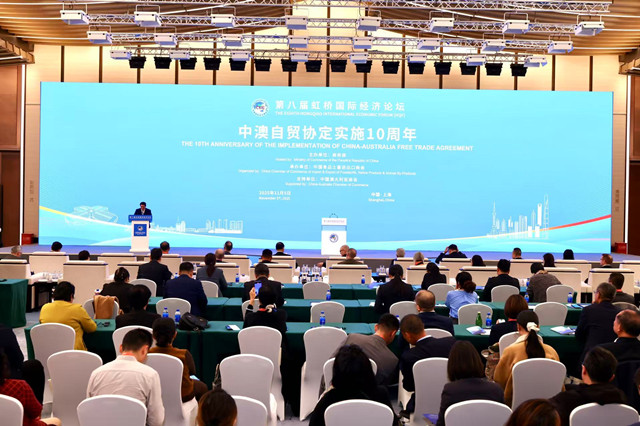
“中澳自贸协定实施10周年”分论坛在上海举行
Shang Wu Bu Wang Zhan· 2025-11-06 10:31
Core Insights - The 10th anniversary of the China-Australia Free Trade Agreement (FTA) was celebrated at the Hongqiao International Economic Forum, highlighting its role as a significant driver of economic cooperation between the two countries [1][2] - The FTA has led to substantial growth in trade volume, significant investment cooperation, and increasingly close supply chain collaboration [1] - Future discussions will focus on enhancing the FTA to ensure it continues to benefit businesses and citizens in both countries over the next decade [1][2] Group 1 - The FTA has been a crucial engine for economic cooperation, resulting in expanded trade scale and effective investment collaboration [1] - China is willing to share opportunities from its modernization with Australia and aims to enhance trade and investment liberalization [1] - The FTA has created a mutually beneficial relationship that not only promotes economic growth but also generates numerous job opportunities [1] Group 2 - The FTA is seen as a new starting point for trade and investment relations amid global economic turbulence [2] - Future cooperation should focus on "joint empowerment," moving beyond traditional sectors like minerals and agriculture to technology-driven strategic development [2] - Discussions at the forum included sustainable development in energy and mineral trade, the role of green technology, and the future of service trade, digital economy, and agricultural products [2]
外媒聚焦进博会:中国坚定承诺引全球共鸣,贸易合作持续升温
Zhong Guo Xin Wen Wang· 2025-11-06 10:09
Core Points - The 8th China International Import Expo (CIIE) opened in Shanghai on November 5, attracting global attention and emphasizing China's commitment to promoting trade freedom and global economic cooperation [1][2] Group 1: Event Overview - The CIIE features participation from over 155 countries, regions, and organizations, with more than 4,100 overseas enterprises exhibiting [2] - The event runs from November 5 to November 10, showcasing a wide range of products and services [2] Group 2: International Participation - 78 Russian companies are participating in the expo, representing the "Made in Russia" section, which spans 1,380 square meters and includes food, agricultural products, consumer goods, and industrial information technology [2] - The Belarusian pavilion is hosting various cultural activities to showcase its national traditions, highlighting the expo as an effective platform for Belarusian exports to China [2] - Malaysia's Deputy Prime Minister attended the opening ceremony, marking the sixth high-level participation since the expo's inception in 2018 [2][5] Group 3: Regional Highlights - Cambodian officials emphasized the expo's role in demonstrating quality products and services to Chinese and international consumers [5] - Iranian enterprises are increasingly participating, aligning with Iran's economic strategy of resilience and diversification [5] - African participation has notably increased, with a reported 80% year-on-year growth in the number of exhibitors, showcasing products like Nigerian cashews and Burundian coffee [5][6] Group 4: Success Stories - The expo has significantly boosted demand for previously lesser-known products, such as Nigerian cashews, and has transformed Rwanda's chili pepper industry into a key export sector benefiting local farmers [6]

商务部:中国加入CPTPP将对维护多边主义和自由贸易发挥更大作用
Xin Hua Cai Jing· 2025-11-06 09:27
Core Viewpoint - The Chinese government is actively promoting its accession to the CPTPP, emphasizing its potential role in maintaining multilateralism and free trade amid rising unilateralism and protectionism [1][2]. Economic Impact Analysis - Recent analyses by two Chinese research institutions indicate that China's accession to the CPTPP could yield significant economic benefits for member countries, regional cooperation, and the global economy [1]. - The Chinese market's large scale is expected to provide greater development opportunities for CPTPP members [1]. - The Chinese Academy of Social Sciences estimates that China's membership could increase member GDP by 0.2% to 1.1% and exports by 2.5% to 11.8% [1]. - The National Development and Reform Commission predicts that global real GDP could grow by 0.2% and trade volume by 2.8% as a result of China's accession [1]. Commitment to Open Economy - China is committed to expanding high-level foreign openness and hopes that CPTPP members will recognize the positive significance of its accession [2].
商务部:中方高度重视、积极推进加入CPTPP相关工作
Jing Ji Guan Cha Wang· 2025-11-06 09:00
Core Viewpoint - The Chinese government is actively promoting its efforts to join the CPTPP, emphasizing its importance in maintaining multilateralism and free trade amid rising unilateralism and protectionism in the international economic order [1] Group 1 - The Ministry of Commerce held a regular press conference on November 6 [1] - Spokesperson He Yadong highlighted the significance of China's potential accession to the CPTPP in the current global trade environment [1] - Joining the CPTPP could enhance China's role in supporting multilateralism and free trade [1]
经贸合作成果丰硕,下一个10年中澳自贸协定如何“提质扩容”?
Di Yi Cai Jing· 2025-11-06 02:28
Core Viewpoint - The future of China-Australia cooperation must transition from traditional mineral and agricultural collaboration to a strategic joint development led by technology, especially as the China-Australia Free Trade Agreement (FTA) approaches its 10th anniversary in 2025 [1]. Group 1: Trade and Economic Cooperation - The China-Australia FTA is the first high-level FTA signed between China and a major developed country, serving as a significant milestone in bilateral relations [1]. - Over the past decade, the FTA has significantly boosted bilateral trade, with the trade volume reaching $211.27 billion in 2024, an increase of 85.6% compared to 2015 [5]. - China has maintained its position as Australia's largest trading partner for 16 consecutive years, with the Chinese market accounting for one-third of Australia's total exports [5]. - The FTA has facilitated a strong increase in Australian products in Chinese consumer markets, with 256 Australian companies participating in the recent China International Import Expo, marking a historical high [4]. Group 2: Future Directions and Opportunities - Future cooperation should focus on enhancing the FTA to meet evolving needs, ensuring it continues to serve both countries' enterprises and consumers effectively [7]. - There is a call for the FTA to evolve from traditional trade in agricultural and mineral products to include sectors such as digital economy, green technology, and new trade rules [8][9]. - The potential for collaboration in areas like clean energy, healthcare, and digital economy is highlighted as key opportunities for the next decade [8]. - The establishment of a robust framework for digital trade and cross-border data flow is essential, leveraging Australia's mature digital regulatory framework and China's extensive platform economy [9].
推进务实合作 促进共同发展
Ren Min Ri Bao· 2025-11-05 22:11
Core Points - The APEC 32nd Leaders' Informal Meeting concluded with China taking over as the host, marking the beginning of the "China Year" for APEC, with expectations for enhanced cooperation in the Asia-Pacific region [2][3] - International figures emphasize the importance of open development and mutual benefits, advocating for the advancement of the Asia-Pacific Free Trade Area and connectivity [2][3] Group 1: Economic Cooperation and Trade - APEC has played a significant role in promoting inclusive growth and maintaining a free and open trade order in the region since its establishment over 30 years ago [3] - The chair of the APEC Business Advisory Council, Lee Geun-ho, highlighted the need for multilateral cooperation based on trust to address global challenges such as climate change and aging populations [3] - The APEC platform facilitates trade facilitation and enhances digital and logistics capabilities, particularly benefiting small and medium-sized enterprises [5] Group 2: China's Role and Initiatives - China's development achievements and economic vitality are recognized as providing valuable lessons for other economies, particularly in infrastructure and poverty alleviation [6][7] - The upcoming APEC meeting in 2026, hosted by China, is expected to inject new momentum into cooperation in digital economy, green transformation, and supply chain resilience [3][6] - China's initiatives, including the Belt and Road Initiative and various global governance proposals, align with APEC's principles of open cooperation and mutual benefits [7][9] Group 3: Regional Stability and Multilateralism - The importance of multilateralism in promoting stability and development is emphasized, with APEC seen as a crucial platform for dialogue and cooperation among member economies [8][9] - The rise of protectionism highlights the need for APEC to maintain its commitment to open regionalism and cooperative spirit [6][8] - APEC's role in addressing economic fragmentation and fostering consensus among major economies is critical for regional prosperity [7][9]

虹桥论坛发出中国高水平对外开放最强音—— 中国特色开放路径展现强大生命力
Zheng Quan Shi Bao· 2025-11-05 18:37
Group 1: Global Open Index Trends - The global openness is showing a complex pattern of "overall tightening, increasing differentiation, and energy conversion" with a slight decline in the global openness index by 0.05% year-on-year for 2024, down 0.34% from 2019, and down 5.39% from 2008 [1][2] - Economic openness index decreased by 0.22% and cultural openness index decreased by 0.58% year-on-year for 2024, both below the levels of 2019 and 2008 [2] Group 2: China's Role in Global Openness - China has emerged as a significant force in maintaining global openness, with its openness index rising from 0.5891 in 1990 to 0.7634 in 2024, marking an increase of nearly 30% over 35 years [1][4] - In the context of overall global tightening, China's openness index has increased by 12.44% since 2008 and by 1.44% since 2019, ranking first among major economies for 2024 with a year-on-year increase of 0.5% [4] Group 3: Foreign Investment in China - As of July 2025, foreign investment in China has led to the establishment of over 1.27 million enterprises with a total investment exceeding $3 trillion, with a direct investment return rate of approximately 9% over the past five years, ranking among the highest globally [5] Group 4: Multinational Companies' Perspectives - Multinational companies like GE Healthcare and Boston Scientific are optimistic about the opportunities in China's market, focusing on local innovation and adapting global technologies to meet local clinical needs [6][7] - The ongoing China International Import Expo is seen as a testament to China's strong market appeal and the stability of its open policies, enhancing Shanghai's role as a hub for global enterprises [6]
推进多边贸易,虹桥论坛聚焦全球贸易重构与WTO改革
Di Yi Cai Jing Zi Xun· 2025-11-05 13:45
Group 1 - The global economy is facing multiple challenges including unilateralism, protectionism, and geopolitical conflicts, leading to a significant restructuring of global trade [1] - The WTO has revised its global goods trade growth forecast for 2026 down to 0.5%, highlighting the urgent need for enhanced international coordination and cooperation [1] Group 2 - The eighth Hongqiao International Economic Forum focused on "Global Trade Restructuring and WTO Reform," emphasizing the necessity of multilateralism to address global challenges [3] - The Chinese Ministry of Commerce highlighted that multilateralism is essential for overcoming challenges, asserting that economic globalization cannot be halted by "de-globalization" [3] - The forum discussed the importance of strengthening communication and cooperation among countries to maintain a resilient and sustainable global supply chain [3] Group 3 - Reforming the WTO is crucial for leading global trade restructuring, as the multilateral trade system is the foundation of international trade [4] - China is a significant engine for global economic growth, contributing approximately 30% to world economic growth during the 14th Five-Year Plan period [4] - The WTO Deputy Director-General emphasized the resilience of the multilateral trade system and the need for member cooperation to maintain its authority and relevance [4] Group 4 - Experts at the forum stressed the importance of the WTO in rewriting balanced trade rules and enhancing its institutional capacity to combat unilateralism [5] - There is a consensus that a rules-based multilateral trade system provides stability and predictability for global trade, and reforms are necessary to keep the rules up to date [5] - Participants expressed hope for China to play a more active role in improving the global governance system and promoting common development [5]
第十一次中俄财长对话联合声明公布
Xin Jing Bao· 2025-11-05 11:38
新京报讯11月5日,财政部发布第十一次中俄财长对话联合声明。以下为全文: 为落实习近平主席与普京总统会晤有关共识,巩固和深化中俄新时代全面战略协作伙伴关系,中国财政 部部长蓝佛安和俄罗斯联邦财政部部长西卢阿诺夫于2025年11月4日在北京共同主持第十一次中俄财长 对话。双方就共同关心的财金议题进行了深入交流,并在以下领域达成了重要共识: 1.双方重申继续发挥中俄财长对话机制重要作用,致力于深化两国经济财金关系,加强宏观经济政策协 调,强化在共同关心的经济财金问题上的沟通与合作,有效提升两国经济财金领域务实合作水平。 2.双方注意到,当前全球经济形势存在高度不确定性,贸易紧张局势持续给全球经济蒙上阴影,中期增 长前景黯淡。尽管遇到阻力,中俄两国将继续保持宏观经济政策协调,助力两国实现发展振兴。 3.双方将进一步加强财税、金融领域交流与合作,积极推进双方财政政策与金融监管合作交流,深化两 国在银行业、证券业和保险业合作。双方愿按照中俄总理第三十次定期会晤共识,稳步推进中俄在银行 领域和资本市场务实合作。在中俄会计准则、审计准则及审计监管等效互认基础上,中俄双方将进一步 加强在会计和审计领域的审计监管交流和跨境执法 ...