新消费

Search documents
ETF规模逼近5万亿、百亿ETF数超百,机构如何看后市?
Di Yi Cai Jing· 2025-08-25 11:50
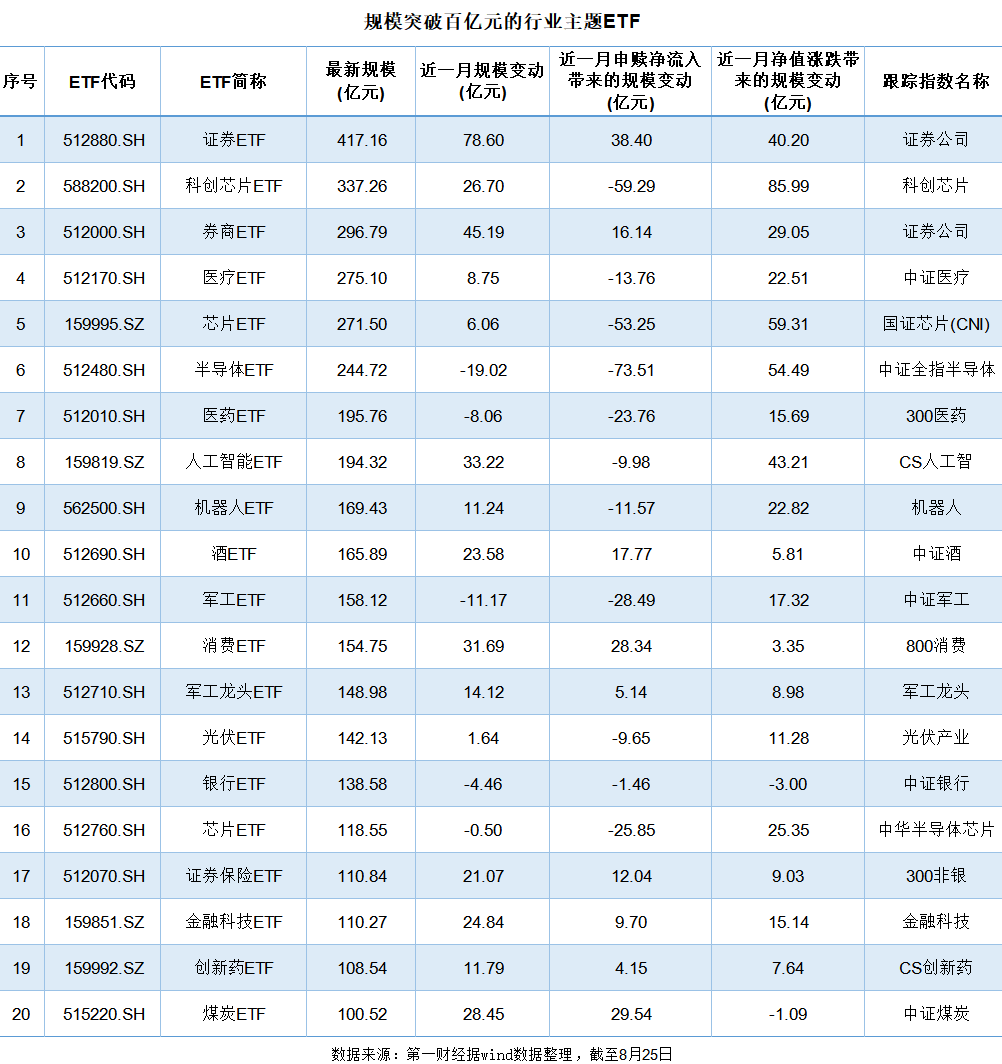
Market Overview - The Shanghai Composite Index has recently broken through the 3700 and 3800 points, reaching a ten-year high and approaching the 3900 point mark, with a record trading volume of 3.18 trillion yuan on August 25 [1][2] - The ETF market has seen significant inflows, with the total market size nearing 5 trillion yuan, marking a year-to-date increase of 1.23 trillion yuan, the highest on record for the same period [2][4] ETF Market Dynamics - The number of ETFs with over 100 billion yuan in assets has increased to 101, up from 66 at the end of last year, with a notable rise in industry-themed products [2][4] - Stock ETFs have shown the largest growth, with an increase of 228.46 billion yuan in the past month, indicating a strong preference for equity market allocation [2][4] Sector Performance - The performance of industry-themed ETFs has been particularly strong, with significant inflows into sectors such as securities, chips, and pharmaceuticals [4][6] - For instance, the securities ETF has seen a 12.48% increase in value over the past month, with a corresponding growth in scale of 40.2 billion yuan [6] Investment Sentiment - Despite the market's enthusiasm, there are concerns about the sustainability of the current rally, with some analysts suggesting that the market has decoupled from the economic fundamentals [1][8] - Investment strategies are advised to focus on sectors with real profit generation and strong industry trends, such as resources, innovative pharmaceuticals, and military technology [11] Future Outlook - Analysts suggest that while there are opportunities in both technology growth and traditional sectors, a balanced approach across different industries is recommended to manage potential risks [9][10] - The market is expected to experience increased volatility due to emotional trading and uncertainties surrounding macroeconomic policies [9][10]

4000点,会有一次调整
Sou Hu Cai Jing· 2025-08-25 11:23
Market Overview - The A-share market is experiencing a confirmed bull market, driven by economic cycles, with historical patterns suggesting a bull market approximately every ten years [3][4] - The current bull market is characterized by significant capital inflow and a strong upward trend, with the Shanghai Composite Index expected to challenge the 4000-point mark [1][3] Stock Performance - Stocks in a bull market do not require logical reasoning for their price increases; historical examples show that valuations can become irrational during such periods [4][5] - The stock price of Cambrian has surged, reflecting the market's preference for AI concepts over traditional sectors like liquor, indicating a shift in investor sentiment [4][5] Investment Strategy - Investors are advised to recognize the cyclical nature of the market and to differentiate between investment and speculation, focusing on sectors like new technology, new pharmaceuticals, and new consumption as primary growth areas [6] - Caution is advised for ordinary value investors regarding participation in speculative sectors like chips, as the bull market can lead to irrational behavior and potential losses [5][6] Sector Focus - The AI and semiconductor sectors are expected to be the main drivers of the current bull market, with Cambrian's market capitalization approaching that of major global players like Intel [4][5] - The investment in new pharmaceuticals is highlighted as having a more substantial technological moat compared to the semiconductor sector, suggesting a more stable investment opportunity [5][6]

消费焕新延续,液冷赋能数据中心,折叠屏或打开成长空间
Tebon Securities· 2025-08-25 09:21
Consumer Trends - The new consumption sector continues to gain momentum, with A-shares experiencing a valuation increase driven by emotional consumption, channel innovation, and brand expansion overseas[4] - In the first half of 2025, the domestic smartphone shipment volume was 20.63 million units, a year-on-year decline of 6.4% but a quarter-on-quarter increase of 7.6%[28] - The global IP toy market is expected to exceed 400 billion yuan by 2025, with China's market growing at a compound annual growth rate (CAGR) of 11.90% from 2019 to 2023, significantly higher than the global rate of 9.30%[8] High-end Manufacturing - Liquid cooling technology is identified as a key solution for data centers to address energy consumption issues, potentially reducing Power Usage Effectiveness (PUE) to below 1.1[4] - The energy consumption of AI data centers is projected to reach 77.7 TWh in 2025, doubling from 2023, with a CAGR of 44.8% from 2022 to 2027[16] - Liquid cooling solutions can achieve energy savings of over 20%-30%, providing both economic and environmental benefits[18] Hard Technology - The penetration rate of foldable smartphones is expected to rise from 1.6% in 2025 to over 3% by 2027, driven by Apple's entry into the market and ongoing price reductions[31] - The total cost of foldable smartphones is significantly higher than non-foldable models, with display/touch modules and lenses seeing increases of 177% and 28% respectively[38] - In 2025, foldable smartphone shipments are projected to reach 19.8 million units, maintaining the same penetration rate as 2024[31]
慕尚集团(01817.HK)利润大幅增长,释放可持续发展的新信号
Ge Long Hui· 2025-08-25 07:48
Group 1: Market Overview - The A-share market has shown strong performance, with the Hong Kong stock market also improving, as evidenced by the Hang Seng Index breaking the 25,000-point mark multiple times, indicating the potential start of a comprehensive bull market [1] - Institutions are optimistic about technology and consumer sectors in the Hong Kong market, noting that these assets are more closely related to current trends in AI applications and new consumption, and have better fundamentals compared to A-shares [1] Group 2: Company Focus - Moshang Group - Moshang Group has demonstrated strong operational resilience, with a significant profit increase, achieving a revenue of 969 million yuan and a net profit growth of 30.9% to 8.872 million yuan in the first half of the year, maintaining profitability since 2022 [4][5] - The company's gross margin remains high at 53.4%, with its main brand GXG generating 897 million yuan in revenue and a gross margin of 54.2%, while its other brand Mode Commuter achieved 191 million yuan in revenue with a gross margin of 58.4% [5] - Moshang Group has effectively managed its offline self-operated channel revenue, which totaled 449 million yuan, and has focused on channel transformation by closing inefficient stores and enhancing single-store performance [6] Group 3: Strategic Potential - Moshang Group's strategic direction is centered on meeting the needs of young consumers, with GXG being recognized as a brand that understands young people's preferences, particularly through its "commuting menswear" strategy [7][8] - The changing consumption patterns among young males, especially the Z generation, present a long-term market opportunity, with predictions indicating that 73% of this demographic will enter the workforce in the next decade [9] - GXG's innovative product offerings, such as the Zero Pressure series, cater to the evolving demands of young professionals, blending functionality with aesthetics [10] Group 4: Innovation and Digital Transformation - Moshang Group is exploring AI applications and private domain marketing to enhance operational innovation and long-term development quality, with AI sampling significantly reducing development time and costs [12] - The company has established a comprehensive digital transformation strategy, integrating data insights with intelligent design to improve product strategy flexibility and competitiveness [13] - A recent exclusive strategic partnership with Dreamxiang Technology aims to address inventory issues while enhancing user engagement and achieving sales growth [13] Group 5: Future Outlook - Moshang Group's strong profitability, clear strategic direction, and alignment with new consumption trends position it well for future growth, with the potential to capitalize on the emerging consumer demands [14] - The company is expected to benefit from the ongoing new consumption wave, which will help unlock its previously established momentum and accelerate its performance recovery [14]
港股科技ETF(513020)上一交易日资金净流入超5000万元,市场关注科技板块成长空间
Mei Ri Jing Ji Xin Wen· 2025-08-25 06:35
Group 1 - The core viewpoint is that AI technology and new consumption sectors have significant growth potential, with southbound capital enhancing its marginal pricing power in Hong Kong stocks, especially in a low-interest-rate environment [1] - The long-term outlook for Hong Kong stocks remains positive due to valuation advantages and trends in industrial transformation and upgrading [1] - Continuous policy support for the domestic technology industry is expected to attract more capital attention towards Hong Kong technology companies [1] Group 2 - The Hong Kong Technology ETF (513020) tracks the Hong Kong Stock Connect Technology Index (931573), focusing on technology companies listed in Hong Kong through the Stock Connect channel [1] - The index covers various sectors including information technology, electronic components, and interactive media and services, with a focus on soft technology areas like internet services and the entire AI industry chain [1] - Investors without stock accounts can consider the Cathay CSI Hong Kong Stock Connect Technology ETF Initiated Link C (015740) and Link A (015739) [1]
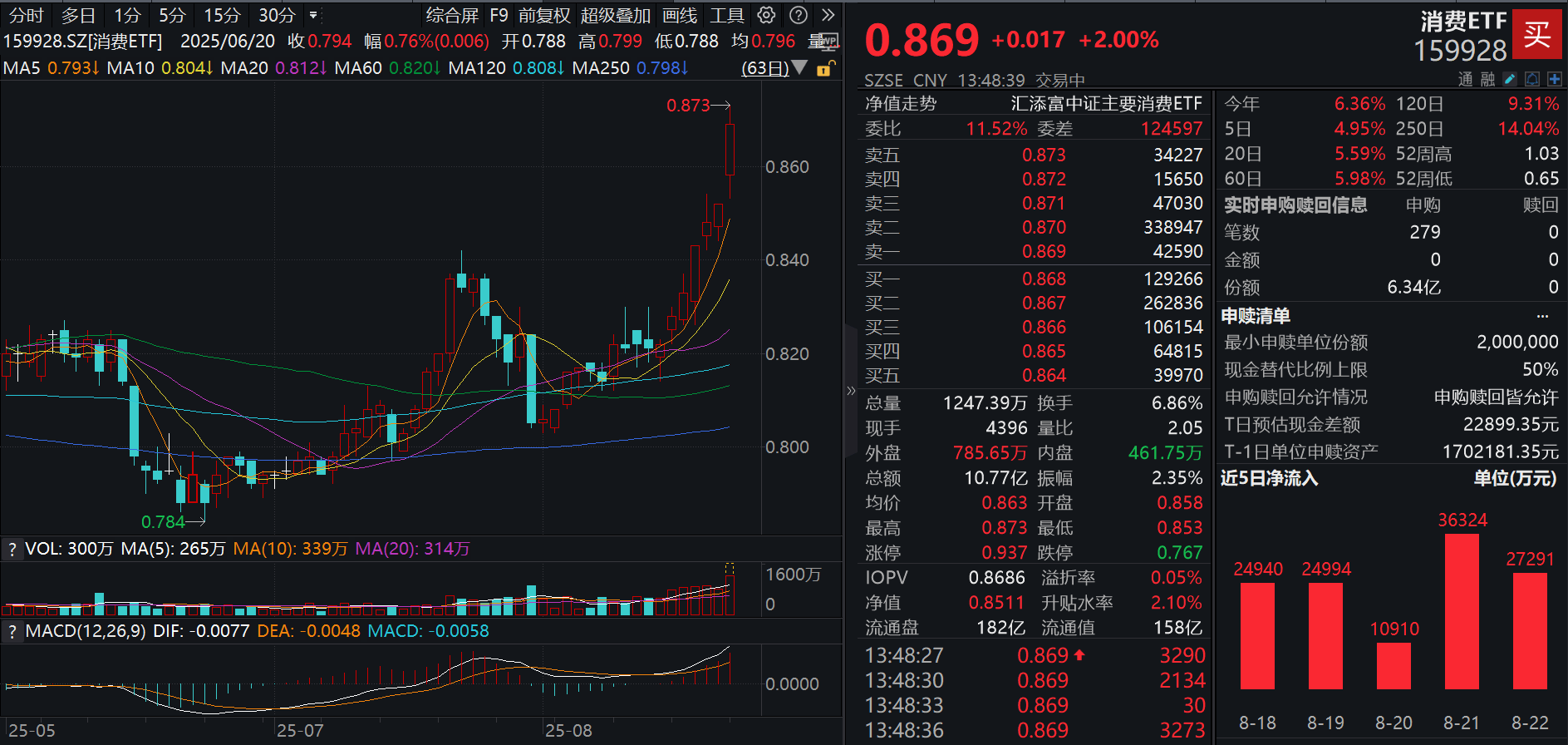
政策再现积极信号,高层部署消费品以旧换新!消费ETF(159928)大涨2%,盘中大举揽金超6.38亿份!
Sou Hu Cai Jing· 2025-08-25 06:17
Group 1: Market Overview - A-shares market shows strong sentiment with trading volume exceeding 2.6 trillion yuan, indicating robust investor activity [1] - Consumption ETF (159928) surged by 2%, with trading volume surpassing 1.1 billion yuan, reflecting significant inflow [1] Group 2: Hong Kong Market - Hong Kong's consumption-focused ETF (159268) experienced a slight increase of 0.94%, with trading volume exceeding 200 million yuan and continuous net inflow for six days [3] - Notable stocks in the Hong Kong market include Haidilao, which rose over 4%, and other brands like Li Ning and Miniso, which also saw gains [3] Group 3: Policy Support and Consumer Financing - Recent meetings have indicated a push for policies supporting the replacement of old consumer goods, with potential increases in funding and expanded categories [5] - A new personal consumption loan interest subsidy policy will take effect on September 1, aimed at supporting loans used specifically for consumption [5] Group 4: Industry Insights - The beverage and snack sectors remain strong, with new product launches and channel expansions contributing to growth [7] - The dairy industry is expected to see a recovery in profitability as raw milk prices decline, with a projected balance in supply and demand by the second half of 2025 [7] Group 5: Consumer Trends - The pig price is expected to rise due to government interventions in pork reserves, which may stabilize market conditions [8] - The pet food sector continues to show high growth, with significant increases in sales reported during recent pet expos [8] Group 6: ETF Composition and Strategy - The consumption ETF (159928) has a strong focus on essential consumer goods, with top holdings including major liquor brands and dairy companies [9] - The Hong Kong consumption ETF (159268) is positioned as an efficient investment vehicle for the new consumer trends, particularly appealing to younger generations [10]
港股新消费板块早盘活跃,港股消费ETF(513230)现已涨近2%
Mei Ri Jing Ji Xin Wen· 2025-08-25 02:47
Group 1 - The Hong Kong stock market opened higher with the Hang Seng Index rising by 1.06%, the Hang Seng Tech Index increasing by 1.49%, and the State-Owned Enterprises Index up by 1.07% [1] - Technology stocks, AI concept stocks, and new energy vehicle companies showed strong performance, while the consumption sector was active, with the Hong Kong consumption ETF (513230) rising nearly 2% [1] - Alibaba has restructured its business segments into four main groups, including Alibaba China E-commerce Group and Alibaba International Digital Commerce Group, with a new programming platform Qoder launched for AI development [1] Group 2 - Huaxia Fund's Hong Kong stock ETF has surpassed 100 billion yuan in total scale, becoming the first fund manager in the market to achieve this milestone [2] - The Huaxia Fund's Hong Kong stock ETF not only has the largest scale but also offers a comprehensive layout with 14 different ETFs covering broad-based, technology, pharmaceutical, dividend, and consumer sectors [2]
泡泡玛特首次入选恒生指数,IP影响力全面破圈,“一超多强”格局初定
Mei Ri Jing Ji Xin Wen· 2025-08-25 02:41
Group 1 - The Hang Seng Index Company announced the inclusion of China Telecom, JD Logistics, and Pop Mart into the Hang Seng Index, increasing the number of constituent stocks from 85 to 88, effective September 8 [1] - This marks the first time Pop Mart has been included in the Hang Seng Index, reflecting strong market recognition of its overall strength [1] - Following its inclusion, Pop Mart launched a new series of plush toys under its IP "THE MONSTERS," reigniting market consumer enthusiasm [1] Group 2 - As of August 22, Pop Mart's stock price was HKD 320.4, with a total market capitalization exceeding HKD 430 billion, and a year-to-date stock price increase of over 258% [2] - For the first half of 2025, Pop Mart reported revenue of CNY 13.88 billion, a year-on-year increase of 204.4%, and an adjusted net profit of CNY 4.71 billion, up 362.8% [2] - The company expects full-year revenue to be no less than CNY 30 billion, indicating strong growth potential [2]

港股消费板块高开高走,新消费标的纳入重要指数,关注港股消费ETF易方达(513070)布局机会
Mei Ri Jing Ji Xin Wen· 2025-08-25 02:29
Core Viewpoint - The Hong Kong consumer sector is experiencing positive momentum, with significant gains in key stocks and the recognition of new consumption brands in major indices [1] Group 1: Market Performance - The CSI Hong Kong Stock Connect Consumer Theme Index rose by 1.8% as of 10:05 AM, with notable increases in stocks such as Li Ning (over 5%), Alibaba-W, and Miniso (over 4%), and Meituan-W and Lao Pu Gold (over 2%) [1] - The inclusion of Pop Mart in the Hang Seng Index, effective from September 8, indicates a growing market acceptance of new consumption brands [1] Group 2: Industry Trends - The new consumption sector is showing strong performance, exemplified by Pop Mart's projected revenue of 13.88 billion yuan for the first half of 2025, representing a year-on-year growth of 204%, and an adjusted net profit of 4.71 billion yuan, up 372% year-on-year [1] - The CSI Hong Kong Stock Connect Consumer Theme Index includes leading companies across various sectors such as tourism, trendy toys, e-commerce, and consumer electronics, with a rolling P/E ratio of 21.3, which is below the 20th percentile since its launch in 2020 [1] Group 3: Investment Opportunities - The E Fund Hong Kong Consumer ETF (513070) offers T+0 trading and a low management fee of 0.15% per year, providing investors with an opportunity to capitalize on the trends of quality and personalized consumption [1]
港股早评:三大指数高开逾1%,科技股普涨,东风集团股份开涨超69%
Ge Long Hui· 2025-08-25 01:36
Group 1 - The core viewpoint indicates that Powell hinted at a potential interest rate cut in September, leading to a significant rise in US stocks, with the Dow Jones reaching a new high and the Chinese concept index increasing by 2.73% [1] - Major technology stocks experienced a broad increase, with Baidu rising nearly 3%, JD.com and Alibaba up over 2%, and Tencent increasing by 1.42% [1] - Automotive stocks surged, highlighted by NIO's nearly 15% increase and Dongfeng Group's stock opening up over 69% due to its subsidiary Lantu Auto's introduction to the Hong Kong market [1] Group 2 - The Hong Kong stock market showed mixed results, with the Hang Seng Index rising by 0.62%, while sectors such as photovoltaic and steel performed well, contrasting with weaker performances in military and chip stocks [1] - Leveraged funds flowed into various ETFs, including government bond ETFs and technology-focused ETFs, indicating strong investor interest [1] - The performance of specific stocks varied, with Miniso rising over 9% and ZTE increasing nearly 4%, while restaurant stocks and Tesla-related stocks faced declines, exemplified by Dongfang Zhenxuan's nearly 3% drop [1]