
智能制造

Search documents
阿塞拜疆媒体:中国AI转变,从屏幕走向车间
Huan Qiu Wang· 2025-12-29 23:18
Core Insights - China's artificial intelligence (AI) is transitioning from screens to manufacturing floors, integrating deeply into the economy and reshaping the industrial value chain [1][2] Group 1: AI Integration in Manufacturing - AI is increasingly utilized in Chinese factories, with robots handling tasks around the clock and sensors tracking assembly lines for real-time adjustments [1] - The collaboration between Jianghuai Automobile and Huawei has led to the development of the Zun Jie Super Factory, where AI systems enhance precision in manufacturing processes [2] - The production rate at GAC Aion's assembly line is approximately one vehicle every 53 seconds, showcasing the efficiency of AI-driven operations [2] Group 2: Industry Growth and Projections - By 2024, China is expected to account for over half of the global new industrial robot installations, surpassing Japan, South Korea, and the United States [2] - The core AI industry in China is projected to exceed 1.2 trillion yuan by 2025, with the digital economy expected to surpass 80 trillion yuan by 2030 [3] - The integration of AI in manufacturing is anticipated to drive growth in upstream and downstream industries, creating spillover effects and broader economic benefits [3] Group 3: Human Capital and Innovation - The number of engineers in China has surged from 5.21 million in 2000 to 17.65 million in 2020, significantly contributing to innovation in manufacturing [3] - Companies like DJI and Huawei are leveraging the innovative capabilities of engineers to rapidly iterate on products across various sectors, including electric vehicles and consumer electronics [3]
AI驱动中国智造跃升
Xin Lang Cai Jing· 2025-12-29 23:10
Core Insights - China's manufacturing industry is rapidly transitioning into a new era driven by artificial intelligence (AI), with significant advancements in smart manufacturing and industrial models [1][10] - The integration of AI is reshaping the manufacturing landscape, enhancing efficiency and enabling a shift from scale advantages to intelligent advantages [1][16] Group 1: Smart Manufacturing Developments - Over 35,000 basic-level, 7,000 advanced-level, and 230 excellent-level smart factories have been established in China since the start of the 14th Five-Year Plan [1][10] - Smart manufacturing is evolving from isolated production lines to comprehensive value chain integration, exemplified by Haier's COSMOPlat system that allows for large-scale personalized customization [2][11] Group 2: AI and Robotics Integration - Human-like robots are increasingly being utilized in factories, with significant advancements in their capabilities, such as precise handling and complex assembly tasks [13][14] - The application of robots in various manufacturing scenarios has led to notable improvements in production efficiency, such as a 20% increase in output and a 90% improvement in changeover efficiency [13][14] Group 3: Digital Transformation and Sustainability - The integration of digital technologies, including AI and 5G, is enhancing manufacturing flexibility and sustainability, with companies like Lenovo implementing zero-carbon factories [6][14] - The shift towards intelligent manufacturing is not only improving production efficiency but also contributing to sustainable development goals [6][14] Group 4: Global Integration and Policy Support - Chinese manufacturing is increasingly integrating into global supply chains, with companies establishing R&D centers abroad and adapting to local standards [7][15] - Continuous policy support from the Ministry of Industry and Information Technology is driving the digital transformation of the manufacturing sector, emphasizing the importance of AI in all aspects of production [16][17]
中国制造迎来“三重跃迁”
Zheng Quan Ri Bao· 2025-12-29 17:11
Core Insights - The integration of artificial intelligence into China's manufacturing sector has evolved beyond basic automation, leading to significant transformations in smart manufacturing [1][2][3] Group 1: First Leap - The first leap is from "functional substitution" to "system reconstruction," where AI becomes the central nervous system of manufacturing, optimizing processes and participating in innovative design [1] - AI technologies are enabling autonomous perception, planning, and learning, transitioning production lines from rigid automation to flexible intelligence [1] Group 2: Second Leap - The second leap is from "data silos" to "network collaboration," addressing the bottlenecks caused by data barriers within enterprises and across supply chains [2] - The emergence of industrial internet platforms and reliable data spaces is facilitating seamless data flow, enhancing collaboration among enterprises [2] Group 3: Third Leap - The third leap is from "efficiency-first" to "effectiveness-balanced," where the integration of intelligence and sustainability is becoming a key trend [2] - Companies are increasingly focusing on energy resource optimization and carbon footprint management within their smart systems, moving towards a comprehensive effectiveness competition that includes quality and sustainability [2] Future Outlook - Looking ahead to 2026, a more intelligent, collaborative, and sustainable vision for China's manufacturing industry is becoming clearer [3]
“点”上突破 “线”上贯通 “面”上蔓延 AI驱动中国智造跃升
Zheng Quan Ri Bao· 2025-12-29 17:03
Core Insights - China's manufacturing industry is rapidly transitioning into a new era driven by artificial intelligence (AI), with significant advancements in smart manufacturing and industrial transformation [1][7] - The integration of AI into manufacturing processes is reshaping the industry, moving from scale advantages to intelligent advantages, and enhancing productivity and efficiency across various sectors [1][7] Group 1: Smart Manufacturing Developments - Over 35,000 basic-level and 7,000 advanced-level smart factories have been established in China since the start of the 14th Five-Year Plan, promoting innovation in processes, equipment, and software [1] - In smart factories like those of Changan Automobile and Haier, AI-driven systems enable real-time data analysis and personalized production, transforming manufacturing from mass production to customized solutions [2][3] Group 2: Technological Innovations - The introduction of humanoid robots in factories marks a significant evolution in smart manufacturing, with robots performing complex tasks such as precise assembly and quality control [4][5] - Companies like ProRobot are developing flexible robotic solutions that adapt to small-batch, multi-variety production needs, enhancing efficiency and precision [5] Group 3: Sustainability and Digital Transformation - The integration of digital twin technology in factories, such as Lenovo's zero-carbon factory, allows for detailed management of carbon emissions and resource usage, showcasing the synergy between smart and green manufacturing [5] - The push for digital transformation is supported by regional platforms that provide verified solutions and services to facilitate the transition for manufacturers [3] Group 4: Global Integration and Market Positioning - Chinese manufacturing is increasingly integrating into global supply chains, with companies establishing R&D centers abroad and adapting to local standards, thereby enhancing their competitive edge [6] - The narrative of Chinese manufacturing is shifting towards sustainability, with innovations in solar energy, energy storage, and electric vehicles resonating with global decarbonization efforts [6] Group 5: Policy Support and Future Outlook - The Chinese government is actively promoting the digital transformation of the manufacturing sector, emphasizing the importance of AI in enhancing the entire production process from design to supply chain management [7][8] - The ongoing evolution of smart manufacturing is expected to continue, with a focus on deeper integration of AI technologies and the development of skilled professionals who can bridge manufacturing and AI expertise [7][8]
“智造、出海、AI”,三年三阶!金牌家居x吴晓波,一直在把脉大家居行业走向
Xin Lang Cai Jing· 2025-12-29 13:44
Group 1 - The core focus of the 2025 speech by Wu Xiaobo is on finding actionable paths within the AI wave, emphasizing its profound impact on the physical world, industries, and young entrepreneurs [1][21] - The collaboration between Jinpai Home and Wu Xiaobo has consistently defined the development direction of China's home furnishing industry, addressing key industry challenges each year [3][23] Group 2 - In 2023, the industry faced challenges due to a downturn in real estate and increased competition, leading to a shift from "scale competition" to "value competition" [4][24] - Jinpai Home's achievements in smart manufacturing were highlighted, including the integration of digital twin technology and intelligent control systems, which significantly improved production efficiency [8][28] - The introduction of the "1㎡ gym" concept showcased innovative product development aimed at meeting consumer needs in urban environments [6][26] Group 3 - In 2024, the focus shifted to global expansion, with Jinpai Home positioning itself as a model for high-quality overseas operations, transitioning from "product export" to "industry export" [10][30] - Jinpai Home's strategy included establishing factories in Thailand and the U.S. to mitigate trade barriers and enhance local production capabilities [10][30] - The company implemented a localized strategy tailored to different markets, ensuring a better fit for local consumer needs [12][32] Group 4 - By 2025, Jinpai Home aims to leverage AI technology to address challenges in the home furnishing industry, enhancing design communication and service delivery [13][33] - The "Feiliu AI" solution was introduced to streamline the home renovation process, significantly reducing design time and improving user experience [18][38] - This AI initiative is seen as a transformative force, shifting the industry from product competition to ecosystem competition, thereby facilitating digital transformation [18][39] Group 5 - The three-year collaboration between Jinpai Home and Wu Xiaobo has effectively tracked the evolution of the home furnishing industry, focusing on smart manufacturing, global expansion, and AI innovation [19][39] - The partnership has demonstrated that industry leaders must balance deep-rooted practices with the ability to capture emerging trends for sustainable growth [19][39]



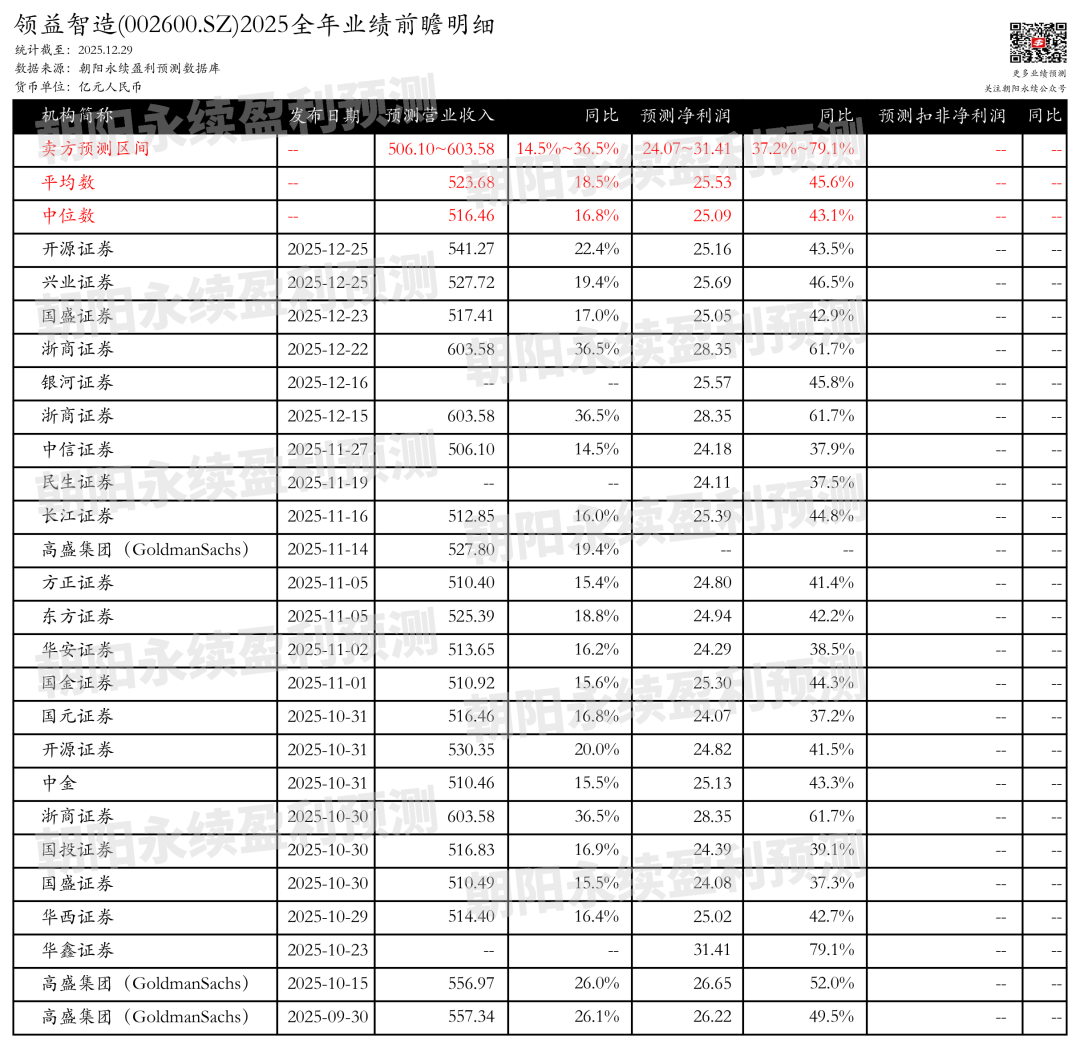
领益智造:人形机器人商业化加速,预测Q4一致预期营收506.10~603.58亿元
Xin Lang Cai Jing· 2025-12-29 13:44
Core Viewpoint - The company is expected to achieve significant revenue and profit growth in Q4 2025, with projected revenue between 50.61 billion to 60.36 billion RMB, representing a year-on-year increase of 14.5% to 36.5%, and net profit between 2.41 billion to 3.14 billion RMB, indicating a growth of 37.2% to 79.1% [1][7]. Financial Forecast - The consensus forecast for Q4 2025 includes: - Revenue: 50.61 billion to 60.36 billion RMB, with an average estimate of 52.37 billion RMB, showing an 18.5% year-on-year growth [3][9]. - Net Profit: 2.41 billion to 3.14 billion RMB, with an average estimate of 2.55 billion RMB, reflecting a 45.6% year-on-year increase [3][9]. - The median revenue forecast is 51.65 billion RMB, with a 16.8% growth, and the median net profit forecast is 2.51 billion RMB, with a 43.1% growth [3][9]. Business Development - The company is advancing in the humanoid robot sector through technological iterations and deep strategic partnerships with global leaders, enhancing production automation and integrating consumer electronics with robotics [4][10]. - The company has developed production design capabilities for humanoid robot dexterous hands, transitioning from component supply to complete assembly, which is expected to expand market opportunities and improve production efficiency [5][10]. - The company has diversified since its establishment in 2006, expanding from die-cutting to various sectors including consumer electronics, photovoltaics, new energy vehicles, and humanoid robots, achieving a global presence [11].

小米“二号人物”拟减持140亿!股民怎么办?
Xin Lang Cai Jing· 2025-12-29 13:39
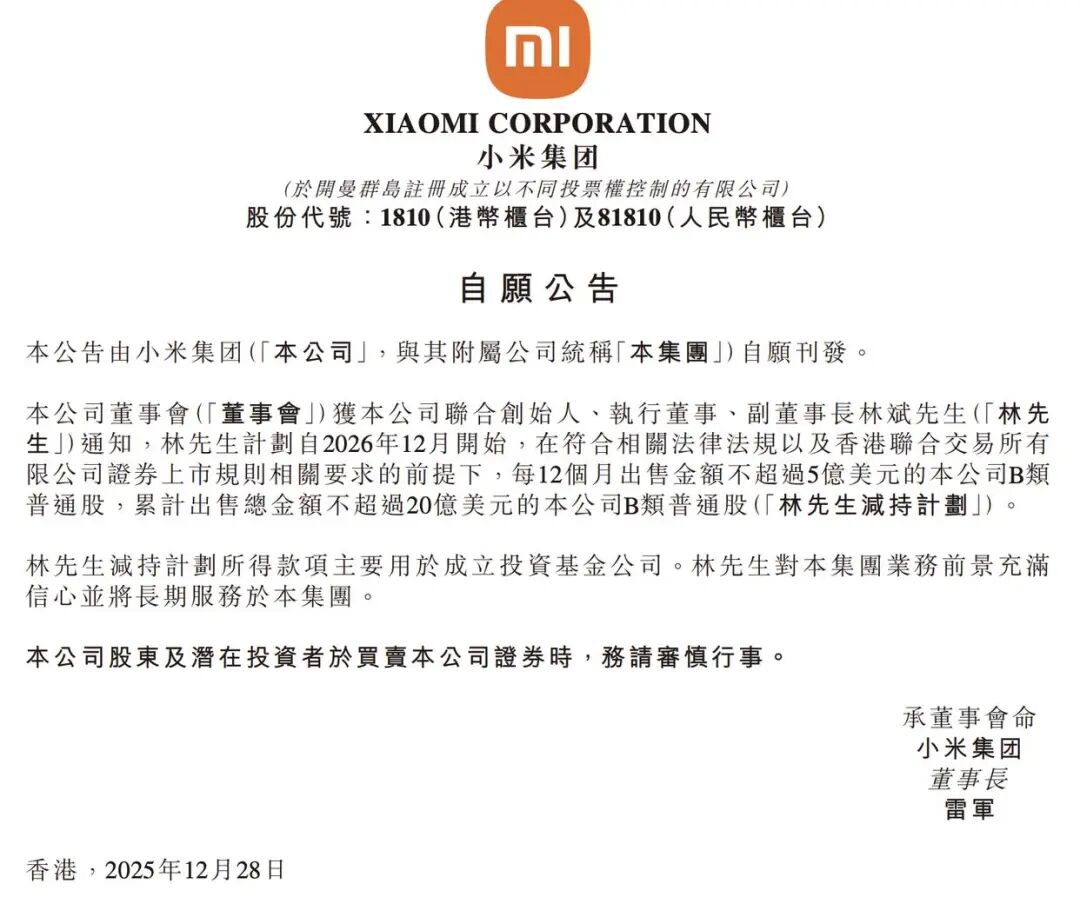
(来源:上市之家) 随着股价近期的大跌,雷军的1亿港元并未挽回颓势,而这位小米"二号人物"的巨额减持计划,可能给公司未来股价带来持续四年的阴影。 12月28日,小米集团(1810.HK)在港交所发布公告称,公司收到联合创始人、执行董事、副董事长林斌的通知。根据该通知,林斌计划自2026年12月开 始,在符合相关法律法规及港交所上市规则的前提下,以每12个月为周期,出售不超过5亿美元的公司B类普通股,累计出售总金额上限为20亿美元(约 合超140亿人民币)。 "对未来业务前景充满信心并将长期服务于集团。"公告中还这样表示。 12月29日,小米集团股价低开超3%,报收38.58港元。 巧合的是,雷军近日1亿港元增持小米集团260万股的平均价,也为每股约38.58港元。 01 "二号人物"减持 在公司官网的介绍中,林斌的位置在雷军之下,卢伟冰之上,被视为小米的"二号人物"。百度百科介绍中显示,他是一位美籍华裔企业家。 小米集团在公告中解释了此次减持的目的,指出林斌减持所得款项将主要用于成立一家投资基金公司。同时,公司特别强调,林斌对小米集团的业务前 景"充满信心",并承诺将"长期服务于本集团",以此向市场传递稳定信 ...
中国制造“十四五”成就展开幕 问界M9成唯一入选新能源汽车
Zheng Quan Ri Bao Wang· 2025-12-29 13:16
Group 1 - The "Building a Strong Nation Road - Achievements Exhibition of Chinese Manufacturing during the 14th Five-Year Plan" showcases over 300 exhibits, highlighting the remarkable achievements of China's manufacturing sector during this period [1] - The AITO M9 is the only selected electric vehicle in the exhibition, symbolizing the historical leap of China's automotive industry from "catching up" to "leading" [1][2] - The Chinese new energy vehicle (NEV) industry is projected to surpass 13 million units in production and sales in 2024, maintaining its position as the global leader for ten consecutive years [2] Group 2 - The AITO M9, designed by Seres in collaboration with Huawei, is displayed alongside major national projects, emphasizing the leading achievements of domestic brands in the transition to electrification and intelligence [2] - The AITO series has achieved cumulative deliveries exceeding 900,000 units, with the M9 alone surpassing 260,000 units since its launch, dominating the luxury car market for 20 consecutive months [2][3] - The AITO M9 ranks first in the domestic hybrid SUV resale value and has consistently held the top position in the plug-in hybrid vehicle resale value for four months [3] Group 3 - The AITO M9's market leadership is attributed to Seres' breakthroughs in core technologies related to intelligence, electrification, and connectivity [4] - The exhibition highlights innovative technologies such as the multi-in-one super range extender system and high-integration seven-in-one electric drive system, showcasing Seres' technological strength [4] - Seres has been a pioneer in range extender technology since 2016, with the latest generation of the super range extender system achieving a 15% reduction in fuel consumption and a thermal efficiency of 44.8% [4]

海尔康养赣州科创园二期正式投产
Zhong Guo Jin Rong Xin Xi Wang· 2025-12-29 13:07
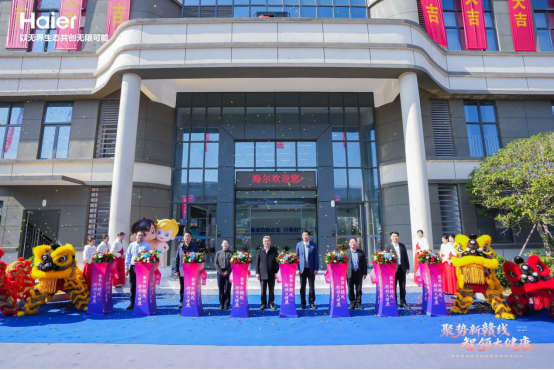
Core Viewpoint - The opening of the second phase of the Haier Kangyang Ganzhou Science and Technology Park marks a significant achievement in the collaboration between local government and leading enterprises to promote high-quality development in the health industry, establishing a benchmark for urban renewal projects in Ganzhou [1][2]. Group 1: Project Overview - The Haier Kangyang Ganzhou Science and Technology Park is a key project aimed at transforming the local economy by integrating industry and urban development, with a focus on the health sector [1][2]. - The second phase of the park covers approximately 23,000 square meters and includes advanced medical equipment testing laboratories, smart manufacturing applications, and aims for an annual production capacity of 6 million units [7]. Group 2: Business Growth and Performance - Since its establishment in Ganzhou in 2021, Haier Kangyang has achieved rapid growth, with sales exceeding 700 million yuan and the completion of the second phase expansion [2][3]. - The first phase of production generated revenue of 80 million yuan in its initial year, expanding its product line to over 20 categories, including oxygen generation and health monitoring devices [3]. Group 3: Technological Innovation - Haier Kangyang focuses on smart manufacturing and has been recognized as a high-tech enterprise in Jiangxi Province, showcasing its commitment to technological advancement and industry integration [3]. - The company has developed a comprehensive product matrix covering over 100 types of home health products, particularly excelling in the field of respiratory health with its innovative oxygen machines [8][9]. Group 4: Strategic Vision - The company aims to address the challenges of an aging population through technological innovation, with plans to leverage the Kaos industrial internet platform for product manufacturing and ecosystem development [9]. - Haier Kangyang is committed to deepening government-enterprise collaboration and optimizing the health industry ecosystem, contributing to the implementation of the Healthy China strategy [9].

银轮股份(002126.SZ):拟向四川银轮增资用于四川银轮西南智能制造基地建设
Ge Long Hui· 2025-12-29 11:21
Group 1 - The core point of the article is that Yinlun Co., Ltd. plans to increase its investment in Sichuan Yinlun New Energy Thermal Management System Co., Ltd. by 37.815 million RMB to meet local supply demands in Southwest China and enhance its market share in the new energy thermal management business [1] Group 2 - The investment will primarily be used for the construction of the Southwest Intelligent Manufacturing Base [1]
