AI泡沫

Search documents
隐含3200亿美元市值波幅,英伟达财报或成AI热潮关键考验
Di Yi Cai Jing Zi Xun· 2025-11-19 00:09
Core Insights - Nvidia is expected to report strong revenue, but the focus will be on management's insights regarding demand, supply chain, and customer investment pace [2] - The company's earnings report is seen as a macro-level variable, influencing not just its stock but the broader AI infrastructure market [2][3] - The AI narrative has significantly impacted global stock markets, with a cumulative increase of over $17 trillion in market value since the launch of ChatGPT [3] Group 1: Market Impact - Nvidia's earnings report could lead to a market capitalization fluctuation of up to $320 billion, potentially setting a record for the largest post-earnings market cap change [1] - The company's weight in the S&P 500 is nearly 8%, meaning any signals regarding demand or supply chain could affect a wide range of sectors from semiconductors to AI infrastructure [1] - Analysts suggest that Nvidia's influence extends beyond its market cap, impacting whether the market enters a new expansion phase or begins to digest previous gains [1] Group 2: AI Infrastructure and Investment - Major tech companies are projected to invest approximately $400 billion in data centers this year, nearly double last year's figures, indicating unprecedented capital expenditure [2] - Predictions indicate that infrastructure investment related to AI computing and data centers could reach around $4 trillion over the next five years [2] - Despite the significant capital expenditure, there is uncertainty regarding productivity improvements, with forecasts ranging from an annualized 0.1% to 2.9% [2] Group 3: Energy and Regulatory Concerns - The expansion of AI infrastructure is leading to increased energy demands, with data centers becoming a major source of electricity consumption in certain U.S. cities [4] - Nvidia controls over 90% of the high-end AI chip market, while AWS, Azure, and Google Cloud dominate over 60% of the global cloud infrastructure market [3] - Regulatory bodies are becoming more vigilant regarding potential systemic risks associated with AI, including concerns about "AI bubbles" and the implications of large tech companies' debt levels [4]

早报 | 49.1万张飞日本机票被取消;谷歌发布Gemini 3;于东来卸任胖东来总经理;普京:中国公民赴俄免签将生效
虎嗅APP· 2025-11-19 00:08
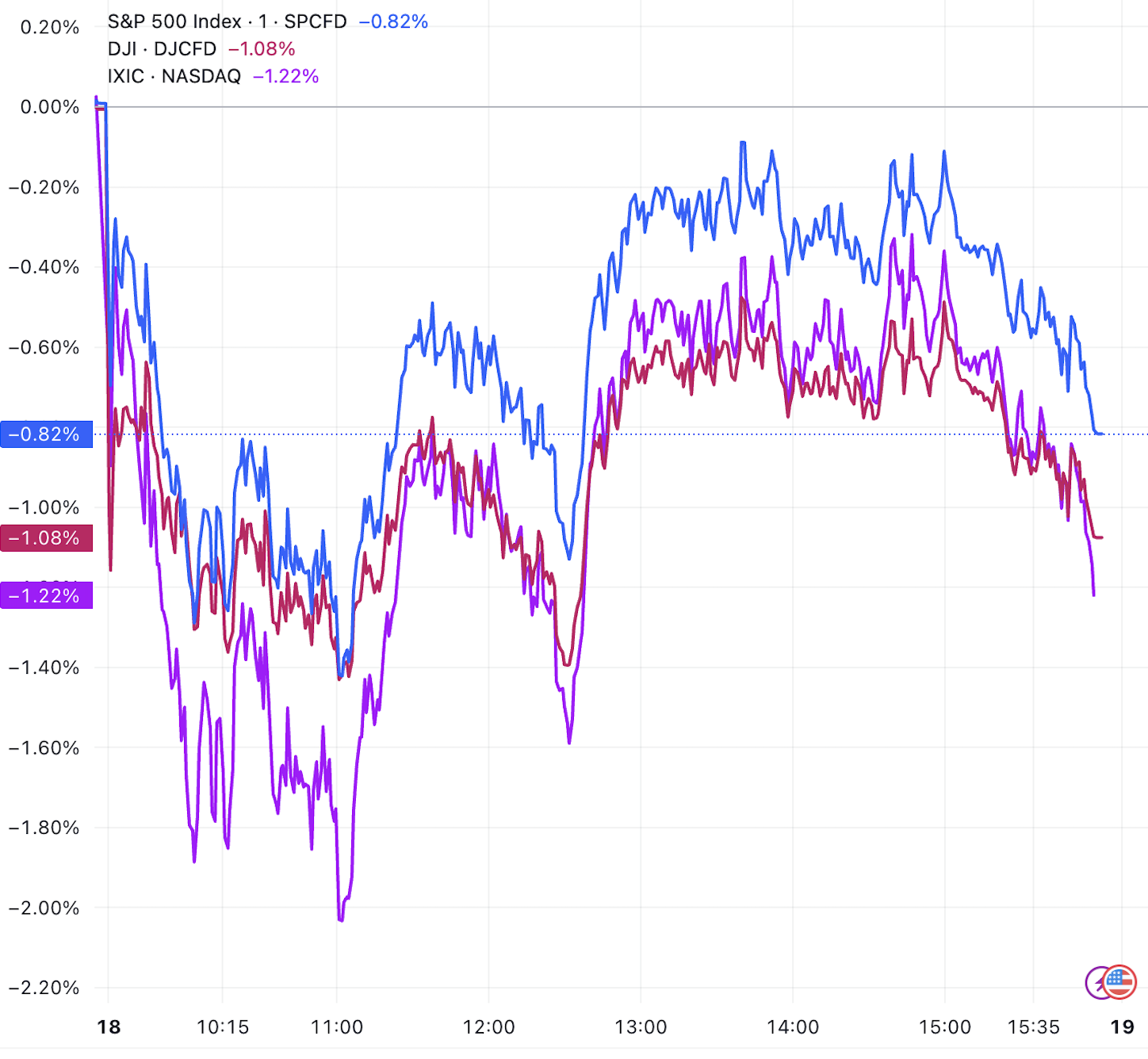
大家早上好!这里是今天的早报,每天早上,我都会在这里跟你聊聊昨夜今晨发生了哪些大事儿。 昨夜今晨 【美股连跌四天,英伟达跌近3%】 当地时间11月18日,美股三大指数集体收跌,道琼斯指数下跌498.500点,跌幅1.07%;标普500指数跌0.83%; 纳斯达克综合指数跌1.21%。 大型科技股多数下挫,亚马逊、AMD跌超4%,微软、英伟达跌超2%,特斯拉跌超1%。 【普京:中国公民赴俄免签政策将于近期生效】 据环球网援引今日俄罗斯(RT)、俄罗斯卫星网报道,当地时间11月18日,俄罗斯总统普京表示,针对中国 公民赴俄免签政策将于近期生效。 报道称,目前,俄罗斯公民可以免签前往中国。 中国外交部发言人郭嘉昆9月2日在例行记者会上表示,为进一步便利中外人员往来,中方决定扩大免签国家范 围,自2025年9月15日至2026年9月14日,对俄罗斯持普通护照人员试行免签政策。俄罗斯持普通护照人员来华 经商、旅游观光、探亲访友、交流访问、过境不超过30天,可免办签证入境。 这项交易体现出云计算和芯片供应商与领先AI开发商之间日益紧密的联系——后者再将资金花回在前者的服 务上。投资者对这类所谓的循环式AI交易愈发担忧,一 ...






Nvidia earnings are all about guidance; Microsoft and Nvidia invest in Anthropic
Youtube· 2025-11-18 23:52
Core Insights - Nvidia and Microsoft are set to invest up to $15 billion in Anthropic, highlighting the ongoing trend of partnerships in the AI sector [1][2] - The competitive landscape in AI is evolving, with Anthropic needing to secure capital to compete with players like OpenAI and Google [5][6] - Nvidia's upcoming earnings report is anticipated to show strong guidance, with projected revenues of around $62 billion for Q4 [7][9] Company Developments - Anthropic has been relatively quiet compared to OpenAI, but recent partnerships are aimed at enhancing their infrastructure capacity [3] - Nvidia's CEO mentioned a demand of $500 billion for AI products over the next two years, indicating significant growth potential [8][9] - Nvidia's business in China remains uncertain, with no revenue currently modeled from that market due to ongoing trade relations [10][11] Market Dynamics - The trend of "circular AI deals" raises concerns about a potential AI bubble, but the focus remains on creating valuable products for end customers [4] - Major investors like Peter Thiel and SoftBank have recently sold stakes in Nvidia, but this is not seen as a negative indicator for the company's demand outlook [12][13] - The competitive landscape has not shifted significantly, with Nvidia still being the preferred choice for hyperscalers despite emerging competition from Google [14][15] Valuation Perspective - Nvidia's valuation is characterized as healthy but not overly cheap, with a free cash flow yield of about 2.5% compared to 10-year yields at 4% [17][18] - The growth potential for Nvidia remains strong, with expectations of mid-teens growth in free cash flow for the foreseeable future [17]

深夜突发,全线大跌
Zheng Quan Shi Bao· 2025-11-18 23:39
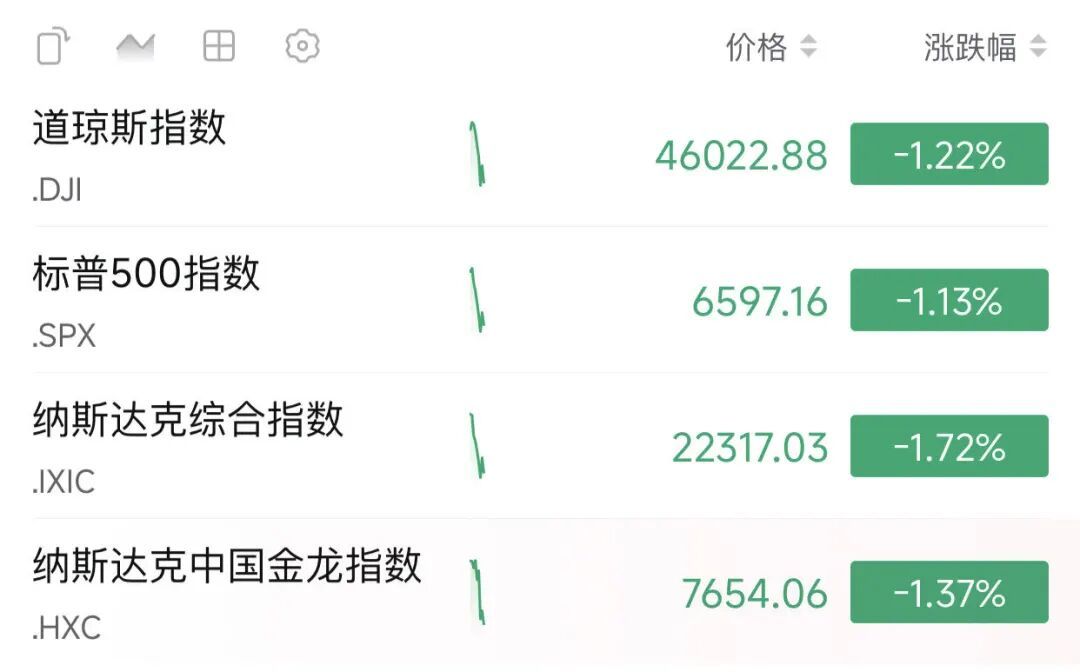
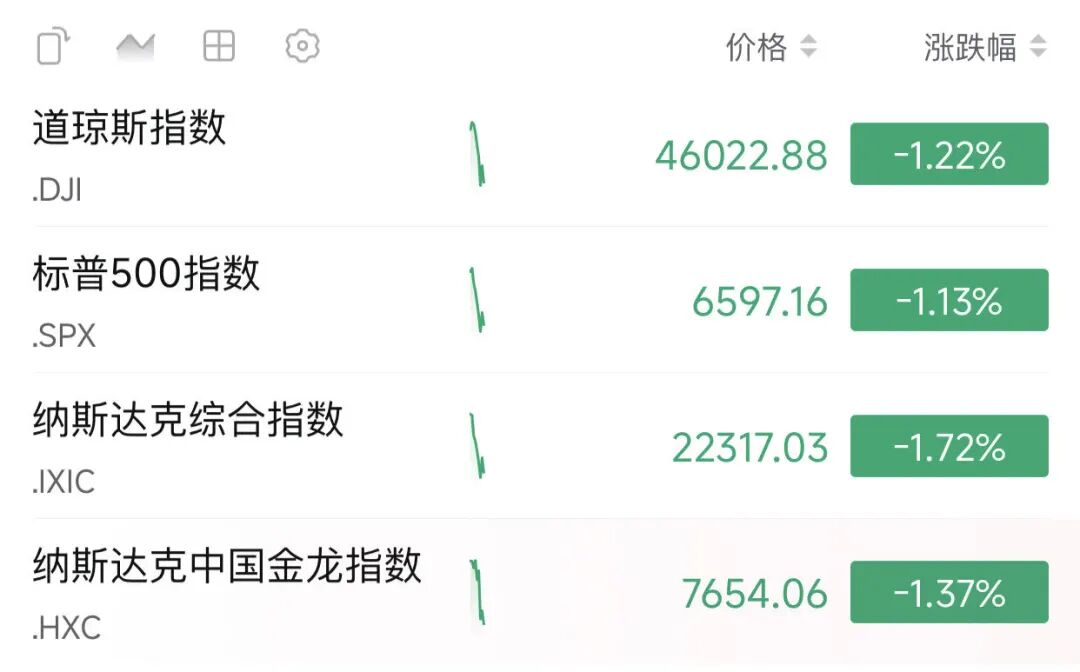
当地时间11月18日(周二),美股三大股指全线大跌,截至发稿,道指下跌1.22%,标普500指数下跌1.13%,纳指下跌1.72%。 | 0 03 | ~ 田 | 价格 = | 涨跌幅 = | | --- | --- | --- | --- | | 道琼斯指数 | | 46022.88 | -1.22% | | .DJI | | | | | 标普500指数 | | 6597.16 | -1.13% | | SPX | | | | | 纳斯达克综合指数 | | 22317.03 | -1.72% | | .IXIC | | | | | 纳斯达克中国金龙指数 | | 7654.06 | -1.37% | | .HXC | | | | 欧洲股市亦全线大跌,截至发稿,英国富时100指数跌超1%,法国CAC40指数跌近2%,德国DAX指数、意大利MIB指数、欧洲STOXX50指数均跌超2%。 经济数据方面,根据ADP研究公司周二发布的数据,在截至11月1日的四周内,美国公司平均每周裁减2500个工作岗位。 这一下降趋势表明,劳动力市场在10月下旬失去了增长势头。ADP在11月5日发布的月度就业报告显示,在此前两个月下降 ...
担忧情绪持续发酵,美股三大指数齐跌 道指、纳指跌超1%
Feng Huang Wang· 2025-11-18 23:39
Market Overview - The Dow Jones index fell by 1.07% to 46,091.74 points, the S&P 500 index decreased by 0.83% to 6,617.32 points, and the Nasdaq index dropped by 1.21% to 22,432.85 points, reflecting concerns over high valuations and accumulating debt in AI-related stocks [2] - A recent survey indicated that 45% of fund managers view the "AI bubble" as the largest "tail risk" in the current market, with rising concerns over excessive corporate spending, particularly on AI projects [2] Company Performance - Major tech stocks experienced declines, with Nvidia down 2.81%, Amazon down over 4%, and Microsoft down 2.70%. Nvidia has fallen over 10% this month, and both Microsoft and Amazon had their ratings downgraded by Redburn analysts [4][13] - Bitcoin rebounded after dropping below $90,000, raising concerns among tech investors who hold significant amounts of cryptocurrency that the stock market may decline further [3] Company News - Google launched its latest AI model, Gemini 3, emphasizing immediate integration into profitable products, including its search engine [5] - Meta won a federal antitrust case, allowing it to retain ownership of Instagram and WhatsApp without the need to divest these businesses [6][7] - Microsoft, Nvidia, and Anthropic announced a collaboration, with Anthropic investing $30 billion in computing resources on Microsoft Azure, supported by Nvidia [8][9] - Nvidia committed to investing up to $10 billion in Anthropic, while Microsoft will invest up to $5 billion, raising Anthropic's valuation to approximately $350 billion [12] Investment and Development - Geely and Renault plan to invest 3.8 billion Brazilian Reais ($714 million) in Brazil to jointly develop new vehicle models, enhancing competitiveness in South America's largest automotive market [16] - Toyota announced plans to invest $912 million across five U.S. states to boost the production of hybrid vehicle components and vehicles, as part of a broader $10 billion investment commitment over the next five years [17]
全球股市遭遇黑色星期二,牛市步入尾声了吗?
Sou Hu Cai Jing· 2025-11-18 23:28
第二个因素是全球AI炒作开始降温,市场担心AI泡沫存在破裂的风险。 今年9月份以来,美联储一共降息了2次,分别为今年9月份和10月份。但是,从乐观的角度考虑,美联储可能会在今年12月份再降息一次。然而,美联储是 否降息依然存在一定的变数。 今年10月至11月中旬,美国上演了43天的停摆,并导致了部分核心经济数据无法如期发布。因为多项核心数据未能够如期发布,从而影响到美国经济的政策 制定,或成为影响美联储12月份降息的一个原因。 同时,美联储接连释放出鹰派言论,对股票市场而言,美联储的一举一动对股市影响深远。从美国接连停摆到美元指数走强,再到美联储释放出鹰派信号, 美联储12月降息的预期大打折扣,加快了资金从股票市场流出的速度。 针对AI泡沫的问题,近期已有多家顶级投资机构密集抛售英伟达的股票,包括软银集团、桥水基金等。有部分机构投资者选择了清仓式抛售,对当前的AI 估值表示了担忧。 全球股市遭遇黑色星期二,包括亚太股市、欧美股市等都出现了不同程度的跌幅。美东时间11月18日,美股三大指数继续收跌,道琼斯和纳斯达克指数均下 跌超过1%。其中,自高点下跌以来,纳斯达克指数的累计跌幅已经超过了7%,本轮调整成为了今 ...
美股“寒意”加剧!标普500指数连跌四日 小盘股逼近技术性回调水平
智通财经网· 2025-11-18 22:22
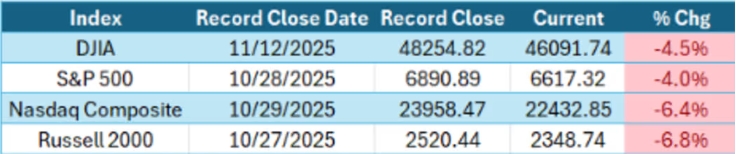
Market Overview - The U.S. stock market has experienced a significant downturn, with the S&P 500 and Dow Jones Industrial Average both recording their fourth consecutive day of declines, indicating a shift towards risk aversion as year-end market conditions face uncertainty [1] - The S&P 500 index fell by 0.83%, while the Dow dropped by 1.07%, marking the longest losing streak since August 21 [1] - The Nasdaq index, heavily weighted with technology stocks, decreased by 1.21%, continuing its downward trend for the second consecutive day [1] Index Performance - The Dow Jones Industrial Average has retreated approximately 4.5% from its historical high set last week [1] - The S&P SmallCap 600 index is nearing a technical correction level, having already surpassed a 10% decline from its peak [1] - A total of 324 stocks within the S&P 500 have fallen more than 10% from their 52-week highs, indicating widespread selling pressure across various sectors [1] Sector Analysis - High-risk assets, including technology giants and industrial stocks, have faced significant sell-offs, while defensive sectors such as healthcare and consumer staples have shown resilience, with healthcare up by 0.54% and consumer staples up by 0.15% [2] - Gold prices have increased by 2.1% since November, despite a recent pullback from highs [2] Economic Factors - Key economic pressures contributing to the market's risk-averse stance include valuation pressures, slowing household spending, employment concerns, and persistent high inflation [3] - The Federal Reserve's recent decision to lower the federal funds rate by 25 basis points to a range of 3.75%—4.0% has led to uncertainty regarding future rate cuts, with market expectations for a December cut dropping from approximately 90% to 48.9% [3] Investor Sentiment - The current market pullback has cast a shadow over traditional year-end rallies, with some analysts suggesting that a 5% correction in the tech sector is a "technically overdue normal adjustment" [3] - Concerns regarding the AI bubble are rising, although the fundamentals of technology companies remain strong [4] - The CNN Fear & Greed Index has fallen to 13, indicating "extreme fear," which historically has been viewed as a buying signal [4] Anticipated Events - Investors are preparing for Nvidia's quarterly earnings report, which is seen as a critical event that could provide guidance on the AI industry's outlook and potentially serve as a turning point for the market [4] - Market participants are anticipating a rebound, with momentum stocks expected to lead the recovery following Nvidia's earnings announcement [4]
恐慌又来了!欧美一起跌,道指重挫超500点,苹果英伟达低迷
Sou Hu Cai Jing· 2025-11-18 18:39
标普500指数下跌0.92%,4月以来首次跌破50日均线这一关键技术支撑位。 市场恐慌指数VIX随之飙升12.97%,报22.39,显示投资者恐慌情绪大幅升温。 华尔街的恐慌情绪像病毒一样蔓延。 道指暴跌557点,标普500指数跌破关键支撑线,而"硅谷风投教父"彼得·蒂尔清仓英伟达的全部股份,正在引发一场关 于AI泡沫的深刻忧虑。 交易终端屏幕上的红色数字不断跳动。 华尔街刚刚经历了一个不眠之夜,道指暴跌557.24点,跌幅达1.18%,创下近一个月来最差表现。 彼得·蒂尔的清仓行为引发市场广泛关注。 他不仅清空了英伟达全部持股,还减持特斯拉20.76万股,减持比例高达76%。 蒂尔宏观基金三季度末持仓总市值仅为7440万美元,相比二季度的2.12亿美元大幅下降65%。 该基金同时新建仓苹果和微软,但总体呈现大幅收缩态势。 彼得·蒂尔今年早些时候曾警告英伟达估值过高,并将科技股估值飙升与1999-2000年互联网泡沫破灭进行了类比。 作为PayPal联合创始人和Facebook早期投资者,他在硅谷拥有巨大影响力,其投资动向备受关注。 在这场全面溃败中,"硅谷风投教父"彼得·蒂尔旗下基金清仓英伟达全部股份的消息 ...
深夜突发!全线大跌!
Zheng Quan Shi Bao· 2025-11-18 15:56
Market Overview - On November 18, U.S. stock indices experienced a significant decline, with the Dow Jones down 1.22%, S&P 500 down 1.13%, and Nasdaq down 1.72% [1][2]. - European markets also fell, with the UK FTSE 100 dropping over 1%, and major indices in France, Germany, and Italy declining by more than 2% [2]. Labor Market Data - According to ADP, U.S. companies cut an average of 2,500 jobs per week in the four weeks ending November 1, indicating a loss of momentum in the labor market [2][3]. - The U.S. Department of Labor reported that the number of initial jobless claims was 232,000 for the week ending October 18, with continuing claims at 1.957 million [3]. Federal Reserve Insights - The upcoming non-farm payroll report is expected to be crucial for the Federal Reserve, especially given the recent labor market data [4]. - The probability of a 25 basis point rate cut by the Federal Reserve in December has dropped below 50%, down from 95% a month ago, reflecting increased market uncertainty [5]. Investment Sentiment - A monthly survey by Bank of America indicated that global investors increased their allocation to stocks and commodities in November, while cash holdings fell to 3.7%, triggering a "sell" signal [5]. - The survey highlighted that 45% of investors view the "AI bubble" as the biggest tail risk, with a record number of investors believing companies are "over-investing" [5]. Technology Sector Performance - Major tech stocks saw declines, with Nvidia, Amazon, and TSMC dropping over 3%, while Microsoft and Meta fell over 2% [7]. - Nvidia and Microsoft announced a strategic partnership with AI startup Anthropic, with Nvidia committing up to $10 billion and Microsoft up to $5 billion [7]. Cloudflare Incident - Cloudflare experienced a significant network outage affecting multiple platforms, leading to a stock price drop of over 7% at one point, closing down over 3% [7][8]. Chinese Stocks Performance - The Nasdaq China Golden Dragon Index fell over 1%, with notable declines in stocks like Pinduoduo (down over 6%) and Tencent Music (down over 3%) [8].


深夜突发!全线大跌!
证券时报· 2025-11-18 15:53
全线大跌。 当地时间11月18日(周二),美股三大股指全线大跌,截至发稿,道指下跌1.22%,标普500指数下跌1.13%,纳指下跌1.72%。 | 0 E 03 | 价格 = | 涨跌幅 ◆ | | --- | --- | --- | | 道琼斯指数 | 46022.88 | -1.22% | | .DJI | | | | 标普500指数 | 6597.16 | -1.13% | | .SPX | | | | 纳斯达克综合指数 | 22317.03 | -1.72% | | .IXIC | | | | 纳斯达克中国金龙指数 | 7654.06 | -1.37% | | .HXC | | | 此外,美国劳工部官网显示,10月18日当周美国首次申请失业救济人数为23.2万人,10月18日当周续请失业金人数为195.7万人。 本周四,美国劳工部将公布9月份的非农就业报告,这份数据对美联储来说将具有不容忽视的重要性。 值得一提的是,根据芝商所"美联储观察"工具,美联储12月降息25个基点的概率已不足50%。而一个月前,市场预期12月降息的概率高达95%。 市场分析认为,在官方数据发布因为美国政府"停摆"而一度中断的 ...