
算力

Search documents
晚报 | 12月3日主题前瞻
Xuan Gu Bao· 2025-12-02 14:28
Group 1: Cloud Computing - Amazon Web Services (AWS) is hosting its annual cloud computing event in Las Vegas, which is significant for Amazon as AWS accounts for one-fifth of its sales and often contributes over half of its profits [1] - AWS is expected to unveil a new multimodal model capable of processing text, speech, images, and video, which aligns with its AI and cloud strategy [1] - Analysts from Morgan Stanley are optimistic about AI investment growth, indicating strong demand for AI capabilities that exceed supply, which is expected to enhance core business operations [1] Group 2: Electric Vehicle Charging Infrastructure - Shanghai's transportation and development authorities issued a notice to enhance safety management of public electric vehicle charging facilities, mandating compliance with national safety standards [2] - By August 2026, all new or updated public charging facilities in Shanghai must use products certified under mandatory product certification [2] - The National Development and Reform Commission aims to establish 28 million charging facilities nationwide by the end of 2027, significantly increasing charging capacity to meet the needs of over 80 million electric vehicles [2] Group 3: Brain-Computer Interface Technology - The Jiangxi provincial government has introduced measures to accelerate the development of brain-computer interface technology, including support for medical devices and project funding [3] - The brain-computer interface industry is expected to reach a global market size of $40 billion by 2030 and exceed $145 billion by 2040, driven by policy support and technological advancements [3] - Domestic companies are making significant progress in areas such as device miniaturization and signal transmission, presenting investment opportunities in the mid to long term [3] Group 4: Artificial Intelligence - The 2025 Volcano Engine Original Power Conference is scheduled for December 18-19, where significant updates on AI models and tools will be announced [4] - ByteDance has established a comprehensive AI ecosystem, focusing on model development, platform integration, and application deployment, with a strong emphasis on hardware [4] - Analysts believe ByteDance's full-stack approach in cloud infrastructure, large models, and applications positions it well for future AI advancements [4] Group 5: Satellite Internet - The "2025 Satellite Internet Industry Ecosystem Conference" will be held in Shanghai, focusing on collaboration across various sectors of the satellite internet industry [5] - The satellite internet sector in China is rapidly developing, with expectations for commercial applications to begin in 2025, supported by policy and technological innovations [5] - The integration of satellite internet with 5G/6G technologies is anticipated to create a unified global communication network, fostering innovation in smart transportation and urban management [5] Group 6: Bamboo as a Plastic Alternative - The National Development and Reform Commission held a meeting to promote the "Bamboo Instead of Plastic" initiative, outlining progress and future strategies [6] - The bamboo industry is projected to exceed 1 trillion yuan in total output value by 2035, becoming a key solution for plastic pollution [6] - The initiative aims to enhance technology, expand application areas, and transition from traditional bamboo products to high-value, high-tech offerings [6] Group 7: Data and Digital Talent Development - Several government departments have issued opinions to strengthen the development of data-related academic disciplines and digital talent, promoting the use of resources like computing power and data vouchers [7]

近百亿资金,净流出!
Zhong Guo Zheng Quan Bao· 2025-12-02 12:08
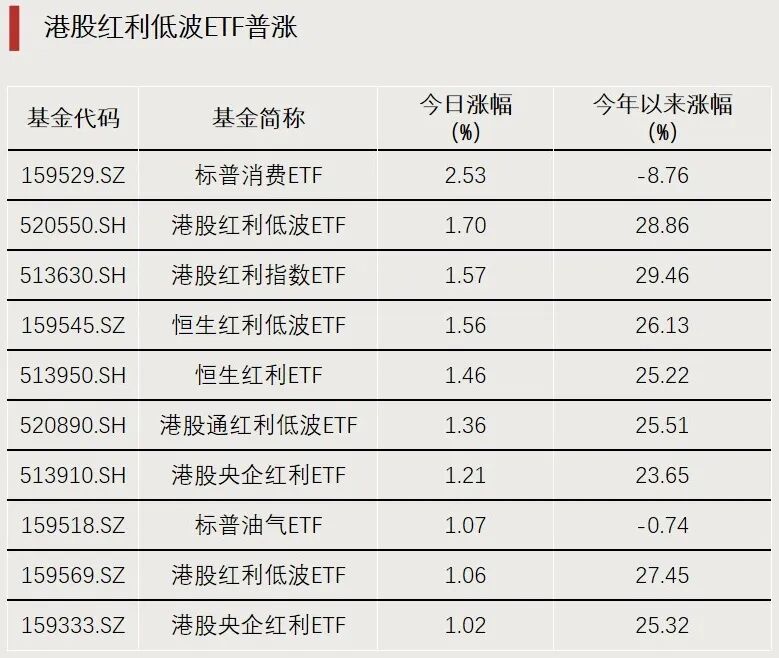
Market Overview - After a week of reduced trading volume and a rebound in late November, the A-share market experienced a pullback on December 2, with trading volumes for related ETFs in the ChiNext and STAR Market falling below the average levels of November [1][4]. Fund Flows - On December 1, nearly 10 billion yuan in net outflows were recorded for A-share ETFs, with broad-based theme ETFs experiencing the most significant outflows [3][9]. - The total trading volume for the A-share market was 1.6073 trillion yuan, a decrease compared to the previous trading day [4]. Performance of ETFs - Several Hong Kong dividend ETFs saw gains, with many increasing by over 1% on the same day [4]. - Year-to-date, multiple Hong Kong dividend-related ETFs have performed well, with some increasing by over 25% [6]. - As of December 1, the latest share count for the Hong Kong dividend ETF reached 6.469 billion shares, with a total scale of 8.694 billion yuan, reflecting a year-to-date share growth of 42.96% and a scale growth of 75.78% [6]. Sector Performance - The energy metals, CRO concepts, and medical services sectors saw the largest declines, while the road and railway transportation, as well as agriculture and forestry sectors, experienced gains [4]. - The trend of investors seeking stable cash flow and high-dividend assets is expected to continue as the year ends, driven by institutional investors locking in profits and a seasonal influx of insurance funds [6][11]. Specific ETF Data - The following ETFs showed notable performance on December 1: - The S&P Consumer ETF rose by 2.53% but is down 8.76% year-to-date - The Hong Kong Dividend Low Volatility ETF increased by 1.70% with a year-to-date gain of 28.86% [5]. - The A500 ETF maintained active trading, while other ETFs like the STAR 50 and ChiNext saw significant reductions in trading volumes compared to November's daily averages [7].
新易盛逆市六连涨!大摩上调谷歌TPU产量预期,光模块CPO获新发展机遇!关注含“光”量超56%的ETF
Xin Lang Ji Jin· 2025-12-02 11:41
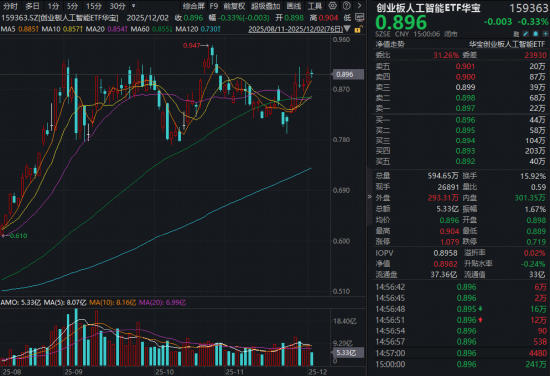
Group 1 - The core viewpoint of the articles highlights the resilience of the AI sector, particularly in the context of the recent performance of the ChiNext AI ETF and the growth prospects for companies involved in AI and related technologies [1][4] - New Yi Sheng, a leading optical module CPO, has seen a significant increase in stock price, indicating strong market interest and performance in the optical module sector [1] - Morgan Stanley's report indicates a substantial upward revision in Google's TPU production forecasts, suggesting a robust demand for AI-related hardware, which could benefit optical module suppliers [3] Group 2 - The AI industry is experiencing a clear upward trend, with short-term adjustments providing good opportunities for investment, particularly in the computing power and AI application sectors [4] - The optical module industry is expected to see a capacity release in Q1 2026, driven by the high demand in the computing power supply chain, which is likely to enhance the performance of leading optical module manufacturers [3] - The first ChiNext AI ETF is highlighted as a key investment vehicle, with a significant portion of its holdings focused on optical module leaders, reflecting the growing importance of this sector in the AI landscape [4]





南京熊猫(600775.SH):公司目前没有产品用于数据中心,公司目前不涉及算力领域
Ge Long Hui· 2025-12-02 10:00
格隆汇12月2日丨南京熊猫(600775.SH)在投资者互动平台表示,公司目前没有产品用于数据中心,公司 目前不涉及算力领域。 ...

刚刚!一则大消息引爆市场!
天天基金网· 2025-12-02 08:31
Core Viewpoint - The article discusses the recent policy support for the computing power industry in Fujian Province, emphasizing the strategic importance of computing power in the digital economy and its role in promoting the integration of digital and real economies [4][5]. Group 1: Policy Measures - Fujian Province aims to achieve a public computing power scale of over 12 EFLOPS by the end of 2027, with plans to construct several medium-sized computing infrastructure projects [4][5]. - The measures include enhancing the efficiency of computing power network transmission and promoting the construction of the "Fuzhou-Shenzhen Short Path Optical Cable" project [8][6]. - The initiative encourages the establishment of a unified computing resource public service platform to facilitate resource allocation and sharing across the province [6][5]. Group 2: Infrastructure Development - The plan outlines the construction of high-performance data centers in key areas, including the Digital Fujian Industrial Park, to lead the demonstration of computing resource applications [5][6]. - It emphasizes the need for strict compliance with national layout requirements for data centers, focusing on energy efficiency and resource utilization [5][6]. - By 2027, the energy utilization efficiency (PUE) of newly built or renovated data centers is expected to be below 1.25, with an overall rack utilization rate of no less than 65% [4][5]. Group 3: Technological Advancements - The article highlights the importance of advancing technologies such as 400G/800G optical transmission and IPv6 segment routing to improve network transmission efficiency [8][9]. - It mentions the goal of achieving a 90% OTN coverage rate in key application areas by 2027 [8]. - The focus is also on the development of edge computing nodes, with a target of deploying at least 50 nodes and creating no less than five typical cases by 2027 [8][9]. Group 4: Market Opportunities - The computing power infrastructure market is viewed as a rapidly expanding sector, with significant growth potential as demand for computing resources continues to rise [10]. - Companies with comprehensive AI stack capabilities are expected to benefit from the increasing demand for computing power solutions, particularly in light of advancements in AI models [10]. - Investment opportunities are highlighted in the supply chain of optical interconnects, including light modules and related technologies, as the market evolves [10].

A股尾盘算力股异动,菲菱科思20CM涨停,美的股价创逾四年来新高
2 1 Shi Ji Jing Ji Bao Dao· 2025-12-02 07:40
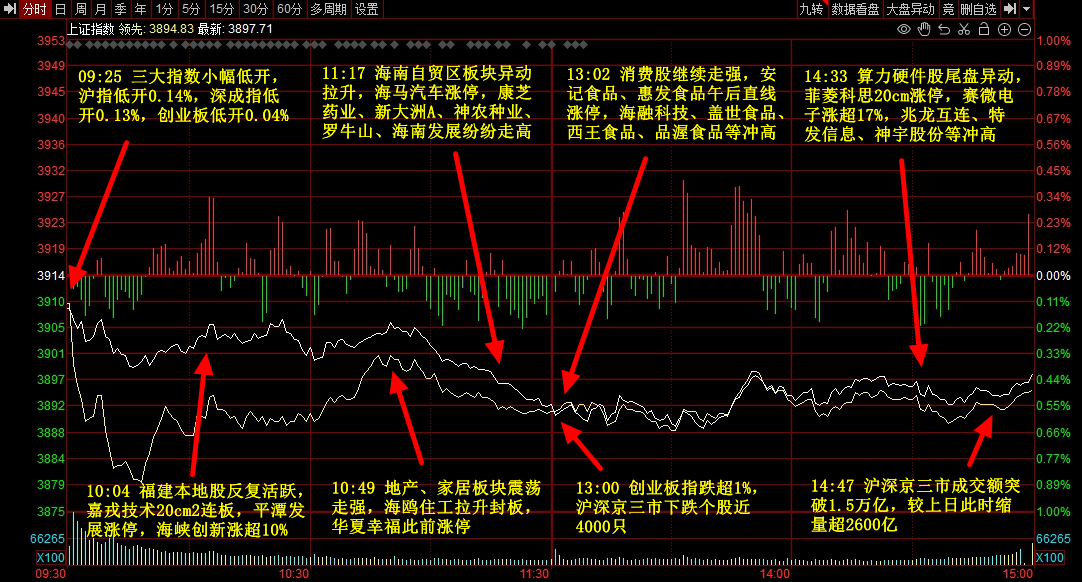
12月2日,A股市场全天震荡调整,截至收盘,沪指跌0.42%,深证成指跌0.68%,创业板指跌0.69%,深 成指、创业板指一度双双跌超1%。 沪深两市成交额1.61万亿,较上一个交易日缩量2822亿。全市场超3700只个股下跌。 板块方面,锂电池 产业链 领跌,创新药、GPU、机器人、光伏、AI应用、半导体、新能源车概念股跌 幅居前。两岸融合、医药商业、消费电子题材逆势走强。 具体来看,福建板块逆势爆发,海欣食品(002702)5连板,睿能科技(603933)4连板,平潭发展 (000592)3天2板。食品概念局部走强,同庆楼(605108)、惠发食品(603536)双双涨停。商业航天 概念表现活跃,航天发展(000547)13天9板,通宇通讯(002792)4连板。下跌方面,电池板块震荡下 跌,石大胜华(603026)跌7%。航运板块表现较弱,招商轮船(601872)触及跌停。 A股算力硬件板块尾盘异动,菲菱科思(301191)20CM涨停,赛微电子(300456)涨超17%,兆龙互 连(300913)、特发信息(000070)、神宇股份(300563)、德科立等跟涨。 医药商业股持续拉升, 海王生物(0 ...
5G通信ETF(515050)逆市翻红,聚焦算力+电子龙头,今年以来累计涨幅超80%
Mei Ri Jing Ji Xin Wen· 2025-12-02 06:38
Core Insights - The A-share market index opened lower on December 2, but the consumer electronics manufacturing sector remained active throughout the day, with the 5G Communication ETF (515050) turning positive in the afternoon despite the overall market trend [1] - The 5G Communication ETF (515050) has seen an impressive increase of over 80% year-to-date [1] Group 1: Market Performance - The consumer electronics manufacturing sector was notably active, with several stocks such as Guanghetong, Lingyi Itech, Industrial Fulian, Tianfu Communication, and Luxshare Precision experiencing gains [1] - The 5G Communication ETF (515050) demonstrated resilience by reversing its trend and gaining value in the afternoon session [1] Group 2: Technological Developments - Doubao released a technical preview of its mobile assistant, which is designed to enhance user interaction and experience by integrating with mobile operating systems [1] - Analysts suggest that Doubao's mobile assistant, along with Quark AI glasses and Huawei's AI toys, could reshape AI interaction models on the device side, potentially accelerating the adoption of AI applications and driving demand in this sector [1]
中原证券晨会聚焦-20251202
Zhongyuan Securities· 2025-12-02 02:12
Core Insights - The report highlights a gradual recovery in various industries, with a focus on investment opportunities arising from supply and demand dynamics [6][14][16] - The AI sector is experiencing rapid growth, with significant advancements in technology and applications, particularly in China [16][17] - The chemical industry is expected to see a marginal recovery in profitability due to improved demand and reduced investment pressures [13][14] Domestic Market Performance - The A-share market has shown a slight upward trend, with the Shanghai Composite Index closing at 3,914.01, reflecting a 0.65% increase [3] - The average P/E ratios for the Shanghai Composite and ChiNext indices are 15.95 and 48.16, respectively, indicating a favorable long-term investment environment [8][9] International Market Performance - Major international indices, such as the Dow Jones and S&P 500, experienced slight declines, with the Dow Jones closing at 30,772.79, down 0.67% [4] Industry Strategies - The chemical industry is entering a phase of improved stability, with a focus on supply-side constraints and demand recovery, particularly in agricultural chemicals and fluorochemicals [13][14] - The AI industry is projected to benefit from increased domestic demand and government support, with a focus on integrated circuits and software [16][17] - The food and beverage sector is facing challenges with declining revenue growth, but opportunities exist in the snack and beverage markets, which are expected to grow significantly [20][21] Investment Recommendations - The report suggests focusing on leading companies in the chemical sector, such as Wanhua Chemical and Satellite Chemical, as well as opportunities in the AI and semiconductor industries [15][16] - In the food and beverage sector, companies like Baoli Food and Dongpeng Beverage are recommended due to their growth potential in the snack and soft drink markets [21] Key Data Updates - The semiconductor industry continues to show strong growth, with global sales reaching $69.47 billion, a 25.1% year-on-year increase [36] - The photovoltaic industry is experiencing a supply-demand imbalance, with a focus on capacity reduction and optimization of the competitive landscape [25][23]
现货白银价格再创新高;DeepSeek发布两个正式版模型|盘前情报
2 1 Shi Ji Jing Ji Bao Dao· 2025-12-02 00:38
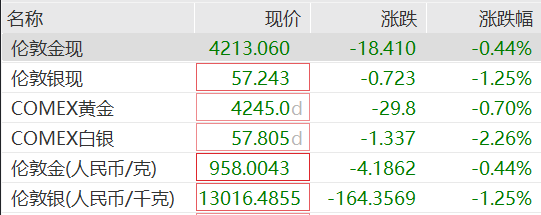
Market Overview - On December 1, the A-share market experienced a rebound, with the Shanghai Composite Index returning above 3900 points, and both the Shenzhen Composite Index and the ChiNext Index rising over 1% [2] - The Shanghai Composite Index closed at 3914.01, up 0.65%, while the Shenzhen Composite Index closed at 13146.72, up 1.25%, and the ChiNext Index closed at 3092.5, up 1.31% [3] - The total trading volume in the Shanghai and Shenzhen markets reached 1.87 trillion yuan, an increase of 288.1 billion yuan compared to the previous trading day [2] Sector Performance - The consumer electronics sector saw a collective surge, while the commercial aerospace concept continued to show strength [2] - The non-ferrous metals sector was active, and the photolithography concept experienced a rapid increase [2] - Conversely, the battery sector faced a pullback after an initial rise [2] International Market Trends - Major U.S. stock indices fell on December 1, with the Dow Jones Industrial Average down 427.09 points (0.90%), the S&P 500 down 36.46 points (0.53%), and the Nasdaq Composite down 89.76 points (0.38%) [4] - European stock indices also declined, with the FTSE 100 down 17.98 points (0.18%), the CAC 40 down 25.71 points (0.32%), and the DAX down 247.35 points (1.04%) [4] - International oil prices rose, with WTI crude oil up $0.77 to $59.32 per barrel (1.32%) and Brent crude oil up $0.79 to $63.17 per barrel (1.27%) [4] Commodity Prices - Spot silver rose 2.85% to $57.987 per ounce, continuing to set historical highs [5] - COMEX gold futures increased by 0.24% to $4265 per ounce, while COMEX silver futures rose 2.25% to $58.45 per ounce [5] Policy and Economic Developments - Jiangsu Changzhou announced a new housing assistance policy to support low-income groups in purchasing new homes, providing up to 20,000 yuan in subsidies for new homes and 18,000 yuan for existing homes [9] - The State Post Bureau reported that China's express delivery volume surpassed 1.8 billion packages as of November 30, marking a historical high [10] - The Ministry of Industry and Information Technology encouraged Chinese companies in solar, wind, lithium batteries, and electric vehicles to expand internationally and invest in green energy projects [11] Institutional Insights - Zhongyuan Securities highlighted the positive outlook for AI and domestic self-controlled sectors, driven by advancements in chip technology and AI applications [13] - Datong Securities noted the favorable conditions in the paper industry, including price increases and cost reductions, enhancing profitability [13] - Aijian Securities suggested that successful launches of reusable rockets could significantly reduce satellite launch costs, benefiting the domestic low-orbit satellite industry [13] Focused Announcements - Tsinghua Unigroup plans to acquire 51% stakes in Beitelai and Shanghai Tongtu for 3.21 billion yuan and 3.57 billion yuan, respectively [14] - Wolong New Energy is investing 8.04 billion yuan in a 200,000 kW/1.2 million kWh energy storage demonstration project [14] - Top Group is planning to issue H-shares and list on the Hong Kong Stock Exchange [14] Fund Flow Analysis - The telecommunications equipment sector saw a net inflow of 4.19%, with ZTE Corporation being the top stock [15] - The semiconductor sector also experienced a net inflow of 2.77%, led by兆易创新 [15] - In contrast, the photovoltaic equipment sector faced a net outflow of 6.59%, with阳光电源 being the most affected stock [15] Individual Stock Movements - ZTE Corporation saw a significant net inflow of 38.06 billion yuan, with a price increase of 10% [16] - 兆易创新 experienced a net inflow of 11.04 billion yuan, with a price increase of 4.84% [16] - 阳光电源 faced a net outflow of 14.01 billion yuan, with a price decrease of 1.83% [16]


格林大华期货早盘提示:股指-20251202
Ge Lin Qi Huo· 2025-12-02 00:38
Report Industry Investment Rating - The team led by the head of Asia at J.P. Morgan and the co-head of global emerging markets equity strategy upgraded the rating of Chinese stocks to "overweight" [2][3] Core Viewpoints - The major indices of the two markets oscillated upward on Monday, with the communication equipment and non-ferrous sectors leading the gains. The stock market rally may attract domestic and global capital inflows, and the market is expected to continue its upward trend. It is recommended to allocate long positions in stock index futures mainly based on the CSI 300 Index and CSI 500 Index, and conduct range trading. Also, look for opportunities to buy deep out-of-the-money long-term call options on stock indices [1][3] Summary by Relevant Catalogs Market Review - On Monday, the major indices of the two markets oscillated upward, with the communication equipment and non-ferrous sectors leading the gains. The trading volume of the two markets was 1.87 trillion yuan, showing an increase in volume during the rise. The CSI 300 Index closed at 4,576 points, up 49 points or 1.10%; the SSE 50 Index closed at 2,993 points, up 24 points or 0.81%; the CSI 500 Index closed at 7,101 points, up 70 points or 1.00%; the CSI 1000 Index closed at 7,386 points, up 52 points or 0.72% [1] - Among industry and thematic ETFs, the top gainers were Gold Stock ETF Funds, Industrial Non-Ferrous ETFs, Communication Equipment ETFs, Internet of Things ETFs, and Tourism ETFs, while the top losers were ChiNext New Energy ETFs, ChiNext Innovative Drug ETFs (Guotai), and Agricultural ETFs (E Fund) [1] - Among the sector indices of the two markets, the top gainers were forestry, rare metals, industrial metals, communication equipment, and AI glasses indices, while the top losers were aquaculture, e-commerce, rail transit equipment, kitchen and bathroom appliances, and wind power equipment indices [1] - The settlement funds of CSI 300 and SSE 50 index stock index futures had net inflows of 1.6 billion yuan and 700 million yuan respectively [1] Important News - In November, the RatingDog China Manufacturing PMI shifted from expansion to contraction. Although new export orders improved, they failed to drive the manufacturing industry to continue expanding. Considering the need to achieve the annual growth target of 5%, there may be a phased boost on the supply and demand sides at the end of the year, and it is expected that the PMI in December will show weak expansion [1] - The first batch of 7 ETFs closely tracking the CSI Science and Technology Innovation and Entrepreneurship Artificial Intelligence Index was launched, and some ETFs were sold out on the first day of issuance. Dozens of ETFs focusing on various industry themes such as the CSI Science and Technology Innovation and Entrepreneurship Robot, CSI Science and Technology Innovation and Entrepreneurship Semiconductor, and SSE Star Market Innovative Drugs are in the application process [1] - In October, the scale of newly registered private fund products was only over 40 billion yuan, which was at a normal level. However, the existing scale increased by 1.14 trillion yuan during the same period, with an increase of more than 17 percentage points, indicating that the growth came from the funds and net values of "old products" [1] - Li Bei, the founder of Banxia Investment, stated that the wealthy are facing an asset shortage with nowhere to place their wealth. The profit-making effect of the stock market will trigger the transfer of household savings, the reconfiguration of domestic institutional asset allocation, and the reconfiguration of global funds and the return of overseas capital to the Chinese market. This round of market may become a bubble and reach a considerable height [1][3] - The silver price reached a new high, and China's silver inventory dropped to a seven-year low of 715.8 tons. This market situation not only reflects the supply-demand imbalance caused by China's record export of 660 tons of silver in October but also confirms that supply-driven price increases are spreading from precious metals to industrial metals, becoming a common trend in commodities [1] - Chinese domestic authority Han Yinhe disclosed that China has achieved a key breakthrough in space AI: the "one-star multi-card" space-based supercomputing architecture of the Institute of Computing Technology, Chinese Academy of Sciences, will be verified in orbit next year. The single-star computing power will achieve a leap through the domestic GPU array, marking China's transformation from a technology follower to a leader in space computing [2] - ByteDance released a technical preview version of Doubao Mobile Assistant, which is embedded in ZTE's mobile phone system. This AI has amazing "intelligent agent" capabilities and can simulate manual cross-App operations, which may trigger a major shock in the industry [2] - Elon Musk said that in the future, the technologies of SpaceX, Tesla, and xAI will gradually integrate to form a self-sufficient ecosystem. This system may break away from the traditional monetary system, and its generated value and output will far exceed those of other industries [2] - With only three months left until the Spring Festival, if the US inventory remains high, the copper price may soar in spring. The current main risks focus on the December FOMC meeting and changes in AI capital expenditure expectations. Technical charts show that the copper price is at a critical breakthrough point, and the underestimated force of hoarding demand is rewriting the supply-demand pattern [2] - Morgan Stanley said that humanoid robots, as the ultimate form of "physical AI," mark a key chapter in human history. By 2050, the global humanoid robot market is expected to reach $5 trillion, and the cumulative deployment volume will reach 1 billion units. During this decades-long growth, semiconductors have become the biggest variable and increment [2] - Goldman Sachs' latest 2026 asset outlook survey shows that technology stocks remain the top choice, but the slowdown of AI is regarded as the biggest risk. The market generally bets that the Fed will cut interest rates twice next year, and the number of people bullish on the US dollar is slightly more than those bearish. In terms of commodities, nearly 70% of investors are bullish on gold, and more than half are bearish on crude oil, showing a sharp contrast [2] - The governor of the Bank of Japan clearly stated that the central bank will "consider raising interest rates" and "make the right decision" at the December meeting. He emphasized that if the economic outlook is realized, interest rates will be raised, and he hopes to raise the interest rate to 0.75% before further elaborating on the future interest rate hike path. The upcoming spring wage negotiation is a key decision point [2] Market Logic - On Monday, the major indices of the two markets oscillated upward, with the communication equipment and non-ferrous sectors leading the gains. The scale of newly registered private fund products in October was normal, but the existing scale increased significantly. J.P. Morgan upgraded the rating of Chinese stocks to "overweight," and Alibaba is making efforts in AI to B and AI to C. Overseas funds have flowed into the Chinese stock market in large amounts, and Morgan Stanley expects the Chinese stock market to continue rising in 2026 [1][2][3] Future Outlook - The major indices of the two markets oscillated upward on Monday. The profit-making effect of the stock market may attract domestic and global capital inflows, and this round of market may become a bubble. There is no so-called AI bubble in the next three years. The bullish sentiment of traders towards the offshore RMB has reached a 14-year high. Overseas funds have flowed into the Chinese stock market in large amounts. J.P. Morgan upgraded the rating of Chinese stocks to "overweight," and the probability of the Fed cutting interest rates in December has risen to over 85%. As the focus of AI shifts to applications, the computing power chain has strengthened again. The major indices of the two markets continued to oscillate and recover on Monday, and the recovery direction in the future remains unchanged. It is recommended to allocate long positions in stock index futures mainly based on the CSI 300 Index and CSI 500 Index, and conduct range trading [1][2][3] Trading Strategies - Stock index futures directional trading: As the focus of AI shifts to applications, the computing power chain has strengthened again. The major indices of the two markets continued to oscillate and recover on Monday, and the recovery direction in the future remains unchanged. Allocate long positions in stock index futures mainly based on the CSI 300 Index and CSI 500 Index, and conduct range trading [3] - Stock index option trading: The stock index is in the period of oscillating recovery. Look for opportunities to buy deep out-of-the-money long-term call options on stock indices [3]