
脑机接口

Search documents
山鹰国际:对于脑机接口等跨界领域,公司暂时没有投入计划
Zheng Quan Ri Bao Wang· 2026-01-21 13:39
证券日报网讯1月21日,山鹰国际(600567)在互动平台回答投资者提问时表示,公司持续投入于造纸 主业的技术升级、产品结构优化、绿色生产等关键领域,旨在巩固和提升公司在核心业务上的长期竞争 力。对于脑机接口等跨界领域,鉴于其与主业协同性低,公司暂时没有投入计划。未来公司也将持续关 注能强化公司主业竞争力的协同机会。 ...

苏州“十五五”规划建议出炉:将培育更多千亿级规模上市企业
Zheng Quan Shi Bao Wang· 2026-01-21 12:18
Core Insights - Suzhou has officially released its "14th Five-Year Plan" proposal, focusing on promoting industries such as embodied intelligence, quantum technology, hydrogen energy, nuclear fusion energy, and brain-computer interfaces as new economic growth points [1] Group 1: Development of New Productive Forces - The proposal emphasizes the importance of the real economy and aims to implement the "Suzhou Intelligent Manufacturing" project, maintaining the manufacturing sector's contribution above 40% [2] - It aims to enhance the competitiveness of emerging industries by advancing innovation infrastructure, technology R&D, and product upgrades, particularly in sectors like electronic information, equipment manufacturing, and new materials [2] - The plan includes fostering world-class advanced manufacturing clusters in biomedicine, high-end medical devices, and semiconductor industries, among others [2] Group 2: Cultivation of Future Industries - The proposal outlines plans to actively develop future industries such as future manufacturing, information, materials, energy, space, and health [3] - It encourages diverse technological routes and application scenarios to accelerate the formation of new economic growth points in areas like embodied intelligence and quantum technology [3] - The plan aims to promote venture capital development to create a multi-faceted investment landscape for future industries [3] Group 3: Building an Innovation Hub - The proposal calls for strengthening the regional innovation system and integrating into the Shanghai (Yangtze River Delta) international technology innovation center [4] - It emphasizes the need for breakthroughs in key core technologies and aims to establish national innovation centers in quantum technology and deep-sea information technology [4] - The plan includes enhancing the role of enterprises in technological innovation and fostering a gradient cultivation system for technology-driven enterprises [4] Group 4: Promoting Large-scale Listed Companies - The proposal highlights the importance of reform in key areas and encourages differentiated reform explorations to enhance systemic coherence [5] - It aims to improve the financial service system, focusing on technology finance, green finance, and digital finance, among others [5] - The plan seeks to support the listing of more large-scale companies and enhance their growth [5] Group 5: High-level Opening Up - The proposal emphasizes deepening international cooperation and implementing high-level opening-up initiatives to attract global high-end resources [7] - It aims to expand institutional openness and engage in innovative trials in various sectors, including biomedicine and smart manufacturing [7] - The plan includes building the Yangtze River Delta ecological and green integration development demonstration zone [7] Group 6: Accelerating Urban Integration - The proposal focuses on enhancing the integration of Suzhou with Shanghai, promoting cooperation in technology innovation and resource sharing [8] - It aims to collaboratively develop world-class high-end industrial clusters in sectors like integrated circuits and artificial intelligence [8] - The plan includes improving transportation infrastructure and public services to facilitate urban integration [8]
权威解读|从2025年成绩单看中国经济增长点
Xin Hua Wang· 2026-01-21 11:49
2025年,我国经济呈现向优向好发展势头,高质量发展成色更足。国家统计局19日发布数据显示,2025年中国国内生产总值(GDP)1401879 亿元,首次跃上140万亿元新台阶,按不变价格计算,比上年增长5.0%。 1月18日拍摄的江苏省港口集团南京港龙潭集装箱码头(无人机照片)。新华社发(杨素平摄) 人工智能、量子科技、脑机接口等前沿领域捷报频传、一批重大科研成果竞相涌现……2025年,我国工业结构持续向优升级,"新"的动能持 续培育壮大,"进"的步伐更加有力。 编导:鲍佳艺 2026年是"十五五"开局之年,站在新起点,我国经济基础稳、优势多、韧性强、潜能大,长期向好的支撑条件和基本趋势没有改变。专家表 示,下阶段,更加积极有为的宏观政策将为经济平稳运行继续保驾护航,确保"十五五"开好局、起好步。 1月19日,在天津市滨海新区,海上油气平台建设工人进行气割作业。新华社发(杜鹏辉摄) 1月19日,工人在位于浙江省湖州市德清县乾元镇的浙江沃德新材料科技有限公司车间赶制铝型材产品订单。新华社发(倪立芳摄) 统筹:汪奇文、梁敏 上海证券报 联合出品 【纠错】 【责任编辑:赵阳】 作者:陈芳 新华社音视频部 ...


机构展望2026年:医药处右侧起点、AI应用迎爆发期、“太空光伏”成新赛道
Sou Hu Cai Jing· 2026-01-21 11:36
Group 1: Investment Opportunities in Various Sectors - The core investment logic in the non-ferrous metals industry has shifted from simple cyclical fluctuations to structural opportunities driven by "strategic value reassessment" and "emerging demand growth" [2] - The AI sector is currently in a "usable" phase, with expectations that it will enter a monetization phase by 2026, particularly in the semiconductor field [2] - The pharmaceutical sector is showing signs of improvement, with cash flow and gross margins on the rise, indicating it is at the beginning of a favorable market phase [3][4] Group 2: Specific Sector Insights - The non-ferrous metals sector is expected to benefit from three main factors: the onset of the Federal Reserve's interest rate cuts, re-industrialization amid de-globalization, and AI industry drivers [5] - The copper supply is limited, with significant production impacts expected from major mines, while gold continues to be supported by central bank purchases [5] - The lithium market is transitioning from surplus to balance, driven by high-cost capacity exit and new growth points in energy storage and electric heavy trucks [6] Group 3: Emerging Trends and Technologies - The "space photovoltaic" sector is gaining attention, with overseas commercial space models proving profitable and creating demand for Chinese photovoltaic supply chains [6] - The AI application in the media sector is anticipated to explode in 2026, driven by advancements in large model capabilities and major internet companies entering the market [8] - The media industry is expected to leverage its content advantages in the AI wave, with significant market potential in AI-driven marketing and content generation [8]

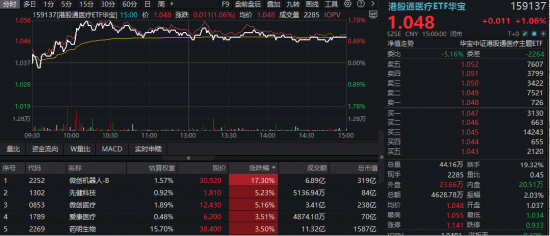
医保新政出台,手术机器人龙头暴涨17%!港股通医疗ETF华宝(159137)摸高1.78%终结四连跌
Xin Lang Ji Jin· 2026-01-21 11:25
Core Viewpoint - The new policy from the National Healthcare Security Administration (NHSA) is expected to significantly boost the medical device industry, particularly benefiting high-end surgical assistance technologies, robotic surgeries, and telemedicine [1][3]. Group 1: Market Reaction - A-share medical ETFs, particularly the largest medical ETF (512170), saw a rise of 1.36% during intraday trading, indicating strong buying interest with over 270 million yuan invested the previous day [1]. - The Hong Kong medical ETF (159137) also experienced a rebound, reaching a peak increase of 1.78% before closing up 1.06%, ending a four-day decline [1]. - Notable stock performances included a 17.3% surge in the leading domestic surgical robot company, MicroPort Scientific Corporation-B, and over 5% increases in MicroPort Medical and Xianjian Technology [1]. Group 2: Policy Impact - The NHSA's new guideline establishes a market mechanism for high-end surgical assistance technologies, which is expected to enhance innovation and profitability in the industry [3]. - The unified pricing framework is anticipated to highlight the cost-performance advantages of domestic surgical robots and related consumables, accelerating the trend of domestic substitution [3]. - The NHSA's commitment to expanding the guideline in the future will create more opportunities for innovative medical device products, benefiting the overall innovation ecosystem in the industry [3]. Group 3: Investment Opportunities - The medical device sector is poised for significant investment opportunities due to the new NHSA policy, with a focus on high-end medical equipment, robotic surgeries, and compliant consumables [3]. - The CXO industry is experiencing improved conditions due to recovering overseas orders and domestic capacity clearance, contributing to sustained growth [3]. - The largest medical ETF (512170) and its associated funds focus on medical devices and services, with over 36% of its index weight in AI medical and brain-computer interface concept stocks [4].


国际金价逼近4900关口
Tebon Securities· 2026-01-21 11:11
Market Analysis - The A-share market exhibited a mixed performance with a slight increase in the Shanghai Composite Index, closing at 4116.94 points, up 0.08%, while the Shenzhen Component Index rose by 0.70% to 14255.13 points [2] - The overall market turnover was 2.62 trillion yuan, a decrease of approximately 6.4% from the previous trading day, indicating a reduction in trading activity but still within a historically high range [2] Sector Performance - The non-ferrous metals sector led the market with a gain of 2.91%, driven by rising international gold prices and geopolitical tensions [5] - The technology sector also performed strongly, with significant increases in GPU, advanced packaging, and circuit board indices, reflecting a robust market sentiment [5] - Conversely, financial and consumer sectors faced downward pressure, with declines in banking, coal, food and beverage, and consumer services stocks [5] Bond Market - The government bond futures market showed a mixed performance, with long-term contracts experiencing significant gains, particularly the 30-year contract which rose by 0.75% [11] - The central bank's net injection of 122.7 billion yuan through reverse repos indicates a continued effort to maintain liquidity in the market [11] Commodity Market - The commodity index increased by 0.40%, with strong performance in new energy metals and precious metals, while real estate-related commodities faced pressure [11] - International gold prices reached a new high, peaking at 4888.43 USD/ounce, reflecting a threefold increase since September 2022 [11] Investment Opportunities - The report highlights several key investment themes, including AI applications, commercial aerospace, nuclear fusion, quantum technology, brain-computer interfaces, and robotics, all supported by government policies and technological advancements [14] - The precious metals sector is expected to benefit from central bank purchases and anticipated interest rate cuts by the Federal Reserve, while the non-ferrous metals sector remains strong due to supply constraints and a weaker dollar [14][17]
17.6亿种子轮!OpenAI 押注脑机接口
思宇MedTech· 2026-01-21 09:00
Core Viewpoint - OpenAI has confirmed its investment in brain-computer interface (BCI) startup Merge Labs, marking its entry into a cutting-edge technology sector with a significant seed funding of $252 million (approximately 1.76 billion RMB) [2][4]. Group 1: Investment Context - The investment was anticipated in mid-2025 and is notable for its size in the BCI field, indicating OpenAI's strategic interest in the evolution of human-AI interaction [2][4]. - OpenAI's involvement is seen as a long-term bet on the development of higher bandwidth human-AI interfaces, addressing the limitations of current interaction methods [5][14]. Group 2: Merge Labs' Approach - Merge Labs, co-founded by OpenAI's CEO Sam Altman and other tech entrepreneurs, is pursuing a distinct technological path in BCI development [6][9]. - The core direction of Merge Labs includes creating a BCI system that integrates biological, device, and AI attributes, aiming for a user-friendly technology that people are willing to adopt [9][10]. Group 3: Comparison with Neuralink - Merge Labs' philosophy contrasts with Neuralink, which focuses on invasive, high-density electrode systems for clinical applications [10][12]. - Merge Labs aims to explore non-invasive or low-invasiveness methods for long-term interfaces, potentially reducing tissue damage and enhancing user acceptance [13][14]. Group 4: Industry Implications - Merge Labs is currently positioned as a research lab rather than a product-focused medical device company, aligning with OpenAI's long-term vision [14]. - The investment signals a shift in how AI companies view the integration of human neural systems into their technological narratives, suggesting a broader exploration of human-AI connections [16]. Group 5: Market Potential - Analysts have estimated the potential market size for brain-computer interfaces to reach $400 billion, highlighting the significance of this technology in future human-AI interactions [15][16].

Neuralink首例受试者脑机接口已能实现OTA升级,医疗设备ETF(159873)近20日实现规模翻倍,今日盘中获申购500万份
2 1 Shi Ji Jing Ji Bao Dao· 2026-01-21 07:11
Group 1 - The three major indices collectively rose, with the medical equipment sector showing active performance, as evidenced by the CSI All Index Medical Care Equipment and Services Index (H30178) increasing by 0.53% [1] - Notable performers within the index included Tianzhihang, which rose over 14%, Shuoshi Bio, which increased over 9%, and Sanyou Medical, which saw a rise of over 6% [1] - The Medical Equipment ETF (159873) recorded a trading volume exceeding 16 million yuan, with a subscription of 5 million units during the trading session [1] Group 2 - The Medical Equipment ETF has experienced a net inflow of funds for nine consecutive trading days, accumulating a total net inflow of 117 million yuan as of January 20 [1] - The ETF's scale has doubled over the past 20 days, reaching a latest circulating scale of 233 million yuan [1] - The ETF closely tracks the CSI All Index Medical Care Equipment and Services Index, which selects listed companies in the medical care theme to reflect the overall performance of these securities [1] Group 3 - The first human subject implanted with Neuralink's brain-machine interface, Nolan Arbo, reported that the module in his brain can be wirelessly upgraded remotely, similar to Tesla's OTA updates [2] - This marks a historic first where a human brain can be updated without surgery, allowing for performance improvements through software updates [2] - Merge Labs, a Silicon Valley startup, has raised $252 million in seed funding from investors including OpenAI, indicating strong interest in advancements in medical technology [2] Group 4 - Guotai Junan Securities noted that the scale of medical equipment bidding continues to grow, supported by ongoing implementation of equipment upgrade policies, which are expected to drive long-term procurement levels [2] - The report recommends medical equipment companies that are likely to benefit from the performance recovery driven by the implementation of these upgrade policies [2]



医疗创新ETF(516820)连续3天净流入,医疗器械板块持续活跃
Xin Lang Cai Jing· 2026-01-21 05:24
Group 1 - The core viewpoint of the articles highlights the positive momentum in the medical and healthcare innovation sector, driven by policy support and technological advancements, particularly in the brain-computer interface market [2][3] - The China Securities Medical and Medical Device Innovation Index (931484) has shown a slight increase of 0.03%, with notable gains from specific stocks such as Teva Bio, which rose by 3.38%, and Ganli Pharmaceutical, which increased by 2.24% [1] - The Medical Innovation ETF (516820) has experienced continuous net inflows over the past three days, totaling 11.24 million yuan, with a peak single-day inflow of 6.0262 million yuan [1] Group 2 - The National Healthcare Security Administration has released a guideline establishing 37 pricing projects for surgical and treatment auxiliary services, which includes advanced technologies such as 3D printing and robotic surgery [1] - The brain-computer interface sector is expected to commercialize rapidly due to a combination of supportive policies and technological breakthroughs, with non-invasive technologies gaining traction for their safety and cost-effectiveness [2] - The top ten weighted stocks in the China Securities Medical and Medical Device Innovation Index account for 63.75% of the index, indicating a concentrated investment in leading companies within the sector [3]
20cm速递|科创板100ETF(588120)涨超1.2%,市场关注科技主线春季行情
Sou Hu Cai Jing· 2026-01-21 04:58
Group 1 - The core viewpoint of the article highlights the positive market sentiment towards the technology sector, particularly driven by new productivity areas such as brain-computer interfaces, AI applications, and commercial aerospace, with the Sci-Tech Innovation Board 100 ETF (588120) rising over 1.2% [1] - The brain-computer interface sector is stimulated by Neuralink's plan for mass production in 2026, while the commercial aerospace sector remains active as a recent market focus [1] - Continuous favorable policies are being released, including the Ministry of Finance's plan to issue ultra-long-term government bonds to support technological innovation, which is expected to guide trillions of yuan into the market [1] Group 2 - The Sci-Tech Innovation Board 100 ETF (588120) tracks the Sci-Tech 100 Index (000698), which includes 100 securities with larger market capitalization and better liquidity from the Sci-Tech Innovation Board, covering high-tech fields such as information technology and healthcare [1] - The index reflects the overall performance of representative technology innovation enterprises in the Sci-Tech Innovation Board, focusing on a growth-oriented investment style [1] - With the domestic monetary policy remaining moderately loose and foreign and long-term funds accelerating their entry into the market, there is an expectation for a spring market rally [1]