硅光技术

Search documents
剑桥科技20251107
2025-11-10 03:34
Summary of Cambridge Technology Conference Call Company Overview - **Company**: Cambridge Technology - **Industry**: Optical Modules Key Points Financial Performance - Cambridge Technology's revenue for the first three quarters of 2025 reached 3.3 billion RMB, falling short of the 750 million Euro threshold set by the OECD's Pillar Two tax regime [2][4][5] - The company expects to maintain a positive outlook for Q4 2025 despite facing delivery pressures, driven by increased customer demand [2][3] Market Demand and Growth - The demand forecast for optical modules, particularly 800G, has been consistently revised upwards, with expectations that demand may exceed 100 million units by 2027 [2][6] - The company is closely collaborating with clients to ensure future delivery plans and material preparations, indicating a robust growth phase in the industry [2][6] Product Development and Technology - Silicon photonics technology is gaining high acceptance in the market, with most of Cambridge Technology's products above 800G utilizing this solution [2][7] - The company has signed supply agreements with five strategic partners to secure CW light source supplies and has addressed key material issues such as silicon photonic engines and DSPs [2][8] Production Capacity and Plans - Cambridge Technology aims to achieve a production capacity of 2.3 million units by the end of 2025, slightly exceeding expectations, and plans to reach 5 million units by the end of 2026, including both 800G and 1.6T production lines [4][15] - The 1.6T product is expected to account for 20% of total production capacity by the end of 2026 [29] Customer Base and Market Expansion - The company is expanding its business not only through existing customers but also by acquiring new clients, indicating a successful market share expansion for its high-speed optical modules [4][9] - Major clients are expected to drive the demand for 1.6T modules, with significant interest from large customers who require high bandwidth solutions [17] Pricing and Profitability - The current price range for 800G modules is approximately $350 to $400, while 1.6T modules are priced above $1,000, with expectations of price reductions in 2026 [19] - The gross margin for the first half of the year reached 32.4%, with projections to maintain above 40% in 2026 as production scales up [26][31] Supply Chain and Material Preparedness - The company has made sufficient preparations for key materials such as lasers and DSP chips, ensuring supply chain stability through annual agreements [25] - The assembly yield is reported to be above the industry average, contributing to the current gross margin levels [33] Strategic Partnerships and Future Outlook - Cambridge Technology is actively pursuing partnerships with new suppliers to meet diverse customer needs and ensure flexibility in responding to market demands [12][14] - The company is also exploring opportunities with major clients like Nokia, which may lead to increased demand for optical modules in 2026 [28] Challenges and Risks - The company acknowledges potential supply chain challenges, particularly concerning the availability of 800G capacity, which may be slightly below the target of 600,000 units for 2025 [21] - The impact of the OECD's Pillar Two tax regime is being monitored, although the company does not expect to be affected in the short term [4][5] Conclusion Cambridge Technology is positioned for growth in the optical module market, driven by increasing demand for high-speed solutions and strategic partnerships. The company is focused on expanding its production capacity and ensuring supply chain stability while navigating potential challenges in the evolving market landscape.
影响市场重大事件:我国成功发射试验三十二号卫星01星、02星、03星;全国首例多源遥感卫星数据资产在晋完成登记
Mei Ri Jing Ji Xin Wen· 2025-11-09 22:58
Group 1 - The core viewpoint of the news is that artificial intelligence (AI) is transitioning from point applications to comprehensive empowerment, becoming a key driver for the intelligent upgrade of the real economy in China [1] - China has become the largest holder of AI patents globally, accounting for 60% of the total [1] - The "China Internet Development Report 2025" highlights that AI is significantly changing the operational methods of the economy and society, with a shift in large models from "heavy training" to "heavy reasoning," resulting in improved reasoning efficiency [1] Group 2 - The successful launch of the experimental satellite No. 32 demonstrates advancements in space technology, with the Long March 11 rocket completing its 606th flight [2] - The launch of the Chu Tian No. 2 technology test satellites by the Li Jian No. 1 rocket marks its 10th flight, indicating progress in commercial space endeavors [2] Group 3 - Guosheng Securities reports that silicon photonics technology is restructuring the optical module industry chain, shifting investment focus from backend packaging to frontend design and wafer manufacturing [3] - The report identifies four key investment directions: silicon photonics design companies, silicon modulation FAB manufacturers, supporting devices, and necessary equipment for silicon photonics [3] Group 4 - The registration of the "Remote Sensing Satellite Multispectral Monitoring Data Set" in Shanxi marks a significant milestone in the resourceization of remote sensing satellite data in China [4] Group 5 - The first batch of pilot projects for national data infrastructure construction has achieved positive results, with 18 cities establishing data infrastructure nodes and over 3,900 entities providing more than 13,000 data products [5] - By the end of September, the total volume of high-quality data sets in China exceeded 500PB, with significant growth in data annotation-related output [5] Group 6 - In October, the Consumer Price Index (CPI) in China rose by 0.2% month-on-month and year-on-year, while the core CPI increased by 1.2%, marking the sixth consecutive month of growth [6] - The Producer Price Index (PPI) showed a month-on-month increase of 0.1%, indicating a shift from stability to growth for the first time this year [6] Group 7 - The PPI in October decreased by 2.1% year-on-year, with the decline narrowing by 0.2 percentage points compared to the previous month, while the average PPI for January to October fell by 2.7% [7] Group 8 - From January 1, the purchase tax for new energy vehicles in China will shift from full exemption to a 50% reduction, coinciding with a peak in consumer demand due to the upcoming policy change and the traditional sales season [8] Group 9 - Beijing is establishing a national data element comprehensive pilot zone, aiming to enhance data management and market-oriented reforms [9] Group 10 - China's laser equipment market accounts for over 50% of the global market, with significant exports to Europe and Southeast Asia [10] - The domestic high-power laser device localization rate has surpassed 70%, indicating a strong position in the global laser equipment market [10]
央行,重磅来袭!
证券时报· 2025-11-09 10:56
Macro Economic Data - The People's Bank of China will release financial data for October, including M2, new loans, and social financing [1][17] - The National Bureau of Statistics will announce October's industrial value added, fixed asset investment, and retail sales data on November 14 [3][18] - In October, the Consumer Price Index (CPI) rose by 0.2% month-on-month and year-on-year, while the core CPI (excluding food and energy) increased by 1.2% year-on-year, marking the sixth consecutive month of growth [4] - The Producer Price Index (PPI) saw a month-on-month increase of 0.1%, the first rise this year, while the year-on-year decline narrowed to 2.1% [4] Foreign Exchange and Reserves - As of the end of October, China's foreign exchange reserves reached $3.3433 trillion, an increase of $4.7 billion from September, marking the highest level since December 2015 [5] - The official gold reserves increased by 30,000 ounces to 7.409 million ounces, the lowest growth rate since the resumption of purchases in November 2024 [5] Policy Announcements - The Ministry of Commerce announced the suspension of certain export controls on dual-use items to the United States until November 27, 2026 [6] - The State Council issued an implementation opinion to accelerate the cultivation and application of new scenarios, focusing on five key areas and proposing 22 priority fields [10] Investment Strategies - CITIC Securities noted increased market volatility since October, emphasizing the importance of stable overseas environments and AI developments in investment strategies [21] - Guosen Securities highlighted the rise of silicon photonics technology, shifting investment focus from packaging to chip design and wafer manufacturing [21] - Guojin Securities pointed out that the lithium battery industry chain is experiencing unprecedented growth opportunities driven by technological breakthroughs and market demand [22]


国盛证券:硅光技术重构光模块产业链 关注前端晶片设计与晶元制造投资方向
智通财经网· 2025-11-09 06:32
Core Insights - The rise of silicon photonics technology is fundamentally restructuring the underlying logic and value chain of the entire industry, shifting the investment focus from backend "packaging" to frontend "chip design and wafer manufacturing" [1][2] - The investment paradigm based on silicon photonics will change, focusing on four key areas: silicon photonic chip design companies, silicon modulation chip FAB manufacturers, supporting chips/devices, and semiconductor equipment required for silicon photonics [1] Industry Transformation - Silicon photonics redefines the core competitiveness of optical communication by shifting from a packaging-dominated model to a fabless model, where the performance, cost, and yield of optical modules are highly dependent on the chip design and wafer manufacturing stages [2][6] - The technology offers advantages such as low power consumption, low latency, high bandwidth, and high integration, with predictions indicating that its market share in optical modules will increase from 30% in 2025 to 60% by 2030 [2] Market Dynamics - The shortage of EML chips, which rely on complex manufacturing processes and III-V compound semiconductor materials, creates a development window for silicon photonics as it serves as a mainstream alternative [3] - The overall health of the optical module industry remains strong, with leading companies like Coherent and Lumentum reporting better-than-expected financial results, indicating robust demand for optical components driven by AI data centers [4][6] Competitive Advantages - Silicon photonics establishes advantages in cost, performance, and production capacity, with the ability to leverage global CMOS wafer fabrication infrastructure for mass production and standardized packaging [5] - The strategic advantage of silicon photonics lies in its production capacity flexibility, allowing for dynamic adjustment based on market demand, enhancing the resilience of the entire supply chain [5] Investment Recommendations - The company continues to favor the computing sector, recommending investments in leading optical module firms such as Zhongji Xuchuang and Xinyi Sheng, as well as other related companies in the optical device space [6][7] - Suggested companies span various segments, including optical communication, computing equipment, and liquid cooling solutions, indicating a broad investment interest in the computing and optical sectors [7][8]

中际旭创(300308):营收环比加速增长,毛利率持续提升
Changjiang Securities· 2025-11-05 09:45
Investment Rating - The investment rating for the company is "Buy" and is maintained [7]. Core Insights - The company reported accelerated revenue growth in Q3 2025, with a revenue of 10.22 billion yuan, representing a year-on-year increase of 56.8% and a quarter-on-quarter increase of 25.9%. The net profit attributable to shareholders reached 3.14 billion yuan, up 125.0% year-on-year and 30.0% quarter-on-quarter [4][10]. - High-margin products are increasing in proportion, and the company is benefiting from improved manufacturing yields and cost reduction measures, leading to a record high gross margin of 42.8% in Q3 2025 [10]. - The company is actively expanding production capacity and securing core resources to ensure the delivery of large-scale orders in the future, with inventory reaching 11.22 billion yuan, a 52.6% increase from the beginning of the year [10]. Summary by Sections Revenue and Profitability - In the first three quarters of 2025, the company achieved a total revenue of 25 billion yuan, a year-on-year increase of 44.4%, and a net profit of 7.13 billion yuan, up 90.1% year-on-year. The Q3 revenue alone was 10.22 billion yuan, with a net profit of 3.14 billion yuan [4][10]. Product Performance - The company has seen continuous growth in the shipment of 800G products since Q1 2025, and 1.6T products are expected to begin large-scale shipments next year due to increasing orders from key customers [10]. Cost Management and Efficiency - The company has successfully reduced costs, with sales, management, and financial expense ratios decreasing to 0.6%, 2.1%, and 0.8% respectively, compared to the previous year [10]. Future Outlook - The company forecasts net profits of 10.4 billion yuan, 17.02 billion yuan, and 21.81 billion yuan for 2025, 2026, and 2027 respectively, with corresponding year-on-year growth rates of 101%, 64%, and 28% [10].

美股科技巨头市场震荡,6G发展大会将举办丨新鲜早科技
2 1 Shi Ji Jing Ji Bao Dao· 2025-11-05 03:29
Group 1: Market Trends - The US stock market experienced a downturn, with major tech stocks like Tesla and Nvidia declining significantly, primarily due to concerns over the return on investment in artificial intelligence [2] - Hong Kong's IPO market has seen substantial activity, leading the world in fundraising with over $26 billion raised in the first ten months of the year [15] Group 2: Company Developments - Apple has tightened its distribution channels in China, prohibiting offline dealers from selling products online to maintain pricing integrity [3] - Spotify reported a 12% year-on-year increase in subscription users, reaching 281 million, with total revenue also growing by 12% to €4.3 billion [9] - Nintendo raised its fiscal year operating profit forecast by 16% to ¥370 billion (approximately $2.45 billion) and increased its Switch 2 sales forecast from 15 million to 19 million units [10] - Uber's total bookings grew by 21% year-on-year to $49.7 billion, although its operating profit fell short of expectations [11] - Onsemi reported third-quarter revenue of $1.55 billion, driven by strong demand for AI-related data center chips [12] Group 3: Industry Insights - The Chinese robotics industry saw a 29.5% year-on-year revenue growth in the first three quarters, with industrial robot production reaching 595,000 units [5] - The first silicon photonics pilot line in Northwest China has commenced operations, supporting advanced fields like AI computing and quantum communication [8] - The AI glasses market is rapidly expanding, with a projected shipment of 4.065 million units in the first half of 2025, marking a 64.2% year-on-year increase [20]
总投资7.5亿元,陕西8英寸硅光平台正式通线
Di Yi Cai Jing Zi Xun· 2025-11-05 01:31
Core Insights - The "8-inch Silicon Photonic Platform" has officially commenced operations, providing R&D and pilot services for photonic industry innovators [1][3] - The platform, with a total investment of 750 million yuan, incorporates advanced technology from Belgium's IMEC and features over 60 key equipment sets [1][3] - The platform aims to address common challenges faced by domestic silicon photonic projects, such as high production costs and long lead times [3][4] Investment and Development - The platform is designed to facilitate small-batch pilot production and full-process verification, enhancing the success rate of industrialization [3] - The establishment of this platform is part of a broader strategy to create a dual-platform structure, combining "6-inch compound photonic chips + 8-inch silicon photonic chips" [3][4] - The company is currently seeking new financing to support process development [4] Industry Landscape - Shaanxi Province has developed three core industrial clusters in the photonic sector, with a total output value exceeding 35 billion yuan and housing 379 companies [4] - The company is building a triad platform architecture of "compound semiconductors + silicon photonics + heterogeneous integration" to support key areas such as optical communication and artificial intelligence [5]
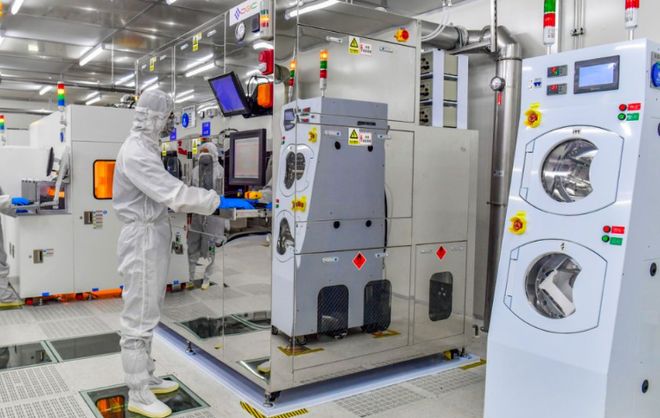
破局“芯”困境 西北地区首条硅光中试线正式通线
Zheng Quan Shi Bao Wang· 2025-11-04 11:38
Core Insights - The "Chasing Light Plan" in Shaanxi has achieved significant progress, with the establishment of the "8-inch Silicon Photonic Integration Technology Innovation Platform," marking a key milestone in the region's photonics industry development [1][2]. Industry Growth - Since the launch of the "Chasing Light Plan" in 2021, the number of companies in the photonics industry in Shaanxi has increased to over 370, with the industry scale growing from 15 billion to 36.5 billion yuan [2]. - The upgraded "Chasing Light Plan - Leap Action" aims to create a complete industrial chain from "materials - chips - devices - systems" [2]. Technological Advancements - The 8-inch Silicon Photonic Platform is the first of its kind in Northwest China, addressing the gap in silicon photonic chip pilot testing [1][4]. - The platform has a total investment of 750 million yuan and has completed all construction by September 2025, featuring advanced technology and equipment [4]. Support for Startups - The photonics institute has resolved R&D and pilot testing challenges for over 100 startups, facilitating the development of a high-quality industrial cluster [3][4]. Collaborative Ecosystem - The "1+N" flexible engineering platform model allows for resource sharing and collaboration among small and medium-sized enterprises, enhancing innovation and reducing initial investment costs [6][7]. - The 6-inch compound platform has already provided services to over 50 clients, while the newly established 8-inch silicon photonic platform has attracted interest from numerous leading companies [7]. Future Developments - The institute plans to advance the construction of a heterogeneous integration platform, covering the entire chain from material growth to system testing, supporting key areas such as optical communication and artificial intelligence [7].
破局“芯”困境,西北地区首条硅光中试线正式通线
半导体芯闻· 2025-11-04 09:48
Core Insights - The article discusses the progress of Shaanxi's "Chasing Light Plan," highlighting the launch of the "8-inch Silicon Photonic Integration Technology Innovation Platform," which aims to bolster the region's photonics industry and support the development of a trillion-level photonics industry cluster [2][6][12]. Group 1: Progress of the "Chasing Light Plan" - Since its initiation in 2021, the "Chasing Light Plan" has led to significant growth in the photonics industry in Shaanxi, with the number of enterprises increasing to over 370 and the industry scale rising from 15 billion to 36.5 billion [6][7]. - The upgraded "Chasing Light Plan - Leap Action" outlines a development path with a layout of "one core, two wings + one park, three areas," positioning Xi'an High-tech Zone as the core area for photonics development [6][12]. Group 2: Establishment of the 8-inch Silicon Photonic Platform - The 8-inch Silicon Photonic Platform, with a total investment of 7.5 billion, officially commenced operations in September 2025, addressing the gap in silicon photonic chip pilot testing in the northwest region [12][14]. - The platform has introduced over 60 key core devices and is based on the 130nm silicon photonic chip process package from Belgium's IMEC, with plans to develop advanced processes above 90nm [12][14]. Group 3: Industry Challenges and Solutions - The silicon photonic technology is crucial for AI computing, smart driving, and quantum communication, but its development has been hampered by the concentration of pilot testing resources in Europe and the U.S., leading to high costs and long lead times for domestic companies [11][12]. - The establishment of the 8-inch Silicon Photonic Platform is seen as a "hardcore solution" to these challenges, enabling local companies to reduce R&D costs and shorten the time to market for new products [12][14]. Group 4: Ecosystem Development and Collaboration - The platform operates under a "1+N" flexible engineering model, where 80% of resources are allocated to support small and medium-sized enterprises, while 20% are reserved for cutting-edge innovation [14][17]. - The 6-inch compound platform has already released over 20 process design kits (PDKs) and served more than 50 clients, while the 8-inch platform has established cooperation agreements with over ten leading companies [17].

“失速”与“领跑”:“达链”公司的股价“见顶”了吗?
经济观察报· 2025-11-04 08:38
Core Viewpoint - The performance of "Dachain" companies shows a mixed picture, with some experiencing significant year-on-year profit growth while facing sequential declines, raising questions about whether this is a temporary adjustment or a sign of peak industry conditions driven by AI demand [2][3][4]. Group 1: Financial Performance - In Q3, several "Dachain" companies reported impressive year-on-year profit growth: Shenghong Technology (300476.SZ) up 260.52%, Xinyi Technology (300502.SZ) up 205.38%, Zhongji Xuchuang (300308.SZ) up 124.98%, and Industrial Fulian (601138.SH) up 62.04% [3]. - Despite strong year-on-year growth, the market reacted negatively, with significant stock price declines for many companies, including a combined market value loss of over 140 billion yuan for leading firms in the optical module segment [3][4]. - Sequentially, Shenghong Technology's net profit fell by 9.88%, Xinyi's revenue decreased by 4.97%, and Tianfu Communication's revenue dropped by 3.18% [4][6]. Group 2: Industry Dynamics - The PCB segment, crucial for AI servers, is showing signs of pressure, with Shenghong Technology citing product upgrades and increased labor costs as reasons for its sequential decline [6][7]. - New Yisheng experienced its first sequential revenue drop after nine consecutive quarters of growth, attributed to changes in product shipment schedules [7]. - The liquid cooling segment, led by Yingweike, also faced sequential declines, with revenue down 11.44% in Q3 [8]. Group 3: Market Trends and Future Outlook - Zhongji Xuchuang and Industrial Fulian emerged as leaders, with Zhongji's net profit up 124.98% and Industrial Fulian's net profit surpassing 10 billion yuan for the first time [8][9]. - The demand for 800G optical modules is expected to continue growing, with significant orders anticipated for next-generation 1.6T products [9][10]. - The industry is witnessing a shift towards "Scale-up" scenarios, where high bandwidth connections between GPUs are becoming critical for AI model training [10]. Group 4: Inventory and Financial Pressure - Companies are facing financial pressure due to increased inventory levels, with Industrial Fulian's inventory rising to 164.66 billion yuan, leading to higher short-term borrowings [12][13]. - New Yisheng reported a significant increase in asset impairment losses due to rising inventory write-downs, indicating potential financial risks [13]. Group 5: Shareholder Behavior - There has been a notable increase in shareholding among retail investors, while major shareholders and executives have begun to reduce their stakes, indicating a potential shift in market sentiment [14]. - The number of shareholders for New Yisheng surged by 58.46% to 155,300, reflecting growing retail interest in the sector [14]. Group 6: Market Projections - TrendForce analysts predict a 20% increase in global AI server shipments in 2026, with a significant rise in the value of AI servers driven by higher-priced integrated solutions [15]. - The growth rate of ASIC chip shipments is expected to surpass that of GPUs, potentially impacting Nvidia's market share [15].