
美国国债

Search documents
How rising national debt can affect your finances
Yahoo Finance· 2025-07-11 19:12
Core Insights - The U.S. government's gross national debt has reached a record $38 trillion, marking the fastest accumulation of $1 trillion in debt outside the COVID-19 pandemic [1] - The national debt has nearly tripled in the last 20 years, with a significant increase attributed to the COVID-19 pandemic and ongoing entitlement programs [3][6] - The debt-to-GDP ratio has grown to 123%, indicating a concerning trend in relation to economic stability [3] Government Spending and Debt Composition - Interest payments on the national debt have increased from 8% of overall expenditures in FY 2019 to 13% in FY 2024, with net interest projected at $881.7 billion in 2024 [4] - The national debt is driven by the difference between federal revenue and budgeted spending, compounded by previous deficits [5] Economic Implications - The rising national debt is likened to a boa constrictor, squeezing the economy through slower growth, less job creation, and higher borrowing costs [3] - Projections indicate that the national debt could exceed $52 trillion by 2035, with significant negative impacts on the economy, including a potential reduction of $340 billion in economic size and a loss of 1.2 million jobs [10] Individual Financial Impact - Rising national debt is expected to lead to depressed wages and job losses, with estimates suggesting a decrease of up to 3% in wages by 2055 [13] - Higher taxes may be necessary to address the national debt, but political resistance makes this unlikely in the current climate [14] Interest Rates and Inflation - Increased national debt is likely to result in higher interest rates, affecting consumer borrowing for homes and businesses [15] - A permanent increase in the federal deficit could lead to inflation, reducing household purchasing power significantly [16] Future Outlook - A recent survey indicated that 80% of respondents view addressing the national debt as an urgent priority, especially following a credit rating downgrade [16] - Concerns about a potential default on U.S. debt could signal an international debt crisis, with unprecedented consequences for the global economy [17][18]
美国国债五连跌 30年期收益率5月以来首次逼近5%
news flash· 2025-07-08 15:39
Core Viewpoint - The U.S. Treasury bonds have declined for the fifth consecutive day, leading to a decrease in demand for long-term bonds as multiple bond auctions are scheduled this week [1] Group 1: Market Performance - U.S. Treasury bonds fell across the board on Tuesday, resulting in an increase in yields by 2 to 4 basis points [1] - The 30-year yield approached 5% for the first time since May, indicating a significant rise in long-term borrowing costs [1] Group 2: Economic Indicators - The rise in yields follows a robust non-farm payroll report, which revealed unexpected strength in the U.S. labor market [1] - Investors have adjusted their expectations regarding Federal Reserve interest rate cuts, reducing bets on potential rate decreases [1] Group 3: Future Expectations - Interest rate swaps indicate that traders anticipate two rate cuts of 25 basis points each by the end of the year, with the first cut expected in September [1]
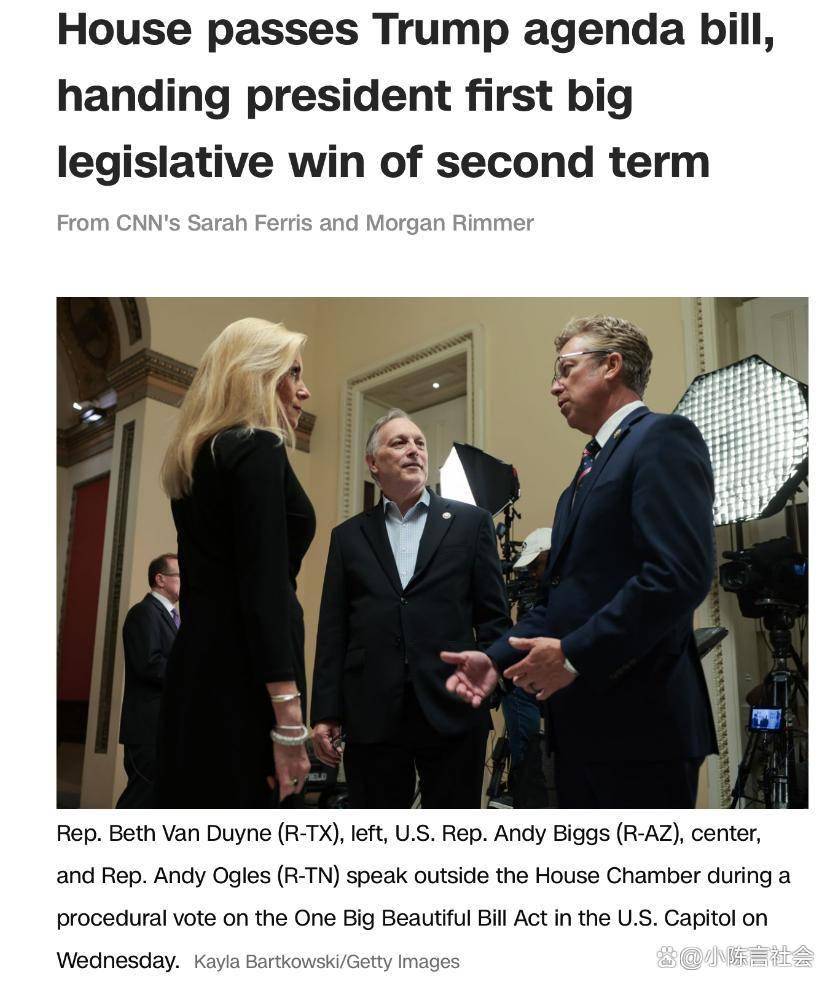
大漂亮法案正式通过,最终的票数为218:214票
Sou Hu Cai Jing· 2025-07-04 13:17
Core Points - The recent passage of the "Big Beautiful Act" in the U.S. Congress reflects a significant shift towards austerity measures that disproportionately affect lower-income individuals and workers [4][10] - The act extends tax benefits for the wealthy while cutting food assistance and medical subsidies for the poor, indicating a regression to a more conservative societal structure reminiscent of the Cold War era [6][10][11] - The U.S. is facing a growing national debt, nearing $35 trillion, with interest payments exceeding $1 trillion annually, prompting the need for spending cuts [9] Summary by Sections Legislative Changes - The "Big Beautiful Act" passed with a narrow vote of 218 to 214, with no Democratic votes in favor and only two Republicans opposing [4] - Key provisions include the extension of tax benefits for the wealthy and cuts to food assistance and medical subsidies for the poor [4][10] Economic Context - Over the past decade, average wage growth in the U.S. was around 3% annually before the pandemic, but real purchasing power has stagnated despite nominal increases of over 5% in recent years [6] - The wealth of the top 10% of Americans increased by over 15% in the past year, driven by stock market and real estate gains, while lower-income households have seen their savings diminish [7] Social Implications - The cuts to welfare programs, including a 4% reduction in food assistance and over 1% in children's health insurance subsidies, suggest a return to a society where the working poor must work harder for less support [10][11] - The current economic environment is characterized by a strong dollar and high interest rates, which may lead to further cuts in education and housing subsidies if fiscal pressures continue [13] Consumer Sentiment - Despite rising stock markets, consumer confidence remains low, with many Americans expecting negative economic conditions in the near future [15] - The passage of the "Big Beautiful Act" indicates a prioritization of corporate interests and fiscal strength over the welfare of ordinary workers, raising concerns about the long-term societal impact [15][17]

7月3日电,强劲的6月份就业数据公布后,美国国债下跌。
news flash· 2025-07-03 12:36
Core Insights - Strong employment data for June has led to a decline in U.S. Treasury bonds [1] Group 1 - The release of robust employment figures for June has influenced market dynamics, particularly resulting in a drop in U.S. government bonds [1]
美国财长警告 关税可能会回升至4月2日水平
news flash· 2025-07-03 11:53
Core Viewpoint - The U.S. Treasury Secretary warns that tariffs may rise back to levels seen on April 2 if trade negotiations do not progress [1] Group 1: Trade Negotiations - The Treasury Secretary cautions U.S. trading partners against prolonging trade talks, emphasizing the need for progress [1] - A meeting with EU negotiators is scheduled, but specific outcomes remain uncertain [1] Group 2: U.S. Debt and Market Confidence - The Treasury Secretary expresses confidence in strong domestic and international demand for U.S. Treasury bonds [1] - The debt management process is described as orderly, indicating a stable approach to handling U.S. debt [1] Group 3: Interest Rates and Federal Reserve - Comments suggest that the two-year Treasury yield indicates that overnight rates are too high, with expectations for inflation to decline [1] - Criticism is directed at the Federal Reserve, suggesting that its judgment appears somewhat off [1] - The Treasury Secretary advocates for the Federal Reserve to control spending and adjust budget sizes appropriately [1]
每日投行/机构观点梳理(2025-07-03)
Jin Shi Shu Ju· 2025-07-03 11:37
Group 1: US Economic Outlook - Morgan Stanley indicates that the upcoming non-farm payroll report may reignite concerns about US economic growth, with expectations of a 110,000 increase in employment for June, down from 139,000 in May, and an anticipated rise in the unemployment rate from 4.2% to 4.3% [1] - UBS notes that the 20% tariffs imposed by the US on Vietnamese goods are at the lower end of expectations, and the details of the trade agreement will be crucial for assessing its economic impact on Vietnam [2] - DBS Bank suggests that while the US-Vietnam trade agreement reduces risks for Vietnam's economic growth, it may not prevent a slowdown in the coming quarters due to a lack of details in the agreement [2] Group 2: Currency and Inflation - ING predicts that the dollar may experience a temporary rebound as tariffs drive inflation, potentially delaying interest rate cuts by the Federal Reserve [3] - The report anticipates that the euro to dollar exchange rate may briefly fall to the 1.13-1.15 range, and the yen to dollar rate may drop to 145-150, indicating a decline of about 4% for both currencies [3] Group 3: US Debt and Interest Rates - Capital Economics forecasts challenges for US Treasury bonds for the remainder of the year, despite recent strong performance, as the Fed's cautious stance on rate cuts may hinder further gains [4] - The report highlights that Fed Chair Powell's comments suggest a reluctance to cut rates until there is clear evidence of economic stability [4] Group 4: European Economic Policy - ANZ Bank expects the European Central Bank to be close to the bottom of its interest rate cycle, predicting a 25 basis point cut in September [5] - The ECB has reduced rates by 200 basis points over the past year, and the current neutral policy rate range is estimated to be between 1.50% and 2.50% [5] Group 5: Chinese Market Insights - Guotai Junan Securities believes that the Chinese stock market has upward potential due to domestic innovation and a decrease in risk-free rates, with a shift in the RMB's depreciation expectations to stability or slight appreciation [6] - CITIC Securities reports a significant divergence in the monetary policy stance among the 12 voting members of the Federal Reserve, which may influence future policy decisions [7] Group 6: Nuclear Power and Technology - CITIC Securities anticipates a new wave of nuclear power construction globally, driven by the need for stable clean energy and the recovery of the nuclear industry [8] - The report emphasizes the importance of nuclear power in energy transition and carbon neutrality efforts, with China leading in newly approved nuclear units [8] Group 7: Investment Opportunities in Technology - CITIC Securities recommends focusing on AI-related investment opportunities, particularly in AI agents and computing power sectors, as the computer industry is expected to see steady growth [9] - The report highlights the potential for structural opportunities in various technology sectors, including cross-border payments and industrial software [9]

大摩:关税奇点!告诉你为什么要继续做多美国国债,做空美元
Zhi Tong Cai Jing· 2025-07-01 09:30
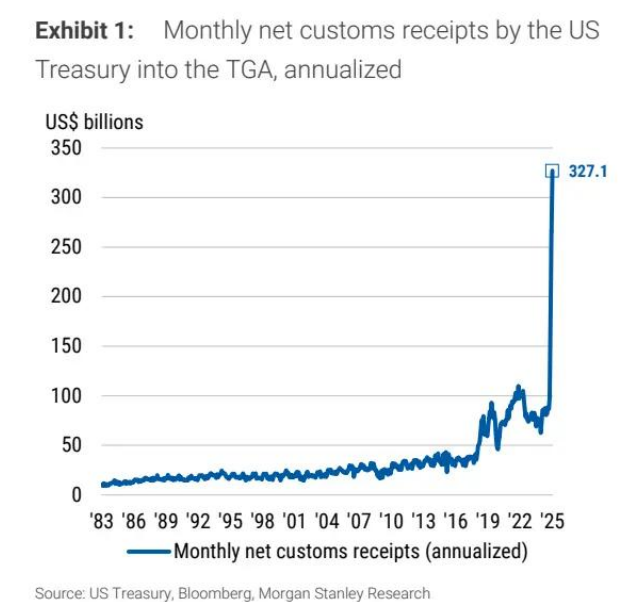
Group 1 - The core argument of the report is that tariffs are not a zero-sum game and have significant implications for U.S. Treasury securities and the U.S. dollar, with a focus on the broader economic impact rather than just the immediate costs to producers and consumers [1][2] - Tariffs paid by U.S. importers are projected to amount to $327 billion annually, which represents 1% of the nominal GDP for 2025 [2][6] - If companies fully absorb the tariff costs, profit margins could drop from 13.8% to 11.7% in Q1 2025, significantly below the 15-year moving average of 12.2% [2][12] Group 2 - The report highlights that if 75% of the tariffs are passed on to consumers, profit margins could exceed the 15-year moving average by 1.1 percentage points [12][13] - The analysis indicates that the current economic environment is leaning towards downside risks, with a noted decline in air passenger traffic compared to previous years [17] - The report suggests that despite some foreign investors increasing their holdings in U.S. stocks, there is a notable trend of U.S. domestic investors reducing their exposure, indicating a potential reallocation of assets [34][36]
X @外汇交易员
外汇交易员· 2025-07-01 01:38
贝莱德在第三季度固定收益展望报告中表示,“我们已经关注美国政府债务问题的危险处境有一段时间了。如果这种情况继续得不到控制,我们认为债务将成为美国在金融市场中所享有的‘特殊地位’面临的最大风险。”公共债务增加可能会降低美国长期国债收益率走势与美国货币政策之间的关联性,尽管美联储降息,收益率仍将上升。美国国债供应增加,可能会面临美联储以及外国央行需求下降的局面。这表明应当将投资多元化,减少对美国公债市场的依赖,同时增加对短期美债的配置,因为短期美债在降息时可能会受益。“尽管政府提议削减开支,但赤字仍在攀升,而且现在更多的支出都用于支付利息。”“随着外国投资者退出,政府每周发行超过5000亿美元的债务,民间市场无法吸收这些债务,从而推高政府借贷成本的风险是切实存在的。” ...
贝森特:预计签署一系列新贸易协议 当前增发长债无意义 稳定币立法或7月中出台
Hua Er Jie Jian Wen· 2025-06-30 20:55
周一,美国财长贝森特表示,他预计将在美国设定的7月9日截止日期前,签署一系列新贸易协议;考虑 到当前的收益率水平,美国政府扩大长期国债发行规模并不合理。对于鲍威尔的继任者,贝森特提到了 两种可能:任命一位新成员,或从现有的美联储理事中挑选。他还表示,稳定币立法可能在7月中旬前 出台。 扩大长期国债发行规模不合理 美国财长贝森特表示,考虑到当前的收益率水平,美国政府扩大长期国债发行规模并不合理,尽管他仍 希望随着通胀放缓,各期限的利率将会下降。他周一接受媒体采访时,被问及是否应增加长期美债在美 国财政部债务发行中的占比时表示: 我们为什么要这么做?真正该这么做的时间是在2021年、2022年。 在当前利率水平下我们为什么要这么做?我们的利率已经高于长期水平超过一个标准差。 贝森特去年曾多次批评前美国财政部长耶伦在债务发行中过于依赖短期国债,称其目的是为了在大选前 维持较低的长期借贷成本、刺激经济。但自他上任以来,仍延续了耶伦的债务发行策略。 新贸易协议将至 贝森特周一表示,他预计将在美国设定的7月9日截止日期前,签署一系列新贸易协议。"进入最后一 周,随着压力增加,将会有一波公告。财政部、贸易代表办公室、商务部 ...
美元稳定币瞄准全球数字金融新霸权
Di Yi Cai Jing· 2025-06-30 12:14
Core Viewpoint - The passage discusses the passage of the "GENIUS Act" by the U.S. Senate, which aims to regulate stablecoins and reflects a broader financial strategy to maintain the dominance of the U.S. dollar in the global economy [1][5]. Group 1: Stablecoin Overview - Stablecoins are digital currencies pegged to specific assets, primarily fiat currencies like the U.S. dollar, providing stability in value [2][3]. - Unlike traditional cryptocurrencies, stablecoins adjust their supply based on market demand and are not fully decentralized, as their issuance and reserve processes are managed by private entities [3][4]. - The majority of stablecoins are dollar-pegged, with over 95% of them based on the U.S. dollar, as the "GENIUS Act" does not recognize gold, silver, or digital assets as collateral [4]. Group 2: U.S. Dollar Dominance - The U.S. dollar's global dominance is under threat, prompting the U.S. to explore digital currencies as a means to sustain its hegemony [5][6]. - The U.S. currently holds a significant share of the global stablecoin market, with 95% of domestic stablecoins and 83% of global fiat stablecoins being dollar-based [6]. - The "GENIUS Act" mandates that stablecoins must be backed by a 1:1 ratio of U.S. dollar cash reserves, which is expected to further increase the volume of dollar stablecoins [6]. Group 3: U.S. Debt and Stablecoins - The U.S. national debt has reached $36.22 trillion, with concerns about the sustainability of this debt level [7]. - Stablecoins are becoming major buyers of U.S. Treasury bonds, with USDT and USDC holding approximately $170 billion in U.S. debt, surpassing several countries [8]. - Predictions suggest that by 2028, the issuance of stablecoins could reach $2 trillion, creating an additional $1.6 trillion demand for U.S. Treasury bonds, which could help absorb new debt issued during Trump's term [8][9]. Group 4: Global Demand for Stablecoins - There is a growing demand for dollar stablecoins in regions with volatile local currencies, as they provide easier access to U.S. dollars [9]. - The "GENIUS Act" stipulates that stablecoin reserves must primarily consist of short-term U.S. Treasury bonds, ensuring safety and liquidity [9].