
美国就业市场

Search documents
降息大反转!美联储重磅发声!12月降息概率上升
Sou Hu Cai Jing· 2025-11-26 04:55
Core Viewpoint - Multiple Federal Reserve officials advocate for significant interest rate cuts to support the U.S. economy, arguing that current monetary policy is hindering economic growth and that there is no inflation issue to address [1][2]. Group 1: Federal Reserve Officials' Statements - Federal Reserve Governor Milan links the deterioration of the U.S. job market to the current tight monetary policy, emphasizing the need for substantial rate cuts to prevent rising unemployment [2]. - Milan believes that the Federal Reserve should quickly lower rates to neutral levels, stating that recent economic data supports a dovish stance [2][3]. - San Francisco Fed President Daly also supports a rate cut in December, citing a greater risk of job market deterioration compared to inflation rising [2][3]. Group 2: Economic Data and Market Reactions - The U.S. September core PPI increased by 2.6% year-on-year, slightly below expectations, while retail sales rose by 0.2% month-on-month, also below forecasts [1]. - Market expectations for a December rate cut have increased, with an 84.7% probability of a 25 basis point cut according to CME FedWatch [1][5]. - Major U.S. stock indices experienced a V-shaped rebound, with the Dow Jones up 1.43% and the S&P 500 up 0.91% [1]. Group 3: Future Projections and Economic Outlook - Goldman Sachs predicts that the Federal Reserve will implement a rate cut in December and anticipates two additional cuts of 25 basis points each in 2026 [6]. - Analysts suggest that the potential for a "preventive rate cut" exists due to delayed economic data releases from the government shutdown, indicating a cautious approach to future monetary policy [6]. - Concerns about rising inflation in the coming year are noted, leading to a cautious stance on U.S. Treasury investments [6].
【百利好非农报告】非农终于出炉 市场反应谨慎
Sou Hu Cai Jing· 2025-11-25 06:58
Core Insights - The U.S. non-farm payroll data for September showed an unexpected increase of 119,000 jobs, significantly surpassing the market expectation of 50,000 jobs, marking the best performance since June of this year [3] - Despite the positive job growth, the unemployment rate rose from 4.3% in August to 4.4%, the highest level since 2021 [3] - The Federal Reserve's interest rate decisions may be influenced by this data, but the importance of the report could be overstated due to prior expectations set by Fed officials [4] Employment Data Summary - Non-farm employment increased by 119,000 in September, exceeding expectations [3] - The unemployment rate increased to 4.4%, up from 4.3% in August [3] - Revisions to previous months showed a decrease of 33,000 jobs combined for July and August [3] Wage Growth Summary - Average hourly wages increased by 3.8% year-over-year, slightly above the expected 3.7% [3] - Month-over-month wage growth was 0.2%, below expectations and a decrease from the previous month's 0.3% [3] Market Reaction Summary - Following the release of the employment data, U.S. stock index futures rose, and U.S. Treasury yields fell, indicating market optimism regarding the Fed's potential interest rate decisions [4] - The probability of a 25 basis point rate cut in December is approximately 42% according to FedWatch [4] Future Implications Summary - The cancellation of the October employment report, which will be merged into the November report, means the September data will be the last complete employment report before the December Fed meeting [4] - The lack of new data before the meeting suggests that a rate cut in December is unlikely [4] Technical Analysis Summary - Technical indicators suggest a potential downward trend for gold prices, with a possibility of breaking below the $3,886 level [4]


就业比通胀更危险!旧金山联储主席称12月降息必要性正在上升
智通财经网· 2025-11-24 22:33
Group 1 - The necessity for a rate cut in December is increasing due to signs of a slowing U.S. labor market, as stated by San Francisco Fed President Daly [1] - Daly expressed concerns that the labor market could deteriorate quickly, making it harder for the Fed to respond in a timely manner [1] - There is a division within the Fed regarding policy direction, with some officials focusing on inflation pressures while others support a rate cut [1] Group 2 - Market expectations for a December rate cut have surged to approximately 76%, up from 42% a week prior, influenced by dovish signals from multiple officials [2] - The U.S. Treasury yields have declined, enhancing the appeal of non-yielding assets like gold, which saw a price increase of over 1.6% [2] - Key economic indicators are set to be released this week, which may influence market recalibration of rate cut expectations [2]
美国9月就业数据:经济与政策不确定性未能出清
Orient Securities· 2025-11-24 01:32
Employment Data Summary - In September 2025, the U.S. added 119,000 non-farm jobs, significantly exceeding the expectation of 50,000[6] - The unemployment rate rose to 4.4%, up from 4.3% in August 2025[6] - Average hourly earnings increased by 0.25% month-on-month, down from 0.41% in the previous month[6] Sector Contributions - The service sector contributed the most to job growth, adding 87,000 jobs, with education and healthcare accounting for 59,000 jobs and leisure and hospitality for 47,000 jobs[8] - Professional and business services saw a decline of 20,000 jobs, marking a continuous decrease over five months[6][8] - Construction and retail sectors also contributed positively, with 19,000 and 14,000 jobs added respectively[8] Labor Market Trends - The three-month moving average for job additions is approximately 62,000, indicating a downward trend[6][9] - The labor force participation rate slightly increased to 62.4%[6] - The number of unemployed individuals rose to 7.6 million, reflecting a significant increase in discouraged workers[6][15] Economic Outlook - The Federal Reserve is expected to continue lowering interest rates if the job market weakens further, with a target endpoint rate of 3% under baseline conditions[6] - The upcoming December data release is critical for assessing the employment trend and potential policy adjustments[6]
【宏观】迟来的非农,犹豫的降息——2025年9月美国非农数据点评(赵格格/周欣平)
光大证券研究· 2025-11-22 00:07
Core Viewpoint - The U.S. non-farm employment data for September 2025 exceeded expectations, indicating a robust job market. The non-farm employment increased by 119,000, surpassing the forecast of 50,000. The service sector added 87,000 jobs, while the goods-producing sector rebounded with an increase of 10,000 jobs after a previous decline [5][6]. Employment Data Summary - The September non-farm employment figures showed a significant increase, with the service sector contributing 87,000 jobs and the goods-producing sector recovering to add 10,000 jobs. This is a notable improvement from previous figures [5][6]. - The construction industry saw an increase of 19,000 jobs, attributed to a decline in mortgage rates following the Federal Reserve's decision to restart rate cuts [6]. Labor Market Dynamics - The labor force participation rate rose to 62.4%, up from 62.3%, indicating a recovery in employment willingness among the youth. However, the unemployment rate increased to 4.4% due to a rise in the number of unemployed individuals by 219,000 [8]. - The data revealed a mixed picture of unemployment, with temporary unemployment decreasing by 53,000, while permanent unemployment increased by 98,000, suggesting ongoing layoffs in certain sectors [8]. Federal Reserve Implications - Given the stronger-than-expected non-farm data and the postponement of employment data for October and November, the Federal Reserve may adopt a cautious approach regarding interest rate cuts, potentially delaying any rate reductions until after the December meeting [5][8]. - Market expectations for a rate cut in December 2025 stand at 39.1%, with further cuts anticipated in January, April, and July 2026, with probabilities of 50.2%, 35.7%, and 31.9% respectively [8].

和讯投顾魏玉根:美国9月非农就业数据解读
Sou Hu Cai Jing· 2025-11-21 01:43
Group 1 - The September non-farm payroll data showed an increase of 119,000 jobs, significantly exceeding the market expectation of around 50,000, indicating resilience in the U.S. job market [1] - The unemployment rate rose to 4.4% in September from 4.3% in August, contrary to market expectations of it remaining at 4.3%, which supports the case for potential interest rate cuts [1][2] - The capital markets reacted with an initial jump in U.S. Treasury prices following the data release, suggesting a possible signal for a rate cut in December, although there remains market uncertainty [1] Group 2 - The U.S. dollar index experienced a brief increase post-data release but quickly fell, indicating a growing market expectation for a weaker dollar and potential interest rate cuts [2] - In the metals market, copper and aluminum prices saw slight increases, while gold and silver prices remained stable, reflecting mixed market sentiments regarding interest rate changes [2] - The final decision on interest rates will depend on a comprehensive assessment of various factors, including unemployment rates, job growth, and wage trends, with Fed Chair Powell's decision being pivotal [2]
U.S. employers added 119,000 jobs in September, delayed report says
Fastcompany· 2025-11-20 19:51
Core Insights - U.S. employers added 119,000 jobs in September, indicating a stronger-than-expected labor market performance [1] Economic Impact - The job addition figure of 119,000 is significant, especially considering the report was delayed for seven weeks due to the federal government shutdown [1]

【环球财经】美国9月非农今晚即将出炉 美联储降息博弈或加剧
Sou Hu Cai Jing· 2025-11-20 10:58
Core Viewpoint - The U.S. labor market is showing signs of weakness, with significant implications for the Federal Reserve's monetary policy decisions, particularly regarding potential interest rate cuts in December [2][6][7]. Employment Data Summary - The U.S. Bureau of Labor Statistics will release the September non-farm employment data on November 20, 48 days late, and will not publish the October report, pushing the November data release to December 16 [2]. - Analysts predict a modest increase of 51,000 jobs in September, a recovery from August's 22,000, but with a wide range of estimates from a decrease of 20,000 to an increase of 105,000 [3]. - The unemployment rate is expected to remain at 4.3%, with average hourly earnings projected to grow by 0.3% month-over-month and 3.7% year-over-year [3]. - The labor market is experiencing a cooling trend, with the average monthly job additions from May to August at only 27,000, down from 96,000 in the first four months of the year [3][4]. Market Reactions and Predictions - The uncertainty surrounding the employment data has led to a divergence among Federal Reserve officials regarding the likelihood of a rate cut in December, with current market expectations for a cut at 29.6% [6]. - If the September employment data exceeds expectations, it may reinforce a hawkish stance from the Fed, while a significant miss could increase the likelihood of a rate cut [6][8]. - Analysts note that the lack of timely economic data due to the government shutdown complicates the Fed's decision-making process, leading to increased internal disagreements [7]. Economic Outlook - The ongoing weakness in the labor market is prompting companies to adjust their workforce in response to economic uncertainties, as evidenced by rising layoff figures in September and October [5]. - The potential for a recession is heightened if employment data continues to show weakness, particularly if the unemployment rate rises [8].

ATFX策略师:美国9月大非农来袭,美元指数突破100关口,多头有望延续
Sou Hu Cai Jing· 2025-11-20 08:58
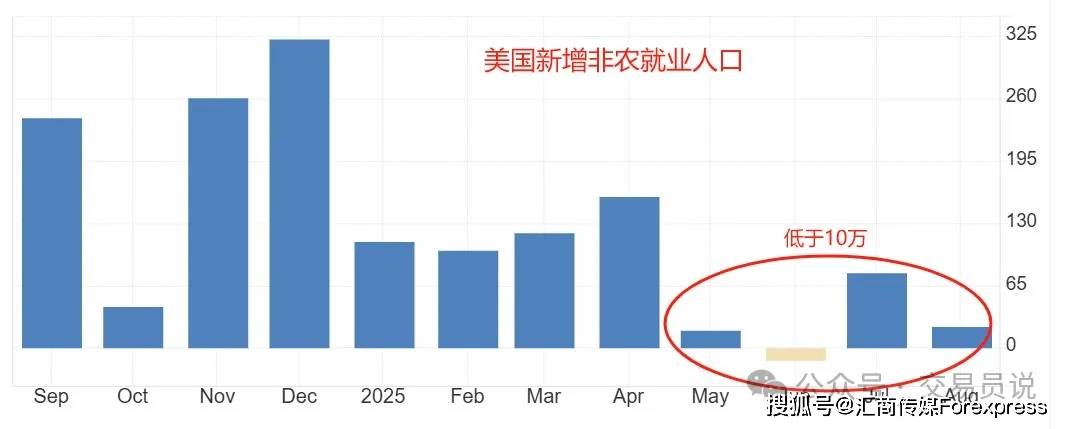
Core Viewpoint - The U.S. Labor Department will release the delayed September non-farm payroll report today at 21:30, which was originally scheduled for October 3 but postponed due to the government shutdown. There is speculation that the October report may never be published due to a lack of data collection [1]. Group 1: Employment Data - The key focus of the September non-farm payroll report is the change in non-farm employment, with a previous value of 22,000 and an expected value of 50,000, indicating a significant anticipated increase, although the absolute figure remains low [3]. - Since May, the U.S. job market has been deteriorating, with non-farm payroll additions falling below 100,000 for four consecutive months, and a negative value recorded in June. This decline is attributed to strict immigration policies and reduced hiring in the AI sector [3]. - The ADP report for September showed a decline of 32,000 jobs, falling short of both the previous value of 54,000 and the expected value of 50,000, suggesting that the non-farm payroll data may also underperform [4]. Group 2: Economic Implications - The poor employment situation has led the Federal Reserve to announce interest rate cuts in September and October, with expectations for further cuts in December if conditions do not improve [3]. - The latest weekly data indicates a loss of 2,500 jobs per week in the U.S. job market, reinforcing the bleak outlook for October and highlighting ongoing recession risks in the macroeconomic environment [4]. Group 3: Market Reactions - The dollar index has seen a significant rise, reaching above the 100 mark, driven by expectations surrounding the non-farm payroll data. If the data aligns with expectations, bullish momentum for the dollar index may continue [6].
ADP四周均值显示裁员攀升 美国就业疲态加深
智通财经网· 2025-11-11 15:40
Group 1 - The average weekly layoffs in the U.S. reached 11,250, indicating a slowdown in the labor market momentum in the second half of October compared to earlier in the month [1] - The ADP report showed that the U.S. private sector added 42,000 jobs in October, marking the first increase after two months of decline, but the overall growth rate remains weak [1] - October's total announced layoffs by U.S. employers reached the highest level for the same month in over 20 years, raising concerns about the employment outlook [1] Group 2 - Due to the ongoing longest government shutdown in U.S. history, the official non-farm payroll reports for September and October have not been released, leading the market to rely on private data from ADP [2] - Goldman Sachs economists predict that if employees participating in the "government delayed resignation plan" are included, the overall non-farm employment in October may decrease by about 50,000, indicating further risks of labor market deterioration [2]
