自动驾驶

Search documents
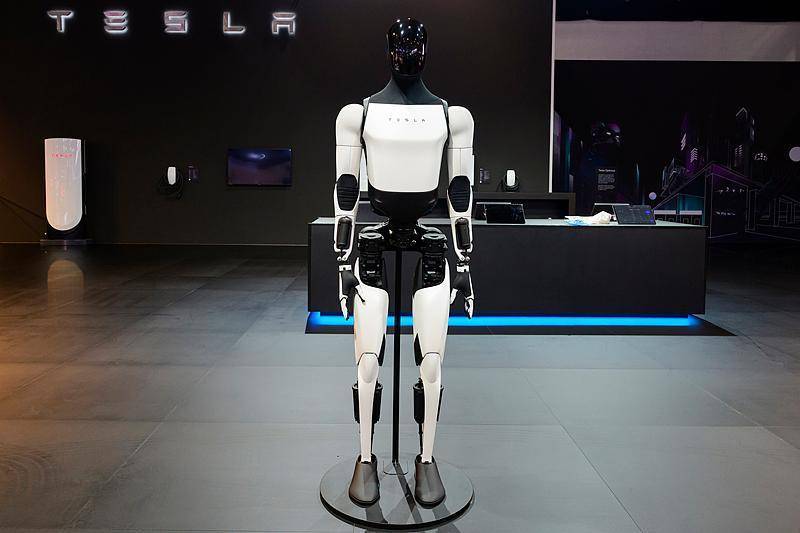
马斯克突袭达沃斯放预告:人形机器人或于明年年底前开卖。全球首富埃隆·马斯克在达沃斯论坛上突然宣布,特斯拉的人形机器人“擎天柱”(Optimus)可能在2026年底前向公众开售。他表示,目前这些机器人已在特斯拉工厂执行简单任务,预计明年将能胜任更复杂的工作。马斯克强调,特斯拉只会在确保产品“...
Sou Hu Cai Jing· 2026-01-24 17:13
Core Viewpoint - Elon Musk announced at the Davos Forum that Tesla's humanoid robot "Optimus" may be available for public sale by the end of 2026, marking a significant development in Tesla's focus on robotics and automation [1] Group 1: Product Development - The humanoid robots are currently performing simple tasks at Tesla factories and are expected to handle more complex jobs by next year [1] - Musk emphasized that Tesla will only release the product after ensuring "extremely high reliability, safety, and broad functionality" [1] Group 2: Strategic Importance - The announcement highlights Tesla's increasing emphasis on the robotics business, especially as growth in the electric vehicle sector slows down [1] - Humanoid robots and autonomous driving are seen as key future directions for Tesla [1] Group 3: Market Implications - If Optimus is successfully launched, it could revolutionize the manufacturing industry and reshape human-machine interaction [1] - Musk acknowledged that the initial production pace will be "exceptionally slow," indicating potential challenges in technology implementation [1]


希迪智驾(03881):深耕无人矿卡的智能驾驶平台型企业
Soochow Securities· 2026-01-24 15:10
Investment Rating - The report assigns a "Buy" rating for the company, marking its first coverage [1]. Core Insights - The company is a global leader in intelligent driving hard technology products, focusing on autonomous mining trucks and V2X technology, aiming to enhance safety and efficiency in closed environments [8][13]. - The company is expected to benefit from national policies promoting automation in mining, with a projected increase in revenue driven by the growth of autonomous mining truck orders [8][49]. - The report forecasts significant revenue growth, with total revenue expected to reach RMB 1.08 billion in 2025, RMB 2 billion in 2026, and RMB 4.05 billion in 2027, reflecting year-on-year growth rates of 162.90%, 85.53%, and 102.47% respectively [1][8]. Summary by Sections 1. Company Overview - The company was founded in 2017 by Professor Li Zexiang and is recognized as a leading provider of intelligent driving hard technology products [8][13]. - It specializes in autonomous mining trucks and logistics vehicles, as well as V2X technology and intelligent perception solutions [17]. 2. Autonomous Mining Truck Solutions - The company has developed a comprehensive solution for autonomous mining, integrating intelligent driving and V2X technologies, which is applicable to various scenarios [8][37]. - Following a significant mining accident in Inner Mongolia, national policies have accelerated the push for automation in mining, with a target of 60% intelligent capacity in coal mines by 2026 [8][44]. 3. V2X Intelligent Transportation Solutions - The company is a leading provider of V2X intelligent transportation solutions, which enhance traffic safety and efficiency through advanced perception technology and communication functions [77][81]. - The V2X market in China is expected to grow rapidly, with a projected market size of RMB 238 billion by 2030, reflecting a compound annual growth rate of 50.9% from 2024 to 2030 [85]. 4. Financial Projections - The report anticipates that the company will achieve a turnaround in net profit by 2025, with projected net profits of RMB -268.79 million in 2025, RMB 102.72 million in 2026, and RMB 627.06 million in 2027 [1][8]. - The company's revenue growth is primarily driven by the increasing volume of autonomous mining truck orders and accelerated delivery [8][49].
Robotaxi驶入“千辆时代”,广东智驾提速规模商业化
2 1 Shi Ji Jing Ji Bao Dao· 2026-01-24 13:17
Core Insights - The autonomous driving industry in China has reached a significant milestone with the Robotaxi fleets of WeRide and Pony.ai surpassing 1,000 vehicles, marking the entry into the "thousand-vehicle era" [1][4][8] Industry Overview - Guangdong province has emerged as a key player in the autonomous driving sector, with 3.618 million new energy vehicles produced in 2022, accounting for 25% of the national total [2] - The province aims to produce 1.1829 million new energy vehicles by 2025, laying a solid foundation for the development of the intelligent driving industry [2] Company Developments - WeRide's Robotaxi has commenced commercial operations in over 10 major cities globally, including Guangzhou, Beijing, and Abu Dhabi, with a focus on fully autonomous operations [2][6] - WeRide reported a revenue of 171 million yuan in Q3 2025, a year-on-year increase of 144.3%, with a gross profit of 56.3 million yuan, reflecting a gross margin of 32.9% [4][5] - The company has achieved a significant reduction in net losses, narrowing by 70.5% year-on-year, indicating a transition towards scale expansion and profitability improvement [4] Technological Advancements - WeRide launched the HPC 3.0 high-performance computing platform, which provides 2,000 TOPS of AI computing power, reducing the cost of its autonomous driving suite by 50% [5] - The WeRide One platform enables efficient mass deployment of autonomous driving across various urban scenarios, enhancing operational capabilities [5][6] Market Expansion - WeRide has accelerated its international expansion, partnering with Uber to establish the largest commercial Robotaxi fleet in Abu Dhabi, with plans to expand to 15 additional international cities over the next five years [6][8] - The company is positioned to benefit from favorable policies, including the recent approval for L4 autonomous vehicles to operate commercially in several cities [7][8] Competitive Landscape - Guangdong's robust industrial foundation, including a well-developed supply chain for chips and electronic components, supports the growth of the autonomous driving sector [7] - The province's supportive government policies and funding initiatives have created a conducive environment for the development of autonomous driving technologies [7][8]
AI赛车开创世界纪录背后的“弯道”与“换道”
Xin Lang Cai Jing· 2026-01-24 05:10
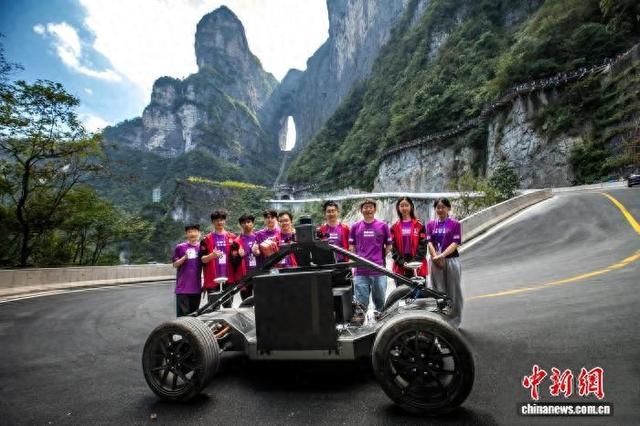
Core Insights - The AI racing team from Tsinghua University set a world record by completing the 10.77 km Tianmen Mountain course in 16 minutes and 10.838 seconds, showcasing advancements in AI-driven autonomous racing technology [1][3]. Group 1: Technical Challenges and Innovations - The Tianmen Mountain course presents a "composite extreme" testing environment due to satellite signal interruptions, steep slopes, and numerous sharp turns, requiring AI to make precise decisions in milliseconds [3]. - The team developed a dynamic local map loading algorithm to address issues with traditional full-load 3D point cloud maps, enabling real-time high-precision positioning [3][4]. - Data collection methods were enhanced through vehicle-cloud collaboration and a combination of virtual and real-world data, integrating factors like corner entry angles and road conditions into the AI model [3]. Group 2: Learning and Development Pathways - Since 2018, the Tsinghua research team has focused on a new end-to-end autonomous driving approach centered on reinforcement learning, significantly reducing training costs compared to traditional methods reliant on vast amounts of real vehicle data [4]. - The team introduced China's first fully neural network-based end-to-end autonomous driving system, marking a significant technological breakthrough in the industry [4]. Group 3: Real-World Application and Future Directions - The success at Tianmen Mountain serves as a critical test for autonomous technology, emphasizing the need for AI algorithms to be validated in real and extreme scenarios to ensure their effectiveness and robustness [5]. - The developed perception-positioning fusion technology allows vehicles to achieve high real-time and high-precision trajectory estimation, enhancing stability in critical situations [5]. - Despite rapid advancements in autonomous driving technology, there remains a notable gap between AI capabilities and human performance in extreme road conditions, indicating ample opportunities for future research and innovation [5].
特斯拉Robotaxi启动全无人运营,但被网友吐槽是“障眼法”
3 6 Ke· 2026-01-24 04:14
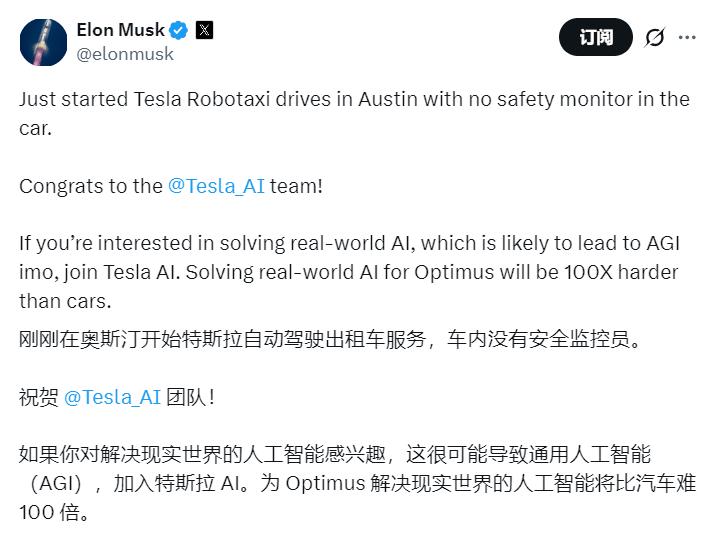
Core Insights - Tesla has announced the launch of its Robotaxi service without a safety driver, marking a significant milestone in autonomous driving technology [2][3][5] - The announcement led to a 4.15% increase in Tesla's stock price, adding approximately $59.6 billion to its market capitalization [9] - The current deployment of fully autonomous Robotaxis is limited to Austin, Texas, with a mix of vehicles still operating with safety drivers in other locations [5][8] Group 1: Robotaxi Launch and Operations - Tesla's Robotaxi service began in Austin, Texas, and has rapidly progressed from initial limited access to full public operation within eight months [3][9] - The company is the first to offer a fully autonomous service using only cameras, without the use of lidar or radar [5] - Currently, only a small number of Robotaxis in Austin are operating without safety drivers, while the majority remain supervised in the Bay Area [5][8] Group 2: Cost and Market Position - Tesla's Robotaxi fleet has reached a total of 200 vehicles across the U.S., with 158 in the Bay Area and 42 in Austin [27] - The upcoming Cybercab is expected to have significantly lower production and operational costs, with estimates suggesting a cost below $30,000 and an operational cost of approximately $0.20 per mile [29][31] - Comparatively, traditional ride-hailing services like Uber and Lyft charge between $1 to $4 per mile, indicating a potential competitive advantage for Tesla's Robotaxi [31] Group 3: User Experience and Feedback - Early users of the Robotaxi service have reported low fares, with one user paying $2.71 for a 1.36-mile ride, highlighting the affordability of the service [35] - There are mixed reactions regarding the true nature of the "fully autonomous" experience, with some users questioning whether safety measures are still in place through external monitoring vehicles [26][12] Group 4: Industry Context - On the same day as Tesla's announcement, Waymo, a major competitor, launched its Robotaxi service in Miami, expanding its operational footprint to six major U.S. cities [36] - The rapid advancements in autonomous vehicle technology by both Tesla and its competitors indicate a highly competitive landscape in the autonomous driving sector [36]
轻舟已过万重山!轻舟智航驶入量产达100万台,轻舟智航于骞:自动驾驶要干20年
Huan Qiu Wang Zi Xun· 2026-01-24 04:11
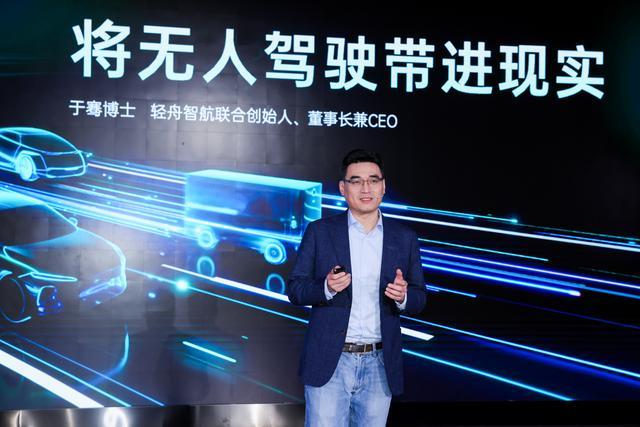
Core Insights - The era of transitioning from assisted driving to autonomous driving has begun, with 2026 marking the start of a new golden decade for autonomous driving and the "super intelligent" era [1][3] - QCraft, co-founded by Dr. Yu Qian, has successfully crossed the production milestone of 1 million units for its assisted driving systems, indicating a new phase of large-scale implementation [3][5] Group 1: Company Developments - QCraft has achieved a significant milestone with over 1 million units of its assisted driving system deployed, marking a new starting point for the company [5] - The company has established partnerships with nearly 10 automotive manufacturers, aiding in the mass production of 23 vehicle models, with expectations to exceed 50 new models in 2026, all featuring urban NOA capabilities [7] - QCraft's user base has accumulated over 2.5 billion kilometers of assisted driving mileage, with nearly 100 million uses of smart parking assistance [7] Group 2: Technological Innovations - QCraft has introduced the industry's first "safety explainable" end-to-end large model, addressing safety concerns associated with the "black box" nature of end-to-end systems [11] - The company has developed a unified architecture called "VLA+ World Model," which enhances the ability of assisted driving systems to handle complex real-world scenarios [13] - QCraft's technology allows for the use of a single journey 6M chip to achieve urban NOA, demonstrating a commitment to providing affordable and effective intelligent driving solutions [8] Group 3: Future Plans - QCraft has outlined a product evolution roadmap from advanced assisted driving to large-scale operations of autonomous driving from 2025 to 2027 [14] - The company aims to enter the L4 unmanned logistics market, collaborating with automotive manufacturers to create a new paradigm of "production equals operation" [16] - QCraft is accelerating its international expansion, establishing offices in cities like Beijing, Suzhou, and Munich, and targeting markets in Europe, East Asia, the Middle East, and Singapore [19]
百万台NOA上车后,轻舟智航想做智驾领域的DeepSeek
Xin Lang Cai Jing· 2026-01-24 03:08
Core Viewpoint - The announcement by CEO Yu Qian of Qingzhou Zhihang regarding the target of over 1 million vehicles equipped with the NOA (Navigation on Autopilot) system by January 2026 marks a significant milestone in the autonomous driving industry, indicating a competitive edge in data accumulation and technology enhancement [1][2]. Group 1: Company Overview - Qingzhou Zhihang, founded in 2019, initially focused on L4 autonomous driving but shifted to mass production vehicle business in 2022, aiming for L2+ advanced driver assistance systems [2][3]. - The company collaborates with major automotive manufacturers like Li Auto and GAC Group, enhancing its visibility and technological capabilities [3][4]. Group 2: Market Position and Strategy - The target of 1 million NOA-equipped vehicles is relatively small compared to China's annual car production of around 30 million, suggesting significant growth potential [2]. - Qingzhou Zhihang's strategy includes addressing the overlooked fuel vehicle market, which still holds a substantial share, and aims to leverage partnerships for engineering adjustments and algorithmic improvements [6][7]. Group 3: Technological Development - The company has developed a mass production plan for urban NOA based on the Horizon Journey 6M chip, aiming to enhance user experience with limited computational power [3][4]. - The integration of L2 and L4 business lines allows for shared technological advancements, with data from L2 assisting in L4 development [4][5]. Group 4: Future Outlook - Qingzhou Zhihang has outlined a three-year product roadmap, targeting a price drop for urban NOA vehicles to 100,000 yuan by 2026 and aiming for 3 million NOA units by 2027 [7]. - The company is also focusing on international expansion, having established a European headquarters and partnerships to support both Chinese manufacturers abroad and global companies entering the Chinese market [6][7].

英伟达的汽车生意经
自动驾驶之心· 2026-01-24 02:55
Core Viewpoint - NVIDIA is transitioning from a hardware supplier to a comprehensive provider of autonomous driving solutions, focusing on a full-stack approach that includes cloud training, simulation, and in-vehicle inference capabilities [4][7]. Group 1: Three Pillars of Full-Stack Solutions - NVIDIA's automotive strategy is built on three main components: DGX for AI model training, OVX for simulation, and AGX for in-vehicle inference [8][20]. - DGX serves as an AI model training factory, utilizing a supercomputing cluster of thousands of GPUs to process vast amounts of driving data [11][12]. - OVX creates a virtual world that mirrors real-world conditions, allowing for extensive testing of autonomous driving algorithms without the risks and costs associated with real-world testing [13][14][16]. - AGX represents NVIDIA's well-known in-vehicle computing chips, which have evolved to provide significantly higher processing power, becoming standard in various flagship models [18][20]. Group 2: Business Model Evolution - NVIDIA's revenue model has shifted from solely selling hardware to offering engineering services, which include deep involvement in automakers' production projects [21][23]. - The company charges a one-time engineering service fee, akin to a "coaching fee," to assist automakers in optimizing their algorithms on NVIDIA's platform [24][25]. - This service model fosters a win-win situation, enhancing automakers' capabilities while providing NVIDIA with valuable feedback for continuous product improvement [25]. Group 3: Open Source Strategy - In early 2025, NVIDIA announced the open-sourcing of its Alpamayo series, which includes a large-scale reasoning model and a comprehensive simulation framework [28][29][30]. - This strategic move aims to lower industry barriers, expand the ecosystem, and establish NVIDIA as a leader in defining the next generation of autonomous driving technology [34][35]. - The open-source approach also serves to mitigate geopolitical risks by transforming core technologies into global public assets [34]. Group 4: Demand from the Chinese Market - NVIDIA's accelerated pace in the automotive sector is largely driven by demand from the Chinese market, which is ahead of overseas automakers by two to three years in smart vehicle development [38][40]. - The rapid iteration and high expectations for functionality from Chinese automakers have prompted NVIDIA to develop specialized tools like TensorRT-LLM for Auto in record time [38][40]. Group 5: Competitive Landscape - NVIDIA maintains confidence against competitors by emphasizing that the ultimate competition in smart driving lies in systemic engineering capabilities and a continuously evolving ecosystem [41][42]. - The company has built a comprehensive stack that includes chips, safety certifications, operating systems, middleware, and development tools, creating a high barrier to entry for competitors [42][44].

特斯拉下月或将在欧洲获得自动驾驶许可
Cai Jing Wang· 2026-01-24 02:40
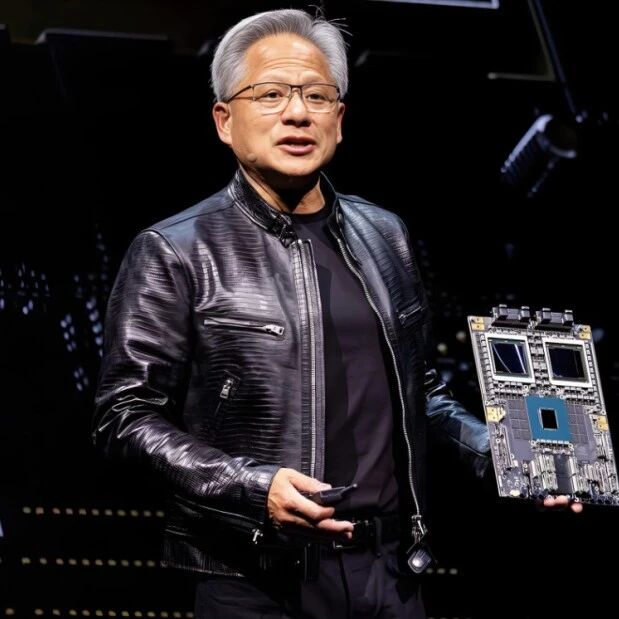
Core Insights - Tesla CEO Elon Musk announced that the subscription price for Full Self-Driving (FSD) will increase as features improve [1] - Musk indicated that Tesla may receive autonomous driving permits in Europe next month [1] - By the end of this year, robotaxi services are expected to be widely available in the United States [1] Group 1 - The increase in FSD subscription pricing is linked to enhancements in functionality [1] - The anticipated approval for autonomous driving in Europe marks a significant regulatory milestone for Tesla [1] - The rollout of robotaxi services in the U.S. represents a major step in Tesla's autonomous vehicle strategy [1]
300万ADR建仓背后!木头姐为何死磕文远知行?
Jin Tou Wang· 2026-01-24 01:43
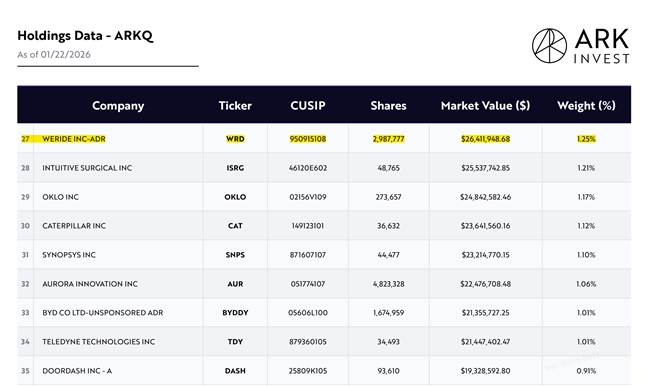
Group 1 - ARK Invest has been increasing its stake in autonomous driving technology company WeRide since December 2025, holding nearly 3 million ADRs valued at approximately $30 million as of January 22, 2026, making WeRide one of the top five investments in its Autonomous Technology & Robotics ETF [1] - The latest report from ARK Invest, "Big Idea 2026," predicts that autonomous ride-hailing services (Robotaxi) will gradually increase their market share in the ride-hailing sector and may dominate urban public transportation [3] - WeRide, founded in 2017, aims to transform human mobility through autonomous driving and has obtained autonomous driving licenses in eight countries, operating in over 40 cities across 11 countries [4] Group 2 - WeRide has developed a fleet of over 1,000 autonomous taxis, with 1,023 vehicles currently deployed, achieving commercial operations in cities like Guangzhou, Beijing, and Abu Dhabi, where the fleet is nearing a critical point of single-vehicle breakeven [6] - The successful partnerships with major OEMs like Chery and GAC for ADAS solutions and the planned mass production delivery by the end of 2025 provide a solid foundation for business expansion [6] - The scale deployment of WeRide's fleet and the upcoming breakeven point in Abu Dhabi validate the feasibility of its business model, aligning with ARK's optimistic outlook on the Robotaxi sector [8]