货币政策

Search documents
澳元在CPI通胀数据公布后保持低迷
Sou Hu Cai Jing· 2026-01-28 02:11
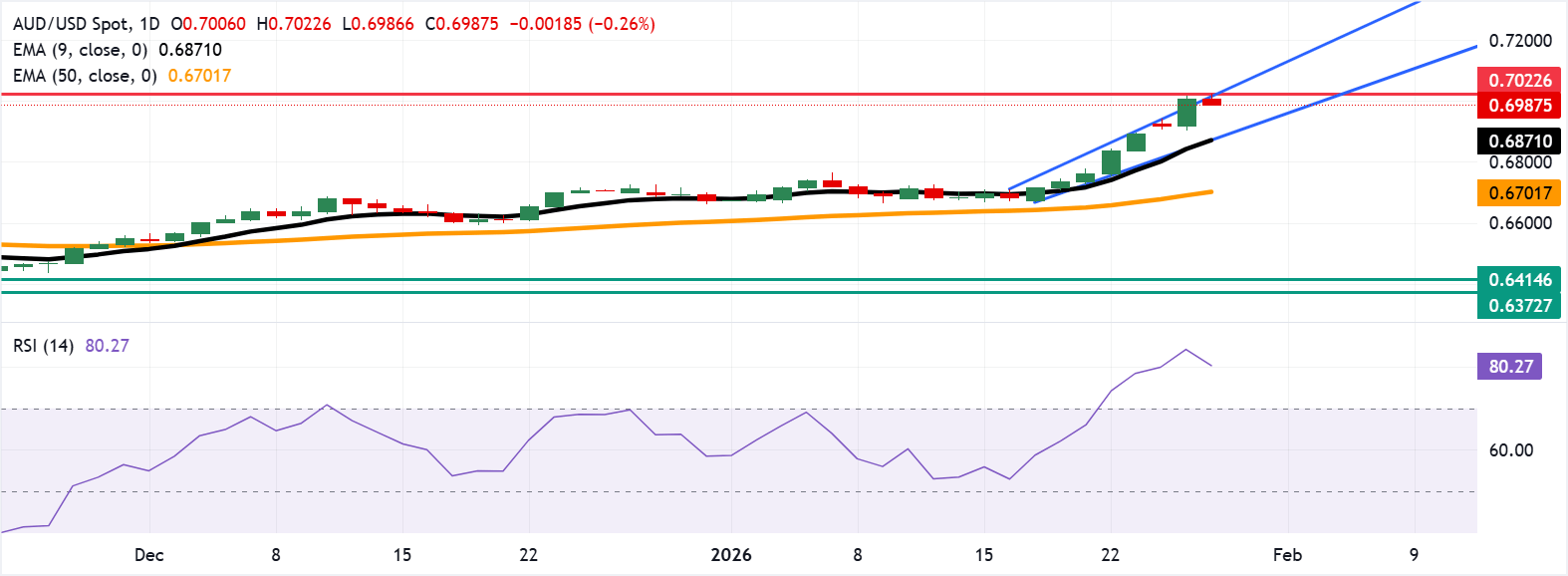
Group 1 - The Australian dollar (AUD) remains subdued following the release of December CPI data, with the inflation rate rising to 3.6% year-on-year, aligning with market expectations [2] - The Reserve Bank of Australia (RBA) is likely to tighten monetary policy due to inflation rates exceeding the target of 2-3%, supported by recent PMI and employment data [2] - The AUD/USD currency pair showed a slight decline after a previous increase of over 1%, trading around 0.6990, indicating a bullish bias within an ascending channel [3] Group 2 - The US Dollar Index (DXY) experienced a drop of over 1% in the previous trading session, reflecting a prevailing "sell the US" sentiment, with DXY nearing its lowest level since February 2022 [4] - Market expectations suggest that the Federal Reserve will maintain interest rates between 3.50%-3.75% after a series of rate cuts, with attention on the subsequent press conference for future policy guidance [4] - Australia's employment change in December rebounded significantly to 65.2K, surpassing the revised figure of 28.7K in November, while the unemployment rate fell from 4.3% to 4.1%, below market consensus [4]

开盘大涨!再创新高
Zhong Guo Ji Jin Bao· 2026-01-28 01:46
Group 1 - The South Korean Composite Stock Price Index opened higher at 5171.85 points, up 1.71% following a significant rise the previous day [1] - LG Energy Solution surged over 7%, while major companies like Hyundai Motor, Samsung Electronics, and SK Hynix also saw gains [2] - SK Hynix met two-thirds of Nvidia's HBM4 demand, and Samsung and SK Hynix doubled the prices of low-power DRAM supplied to Apple in Q1, with increases of over 80% and approximately 100% respectively [2] Group 2 - The Nikkei 225 index fell below 53,000 points, declining by 0.74%, raising concerns about corporate profitability due to the yen's rebound [3] - Major automotive and pharmaceutical companies, including Toyota, Mazda, and Sumitomo Pharma, experienced declines of over 3% [3] - The Bank of Japan's meeting minutes indicated a consensus among members to consider further interest rate hikes if the economic outlook aligns with expectations, while maintaining a loose monetary policy environment [3]
开盘大涨!再创新高
中国基金报· 2026-01-28 01:44
Market Overview - The South Korean Composite Stock Price Index opened higher, reporting 5171.85 points, an increase of 1.71% from the previous close of 5084.85 points [2][3] - The trading volume reached 68.79 million shares, with a market capitalization of 961.35 trillion won for Samsung Electronics and 593.32 trillion won for SK Hynix [3][4] Key Stock Performances - LG Energy Solutions surged over 7.47%, while Hyundai Motor and Samsung Electronics also saw gains of 2.56% and 1.82% respectively [4] - SK Hynix met two-thirds of NVIDIA's HBM4 demand, indicating strong performance in the semiconductor sector [4] Pricing Trends - Samsung and SK Hynix have doubled the prices of low-power DRAM supplied to Apple compared to the previous quarter, with increases exceeding 80% and approximately 100% respectively [4] - This price hike reflects a shift in Apple's procurement strategy due to supply constraints, potentially impacting future negotiations [4] Trade Relations and Economic Impact - Former President Trump threatened to impose tariffs on South Korean imports due to unmet agreements, which could weaken the competitiveness of South Korean exporters in the U.S. market [5][6] - The potential tariffs may particularly affect the automotive sector, raising concerns about the ability of South Korean chip manufacturers to receive favorable treatment under U.S. semiconductor tariff frameworks [6] Japanese Market Update - The Nikkei 225 index fell below 53,000 points, declining by 0.74%, with significant drops in automotive and pharmaceutical stocks, including Toyota and Mazda, both down over 3% [7][8] - The Bank of Japan's meeting minutes indicated a consensus among members to continue a loose monetary policy, even if interest rates are raised in the future [8]

有色金属日报-20260128
Wu Kuang Qi Huo· 2026-01-28 01:16
1. Report Industry Investment Rating No information regarding the industry investment rating is provided in the report. 2. Core Viewpoints of the Report - Copper: With the approaching Fed interest - rate meeting, market volatility has increased. Although sentiment is supported by policies and strategic resource demand, the short - term copper price may be range - bound due to tight copper ore supply, seasonally weak refined copper demand, and increasing global visible inventories [3][4]. - Aluminum: Despite the accumulation of domestic aluminum ingot and aluminum rod inventories, the high price suppressing downstream demand is not a major negative factor in the off - season. With relatively low LME aluminum inventories and high US aluminum spot premiums, and loose domestic and overseas policies, the aluminum price is expected to be strong and range - bound [5][6]. - Lead: Although the visible lead ore inventory is rising, high by - product profits suppress the decline of lead concentrate TC. The current industrial situation is weak, but the expected reduction in lead ingot surplus is due to the tightening of recycled smelting raw materials in winter [7][8]. - Zinc: Zinc ore visible inventory is accumulating, and zinc concentrate TC has stabilized. The domestic zinc industry remains weak, but concerns about European smelting costs due to rising overseas natural gas prices and the low zinc - copper and zinc - aluminum ratios support the zinc price, which is still in the process of making up for the macro - attribute increase [9][10]. - Tin: Short - term tin price trends are determined by futures market capital games. In the context of a strong precious metals and non - ferrous metals sector, the tin price is expected to be strong in the short term [11][12]. - Nickel: Although there is an expected increase in refined nickel production in January, it is not reflected in visible inventories. With the expected reduction of the RKAB quota in Indonesia, the Shanghai nickel price is expected to fluctuate widely in the short term [13][14]. - Lithium Carbonate: The fundamental improvement expectation of lithium carbonate remains unchanged. With high uncertainty on the supply side and strong support from off - season de - stocking expectations, there is a potential risk of profit - taking and correction, so it is recommended to observe carefully or take a light - position approach [16][17]. - Alumina: After the rainy season, the shipment from Guinea is gradually recovering, and the AXIS mine is resuming production. The alumina smelting capacity is in an over - supply situation, and there are three difficulties in continuous rebound. It is recommended to observe in the short term [19][20]. - Stainless Steel: Due to the tight supply of raw materials and the potential impact on supply from the possible investigation of the Indonesian port logistics, the stainless - steel price is expected to rise, but with high volatility [22][23]. - Cast Aluminum Alloy: With strong cost support and continuous supply - side disturbances, the price of cast aluminum alloy is expected to be strong and range - bound [25][26]. 3. Summary by Directory Copper Market Information - The Fed interest - rate meeting is approaching, causing market volatility. The US dollar index weakened, and the copper price declined and then rebounded. The LME 3M copper closed down 1.21% at $13,024 per ton, and the Shanghai copper main contract closed at 101,560 yuan per ton. LME copper inventories increased by 1,825 tons to 172,350 tons, with the increase coming from Asian and North American warehouses. The domestic SHFE daily warehouse receipts slightly decreased to 145,000 tons. The spot in Shanghai and Guangdong was at a discount to the futures, and the import loss of Shanghai copper spot narrowed to about 650 yuan per ton. The refined - scrap copper price difference was 2,720 yuan per ton, slightly narrowing [3]. Strategy Viewpoint - Sentiment is supported by policies and strategic resource demand. The short - term copper price may be range - bound. The reference range for the Shanghai copper main contract is 101,000 - 104,500 yuan per ton, and for LME 3M copper, it is $12,900 - $13,400 per ton [4]. Aluminum Market Information - The US dollar index declined, gold prices hit new highs, and oil prices rose. The aluminum price fluctuated upwards. The LME aluminum closed up 0.53% at $3,212 per ton, and the Shanghai aluminum main contract closed at 24,350 yuan per ton. The position of the Shanghai aluminum weighted contract decreased by 15,000 to 717,000 lots, and the futures warehouse receipts slightly decreased to 141,000 tons. Domestic aluminum ingot and aluminum rod inventories increased slightly, and the aluminum rod processing fee continued to rise. The LME aluminum inventory decreased by 3,000 tons to 502,000 tons [5]. Strategy Viewpoint - Despite inventory accumulation, it is not a major negative in the off - season. With low LME inventories and high US spot premiums, and loose policies, the aluminum price is expected to be strong and range - bound. The reference range for the Shanghai aluminum main contract is 24,100 - 24,700 yuan per ton, and for LME 3M aluminum, it is $3,170 - $3,260 per ton [6]. Lead Market Information - On Tuesday, the Shanghai lead index closed down 0.37% at 17,016 yuan per ton. The LME 3S lead rose $5.5 to $2,032.5 per ton. The SMM1 lead ingot average price was 16,850 yuan per ton, and the refined - scrap lead price difference was 100 yuan per ton. The SHFE lead ingot futures inventory was 29,000 tons, and the LME lead ingot inventory was 213,600 tons [7]. Strategy Viewpoint - Although the visible lead ore inventory is rising, high by - product profits suppress the decline of lead concentrate TC. The industrial situation is weak, but the expected reduction in lead ingot surplus is due to the tightening of recycled smelting raw materials in winter [8]. Zinc Market Information - On Tuesday, the Shanghai zinc index closed up 0.88% at 24,962 yuan per ton. The LME 3S zinc rose $39 to $3,331 per ton. The SMM0 zinc ingot average price was 24,760 yuan per ton. The SHFE zinc ingot futures inventory was 28,300 tons, and the LME zinc ingot inventory was 111,300 tons [9]. Strategy Viewpoint - Zinc ore visible inventory is accumulating, and zinc concentrate TC has stabilized. The domestic zinc industry remains weak, but concerns about European smelting costs due to rising overseas natural gas prices and the low zinc - copper and zinc - aluminum ratios support the zinc price, which is still in the process of making up for the macro - attribute increase [10]. Tin Market Information - On January 27, the tin price rose and then fell. The Shanghai tin main contract closed at 451,160 yuan per ton, up 6.07%. The SHFE inventory decreased by 71 tons to 8,553 tons. The supply is difficult to increase significantly in the short term due to tight scrap tin raw materials and high - price观望 by downstream. The downstream inventory is low, and the acceptance of the tin price is increasing [11]. Strategy Viewpoint - Short - term tin price trends are determined by futures market capital games. In the context of a strong precious metals and non - ferrous metals sector, the tin price is expected to be strong in the short term. It is recommended to observe. The reference range for the domestic main contract is 430,000 - 470,000 yuan per ton, and for overseas LME tin, it is $52,000 - $58,000 per ton [12]. Nickel Market Information - On January 27, the nickel price fluctuated. The Shanghai nickel main contract closed at 146,370 yuan per ton, up 0.44%. The spot premiums of different brands were stable. The nickel ore price was stable, and the nickel iron price rose [13]. Strategy Viewpoint - Although there is an expected increase in refined nickel production in January, it is not reflected in visible inventories. With the expected reduction of the RKAB quota in Indonesia, the Shanghai nickel price is expected to fluctuate widely in the short term. It is recommended to observe. The short - term reference range for the Shanghai nickel price is 130,000 - 160,000 yuan per ton, and for LME 3M nickel, it is $16,000 - $19,000 per ton [14]. Lithium Carbonate Market Information - The Wukuang Steel Union lithium carbonate spot index (MMLC) closed at 169,666 yuan, up 0.52%. The LC2605 contract closed at 179,600 yuan, up 8.40% [16]. Strategy Viewpoint - The fundamental improvement expectation of lithium carbonate remains unchanged. With high uncertainty on the supply side and strong support from off - season de - stocking expectations, there is a potential risk of profit - taking and correction, so it is recommended to observe carefully or take a light - position approach. The reference range for the Guangzhou Futures Exchange lithium carbonate 2605 contract is 169,000 - 188,000 yuan per ton [17]. Alumina Market Information - On January 27, the alumina index rose 0.1% to 2,731 yuan per ton. The position decreased by 17,000 to 662,300 lots. The Shandong spot price was 2,555 yuan per ton, at a discount of 179 yuan per ton to the main contract. The overseas MYSTEEL Australia FOB price was $304 per ton, and the import loss was 81 yuan per ton. The futures warehouse receipts increased by 6,300 tons to 155,500 tons [19]. Strategy Viewpoint - After the rainy season, the shipment from Guinea is gradually recovering, and the AXIS mine is resuming production. The alumina smelting capacity is in an over - supply situation, and there are three difficulties in continuous rebound. It is recommended to observe in the short term. The reference range for the domestic main contract AO2605 is 2,650 - 2,800 yuan per ton, and attention should be paid to supply - side policies, Guinea ore policies, and the Fed's monetary policy [20]. Stainless Steel Market Information - On Tuesday, the stainless - steel main contract closed at 14,540 yuan per ton, down 0.72%. The position decreased by 15,508 to 303,700 lots. The spot prices in Foshan and Wuxi markets changed. The raw material prices also changed. The futures inventory decreased by 7,180 tons to 38,938 tons, and the social inventory decreased to 878,900 tons [22]. Strategy Viewpoint - Due to the tight supply of raw materials and the potential impact on supply from the possible investigation of the Indonesian port logistics, the stainless - steel price is expected to rise, but with high volatility. The reference range for the main contract is 14,200 - 15,100 yuan per ton [23]. Cast Aluminum Alloy Market Information - The cast aluminum alloy price fluctuated. The main AD2603 contract closed up 0.2% at 23,055 yuan per ton. The position increased to 17,900 lots, and the trading volume was 15,500 lots. The domestic three - place inventory slightly decreased to 41,700 tons [25]. Strategy Viewpoint - With strong cost support and continuous supply - side disturbances, the price of cast aluminum alloy is expected to be strong and range - bound [26].
新加坡金管局料将维持货币政策不变 释放鹰派转向信号
Xin Lang Cai Jing· 2026-01-28 00:44
新加坡央行预计将连续第三次维持政策不变,但经济学家认为,随着通胀出现加速迹象,央行存在转向 鹰派的空间。 一项彭博调查显示,在20位经济学家中,有19位预测新加坡金管局将于周四维持政策不变。美国银行是 唯一一家预测本周将收紧政策的银行,而大华银行则认为不能排除采取"先发制人"措施的可能性。 新加坡央行预计将连续第三次维持政策不变,但经济学家认为,随着通胀出现加速迹象,央行存在转向 鹰派的空间。 一项彭博调查显示,在20位经济学家中,有19位预测新加坡金管局将于周四维持政策不变。美国银行是 唯一一家预测本周将收紧政策的银行,而大华银行则认为不能排除采取"先发制人"措施的可能性。 在13名受访者中,有9人预计声明将呈现鹰派倾向,有4人预计基调不会改变。 新加坡金管局每年进行四次政策评估,自2025年4月上次宽松政策以支持经济增长以来,一直维持政策 不变。与大多数通过利率调控的央行不同,新加坡力求通过将本币贸易加权升值幅度控制在目标区间 内,来维持中期物价稳定。 在13名受访者中,有9人预计声明将呈现鹰派倾向,有4人预计基调不会改变。 新加坡金管局每年进行四次政策评估,自2025年4月上次宽松政策以支持经济增长以来 ...
【固收】“4.5%至5%”的预期与长债的收益率——2026年1月27日利率债观察(张旭)
光大证券研究· 2026-01-27 23:07
Core Viewpoint - The expectation of a GDP growth target set between "4.5% to 5%" is likely to be realized, which has contributed to the decline in bond yields, as this figure is lower than the previous market expectation of "around 5%" [2][3] Group 1: Impact of GDP Growth Target on Bond Yields - A lower GDP growth target is perceived by some investors to correspond with lower interest rates, but this view is debatable as it conflates the growth target with potential economic growth [3] - The natural interest rate, which aligns with maximum economic output and price stability, should match the macro-level interest rates in the long term [3] - The downward adjustment of the annual GDP growth target is not necessarily beneficial for the bond market and may have a neutral to slightly negative impact [3] Group 2: Monetary Policy and Economic Stability - The fundamental goal of financial macro-control is to stabilize economic operations, with economic performance being the core factor influencing monetary policy [4] - When the demand for economic growth is strong, monetary authorities typically lower policy rates and increase liquidity, which is favorable for long-term interest rates [4] - Conversely, a lower economic growth target reduces the necessity for aggressive monetary policy actions, negatively impacting bond market valuations [4] Group 3: Bond Market Outlook - The bond market is expected to remain in a low volatility state until the end of February, with limited space for yield fluctuations, likely stabilizing around 1.8% to 1.9% for the 10-year government bond yield [4] - A significant downward shift in the 10-year government bond yield is anticipated to occur after expectations for a reduction in the 7D OMO rate materialize, but the extent of this shift is expected to be limited [5][6] - The current yield spread between the 10-year bond yield and the 7D OMO rate is only 42 basis points, indicating that substantial compression of this spread is challenging [6]
The market thinks BlackRock's Rick Rieder will be the next Fed chair. Here's what's at stake
CNBC· 2026-01-27 21:23
A five-month process of finding the next Federal Reserve chair appears to be down to its final days, with one candidate emerging as the betting favorite even as others remain in the mix.BlackRock fixed income chief Rick Rieder is seen by prediction markets as the frontrunner to replace Jerome Powell at the helm of the central bank. Kalshi has the Wall Street veteran holding a 48% chance, well ahead of the next-closest competitor, former Governor Kevin Warsh, at 31%.But sentiment has been volatile, and it wa ...


The Fed releases its latest interest rate decision Wednesday. Here's what to expect
CNBC· 2026-01-27 18:45
U.S. Federal Reserve Chair Jerome Powell holds a press conference after the Fed cut interest rates by quarter of a percentage point, in Washington, D.C., U.S., October 29, 2025."Overall, the Fed just wants to stand pat. They feel they've got time to wait and see," former Fed Vice Chair Roger Ferguson said in a CNBC interview Monday. "This feels like a wait-and-see meeting, and we should all be listening to see if there's any hint or a bias towards a future action."Despite a recent spate of disagreements amo ...

美国就业数据能带来宽松交易机会吗?-兴业证券
Sou Hu Cai Jing· 2026-01-27 16:38
Group 1 - The core viewpoint of the report is that the U.S. labor market has transitioned from a post-pandemic state of supply-demand imbalance to a more balanced state, with current employment performance showing signs of weakness [1][15][18] - The unemployment rate increased from 4.1% in mid-2025 to 4.4% by the end of 2025, primarily due to an increase in labor supply rather than layoffs [1][18] - Labor force participation rates have rebounded, particularly among youth and immigrants, but the sustainability of this influx is questionable [1][22][27] Group 2 - On the supply side, the increase in unemployment is attributed to a rise in labor supply, with the labor force participation rate stabilizing in the first half of 2025 and then increasing in the second half [18][22] - The demand side faces cooling pressures, with companies absorbing tariff costs and compressing labor costs, leading to a preference for lower-paid workers and increased part-time positions [2][43] - Government funding constraints are limiting personnel expansion, and job mobility among job seekers has decreased, indicating a decline in confidence [2][43][44] Group 3 - The report suggests that if employment continues to weaken and inflation remains manageable, the Federal Reserve may increase the weight of employment risk in its monetary policy decisions, potentially reopening avenues for easing [2][43] - The current market anticipates that the Federal Reserve will implement less than two rate cuts in 2026 [2][43][31] - The labor market's response to economic conditions is critical, with the potential for a loosening of monetary policy if employment data shows further deterioration [2][43][31]


2026年黄金还能买吗?历史五次大跌回顾,关键买卖信号揭秘
Sou Hu Cai Jing· 2026-01-27 16:20
Core Viewpoint - The article discusses the future of gold investment in 2026, emphasizing the historical context of gold price fluctuations and the influence of monetary policy and geopolitical risks on gold's value [1][12]. Group 1: Historical Context of Gold Prices - The significant drop in gold prices in 1980 serves as a warning, where prices fell from $850 to $440 due to rising interest rates and political risks, leading to a long-term bearish trend [1]. - The long-term bear market in the 1990s was driven by a recovering U.S. economy, lower inflation, and a strong dollar, which marginalized gold as a safe-haven asset [3]. - The 2008 financial crisis saw a temporary sell-off of gold as institutions sought liquidity, but subsequent monetary easing restored gold's appeal [3]. Group 2: Recent Trends and Current Signals - The COVID-19 pandemic initially caused panic selling, but coordinated central bank actions led to a recovery and new highs for gold, highlighting the dual impact of liquidity crises and monetary easing on gold prices [5]. - As of late 2025 and early 2026, mixed signals are present: the Federal Reserve is in a rate-cutting cycle, which is generally favorable for gold, while global economic recovery remains weak, sustaining demand for gold as a safe haven [6]. - Central banks, particularly in China, have been net buyers of gold, with over 1,000 tons purchased globally in 2025, indicating strong demand support [6]. Group 3: Future Considerations for Gold Investment - The pivotal moment in June 2026 will be the Federal Reserve's direction post-Powell, which could either support gold prices through continued rate cuts or lead to a risk-on environment that may negatively impact gold [8]. - Gold is not a yield-generating asset, and its opportunity cost remains high in a rising interest rate environment, necessitating a patient and strategic investment approach [8][10]. - Investors should consider their investment horizon, asset diversification, and liquidity plans, as unexpected events can force the sale of assets at unfavorable times [10]. Group 4: Strategic Recommendations - In a scenario of moderate rate cuts and continued central bank buying, dollar-cost averaging and slight increases in gold holdings are advisable [10]. - In the event of drastic rate cuts and a resurgence in market risk appetite, a conservative approach involving reduction of holdings or hedging with options is recommended [10]. - For long-term investors, viewing gold as insurance and a hedge against systemic risks is prudent, with a strategy of gradual accumulation rather than concentrated bets [10][12].