
云计算

Search documents
优刻得跌2.31% 2020年上市两募资共26.44亿元
Zhong Guo Jing Ji Wang· 2025-12-22 08:37
Core Viewpoint - UCloud (688158.SH) is currently trading at 25.32 CNY, reflecting a decline of 2.31% and is in a state of share price drop below its initial public offering (IPO) price [1] Group 1: IPO Details - UCloud was listed on the Shanghai Stock Exchange's Sci-Tech Innovation Board on January 20, 2020, with an IPO price of 33.23 CNY per share [1] - The total number of shares issued during the IPO was 58.5 million, raising a total of 1.944 billion CNY, with a net amount of 1.840 billion CNY after deducting issuance costs [1] - The total issuance costs amounted to 104 million CNY, including underwriting and sponsorship fees of 88.31 million CNY [1] Group 2: Follow-on Offering - On February 16, 2022, UCloud announced the results of a specific stock issuance, priced at 23.11 CNY per share, with 30,289,917 shares issued to 8 specific investors [2] - The total funds raised from this issuance were approximately 699.999 million CNY, with a net amount of approximately 691.286 million CNY after deducting issuance costs [2] - The combined fundraising from the IPO and the follow-on offering totals approximately 2.644 billion CNY [2]

澜起科技(688008):内存配套芯片龙头,新品逐鹿AI运力
Soochow Securities· 2025-12-22 08:20
Investment Rating - The report assigns a "Buy" rating for the company, Lanqi Technology (688008), marking its first coverage [1]. Core Insights - Lanqi Technology is a leading global company in data processing and interconnect chip design, focusing on high-performance, low-power chip solutions for cloud computing and artificial intelligence [9][14]. - The company has two main product lines: interconnect chips and the Zindai server platform, with a strong market position in memory interface chips, being one of the top three DDR5 manufacturers globally [9][14]. - The report predicts significant revenue growth driven by the increasing penetration of DDR5 and the demand for AI-related "capacity" chips, with expected net profits of 2.35 billion, 3.42 billion, and 4.59 billion yuan for 2025, 2026, and 2027 respectively [1][9]. Summary by Sections 1. Company Overview - Lanqi Technology was established in 2004 and is dedicated to providing chip solutions for cloud computing and AI, with a focus on enhancing system performance through high-speed interconnect chips [14]. - The company has a diversified ownership structure with no controlling shareholder, and its management team possesses extensive experience in the semiconductor industry [15][17]. 2. Interconnect Chips - The interconnect chip segment is a key revenue driver, with a comprehensive product matrix that includes memory interface chips and PCIe Retimer chips, among others [9][14]. - The global market for memory interconnect chips is expected to grow significantly, with a projected CAGR of 25.9% from 2024 to 2030, driven by the transition from DDR4 to DDR5 technology [34]. 3. Zindai Server Platform - The Zindai server platform includes CPUs, data protection chips, and hybrid security memory modules, designed to provide secure computing environments for cloud data centers [72]. - The global server market is anticipated to grow steadily, with an expected increase in shipments from 13.6 million units in 2020 to 16.3 million units by 2025, benefiting Lanqi's server platform products [72].

数码视讯跌0.38%,成交额9119.59万元,近3日主力净流入-815.29万
Xin Lang Cai Jing· 2025-12-22 07:36
Core Viewpoint - The company, Digital Video Technology Co., Ltd., is involved in various sectors including cloud computing, data security, blockchain, and internet finance, with a focus on integrating advanced technologies into its services [2][3]. Group 1: Company Overview - Digital Video Technology Co., Ltd. was established on March 14, 2000, and went public on April 30, 2010. The company is located in Haidian District, Beijing [7]. - The main business segments include video technology products and services (34.01%), information service terminals (21.46%), and financial technology products (6.70%) among others [8]. Group 2: Financial Performance - For the period from January to September 2025, the company achieved a revenue of 465 million yuan, representing a year-on-year growth of 24.58%. The net profit attributable to shareholders was 24.62 million yuan, up by 10.34% year-on-year [8]. - The company has distributed a total of 370 million yuan in dividends since its A-share listing, with 42.83 million yuan distributed over the past three years [8]. Group 3: Technology and Innovation - The company has developed a cloud video platform that integrates AI technologies such as deep learning and big data analysis, catering to various application scenarios [2]. - In the field of data security, the company possesses proprietary digital security architecture and capabilities, focusing on trusted computing environments and national encryption algorithms [2][3]. - The company is exploring blockchain technology for digital copyright management, which enhances the control of authors over their copyrights compared to traditional methods [3]. Group 4: Market Activity - As of December 22, the company's stock price decreased by 0.38%, with a trading volume of approximately 91.20 million yuan and a market capitalization of 7.56 billion yuan [1]. - The stock has seen a net outflow of 7.24 million yuan from major investors, indicating a reduction in holdings over the past two days [4][5].

云天励飞涨2.08%,成交额2.12亿元,主力资金净流出678.05万元
Xin Lang Cai Jing· 2025-12-22 03:43
Group 1 - The core viewpoint of the news is that Yuntian Lifei's stock has shown significant volatility, with a year-to-date increase of 43.49% but a recent decline in the last five days [1] - As of December 22, Yuntian Lifei's stock price is 71.17 yuan per share, with a total market capitalization of 25.538 billion yuan [1] - The company has experienced a net outflow of main funds amounting to 6.7805 million yuan, with large orders showing a buy of 48.2617 million yuan and a sell of 59.4434 million yuan [1] Group 2 - Yuntian Lifei, established on August 27, 2014, specializes in artificial intelligence algorithms and chip technology, with its main business revenue composition being 44.22% from consumer-level applications, 27.66% from industry-level applications, and 27.10% from enterprise-level applications [2] - The company was listed on April 4, 2023, and is categorized under the computer-IT services sector, with concepts including AI toys, neural networks, cloud computing, SOC chips, and edge computing [2] - As of September 30, 2025, Yuntian Lifei reported a revenue of 0.951 billion yuan, a year-on-year increase of 96.85%, while the net profit attributable to shareholders was -0.298 billion yuan, reflecting a year-on-year growth of 29.95% [2] Group 3 - As of September 30, 2025, the top ten circulating shareholders of Yuntian Lifei include Huaxia CSI Robot ETF as the third-largest shareholder, increasing its holdings by 1.279 million shares [3] - Hong Kong Central Clearing Limited is a new shareholder, holding 2.9903 million shares, ranking as the ninth-largest shareholder [3] - Bosera SSE STAR Market Artificial Intelligence ETF is the tenth-largest shareholder, increasing its holdings by 0.4227 million shares [3]

大普微:主控固件模组全链路自研 PCIe前瞻布局厚积薄发
Feng Huang Wang Cai Jing· 2025-12-22 03:13
Core Viewpoint - The semiconductor storage industry, particularly enterprise-level SSDs, is experiencing significant growth driven by the demands of AI, data centers, and cloud computing, with companies like Shenzhen Dapu Microelectronics leading in full-stack self-research capabilities for SSDs [1][2][4]. Industry Overview - The enterprise-level SSD market is rapidly replacing HDDs due to superior performance in random access speed and bandwidth, with enterprise-level SSDs offering thousands of times the speed of HDDs [2]. - The global enterprise SSD market share of PCIe SSDs has increased from 27.27% in 2017 to an expected 85.39% by 2024, indicating a strong shift towards high-performance storage solutions [3]. Company Positioning - Shenzhen Dapu Microelectronics is one of the few companies capable of self-developing the entire stack of enterprise SSDs, including the controller chip, firmware, and modules, allowing for competitive domestic alternatives in the market [1][4]. - The company launched its PCIe 5.0 SSD products in August 2022, positioning itself advantageously during the transition to this new standard, with projected sales of PCIe 5.0 products reaching 26.18% by mid-2025 [4]. Technical Capabilities - The company’s controller chip utilizes a multi-core parallel processing architecture optimized for high-load environments, enhancing I/O throughput and latency performance [5]. - Advanced firmware frameworks have been developed to optimize performance in high-concurrency scenarios, ensuring stability and reliability in complex business environments [6]. Customer Relationships - The company has established strong relationships with major clients, including ByteDance, Tencent, Alibaba, and various telecommunications operators, which enhances its competitive edge in the enterprise SSD market [7][8]. - The high barriers to entry in the enterprise SSD sector mean that once clients integrate a supplier's products, they tend to maintain long-term relationships, further solidifying the company's market position [8]. Research and Development - The company has invested 36.15% of its cumulative revenue into R&D over the past three years, leading to significant advancements in its SSD products [9]. - The company has developed proprietary chips for both PCIe 4.0 and PCIe 5.0 SSDs, with ongoing research into PCIe 6.0 technology, expected to commercialize by 2028 [9][10]. Talent and Innovation - The company emphasizes a strong talent development system, with 69.01% of its workforce in R&D roles, ensuring a high level of expertise and innovation [10]. - The focus on high-quality development and rapid response to customer needs positions the company as a key player in the semiconductor storage industry, particularly in the context of national data security strategies [10].
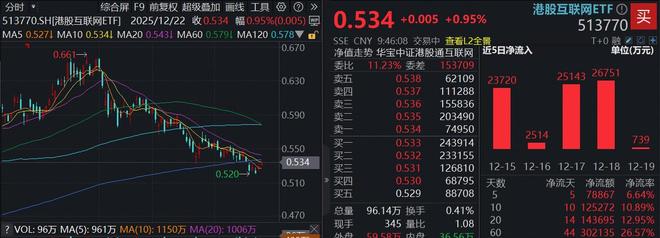
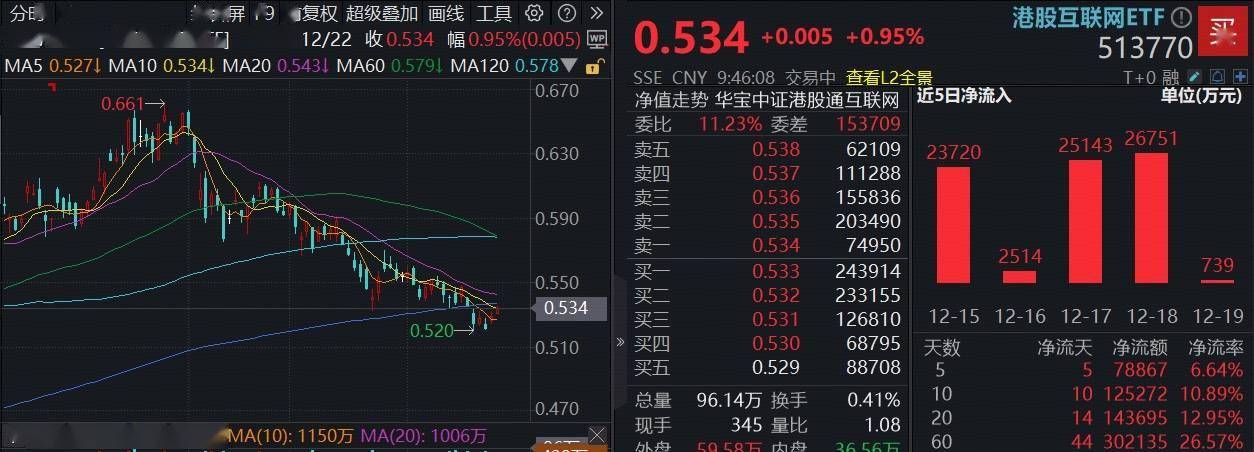
ETF盘中资讯 外部风险收窄,港股AI继续攀升,阿里涨超2%,百亿港股互联网ETF(513770)续涨逾1%,规模再探新高
Jin Rong Jie· 2025-12-22 02:48
Group 1 - The Hong Kong stock market opened higher on December 22, with major internet stocks showing strength, including Alibaba-W rising over 2% and Bilibili-W and Meituan-W increasing by more than 1% [1] - The Hong Kong Internet ETF (513770) experienced a net inflow of 1.253 billion yuan over the past 10 days, reaching a record high fund size of over 12.2 billion yuan [3][5] - The technology sector is viewed as a long-term investment focus, with expectations of a rebound due to multiple favorable factors after previous adjustments [3] Group 2 - The Hong Kong Internet ETF (513770) passively tracks the CSI Hong Kong Internet Index, heavily investing in leading internet companies like Alibaba-W and Tencent Holdings, with the top 10 holdings accounting for over 73% of the portfolio [5] - The Hong Kong market is currently seen as having high cost-effectiveness, particularly in the technology sector, which is expected to attract more investments as liquidity shocks subside and valuations remain low [3] - The Hong Kong Large Cap 30 ETF (520560) is highlighted as a suitable long-term investment tool, combining high-growth technology stocks with stable dividend-paying companies [6]

品高股份股价涨5.01%,格林基金旗下1只基金重仓,持有2.27万股浮盈赚取7.26万元
Xin Lang Cai Jing· 2025-12-22 02:42
Group 1 - The core viewpoint of the news is that Pingao Co., Ltd. has seen a stock price increase of 5.01%, reaching 67.06 CNY per share, with a total market capitalization of 7.581 billion CNY as of the report date [1] - Pingao Co., Ltd. is a professional provider of cloud computing and industry information services in China, established on January 1, 2003, and listed on December 30, 2021 [1] - The company offers a full-stack enterprise-level cloud platform and information services across various industries, including rail transit, government, telecommunications, public security, automotive, finance, education, and military [1] Group 2 - According to data, the Green Fund holds a significant position in Pingao Co., Ltd., with the Green Research Preferred Mixed A Fund (011977) owning 22,700 shares, representing 0.71% of the fund's net value [2] - The Green Research Preferred Mixed A Fund has achieved a year-to-date return of 30.64%, ranking 2,642 out of 8,170 in its category [2] - The fund manager, Zheng Zhonghua, has been in position for 6 years and 286 days, with the fund's total asset size at 849 million CNY [3]

“AI需求+供给偏紧”双驱动,光模块强势拉升!低费率创业板人工智能ETF华夏(159381)、5G通信ETF(515050)大涨3%
Xin Lang Cai Jing· 2025-12-22 02:41
Group 1 - The core viewpoint of the news highlights the strong performance of AI computing power, particularly in the optical module CPO and optical communication sectors, with significant market gains observed [1] - As of 10:15, the 5G Communication ETF (515050) surged by 3.69%, while the AI-focused ChiNext ETF (159381) rose by 3.28%, indicating robust investor interest in these sectors [1] - The price of domestic G652D optical fibers has been steadily increasing since Q3, driven by overseas AI demand, leading to an 87.78% year-on-year increase in China's optical rod exports from January to November 2025 [1] Group 2 - LightCounting's latest report predicts that the optical module market will exceed $23 billion by 2025, with demand for many products, including optical modules, currently outpacing supply by twofold or more [1] - CITIC Securities remains optimistic about the AI computing power sector, noting that the demand for computing power is strong and the competition is ongoing, with a focus on both North American and domestic supply chains [1] - The domestic supply chain is expected to benefit from increased production capacity and the release of H200, which may accelerate the deployment of AI computing infrastructure [1] Group 3 - The ChiNext AI ETF (159381) tracks the ChiNext AI Index and has a significant weight in optical module CPOs, with the top three holdings being Zhongji Xuchuang (26.62%), Xinyi Sheng (19.35%), and Tianfu Communication (5.05%) [2] - The 5G Communication ETF (515050) focuses on the 5G communication theme index, with major holdings in companies like Zhongji Xuchuang and Xinyi Sheng [2] - The Cloud Computing 50 ETF (516630) tracks a cloud computing index with a high AI computing power content, covering various sectors including optical modules, data centers, and AI servers [2]



ETF盘中资讯 | 外部风险收窄,港股AI继续攀升,阿里涨超2%,百亿港股互联网ETF(513770)续涨逾1%,规模再探新高
Sou Hu Cai Jing· 2025-12-22 02:29
Group 1 - The Hong Kong stock market opened higher on December 22, with major internet stocks showing strength, including Alibaba-W rising over 2% and Bilibili-W and Meituan-W increasing by more than 1% [1] - The Hong Kong internet ETF (513770) experienced a price increase of over 1% at one point, currently up 0.95%, and has surpassed the 10-day moving average [1] - Recent inflows into the Hong Kong internet sector have been significant, with the internet ETF (513770) seeing a net inflow of 1.253 billion yuan over the past 10 days, bringing its total fund size to over 12.2 billion yuan, a record high [3] Group 2 - Galaxy Securities noted that external risks are narrowing, and the Hong Kong stock market is expected to trend upwards, with the technology sector remaining a long-term investment focus due to recent valuation corrections and multiple favorable factors [3] - According to China Merchants Securities, the current valuation of Hong Kong stocks is attractive, particularly in the technology sector, suggesting gradual investment in this area [3] - The Hong Kong internet ETF (513770) and its linked funds passively track the CSI Hong Kong Internet Index, heavily investing in leading internet companies like Alibaba-W and Tencent Holdings, with the top 10 holdings accounting for over 73% of the portfolio [5] Group 3 - The Hong Kong internet ETF (513770) has an average daily trading volume exceeding 600 million yuan this year, supporting intraday T+0 trading and demonstrating good liquidity [5] - For investors looking to reduce volatility while still focusing on technology, the Hong Kong Large Cap 30 ETF (520560) is recommended, which combines high-growth tech stocks with stable dividend-paying companies [5]
计算机行业 2026 年度投资策略:AI 变革前夜,聚焦应用巨头与基础资源
Changjiang Securities· 2025-12-22 01:10
Investment Rating - The report maintains a "Positive" investment rating for the software and services sector [11]. Core Insights - The report indicates that the darkest period has passed, and AI is driving a new round of transformation cycles. Cost reduction is driving profit recovery, while insufficient demand remains a core contradiction in the sector. The revenue growth rate for the sector is expected to remain low from 2022 to 2024, with a weak recovery anticipated in 2025. The apparent profit growth is significantly driven by cost control measures [7][20]. Summary by Sections Industry Overview - The computer industry is experiencing a weak recovery in 2025, with total revenue reaching 482.3 billion yuan, a year-on-year increase of 5.1%. The contract liabilities in the computer industry reached 95.57 billion yuan by Q3 2025, reflecting a year-on-year increase of 9.6% [20][23]. AI and Application Focus - The report emphasizes that the current narrative in the sector revolves around the application of AI. The AI application monetization is still in its early stages, and the focus should be on application giants and foundational resources. The competition in the model side is intensifying, with leading models like GPT-5 and Gemini-3 exploring commercial monetization paths [7][9]. Infrastructure and Resource Allocation - The report highlights that the AI-driven arms race is beneficial for foundational resources, particularly in cloud computing and domestic computing power. Major companies are increasing capital expenditures (Capex) to enhance future competitiveness rather than immediate profits. The domestic token market is expected to see significant growth in the coming year, further boosting demand for computing power [8][9]. Market Dynamics - The report notes that the computer sector has undergone various phases in 2025, including "main line convergence" and "wide fluctuations." As of December 14, 2025, the Yangtze Computer Index has risen by 17.7%, ranking 16th among primary industries [7][33]. Profitability and Valuation - The apparent profit growth for the computer industry in Q1-Q3 2025 reached 12.41 billion yuan, a substantial increase of 184.0% year-on-year. The industry’s gross profit margin stabilized at 31.71%, with a decrease of 1.1 percentage points year-on-year. The report indicates that the overall valuation of the sector remains relatively high, with the latest PE-TTM at 65.31 times, placing it in the 86th percentile since 2016 [23][26]. Application and Model Development - The report stresses the importance of digital infrastructure as a prerequisite for AI implementation. It identifies potential early adopters in various sectors such as creative industries, customer service, e-commerce, recruitment, taxation, multimodal applications, and judicial scenarios [9][49]. Future Outlook - The report anticipates that 2026 will be a pivotal year for AI, with significant advancements in model capabilities and task performance. The competition among major players is expected to intensify, leading to a critical period for market share acquisition [9][49].