
黄金股

Search documents
金价“过山车”,银行提示风险,积存金还适合大众投资者吗
Di Yi Cai Jing· 2026-02-04 08:45
Core Insights - The article discusses the recent volatility in gold prices and the implications for gold accumulation products, highlighting the shift in investor sentiment and the adjustments made by banks in response to market conditions [2][3][4]. Group 1: Market Trends - International gold prices have experienced significant fluctuations, recently reaching over $5,000 per ounce before retreating, while domestic gold jewelry prices have also seen a decline from 1,700 RMB per gram to around 1,500 RMB [2]. - Gold accumulation products have gained popularity among investors as a low-risk alternative for inflation hedging, but the recent volatility has revealed associated investment risks [2][3]. Group 2: Bank Adjustments - Several banks have adjusted their gold accumulation business, raising the entry threshold and minimum investment amounts to mitigate risks associated with market volatility [4][5]. - For instance, China Construction Bank increased the minimum investment amount for gold accumulation to 1,500 RMB, while other banks have restricted services based on clients' risk tolerance assessments [4][5]. Group 3: Investor Behavior - Many investors perceive gold accumulation as a short-term investment, but experts suggest it is more suitable for those looking to accumulate wealth over a longer period [6][7]. - The misconception about the liquidity and convertibility of gold accumulation products has led to unexpected losses for some investors, emphasizing the need for clearer communication from banks regarding the terms and conditions of these products [7][8]. Group 4: Risk Management - The article highlights the importance of risk management in gold accumulation, with banks advising investors to assess their risk tolerance and adopt a long-term investment perspective [3][4]. - Experts recommend that banks improve the design and information provided for gold accumulation products to emphasize the need for long-term holding and gradual investment strategies [6][7].

杨德龙:近期国际金价大幅波动的原因与启示
Xin Lang Cai Jing· 2026-02-04 01:51
Core Viewpoint - Recent fluctuations in international gold prices have raised concerns among investors, with gold reaching $5600 per ounce before a significant drop, particularly in silver, which saw a 30% decline in a single day [1][2][6] Group 1: Market Dynamics - The recent drop in gold prices is attributed to a hawkish stance from the new Federal Reserve Chairman, leading to fears of tightening liquidity and balance sheet reduction [1][2] - The rapid increase in gold prices, exceeding $1000 in just a couple of weeks, was unsustainable, indicating that such sharp rises often precede significant corrections [1][2][6] - The current rebound in gold prices, now above $4800 per ounce, suggests that many investors are taking advantage of the dip, presenting a re-entry opportunity for those who missed earlier gains [2][7] Group 2: Investment Strategy - Investors are advised to view gold and silver as part of a long-term asset allocation strategy rather than short-term trading opportunities, with a recommendation to allocate about 20% of their portfolio to gold-related assets [2][7] - The volatility in gold and silver prices serves as a reminder that no asset is immune to fluctuations, emphasizing the importance of a rational investment approach [2][7] Group 3: Long-term Outlook - Looking ahead to 2026, gold and silver are expected to remain attractive assets, although the likelihood of a one-sided price surge like in 2025 is low, with increased volatility anticipated [3][8] - Factors such as rising U.S. national debt, which has surpassed $38 trillion, and concerns over fiscal sustainability are likely to support the long-term upward trend in gold prices [3][9] - The ongoing trend of "de-dollarization" is expected to gradually reduce the dollar's dominance in global payments and reserves, enhancing the appeal of gold and other hard currencies [4][9] Group 4: Economic Context - Domestic investors are facing a pivotal moment in asset allocation, with a significant amount of fixed-term deposits maturing and interest rates declining, prompting a search for new investment avenues [10] - The A-share market is showing signs of a slow bull market, with historical patterns suggesting potential for a spring rally, which could lead to increased investment in equities [10][11] - The focus for 2025 will be on technology stocks, while 2026 is expected to highlight innovations in various sectors, indicating a potential shift in capital market dynamics [10][11]
视频|黄金白银“瀑布流直线跳水” !有人后悔“卖飞了”,有人懊恼“买少了”,后市他们这么看
Sou Hu Cai Jing· 2026-01-31 02:18
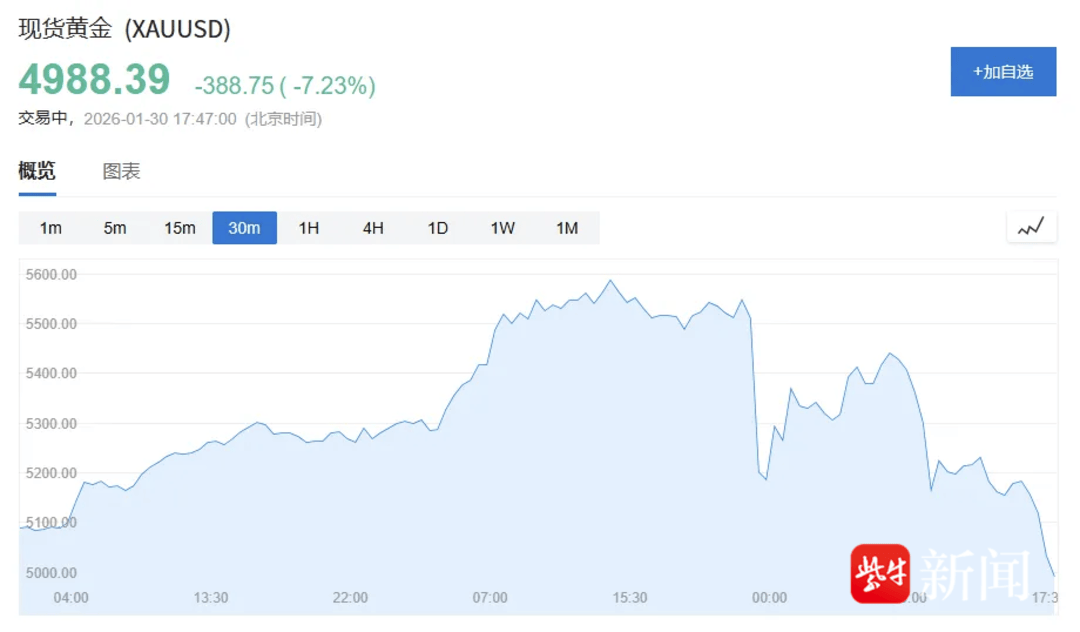
Core Viewpoint - The recent sharp decline in gold and silver prices, with gold dropping from approximately $5600 to below $5000 per ounce in a single day, is attributed to a combination of profit-taking and market sentiment, rather than a fundamental shift in the long-term bullish trend for precious metals [1][12][14]. Price Movements - On January 29, gold prices surged to around $5600 per ounce before plummeting to $5105.83, marking a maximum intraday drop of 5.7%, and closing at $5377.4, down 0.69% [2][6]. - Silver prices fell from a historical high of $121.67 per ounce to $106.80, with a maximum intraday decline of 8.5% [2]. - By January 30, gold further declined to $4950, with a daily drop exceeding 7%, while silver fell to approximately $96, reflecting a 16% decrease [6]. Market Reactions - The drastic price movements have led to significant losses for gold stocks, with companies like Shandong Gold and Chifeng Gold experiencing declines of over 14% on January 30 [6]. - Retail investors expressed regret over missed opportunities, with discussions on social media highlighting sentiments of both regret for selling too early and frustration over not buying more [7]. Consumer Behavior - Gold jewelry prices have adjusted, with retail prices dropping from around 1700 yuan per gram to approximately 1685 yuan, with promotional discounts bringing effective prices down to about 1605 yuan [9]. - The end of the year remains a peak consumption period for gold jewelry, with consumers advised to purchase based on personal needs rather than short-term price fluctuations [12]. Expert Insights - Experts suggest that the recent price drop is a temporary adjustment within a longer-term bullish trend for precious metals, likening it to a "deep squat" rather than a fundamental reversal [12]. - Investment strategies should focus on maintaining a diversified portfolio and avoiding high-risk speculative behavior, especially during periods of extreme market volatility [13][14]. - The long-term outlook for gold remains positive, supported by ongoing financial and geopolitical uncertainties, although short-term volatility is expected to continue [14][15].
美国外资审查新动向!CFIUS加大执法力度,“黄金股”兴起
Di Yi Cai Jing· 2026-01-14 09:49
Core Insights - The U.S. government's foreign investment review process has undergone significant changes over the past year, particularly with the implementation of the "America First Investment Policy" and the evolving role of the Committee on Foreign Investment in the United States (CFIUS) [1][2][3] Group 1: CFIUS Review Trends - CFIUS has expanded its jurisdiction to include critical sectors such as technology, infrastructure, personal data, healthcare, agriculture, energy, and raw materials, while also establishing a "fast track" process for investments from allied nations [2][3] - In 2025, CFIUS's enforcement actions reached a record high, with total fines nearing $88 million and the highest single fine amounting to $60 million, reflecting a significant increase in scrutiny of foreign investments [2] - The number of filings in the semiconductor and electronics manufacturing sectors dropped by 60%, and filings in scientific research and development decreased by 57%, indicating a deterrent effect on foreign investment in advanced R&D and manufacturing [2] Group 2: Differentiated Treatment and Risk Assessment - CFIUS is expected to continue its trend of differentiated treatment in 2026, with increased scrutiny on investments from specific sources while introducing expedited processes for friendly nations [3] - Transactions involving sensitive factors such as semiconductors and supply chain security may face pre- or post-review scrutiny, increasing legal and policy uncertainties for investments in the U.S. [3] - The review of the Nippon Steel acquisition of U.S. Steel illustrates the integration of CFIUS reviews with domestic industrial policies, extending beyond traditional national security concerns to include labor rights and competitive policies [3][4] Group 3: Golden Share Mechanism - The approval of the Nippon Steel acquisition was significantly influenced by the "golden share" agreement, which granted the U.S. government veto power over key business decisions [4][5] - The "golden share" mechanism allows foreign governments to retain strategic control over sensitive entities by holding a small percentage of equity while gaining disproportionate influence over operational decisions [5][6] - This trend is evident in various jurisdictions, where governments are increasingly using "golden shares" to secure control over critical decisions, reflecting a shift towards broader industrial policy goals beyond traditional national security [6][7] Group 4: Strategic Considerations for Foreign Investment - Companies planning investments in sensitive sectors must assess the importance of the industry to national interests and its alignment with the host country's industrial agenda [7] - Early planning to identify potential risks is becoming increasingly critical for foreign investors, as compliance with national priorities can facilitate smoother regulatory approvals [7]
基金观察:黄金还有强势行情吗?
Sou Hu Cai Jing· 2026-01-14 02:39
Core Viewpoint - The strong trend in gold prices is expected to continue in the medium to long term, but significant short-term volatility should be anticipated, especially after reaching historical highs [2][4]. Group 1: Factors Influencing Gold Prices - The primary factor affecting gold investment is the U.S. real interest rates, which historically show an inverse relationship with gold prices. A downward trend in U.S. Treasury yields is likely to support gold prices [3]. - Central banks have significantly increased their gold purchases, with annual additions exceeding 1,000 tons since 2022, compared to just over 470 tons annually from 2010 to 2021. This shift reflects concerns over the uncertainty of dollar assets and aims for asset diversification [3]. - Geopolitical events can cause substantial short-term impacts on gold prices, leading to pronounced fluctuations in the market [4]. Group 2: New Pricing Logic for Gold - The trend of central banks increasing gold reserves and seeking alternatives to the dollar has become a significant driver for rising gold prices. However, the sustainability of this trend remains uncertain [5]. Group 3: Investment Strategies in Gold - Gold stocks should not be compared directly with physical gold and gold ETFs, as they are more influenced by stock market fluctuations. For pure investment purposes, gold ETFs are recommended due to their liquidity and direct correlation with gold prices [6]. - Physical gold investments, such as gold bars, are considered more suitable for those looking to invest in tangible assets, while gold jewelry may incur additional design costs [6].
现货黄金年内飙升近68% 三重逻辑支撑黄金新叙事行至“中场”
Shang Hai Zheng Quan Bao· 2025-12-22 18:23
Core Insights - The global gold investment trend is gaining momentum, with significant price increases and a shift in perception from a traditional safe-haven asset to a core investment asset [1][6][7] Group 1: Market Trends - In December 2023, spot gold prices surpassed $4,400 per ounce, marking a nearly 68% increase for the year, significantly outperforming other major assets [1] - The number of clients engaging in gold accumulation products has surged, with over 30,000 clients at a major bank, and a 3.1 times increase in transaction volume compared to the previous year [5] Group 2: Investor Behavior - Individual investors are increasingly adopting gold as a long-term investment strategy, with many viewing it as a retirement savings plan [2][3] - Despite market volatility, investors are reluctant to exit their positions, indicating a strong belief in gold's long-term value [4] Group 3: Economic Factors - The rise in gold prices is attributed to several macroeconomic factors, including debt expansion in major economies, declining labor productivity, and geopolitical tensions [6][7] - Central banks have been accumulating gold since 2022, reinforcing its status as a strategic reserve asset [6] Group 4: Future Projections - Experts predict that the current gold bull market may be in its mid-stage, with continued recommendations for gold allocation in investment portfolios [8] - Forecasts suggest that gold prices could reach $4,500 per ounce by mid-2026, with potential to challenge $4,900 per ounce [8]
永赢基金刘庭宇:降息周期下黄金及黄金股或开启新一轮主升浪
Sou Hu Cai Jing· 2025-12-22 11:25
Core Viewpoint - The recent dovish interest rate decision by the Federal Reserve has opened up medium-term upward space for gold prices, with expectations of further rate cuts in 2026 providing ongoing support for gold prices [1][2] Group 1: Market Dynamics - The spot gold price has reached a new historical record as of December 22 [1] - The influx of trading capital due to the interest rate cut cycle and the increasing long-term allocation demand amid de-dollarization trends highlight the significant investment value of the gold sector [1] - Recent declines in implied volatility of gold have returned to historical averages, reducing market uncertainty and enhancing investment cost-effectiveness [1] Group 2: Economic Indicators - The U.S. unemployment rate in November exceeded expectations, coupled with lower-than-expected inflation data and persistently weak consumer data, indicating a slowdown in U.S. economic growth, which supports further easing by the Federal Reserve [1] - Major financial institutions, including Goldman Sachs, Bank of America, UBS, and the World Gold Council, have raised their gold price targets to the range of $4,900 to $5,000, providing solid price support for gold stocks [1] Group 3: Company Performance - Gold stocks are experiencing high growth, with the top ten constituents of the CSI Hong Kong-Shenzhen Gold Stock Index maintaining a 62% growth rate in the first three quarters of 2025, aligning with market expectations [2] - This high growth is attributed to the upward movement of gold prices and the active expansion of gold mining companies, creating a "volume and price rise" scenario that is expected to continue [2] - As of November 30, with gold priced at $3,800 per ounce, major gold mining companies are projected to have an average P/E ratio of only 11-15 times for 2026, compared to a historical average of around 20 times, indicating significant valuation recovery potential [2] Group 4: Investment Outlook - The current gold stock sector is in a phase of "macro policy benefits + long-term allocation demand + strong fundamental growth," suggesting a triple resonance period [2] - As the interest rate cut cycle progresses, the dual recovery of performance and valuation in gold stocks is expected to deepen [2]
金价再创新高,永赢基金刘庭宇:降息周期下黄金及黄金股或开启新一轮主升浪
Xin Lang Cai Jing· 2025-12-22 05:42
Core Viewpoint - The recent increase in spot gold prices to historical highs is driven by expectations of interest rate cuts by the Federal Reserve, which opens up medium-term upward potential for the gold sector [1] Group 1: Economic Indicators and Federal Reserve Actions - The U.S. unemployment rate rose unexpectedly in November, while non-farm employment exceeded expectations, indicating a slowdown in economic growth, which supports further easing by the Federal Reserve [1] - Citigroup has raised its forecast for interest rate cuts in 2026 to three times, influenced by the White House's pressure due to rising debt interest payments and a dovish stance among most candidates for the Federal Reserve chair [1] - Historical data shows that during periods of interest rate cuts, gold, as a non-yielding asset, tends to appreciate significantly due to reduced opportunity costs [1] Group 2: Long-term Demand for Gold - The weakening independence of the Federal Reserve and the global trend of de-dollarization enhance the long-term investment value of gold [2] - The probability of stagflation in the U.S. is high, and major European economies are also facing fiscal deterioration and stagflation risks, making gold more attractive compared to other asset classes [2] - Emerging market central banks are increasing their gold reserves, which are currently below the global average, indicating strong demand for gold [2] Group 3: Performance of Gold Stocks - Gold stocks are experiencing high growth, with the top ten constituents of the CSI Gold Index showing a 62% growth rate in the first three quarters of 2025, driven by rising gold prices and increased production [3] - As of November 30, 2025, major gold mining companies have an average PE ratio of 11-15 times based on a gold price of $3,800 per ounce, indicating significant room for valuation recovery compared to the historical average of 20 times [3] - The influx of absolute return-oriented funds into gold and gold stocks is expected to provide stable support for the sector, reducing volatility and enhancing attractiveness [3] - The gold stock sector is currently in a phase of "macro policy benefits + long-term demand + strong fundamentals," suggesting a potential for continued performance improvement [3]
美联储第三次扩表开启:美元的黄昏与黄金的新纪元
雪球· 2025-12-13 03:44
Group 1 - The Federal Reserve's recent decision to lower interest rates by 0.25% and initiate a $40 billion bond purchase within 30 days marks the beginning of a significant expansion of its balance sheet, indicating that the U.S. economy is entering a "crisis moment" again [4] - The expansion of the balance sheet is driven by an imbalance in the U.S. Treasury market and unsustainable debt interest payments, with new Treasury issuance expected to reach $2.5 trillion to $3 trillion annually and interest payments around $1.5 trillion [5] - The Federal Reserve's actions are seen as a form of debt monetization, which may appear to solve fiscal crises but ultimately risks undermining the dollar's status as the global reserve currency [6] Group 2 - The current monetary policy is expected to lead to a resurgence of inflation, with the increase in money supply likely to erode the purchasing power of the dollar over time [6] - The pricing structure of gold is undergoing a fundamental change, with $4,000 per ounce potentially becoming a new support level, driven by the Fed's bond purchases and rising inflation expectations [7] - Investment strategies are shifting towards gold stocks and industrial metals, as rising gold prices are expected to significantly boost profits for mining companies, while metals like silver, copper, and tin are anticipated to benefit from both inflation and their intrinsic value [8]

美国新一轮货币宽松有望支撑金价中枢继续上移
Xin Lang Cai Jing· 2025-12-11 12:04
Group 1 - The Federal Reserve announced a 25 basis point reduction in the federal funds rate target range to 3.50%-3.75%, marking the third consecutive rate cut since September and the sixth since the start of the current easing cycle in September 2024, totaling a cumulative reduction of 175 basis points [1] - The easing monetary policy is expected to benefit gold prices, with a favorable macro environment anticipated for 2026, as new rounds of monetary easing and fiscal expansion in the U.S. will significantly weaken the credibility of fiat currencies, supporting a higher price level for gold [1][2] - Market caution prior to the rate cut led to a stable gold price, with resistance observed around the $4250-$4300 per ounce range, which is a dense trading zone from October and November [1] Group 2 - In the short term, gold prices need time to digest significant gains and the large amount of positions above $4200 per ounce, while the macro environment in 2026 is expected to remain favorable for gold [2] - The U.S. tax cuts and interest rate reductions in 2026 are projected to initiate a new global easing cycle, with competitive currency devaluation led by Japan, further depreciating credit currencies [2] - The People's Bank of China reported an increase in gold reserves to 74.12 million ounces by the end of November, up from 74.09 million ounces at the end of October, marking a continuous increase in gold holdings for 13 months, totaling 1.32 million ounces [2] - Gold stocks are currently lagging behind gold prices, with insufficient profit release expected for 2025, indicating potential for valuation recovery to around 15 times PE, which remains low [2]