以铜代银

Search documents
帝科股份(300842):银价上涨促银包铜落地 存储业务打开增长空间
Xin Lang Cai Jing· 2026-02-08 02:37
Core Viewpoint - The significant increase in silver prices is driving the adoption of silver-plated copper, with the storage business gradually ramping up, and the impact of share-based payment expenses diminishing, leading to a potential reversal in company performance by 2026 [1]. Group 1: Storage Business - The storage business is transitioning from layout to volume verification, expected to become a new growth curve for the company [2]. - In investor relations activities, the company disclosed substantial growth in storage business revenue and shipments for 2025, with plans for acquisitions to achieve a closed-loop storage industry chain by 2024 and 2025 [2]. - The storage segment is anticipated to hedge against price fluctuations in the photovoltaic materials sector, enhancing profit stability and predictability [2]. Group 2: Silver-Plated Copper - The rising silver prices are compelling a shift towards silver-plated copper, which is expected to accelerate penetration rates in the future [3]. - The company expects 2026 to be the year of large-scale production for high copper paste in the industry, as the transition from validation to mass production of silver-plated copper is accelerating [3]. - The pace of future volume growth and customer development will be critical factors influencing this transition [3]. Group 3: Profit Forecast and Valuation - Due to fair value losses from silver price fluctuations, the company has revised its profit forecasts for 2025 and 2026 downwards by 199.8% and 36.8% to -214 million yuan and 318 million yuan, respectively [4]. - The storage and silver-plated copper segments are expected to contribute more to performance in the future, leading to a switch in valuation to 2027, with a profit forecast of 554 million yuan for that year [4]. - The target price has been raised by 116.7% to 130 yuan, corresponding to a price-to-earnings ratio of 27.8 times, with a potential upside of 22.6% from the current stock price [4].
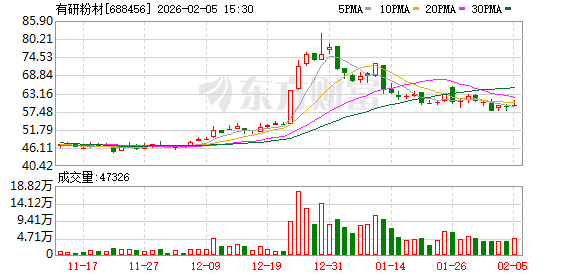
有研粉材:公司基于铜基粉体科技创新能力和规模化产业基础,有望在2026年实现相关产品的市场增量突破
Mei Ri Jing Ji Xin Wen· 2026-02-05 09:51
Group 1 - The core viewpoint of the article highlights the potential market growth for the company’s new products, particularly those utilizing copper-based technology, which are expected to significantly contribute to market expansion by 2026 [2][3] - The company indicated that the progress of product testing is contingent upon customer trials, suggesting a strategic approach to product development and market entry [2] - The company sees substantial opportunities in the "copper replacing silver" market, which is characterized by a large potential scale, indicating a focus on innovation and industrial capacity in copper-based powder technology [2]


三孚新科:光伏银浆行业普遍采用“银价+加工费”的定价模式
Zheng Quan Ri Bao Zhi Sheng· 2026-02-03 12:37
Group 1 - The core viewpoint of the article highlights that the photovoltaic silver paste industry generally adopts a pricing model based on "silver price + processing fee," with the risk of silver price fluctuations primarily borne by downstream customers [1] - The company's strategic focus in the photovoltaic sector is on providing cost-reduction technology solutions that utilize non-silver or low-silver products, such as electroplated copper [1] - The electroplated copper process can achieve "copper instead of silver," fundamentally reducing the consumption of precious metals and helping customers establish a long-term, stable cost advantage [1]

公司问答丨三孚新科:光伏银浆行业普遍采用“银价+加工费”的定价模式 银价风险主要由下游客户承担
Ge Long Hui A P P· 2026-02-03 08:20
Core Viewpoint - The company emphasizes its focus on providing cost-reduction technology solutions that utilize non-silver or low-silver products in response to the volatility of silver prices in the photovoltaic silver paste industry [1] Group 1: Company Strategy - The company states that the photovoltaic silver paste industry generally adopts a pricing model based on "silver price + processing fee," with the risk of silver price fluctuations primarily borne by downstream customers [1] - The company's strategic focus in the photovoltaic sector is on offering cost-reduction technology solutions that minimize the use of precious metals, such as the copper plating process [1] Group 2: Technology Solutions - The company can provide supporting additives for the copper plating process, which allows for "copper instead of silver," fundamentally reducing the consumption of precious metals [1] - This approach helps customers build a long-term and stable cost advantage in their operations [1]
三孚新科(688359.SH):公司光伏板块的战略重心在于提供非银或少银产品的降本技术解决方案
Ge Long Hui· 2026-02-03 07:37
Core Viewpoint - The photovoltaic silver paste industry generally adopts a pricing model based on "silver price + processing fee," with silver price risks primarily borne by downstream customers [1] Group 1: Company Strategy - The company's strategic focus in the photovoltaic sector is on providing cost-reduction technology solutions for non-silver or low-silver products, such as electroplated copper [1] - The company can supply supporting electroplating additives for the photovoltaic electroplated copper process [1] Group 2: Industry Trends - The electroplated copper process can achieve "copper instead of silver," fundamentally reducing the consumption of precious metals and helping customers build long-term, stable cost advantages [1]
白银有色7连板!股价30天翻倍,预亏6.75亿元难盖追逐热情
Hua Xia Shi Bao· 2026-01-28 12:13
Core Viewpoint - The recent surge in silver prices has led to a significant increase in the stock price of Silver Industry (601212.SH), but the company's projected losses for 2025 raise concerns about the sustainability of this optimism [2][7]. Group 1: Market Performance - The silver sector has become a standout performer in the A-share market, with Silver Industry achieving a seven-day consecutive rise, reaching a peak price of 13.81 yuan and a total market capitalization exceeding 100 billion yuan [2]. - The stock has seen a cumulative increase of 93.15% over the period, with a staggering 160% rise in the last 30 trading days and nearly 400% over the past year [2]. - The international silver price has surged over 50% in less than a month, reaching historical highs, driven by geopolitical risks and increased industrial demand [3][4]. Group 2: Company Fundamentals - Despite the stock price surge, Silver Industry's fundamentals are weak, with a projected net loss of 4.5 billion to 6.75 billion yuan for 2025, marking the first annual loss since 2011 [7]. - The company's revenue from silver products is minimal, contributing only 4.54% to total revenue, while its core business, copper, accounts for 47.65% [5]. - The company has faced significant legal and financial challenges, including a 3.14 billion yuan provision for liabilities due to a contract dispute, which has heavily impacted profitability [7][9]. Group 3: Valuation Concerns - Silver Industry's valuation is significantly inflated, with static and dynamic P/E ratios of 1045.76 and 477.66, respectively, far exceeding industry averages by 734.19% and 324.08% [5]. - The current stock price increase is largely driven by market sentiment and speculation rather than improvements in the company's fundamentals [11][12]. Group 4: Governance and Compliance Issues - The company has faced regulatory scrutiny for information disclosure violations, resulting in fines and highlighting weaknesses in its internal control systems [9]. - Past financial mismanagement, including undisclosed overdue financial products, has raised concerns about the company's governance and compliance practices [9]. Group 5: Future Outlook - The ongoing rise in silver prices may not translate into profits for Silver Industry due to its low exposure to silver revenue and the potential for technological shifts in the industry, such as the replacement of silver with copper in photovoltaic applications [11][12]. - The company is attempting to alleviate its financial pressures through asset disposals, but this strategy may not address the underlying issues affecting its profitability [10].


银价高企倒逼产业变革-光伏金属化革命的-铜-时代开启
2026-01-26 15:54
Summary of Key Points from Conference Call Records Industry Overview - The photovoltaic (PV) industry is accelerating the transition from silver to copper in metallization processes, driven by high silver prices. This includes technologies such as silver-coated copper, electroplated copper, and pure copper paste. Silver-coated copper and electroplated copper have already achieved GWh-level production lines, while pure copper paste is still facing technical challenges but is being actively pursued by multiple companies [1][2][3]. Core Insights and Arguments - **Market Projections**: It is expected that 2026 will mark the year of significant adoption of copper in place of silver. If the penetration rates for silver-coated copper and copper paste reach 17.7% and 43% respectively, with battery production at 600 GW and 700 GW, the demand for copper will be approximately 1,000 tons and 2,900 tons for 2026 and 2027 respectively. The processing fee market could reach 1 billion yuan and 2.9 billion yuan in those years [1][3][4]. - **Company Highlights**: - **博迁新材 (Bojian New Materials)** is currently the only company capable of mass-producing nano-grade copper powder for photovoltaic applications. Their PVD method produces high-purity, high-conductivity nano-powders, which could lead to a market size of 20 billion yuan if fully adopted in the PV sector [1][7]. - **Samsung** has signed a nearly 5 billion yuan contract with 博迁新材 for AI server GPU chip capacitors, which positions 博迁新材 as a strong competitor in the AI server market, achieving a 40% market share [1][9]. - **Cost Structure Changes**: The rising price of silver has altered the cost structure of PV components, with silver costs nearing 20% of total component costs. Companies are actively seeking alternatives like copper to reduce metallization costs [1][11][16]. Additional Important Content - **Challenges in the PV Industry**: The main challenges include rising prices of silicon and silver, which have led to increased losses for battery and component manufacturers. The industry urgently needs to reduce costs through metallization innovations [2][11]. - **Technological Developments**: Companies like 聚合 (Juhua) and 帝科股份 (Dike) are making strides in pure copper paste technology and silver seed layer solutions, with expected net profits of 5.2 billion yuan and 4.3 billion yuan respectively for 2026 [3][30][32]. - **Market Dynamics**: The silver market is currently in a tight balance, with supply around 32,000 tons and demand at approximately 36,000 tons. The PV industry's demand for silver is expected to remain high due to the transition to N-type battery technology, which increases silver consumption [12][15]. - **Copper as an Alternative**: Copper is seen as a viable alternative due to its lower cost and stable supply, despite challenges such as oxidation and diffusion at high temperatures. Solutions from other industries, such as PCB and MLCC, may provide insights for overcoming these challenges in the PV sector [18][19]. - **Future Trends**: The global demand for PV is expected to grow rapidly, driven by carbon neutrality policies and energy crises. The industry must seek alternative materials or optimize processes to maintain sustainable development and control costs [12][16]. This summary encapsulates the critical insights and developments within the photovoltaic industry as discussed in the conference call records, highlighting the shift towards copper in metallization processes and the associated market dynamics.

中信建投:预计白银供需长期紧平衡 银价高企倒逼产业变革
Zhi Tong Cai Jing· 2026-01-22 01:52
Core Viewpoint - The recent increase in silicon and silver prices has intensified profit pressure on photovoltaic (PV) cell and module companies, making the reduction of silver consumption a pressing issue for these firms [1][3]. Supply and Demand Analysis - Silver has been in a supply-demand gap since 2019, with a long-term expectation of tight balance due to rigid supply and emerging applications [2]. - The supply side is constrained by limited mining output and slow growth in recycling, with over 80% of silver supply coming from mining [2]. - On the demand side, the resilience of photovoltaic demand, along with growth in AI computing and automotive electronics, is expected to influence silver supply-demand balance significantly [2]. Cost Pressure and Alternatives - The cost of silver paste has reached 19.3% of module costs, making it the largest cost component [2]. - Copper is identified as the most suitable alternative to silver, although challenges such as oxidation and diffusion need to be addressed [3][4]. - Current advancements in silver-coated copper and electroplated copper are promising, with silver-coated copper showing rapid progress and lower capital expenditure [4][5]. Technological Developments - Silver-coated copper has been successfully tested in HJT cells, reducing metallization costs significantly [5]. - The TOPCon cell technology is exploring a dual printing and sintering approach to mitigate the risks associated with high-temperature processes [5]. - Electroplated copper technology is advancing, with significant production progress reported by leading companies [6]. Investment Opportunities - The rapid increase in the penetration of silver-coated copper and copper paste is expected to provide substantial profit elasticity for paste and metal powder companies [7]. - Companies like Juhua Materials and Dike Co., which focus on silver paste, are well-positioned to benefit from the transition to copper alternatives [8]. - Metal powder companies such as BQian New Materials are also expected to see significant growth due to their unique offerings in the copper powder market [8].



外部干扰落定 白银后市关注三方面变化
Qi Huo Ri Bao· 2026-01-19 00:19
Core Viewpoint - The silver price has reached new highs despite rumors of a potential decline due to the Bloomberg Commodity Index (BCOM) rebalancing, driven by strong investment demand and supply constraints [1][2]. Group 1: Price Movements and Trends - As of January 16, the London silver price closed at $90.134 per ounce, with a weekly increase of 12.8%, peaking above $93 per ounce [1]. - COMEX silver futures saw a weekly increase of 13.37%, while Shanghai silver futures surged by 22.83% [1]. - The BCOM annual rebalancing period from January 8 to 14, 2026, is expected to have a short-term impact, with market participants likely to use any price dips as buying opportunities [2]. Group 2: Supply and Demand Dynamics - Investment demand for silver remains strong, with non-commercial net long positions on COMEX increasing from 30,000 contracts in late December to 32,000 contracts by January 13 [1]. - The global silver production dropped to 820 million ounces (approximately 25,800 tons) in 2025, a 12% decrease from the peak in 2020, while recycled silver supply has increased only slightly, insufficient to meet industrial demand [2]. - The ongoing supply constraints are expected to keep silver in a "bull market" due to a widening supply-demand gap [2]. Group 3: Future Outlook and Market Factors - Experts predict that silver prices will likely remain high in Q1 2026, with potential for further increases, although volatility is expected to rise due to various market factors [3]. - The U.S. government's decision to delay imposing tariffs on key minerals, including silver, may introduce short-term price correction risks [3]. - The rising costs in industries due to increasing silver prices have prompted companies, particularly in the photovoltaic sector, to accelerate the adoption of copper alternatives, although widespread replacement is not yet feasible [3][4]. Group 4: Strategic Considerations - Future silver trading should focus on whether positive factors have been fully priced in, such as ongoing declines in silver inventory and potential Federal Reserve interest rate cuts [4]. - Monitoring risk control measures by exchanges is crucial, as decreased trading activity could halt the upward price momentum, leading to a "slow bull" market [4]. - Global geopolitical tensions may further accelerate silver price increases if they continue to escalate [4].
外部干扰落定!白银后市关注三方面变化
Qi Huo Ri Bao· 2026-01-19 00:02
Group 1 - The core viewpoint of the articles indicates that despite rumors of a decline in silver prices due to the Bloomberg Commodity Index (BCOM) rebalancing, silver prices have reached new highs due to changes in supply-demand dynamics and market perceptions [1][2][3] - As of January 16, silver prices in London reached $90.134 per ounce, with a weekly increase of 12.8%, and COMEX silver futures rose by 13.37%, while Shanghai silver futures surged by 22.83% [1] - The investment demand for silver remains strong, with non-commercial net long positions on COMEX increasing from 30,000 contracts in late December to 32,000 contracts by January 13 [1][2] Group 2 - The BCOM annual rebalancing period was strictly limited to January 8-14, 2026, indicating that the selling pressure was concentrated and not expected to have a long-term impact on prices [2] - The supply-demand imbalance, along with the shift in Federal Reserve monetary policy and significant capital inflows, is driving the current bull market in silver [2][3] - Global silver production fell to 820 million ounces in 2025, a 12% decrease from the peak in 2020, while recycled silver supply increased only slightly, failing to meet industrial demand [2] Group 3 - The rapid development of sectors such as photovoltaics, electric vehicles, AI infrastructure, and 5G communications has led to a new growth phase in silver consumption [3] - Experts predict that silver prices will likely remain high in Q1 2026, with the possibility of reaching new highs, although volatility is expected to increase due to various supporting factors [3][4] - The recent announcement by the U.S. government to refrain from imposing comprehensive tariffs on key minerals, including silver, suggests a potential short-term risk of price correction [3] Group 4 - The ongoing supply shortage of silver is expected to persist for a considerable time, providing significant advantages to bullish forces in the market [4] - Future silver trading should focus on whether previous bullish factors have been fully priced in, the impact of risk control measures on trading activity, and the escalation of global geopolitical tensions [4]