
住房通胀

Search documents
【广发宏观陈嘉荔】美国通胀数据:预期与现实
郭磊宏观茶座· 2026-03-12 02:09
Core Viewpoint - The article discusses the stability of U.S. inflation data in February 2026, with the Consumer Price Index (CPI) increasing by 2.4% year-on-year and the core CPI rising by 2.5%, both in line with expectations and previous values. It highlights the impact of tariff transmission effects on core goods and anticipates potential upward pressure on the Personal Consumption Expenditures (PCE) index due to rising energy prices and other factors [1][6]. Group 1: Inflation Data Analysis - In February, the core goods prices increased by 0.1% month-on-month, rebounding from 0% in the previous month. Notable increases were seen in appliances (3.1%), clothing (1.3%), and software (6.5%) due to tariff impacts [2][11]. - The PCE inflation index, which has a higher weight for goods compared to CPI (approximately 38% vs. 25%), is expected to reflect a more pronounced effect from the rebound in core goods inflation, with Cleveland Fed predicting a month-on-month increase of 0.3% for February PCE [11][12]. Group 2: Service Sector Insights - The core service prices increased by 0.3% month-on-month in February, down from 0.4% in the previous month, while year-on-year growth remained stable at 2.9% [3][13]. - Rent prices showed a slight increase of 0.2%, with owner’s equivalent rent (OER) continuing to slow down, indicating a downward trend in housing inflation [15][13]. Group 3: Future Inflation Expectations - The article suggests that U.S. core inflation is in a state of asymmetric risk, with expectations for the core CPI to center between 2.6% and 2.9% over the next three months. Factors influencing this include ongoing tariff cost transmission, energy price shocks from geopolitical conflicts, and a tight labor market [4][15][17]. - The geopolitical situation, particularly regarding Iran and oil prices, is identified as a critical factor for future inflation trends, with potential upward pressure on prices due to energy costs not yet fully reflected in the data [19][20]. Group 4: Market Reactions - The market has shown signs of tightening expectations regarding interest rate cuts, with the next anticipated cut projected for July 2026. The 2-year and 10-year U.S. Treasury yields have increased, reflecting market adjustments to inflation data and geopolitical developments [5][19]. - Stock market performance has been mixed, with sectors such as software and energy outperforming, while others like private equity and transportation lagged behind [5][19].


美联储理事米兰:尽管1月就业数据强劲,仍有诸多理由支持降息
Sou Hu Cai Jing· 2026-02-11 23:36
Core Viewpoint - The unexpectedly strong employment data for January does not imply that policymakers should pause further interest rate cuts [1] Group 1: Federal Reserve Policy - Fed Governor Milan suggests that planned supply-side reforms, such as reducing business regulations, will facilitate continued rate cuts [1] - Expectations of a slowdown in housing inflation are seen as a factor that could support further reductions in the benchmark interest rate [1] - Since joining the Federal Reserve Board in September, Milan has consistently opposed the majority view at policy meetings, advocating for larger rate cuts than other officials are willing to support [1]
美联储理事米兰称尽管1月就业数据强劲 仍有诸多理由支持降息
Sou Hu Cai Jing· 2026-02-11 22:49
Core Viewpoint - The unexpectedly strong performance of January employment data does not imply that policymakers should pause further interest rate cuts [1] Group 1: Economic Policy Insights - Milan indicated that planned supply-side reforms, such as reducing business regulations, along with expectations of a slowdown in housing inflation, will clear the way for policymakers to continue lowering the benchmark interest rate [1] - Since joining the Federal Reserve Board in September, Milan has opposed the majority view at every policy meeting, advocating for a larger rate cut than other officials are prepared to support [1]
核心通胀降温!美国12月核心CPI涨幅2.6%,持平四年来最低水平,CPI同比上涨2.7%符合预期
Sou Hu Cai Jing· 2026-01-13 15:58
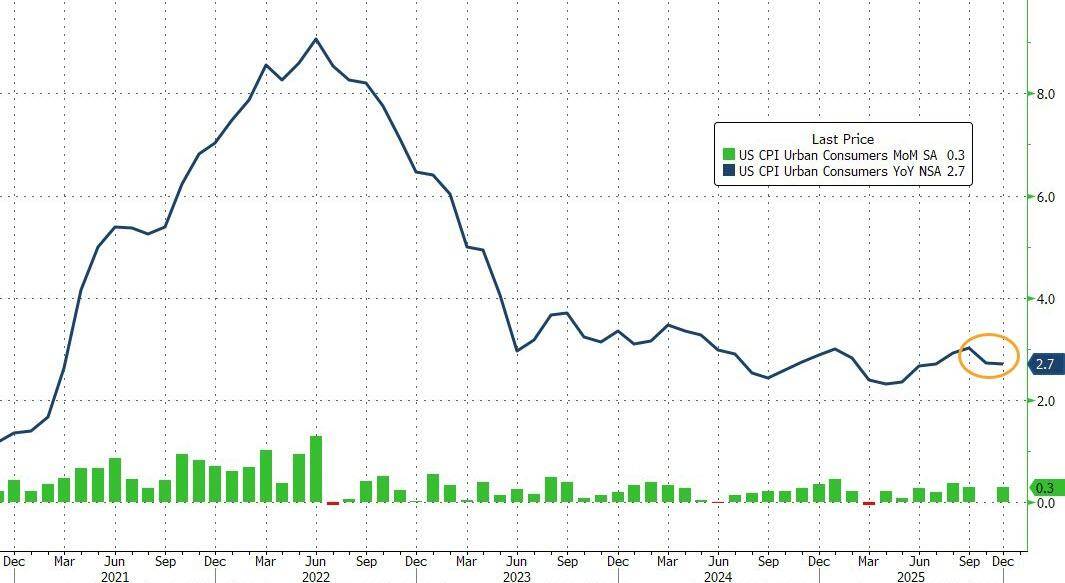
Core Insights - The December CPI in the U.S. shows a year-on-year increase of 2.7%, aligning with expectations and remaining at the lowest level in four years [1] - The core CPI year-on-year growth is 2.6%, slightly below the expected 2.7%, indicating a further slowdown in inflation [2][8] - The overall inflation data is viewed as a convincing signal of cooling inflation, with market reactions indicating increased bets on the Federal Reserve potentially lowering interest rates earlier than anticipated [3][11] Inflation Details - The December core CPI increased by 0.2% month-on-month, which is below the expected 0.3% [2][8] - The structure of inflation shows that while commodity prices remained stable, service and food prices were the main contributors to inflation in December [5] - Housing inflation pressure is significantly easing, with a month-on-month increase of 0.4% and a year-on-year increase dropping from 3.3% in November to 3.2% in December [6] Market Reactions - Following the data release, U.S. stock futures rose, while U.S. Treasury yields and the dollar fell, reflecting market sentiment towards potential interest rate cuts by the Federal Reserve [3] - The probability of a rate cut in April is now priced at approximately 42%, up from 38% prior to the data release, although June is still viewed as the most likely timing for a cut [3] Core Inflation Trends - The core CPI's year-on-year growth of 2.6% is the lowest since March 2021, reinforcing the trend of declining inflation [8] - Core goods prices decreased month-on-month, while service prices saw a slight acceleration, with the "super core inflation" metric (excluding housing services) also showing a slowdown to the lowest level since September 2021 [8]
美国CPI,要开始报复性反弹了?
Hua Er Jie Jian Wen· 2026-01-09 04:19
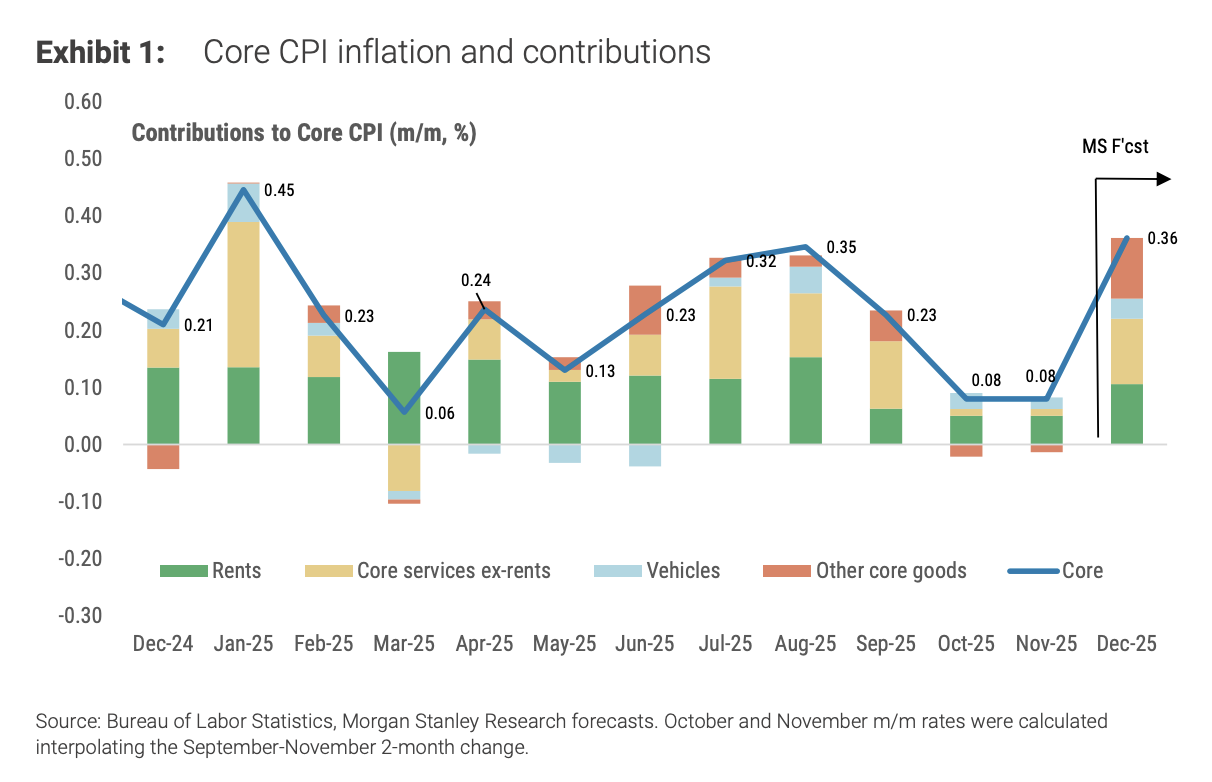
Core Viewpoint - The December CPI data in the U.S. is expected to show a significant rebound due to statistical distortions from the government shutdown, rather than genuine inflationary pressures [1][4]. Group 1: CPI Predictions - Morgan Stanley forecasts a notable increase in the core CPI for December, with a month-on-month growth of 0.36%, significantly higher than the average of 0.08% in October and November [1][3]. - The likelihood of the core CPI rounding to 0.3% or 0.4% is considered equal, but the risk of reaching 0.5% is higher than 0.2% [3][8]. - The December data will provide clearer insights into the transmission of tariffs to consumer prices, which had been absent in the October and November data [3][10]. Group 2: Statistical Distortions - Two main statistical biases due to the government shutdown are expected to affect the December CPI data: - The dual-month sampling bias, which has led to an underestimation of inflation in October, is projected to contribute approximately 8 basis points to the December core CPI [4]. - The holiday discount bias, resulting from delayed price collection in November, is expected to add an additional 3 basis points to the core CPI prediction [4]. Group 3: Inflation Trends - Core goods inflation is anticipated to reach a new high for the year, with a projected month-on-month increase of 0.59% in December, driven by rising prices in new and used cars, clothing, and other core goods [5]. - Rent inflation is expected to normalize, with the owner's equivalent rent (OER) projected to grow by 0.27% month-on-month in December [5]. - Overall CPI is expected to rebound with a month-on-month growth of 0.37% and a year-on-year increase of 2.7% [5]. Group 4: Key Focus Areas - The uncertainty surrounding the magnitude of the rebound is acknowledged, with the potential for actual data to exceed the forecasted growth [8]. - The sustainability of the slowdown in housing inflation will be assessed with December serving as a clean observation point following significant declines in September [9]. - The timing of tariff transmission effects is crucial, as December data will be a key verification window for the impact of tariffs on core inflation, which is expected to contribute an additional 45 basis points [10]. Group 5: Market Reactions - Strong data may be dismissed by the market as statistical noise, while weak data could signal a significant cooling of inflation [11]. - The asymmetry in market reactions suggests that if December CPI falls below expectations, it could significantly boost interest rate-sensitive assets, whereas data that meets or slightly exceeds expectations may not provoke strong market responses [11][14].

12月16日上期所沪银期货仓单较上一日上涨32901千克
Jin Tou Wang· 2025-12-16 08:59
Group 1 - The total silver futures in Shanghai Futures Exchange reached 890,715 kilograms, with an increase of 32,901 kilograms compared to the previous day [1] - The main silver futures opened at 14,944 yuan per kilogram, peaked at 14,957 yuan, and dropped to a low of 14,454 yuan, closing at 14,666 yuan, reflecting a decrease of 0.30% [1] - The total silver warehouse receipts in Shanghai were 720,833 kilograms, with a net increase of 37,997 kilograms [2] Group 2 - Federal Reserve Governor Milan indicated that the current monetary policy stance is overly tight for the economy, suggesting a positive inflation outlook and warning signs in the labor market [2] - Milan expects housing inflation to ease as rental increases return to normal levels post-COVID-19, and believes that service sector inflation is unlikely to face upward pressure due to a cooling labor market [2] - Milan emphasized that deterioration in the labor market can occur rapidly and non-linearly, advocating for a quicker policy easing to approach a neutral stance [3]
美联储理事米兰:经衡量的住房通胀滞后于租金通胀的持续放缓,而投资组合管理费的上涨则与市场力量无关。
Sou Hu Cai Jing· 2025-12-15 14:52
Group 1 - The core viewpoint is that measured housing inflation is lagging behind the ongoing slowdown in rental inflation, indicating a potential shift in housing market dynamics [1] - The increase in portfolio management fees is stated to be unrelated to market forces, suggesting that these fees may be driven by other factors rather than supply and demand [1]
特朗普信赖的美联储理事米兰发声:房租上涨或致其调整通胀预期
Sou Hu Cai Jing· 2025-10-05 18:56
Core Viewpoint - Stephen Milan, a newly appointed Federal Reserve governor closely associated with the former Trump administration, advocates for aggressive interest rate cuts, challenging the cautious stance of the Fed [1][3][5] Group 1: Interest Rate Policy - Milan voted against the majority at the last Federal Reserve meeting, advocating for a 50 basis point cut instead of the 25 basis points supported by his colleagues [1][3] - He believes the current interest rates are significantly above the neutral rate, which he estimates to be around 2.5%, indicating a gap of nearly 200 basis points [3] - Milan calls for a rapid and substantial reduction in rates, suggesting a total cut of 125 basis points in the remaining meetings of the year, which exceeds the general expectation of 50 basis points [3][5] Group 2: Inflation Perspective - Milan emphasizes that inflation pressures are easing, particularly in housing costs, which he considers a key factor in his inflation outlook [5][6] - He assigns a significant weight to housing costs in inflation measures, noting that they account for approximately 16% of PCE inflation and a higher percentage in CPI [5] - He attributes the decline in housing inflation to stricter immigration policies during the Trump administration, which he believes have reduced housing demand [5][6] Group 3: Market Reactions and Criticism - Milan's views have sparked scrutiny, particularly regarding the potential influence of political factors on his decision-making, given his ties to the Trump administration [6][8] - He attempts to distance himself from political influences, asserting that his analysis is based on objective economic data [8] - Critics argue that his models may oversimplify complex economic factors, potentially overlooking risks such as geopolitical tensions and wage pressures that could counteract housing cost declines [9] Group 4: Comparison with Fed Leadership - In contrast to Milan's aggressive stance, Fed Chair Jerome Powell has adopted a more cautious approach, emphasizing the need for more data before making policy adjustments [9] - Powell's comments reflect a "wait and see" attitude, highlighting uncertainties surrounding tariffs and immigration policies, which differ from Milan's call for immediate action [9][10] - Milan's focus on housing costs and willingness to adjust his views based on data make him a unique variable in the Fed's policy discussions moving forward [10]

特朗普信赖的美联储理事米兰称,房租上涨或导致其改变通胀预期
Hua Er Jie Jian Wen· 2025-10-03 15:09
Core Viewpoint - Federal Reserve Governor Smilan indicated that he would adjust his inflation outlook if housing costs unexpectedly rise, acknowledging that his non-consensus view is not fixed [1] Group 1: Housing Costs and Inflation - Smilan pointed out that stricter immigration policies implemented by President Trump and trends in average rent could potentially suppress housing inflation [1] - He emphasized that if certain events indicate that the expected channels are ineffective and lead to significant rent increases, his moderate inflation forecast would need to be revised [1]
新官上任三把火!美联储理事米兰呼吁激进降息 挑战鲍威尔渐进策略
Zhi Tong Cai Jing· 2025-09-25 22:24
Core Viewpoint - The new Federal Reserve Governor, Milan, advocates for aggressive interest rate cuts to address economic risks, contrasting with Chairman Powell's gradual approach [1] Group 1: Interest Rate Policy - Milan suggests that current interest rates are 1.5 to 2 percentage points above the neutral rate and calls for multiple 50 basis point cuts to bring rates to a suitable range [1] - He emphasizes that maintaining high rates for an extended period increases economic risks, particularly the likelihood of rising unemployment [1] - Milan defines the neutral rate as being around the mid-2% level, significantly lower than the current Federal Funds rate of 4.00%-4.25% [1] Group 2: Economic Implications - Milan links the recent population growth and subsequent decline to significant economic impacts, noting that the previous surge in population was due to government borrowing and increased immigration [1] - He warns that every day rates remain above the neutral level makes monetary policy more restrictive, increasing financing and investment costs for businesses and households [1] Group 3: Immigration and Housing Market - Milan connects immigration trends to housing rental prices, predicting that negative net immigration will lead to increased housing supply and a cooling of rental inflation over the next 6 to 12 months [2] - He argues that the current high levels of the stock market are driven by non-monetary factors such as tax cuts and deregulation, rather than Federal Reserve monetary policy [2] Group 4: Independence and Future Outlook - Milan's focus on immigration and tariffs aligns with the policies of the Trump administration, raising questions about the independence of the Federal Reserve [2] - Despite his previous role in the Trump administration, Milan asserts that his decisions will be based on independent analysis rather than political directives [2] - Appointed to fill a temporary vacancy, Milan's term will end in January 2026, during which he expects to have three voting opportunities [2]