
全球电网升级

Search documents
未知机构:广发军工化工全球电网升级投资首选民士达买入评级芳-20260306
未知机构· 2026-03-06 02:35
Summary of Key Points Industry and Company Involved - The report focuses on the **global electric grid upgrade investment** and highlights **民士达 (Minsida)** as a key player in the **transformer insulation materials** sector [1] Core Insights and Arguments - **Aramid paper** accounts for approximately **5%** of the value of transformers and UPS systems, indicating its significance in the industry [1] - The company has established itself with major clients in the transformer insulation field, including **ABB, Siemens, Schneider, and Jinpan Electric**, which are recognized global enterprises [1] - The demand for transformer electrical insulation is expected to accelerate due to the **high growth in overseas data center construction** related to electric grids [1] - There is an anticipated price increase due to market optimization, which could benefit the company as it is a core component in transformers [1] - The company's market share in aramid paper is second only to **DuPont**, with DuPont expected to complete its sale by **Q1 2026** [1] - Given the ongoing supply-demand tension and the new entity's requirements, the company is positioned to follow price increases in transformers [1] - The company is also a core supplier of aramid paper for **domestic large aircraft** and the **aerospace sector**, suggesting potential for significant profit elasticity in the global civil aviation market [1] Other Important but Possibly Overlooked Content - The report emphasizes the **high prosperity** of the overseas electric grid data center construction, which may not be fully recognized by all investors [1] - The strategic positioning of the company as a supplier in both the aerospace and electric grid sectors highlights its diversified revenue streams and potential resilience against market fluctuations [1]
伊顿(ETN US):受益数据中心订单需求和产能释放
HTSC· 2026-02-06 02:30
Investment Rating - The investment rating for the company is maintained at "Buy" with a target price of $418.00 [1][5] Core Insights - The company reported a revenue of $70.55 billion for Q4 2025, representing a year-on-year increase of 13%, and a full-year revenue of $274.48 billion, up 10% year-on-year. The operating profit margin was 24.9% for Q4 2025 and 24.5% for FY25, with net profit attributable to shareholders reaching $11.32 billion for Q4 2025, a 16.6% increase year-on-year [1][2] - The company is expected to benefit from high demand in the electrical equipment sector, particularly from data center orders, which are projected to continue contributing to revenue growth. The company announced the acquisition of Boyd in November 2025 to enhance its liquid cooling product offerings and plans to spin off its mobility business to focus on its core electrical equipment operations [1][3][4] Summary by Sections Financial Performance - In Q4 2025, the company's electrical Americas and global segments achieved revenues of $35.06 billion and $17.28 billion, respectively, with year-on-year growth of 21% and 10%. The operating profit margins were 29.8% and 19.7%, with the Americas segment experiencing a decline in profit margin due to capacity expansion costs [2] - The company expects to see a significant increase in data center orders in 2025, with projections of 200% growth in the U.S. and 80% in Europe. AI and cloud services are anticipated to account for 50% of new data center orders [2] Strategic Developments - The company is focusing on enhancing its data center equipment supply chain and has announced the acquisition of Boyd to enter the liquid cooling market. This acquisition is expected to increase the market value of data center offerings from $2.9 million/MW to $3.4 million/MW, with an anticipated revenue contribution of approximately $1.7 billion from Boyd in 2026 [3][4] - The company is investing $1.5 billion to expand its production capacity across about 200 projects, with half of these expected to be completed by mid-2025. The remaining projects are projected to be completed by the first half of 2026, leading to a capacity release period from late 2026 to 2027 [4] Earnings Forecast and Valuation - The forecast for net profit attributable to shareholders for 2026-2028 is $48.8 billion, $56.6 billion, and $63.6 billion, respectively, with corresponding EPS estimates of $12.48, $14.47, and $16.27 per share. The company is assigned a PE ratio of 33.5x for 2026, reflecting an 8% premium over comparable companies [5]

光伏50ETF(159864)盘中涨超1.2%,连续3日迎资金净流入,产业趋势与技术突破受关注
Mei Ri Jing Ji Xin Wen· 2026-01-29 07:32
Core Insights - The photovoltaic 50 ETF (159864) has seen a price increase of over 1.2% during intraday trading on January 29, marking three consecutive days of net capital inflow, driven by industry trends and technological breakthroughs [1] Industry Trends - The energy storage trend continues to improve, with the domestic procurement scale expected to exceed 100 GWh by December 2025, showing characteristics of simultaneous growth in both volume and price [1] - The weighted average price of lithium battery energy storage systems has rebounded month-on-month, indicating a positive market shift [1] - Energy storage is likely to become a standard feature for grid-connected green electricity projects, with multiple provinces issuing clear guidelines [1] Demand for Power Equipment - The expansion of AI and the global upgrade of power grids are driving demand for transformers and other power equipment, with China accounting for 60% of global transformer production capacity, positioning it as a key supplier [1] - Chinese leading enterprises are experiencing robust overseas orders as they transition their export products towards high-end markets [1] Photovoltaic Technology Advancements - In the photovoltaic sector, the efficiency of heterojunction/perovskite tandem solar cells has surpassed previous benchmarks, aligning with high-end applications such as space photovoltaics due to their high efficiency and lightweight characteristics [1] - The industry is witnessing a shift away from internal competition, accelerating the restructuring of supply and demand [1] - Solid-state batteries are entering a critical window for engineering and industrialization [1] Market Overview - The photovoltaic 50 ETF (159864) tracks the photovoltaic industry index (931151), which reflects the overall performance of upstream, midstream, and downstream companies in the photovoltaic industry, covering sectors such as silicon materials, silicon wafers, battery cells, modules, and related equipment manufacturers [1]
铜产业链周度报告-20260111
Guo Tai Jun An Qi Huo· 2026-01-11 10:05
1. Report Industry Investment Rating No information provided in the report about the industry investment rating. 2. Core Viewpoints of the Report - Microscopically, there is a long - term bullish view on copper, with a strong price trend. However, increased macro - level disturbance factors lead to greater price fluctuations. The macro situation includes the US December non - farm payrolls falling short of expectations, the unemployment rate increase hitting a new low since 2020, and the market expecting the Fed to cut interest rates by about 50 basis points in 2026, with the probability of a January rate cut at zero and the first cut expected in June. The US Supreme Court has not announced a verdict on Trump's tariffs, and the next ruling will be on January 14. China's December CPI year - on - year increase reached a 34 - month high, and PPI increased month - on - month for three consecutive months [7]. - Fundamentally, the short - term domestic spot driving logic has temporarily weakened, while the overseas spot logic remains strong. The global copper inventory increased this week, with a significant increase in social inventory. As of January 8, 2026, the global total inventory was 950,300 tons, an increase of 44,900 tons from January 1. The domestic social inventory increased by 39,400 tons, and the COMEX inventory increased by 15,300 tons. The domestic spot discount has narrowed to 45 yuan/ton, indicating that the decline in price has led to a rebound in downstream demand. The LME 0 - 3 premium has expanded from $38.60/ton on January 2 to $41.94/ton on January 9 [7]. - In the long term, the fundamentals still support the copper price. The port inventory of copper concentrates has continued to decline, dropping rapidly from 680,000 tons on December 26 to 428,000 tons on January 9. The long - term TC for imported copper concentrates in China in 2026 is $0/ton, significantly lower than the 2025 level, which indicates a tight supply of copper concentrates. China is preventing blind investment and disorderly construction in smelters and encouraging large backbone enterprises to implement mergers and reorganizations to improve industrial competitiveness, which may also lead to structural changes in the smelting industry. From the consumption side, the long - term consumption recovery expectation remains strong, and the consumption logic of emerging industries such as AI computing centers is constantly strengthening. Giants like OpenAI and Microsoft are increasing infrastructure investment, and many places in the US are promoting gigawatt - scale cluster projects, with single - project investment exceeding $10 billion, focusing on the deployment of high - density liquid - cooling technology. At the same time, local US governments are attracting investment through incentive policies such as tax exemptions and fee - for - tax deductions. However, policy uncertainties brought about by the mid - term elections and the Fed's leadership change may affect the industry's investment rhythm and implementation process. In addition, new energy vehicles and global power grid upgrades remain the core driving forces, and power grid renovations in Europe and the US and the expansion of the manufacturing industry in Southeast Asia continue to contribute to the increase [7]. - In terms of trading strategies, the short - term rigid replenishment of downstream enterprises provides a bottom support for prices. Based on the long - term positive fundamentals, the idea of buying copper on dips remains unchanged. Currently, the price fluctuates greatly, so it is particularly important to find a good safety margin for buying. In terms of spread trading, the current profit margin for spot exports has narrowed, so be cautious with internal - external reverse arbitrage [7]. 3. Summaries According to Relevant Catalogs 3.1 Trading End - **Volatility**: The volatility of LME, SHFE, INE, and COMEX copper has expanded. The LME copper price volatility is around 20%, and the SHFE copper volatility has reached about 25%, showing a significant rebound from the previous week [13]. - **Term Spread**: The term structure of SHFE copper has weakened marginally. The spread between SHFE 01 - 02 contracts was - 200 yuan/ton on January 9, 2026, lower than 560 yuan/ton on December 31. The LME copper spot premium has expanded, with the LME 0 - 3 premium reaching $41.94/ton on January 9, higher than $38.60/ton on January 2. The near - end C structure of COMEX copper has expanded, with the price spread between the February and March 2026 contracts being - $68.34/ton on January 9, significantly wider than - $55.12/ton on January 2 [20]. - **Position**: The positions of SHFE and INE copper have increased, with the SHFE copper position increasing by 63,900 lots to 681,600 lots, while the LME copper position has decreased [21]. - **Fund and Industry Positions**: The net short position of LME commercial enterprises has decreased, from 77,500 lots on December 24 to 72,600 lots on January 2. The net long position of CFTC non - commercial enterprises has decreased from 59,800 lots on December 30 to 57,900 lots on January 6 [27]. - **Spot Premium and Discount**: The domestic copper spot discount has narrowed, from a discount of 190 yuan/ton on December 31 to a discount of 45 yuan/ton on January 9, 2026. The Yangshan Port copper premium has declined, from $51/ton on December 31 to $42/ton on January 9. The US copper premium has remained at a high level. The Rotterdam copper premium has increased from $185/ton on January 2 to $200/ton on January 9, and the Southeast Asian copper premium has remained at $187.5/ton [34]. - **Inventory**: The global total copper inventory has increased, from 905,500 tons on January 1, 2026, to 950,300 tons on January 8. The domestic social inventory has increased, from 238,900 tons on January 1 to 273,800 tons on January 8, reaching a high level in the same period of history. The bonded area inventory has increased from 75,500 tons on December 31 to 78,800 tons on January 8. The COMEX inventory has increased and is at a high level in the same period of history, rising from 499,800 short tons on January 2 to 518,000 short tons on January 9. The LME copper inventory has decreased, from 155,300 tons on January 2 to 139,000 tons on January 9 [38]. - **Position - to - Inventory Ratio**: The position - to - inventory ratio of SHFE copper 02 contract has declined and is at a low level in the same period of history. The LME copper position - to - inventory ratio has fluctuated, indicating that the overseas spot lacks a driving logic [39]. 3.2 Supply End - **Copper Concentrates**: The import of copper concentrates has increased year - on - year. According to customs data, China's imports of copper ore and concentrates in November 2025 were 2.5262 million tons, a month - on - month increase of 3.05% and a year - on - year increase of 12.55%. The port inventory of copper concentrates has decreased, from 496,000 tons on January 2 to 428,000 tons on January 9. The processing fee for copper concentrates has remained weak, and the smelting loss has decreased from 1,988 yuan/ton on December 31 to 2,016 yuan/ton on January 9, 2026 [45]. - **Recycled Copper**: The import of recycled copper has increased. In November, the import of recycled copper was 208,100 tons, a year - on - year increase of 19.94%. In September, the domestic production of recycled copper was 97,700 tons, a year - on - year increase of 17.85%. The price difference between refined and recycled copper has expanded and is higher than the break - even point, and the import loss of recycled copper has turned into a profit [46][51]. - **Blister Copper**: The import of blister copper has increased month - on - month. In November, the import was 58,300 tons, a month - on - month increase of 5.60%. In December, the processing fee for blister copper has recovered, with the southern processing fee at 1,500 yuan/ton and the import processing fee at $95/ton [55]. - **Refined Copper**: The domestic production of refined copper has increased year - on - year. In November, the production was 1.1031 million tons, a year - on - year increase of 9.75%, and the cumulative production from January to November was 12.2545 million tons, a year - on - year increase of 11.76%. It is expected that the production in December will be 1.0955 million tons, a year - on - year increase of 6.69%. The import volume of refined copper has decreased. In November, the import was 271,100 tons, a year - on - year decrease of 24.67%. China's imports of unwrought copper and copper products in November were 430,000 tons, a year - on - year decrease of 18.87%. The loss of copper spot imports has narrowed, from a loss of 1,083.72 yuan/ton on December 31 to a loss of 981.04 yuan/ton on January 9, 2026 [58]. 3.3 Demand End - **Operating Rate**: In November, the operating rates of copper tube and copper plate and strip foil enterprises have rebounded but are at a low level in the same period of history. In the week of January 8, the operating rate of wire and cable enterprises has declined marginally [62]. - **Profit**: The processing fee for copper rods has rebounded but is at a low level in the same period of history. As of January 9, the processing fee for copper rods used in the power industry in East China was 410 yuan/ton, higher than 240 yuan/ton on December 31. The processing fee for copper tubes has rebounded and is at a high level in the same period of history. On January 9, the 10 - day moving average of the processing fee for R410A special copper tubes was 5,368 yuan/ton, higher than 5,343 yuan/ton on December 31. The processing fees for copper plates and strips and lithium - ion copper foils have remained stable and are at a low level [67]. - **Raw Material Inventory**: In November, the raw material inventory of copper rod enterprises was at a moderately low level in the same period of history, and the raw material inventory of copper tubes was at a low level in the same period of history. The weekly raw material inventory of wire and cable enterprises has continued to decline [68]. - **Finished Product Inventory**: In November, the finished product inventory of copper rod enterprises was at a high level in the same period of history, and the finished product inventory of copper tubes was at a relatively low level in the same period of history. The weekly finished product inventory of wire and cable enterprises has decreased [71]. 3.4 Consumption End - **Apparent Consumption**: The domestic actual consumption of copper has performed well. From January to November, the cumulative consumption was 14.5615 million tons, a year - on - year increase of 6.14%. From January to November, the apparent consumption was 14.6431 million tons, a year - on - year increase of 5.44%. Industries such as power grid investment, home appliances, and new energy are important supports for copper consumption. Among them, the growth rate of power grid investment has slowed down. From January to November, the cumulative power grid investment was 560.4 billion yuan, a year - on - year increase of 5.90% [78]. - **Air - Conditioner and New Energy Vehicle Production**: In November, the domestic air - conditioner production was 10.577 million units, a year - on - year decrease of 35.70%. In November, the domestic new energy vehicle production was 1.88 million units, a year - on - year increase of 20.05% [79].
铜价 结构性牛市可期
Qi Huo Ri Bao· 2025-12-19 00:57
Group 1 - The current copper prices have fully absorbed optimistic expectations, and potential technical adjustments may occur if the Federal Reserve slows down interest rate cuts, downstream demand weakens, or mine restarts exceed expectations [1][4] - Since Q4 2025, global copper prices have continuously reached historical highs, with the Shanghai copper futures surpassing 94,500 yuan/ton and LME copper prices hitting $12,000/ton, both showing an annual increase of over 30% [1] - The recent surge in copper prices is attributed to multiple factors, including supply bottlenecks, the release of financial attributes, and policy disturbances, rather than a single supply-demand imbalance [1][2] Group 2 - Global copper mine supply is facing systemic pressure, with a projected year-on-year decline of approximately 4.7% in 2025 due to incidents in major mines, leading to an expected supply gap of 150,000 to 300,000 tons [2] - The average grade of copper mines has decreased by 30% since 1990, and the average annual growth rate of new projects is expected to be less than 2% over the next five years, exacerbating long-term supply pressures [2] - The global copper smelting sector is experiencing significant challenges, with processing fees at historically low levels, leading to production losses and reduced capacity among smelting companies [2] Group 3 - Traditional consumption sectors for copper, such as construction and home appliances, are showing weakness, while the renewable energy and AI industries are emerging as core growth drivers [3] - The annual copper consumption in photovoltaic and wind power installations exceeds 1.8 million tons, and the copper usage in electric vehicles is three times that of traditional vehicles [3] - Global copper inventory is showing significant regional disparities, with COMEX inventory surging to 400,000 tons (a 300% year-on-year increase), while LME Asian warehouse inventory has dropped below 150,000 tons [3] Group 4 - The copper market is expected to maintain a tight balance in 2026, with a projected supply-demand gap potentially expanding to 300,000 tons due to limited new capacity releases [4] - Demand growth driven by AI data centers and global grid upgrades is expected to average between 5% and 10% annually, which may offset declines in traditional consumption sectors [4] - In a low inventory environment, any supply disruptions due to geopolitical conflicts or policy changes could lead to a structural bull market in copper prices, potentially reaching the range of 100,000 to 110,000 yuan/ton [4]
当算力狂飙撞上全球铜荒,一场关于国运的金属博弈
阿尔法工场研究院· 2025-12-10 13:54
Core Viewpoint - The article highlights an impending global copper crisis triggered by the shutdown of key copper smelting facilities by Glencore, which could significantly impact future technological advancements and economic stability due to copper's essential role in various industries [4][5][34]. Supply Side - Glencore's decision to close its two major copper smelting plants in Canada is a critical signal of a broader supply crisis in the copper industry, marking the collapse of a 30-year supply-demand balance [10][11]. - The copper smelting industry is facing unprecedented pressure due to a severe shortage of copper concentrate, leading to negative processing fees (TC/RC), indicating that smelters are losing money just to keep operations running [12][34]. - Environmental regulations and the high costs of modernizing aging smelting facilities are further complicating the supply situation, making it economically unfeasible for companies to continue operations under current conditions [13][28]. Demand Side - The demand for copper is driven by three major engines: the transition to green energy, the AI revolution, and the global upgrade of electrical grids, all of which are creating a structural and irreversible increase in copper consumption [15][24]. - Electric vehicles (EVs) require significantly more copper than traditional vehicles, with each EV using 4 to 6 times more copper, contributing to the rising demand [16][20]. - AI data centers are emerging as new growth areas for copper consumption, necessitating extensive electrical infrastructure and cooling systems that rely heavily on copper [19][20]. Structural Challenges - The copper supply chain is constrained by geological limits, with declining ore grades in major producing countries like Chile, leading to increased extraction costs and environmental pressures [28][29]. - The long investment cycle in mining means that even with high copper prices, new production cannot be brought online quickly enough to meet demand, creating a significant supply gap [31]. - Geopolitical risks in major copper-producing countries are rising, with resource nationalism leading to stricter regulations and potential disruptions in supply [32][34]. Strategic Responses - To address the looming copper crisis, China must adopt a dual strategy of expanding overseas resource acquisition while simultaneously developing a domestic recycling system for copper [43][48]. - The focus on recycling and urban mining can help mitigate reliance on imported copper, as China has a substantial stock of waste copper that can be repurposed [48][49]. - Establishing a robust overseas presence in resource-rich but politically stable regions is essential for securing copper supplies and reducing vulnerability to geopolitical risks [44][46].


铜价创历史新高,高盛:全球市场进入“循环融涨”行情?
Hua Er Jie Jian Wen· 2025-12-02 15:21
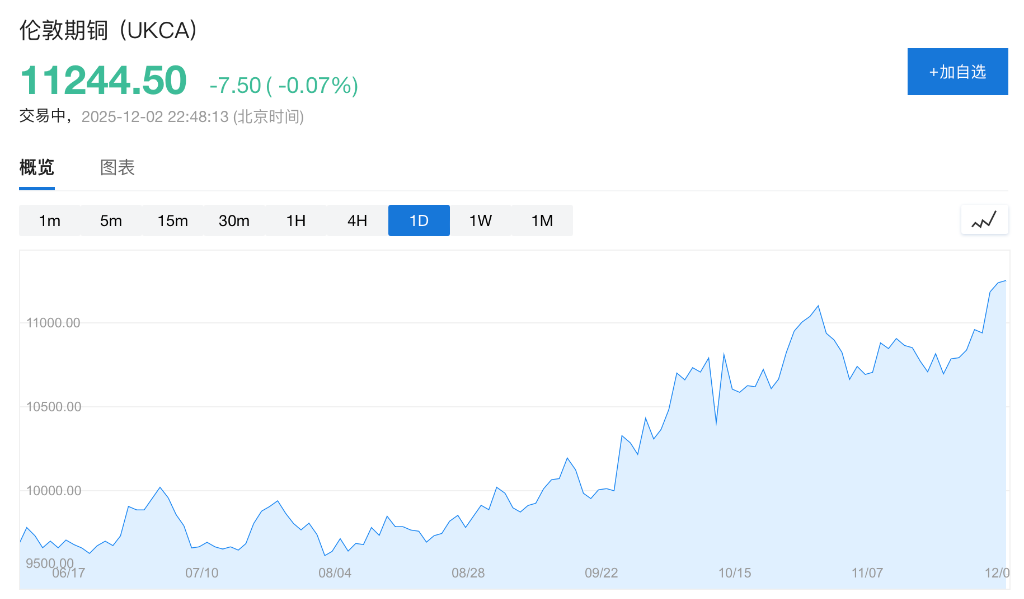
Core Viewpoint - Copper prices are experiencing a significant restructuring driven by expectations of U.S. tariffs and structural supply tensions globally, leading to a self-reinforcing cycle of inventory depletion and price increases [1][4]. Group 1: Market Dynamics - Goldman Sachs commodity experts warn that arbitrage trading based on tariff expectations is creating a cycle of "inventory depletion—widening price spreads—accelerated stockpiling," pushing global copper prices into historical high ranges [1]. - LME copper prices have seen a cumulative increase of 30% this year, with prices reaching $11,294.50 per ton, while Comex copper futures rose by 1.6% [1]. - The tightening of LME inventories, combined with active arbitrage trading in the COMEX market, is strengthening the backwardation structure, further stimulating arbitrage activities [4]. Group 2: Supply Challenges - Major copper mines are facing production challenges, including supply constraints at the Grasberg mine, declining inventories at Kakalua, operational friction at Codelco, weak output at Collahuasi, and low extraction rates at the QB project [4]. - The current supply-demand imbalance is expected to persist in the coming quarters, particularly as global copper mine supplies remain constrained and U.S. infrastructure demand remains strong [7]. Group 3: U.S. Market Influence - The U.S. is becoming the marginal price setter in the copper market, with predictions that copper prices could reach $12,000 to $13,000 per ton due to rising U.S. import demand [5]. - As the Chinese market reopens after the Spring Festival, it may face a significant shortage of copper cathodes, exacerbating the supply situation [5]. Group 4: Long-term Demand Drivers - Investors are entering the copper market not only for profitable U.S. arbitrage but also betting on long-term structural demand driven by the next wave of AI computing and global grid upgrades [6]. - The current market dynamics are seen as one of the most compelling trades in the last 30 years, according to industry experts [6].
全球电网升级大周期,关注出海大方向,电网设备ETF(159326)持续获资金抢筹
Mei Ri Jing Ji Xin Wen· 2025-11-19 06:38
Group 1 - The A-share market experienced slight fluctuations on November 19, with the previously strong-performing power grid equipment sector undergoing a phase correction, as evidenced by the only power grid equipment ETF (159326) declining by 1.11% with a trading volume of 154 million yuan [1] - The power grid equipment ETF has attracted significant capital attention recently, with a net inflow exceeding 1.5 billion yuan in the past month, bringing its total size to over 1.9 billion yuan, making it the largest power grid equipment-themed ETF in the market [1] - High demand for AI computing power is leading to global electricity supply tensions, with a recent Goldman Sachs report indicating that electricity supply has become a major obstacle to AI development, predicting a 160% increase in electricity demand from global data centers by 2030 [1] Group 2 - Huatai Securities noted that the export logic for primary equipment, represented by transformers, remains strong, with both orders and revenue showing rapid growth in the main and distribution networks [1] - The ETF tracks the CSI Power Grid Equipment Theme Index, with its constituent stocks primarily distributed across power transmission and transformation equipment, grid automation equipment, cable components, communication cables, and distribution equipment, demonstrating strong representativeness [1] - The weight of ultra-high voltage equipment in the index is as high as 64%, the highest in the market, indicating a significant focus on high-voltage level grid equipment shortages that are expected to persist [1]
铜市十月上演“冰火两重天”:供应危机与贸易硝烟下的万元关口博弈
Sou Hu Cai Jing· 2025-10-15 16:14
Market Drivers - The current copper market is characterized by a coexistence of "macro shocks and fundamental resilience" [1] - Supply shortages are a hard constraint, with recent disruptions, particularly the shutdown of Indonesia's Grasberg copper mine, defined by Goldman Sachs as a "black swan event" impacting supply until 2027 [1] - The demand narrative presents a "now weak" versus "future strong" scenario, with high copper prices suppressing short-term consumption but long-term demand driven by AI data centers, the new energy revolution, and global grid upgrades [1] Price Dynamics - Copper prices experienced a spike, reaching over $11,000 per ton, followed by a significant pullback, with a drop exceeding 5% on October 11 due to trade tensions [3] Supply Side - Global supply is under pressure, with the Grasberg mine's shutdown expected to create a 500,000-ton supply gap, alongside reductions in Chile, Peru, and Canada [4] - The processing fee for imported copper concentrate has fallen to negative values (-$40 per ton) [4] Demand Side - There is a disparity in demand, with downstream processing companies facing high inventory levels and a "high price, low order" dilemma, while sectors like AI data centers and electric vehicles are expected to drive long-term demand [4] - Goldman Sachs has referred to copper as the "new oil" due to its critical role in future technologies [4] Macro and Policy Environment - Mixed factors are influencing the market, with expectations of Federal Reserve rate cuts and a weaker dollar providing support, contrasted by trade tensions from Trump's administration [4] - Domestic policies aimed at stabilizing growth in the non-ferrous metals industry are boosting long-term confidence [4] Inventory and Market Sentiment - There is a notable divergence in inventory levels, with global visible stocks at historically low levels, while COMEX inventories in the U.S. remain high [4] - The market is currently driven by risk-averse sentiment and speculative buying, highlighting the enhanced financial attributes of copper [4]