
原油供应风险

Search documents
A股油气板块走高
第一财经· 2026-03-19 07:35
Core Viewpoint - The article discusses the escalating tensions in the Middle East, particularly focusing on Iran's retaliatory actions against U.S. oil facilities, which have led to significant concerns about global oil supply disruptions [3][4]. Group 1: Geopolitical Developments - Iran's Islamic Revolutionary Guard Corps has launched a series of attacks on U.S.-related oil facilities in the Middle East, warning of severe consequences for further attacks on its energy infrastructure [3]. - The recent Israeli airstrikes on Iranian gas facilities have intensified the conflict, prompting Iran to threaten continued assaults on energy infrastructure linked to the U.S. and its allies [3][4]. Group 2: Market Reactions - The oil and gas sector in the A-share market has seen a strong performance, with the oil and gas index rising by 3.01% to 4700.74, reflecting market concerns over potential supply disruptions [3]. - International oil prices have continued to rise, with Brent crude reaching $112.02 per barrel, driven by fears of supply risks due to the ongoing geopolitical tensions [3][4]. Group 3: Supply Chain Concerns - Analysts indicate that the conflict has transformed from a mere threat to actual damage to energy infrastructure, heightening expectations of vulnerability in global oil supply [4]. - Current oil production in Iraq is reported to be only one-third of pre-conflict levels, and the strategic Strait of Hormuz remains under significant shipping restrictions, further exacerbating supply concerns [5].

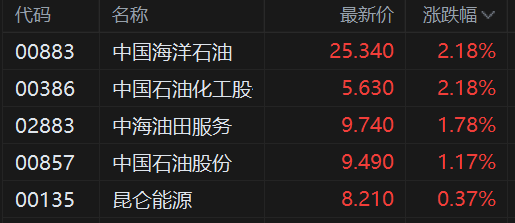
港股异动丨石油股活跃 中国石油化工涨超2%刷新历史新高
Ge Long Hui· 2026-02-12 03:41
Group 1 - The core viewpoint of the news highlights the active performance of Hong Kong oil stocks, with notable increases in shares of China National Offshore Oil Corporation (CNOOC) and Sinopec, both rising over 2% [1] - CNOOC's stock price reached a new high since its listing, while CNOOC Oilfield Services rose by 1.8%, and China Petroleum & Chemical Corporation (Sinopec) increased by over 1% [1] - The rise in oil stocks is attributed to traders' focus on the escalating tensions between the US and Iran, overshadowing signals of increased supply, with WTI crude oil stabilizing around $65 per barrel [1] Group 2 - The report indicates that WTI crude oil prices had previously risen by over 1% on Wednesday, despite comments from Trump regarding potential agreements with Tehran [1] - Concerns about potential military strikes and supply risks continue to weigh on traders, indicating a cautious market sentiment [1] - The International Energy Agency (IEA) is set to release its monthly market outlook report, which may reiterate concerns about global supply surplus [1]


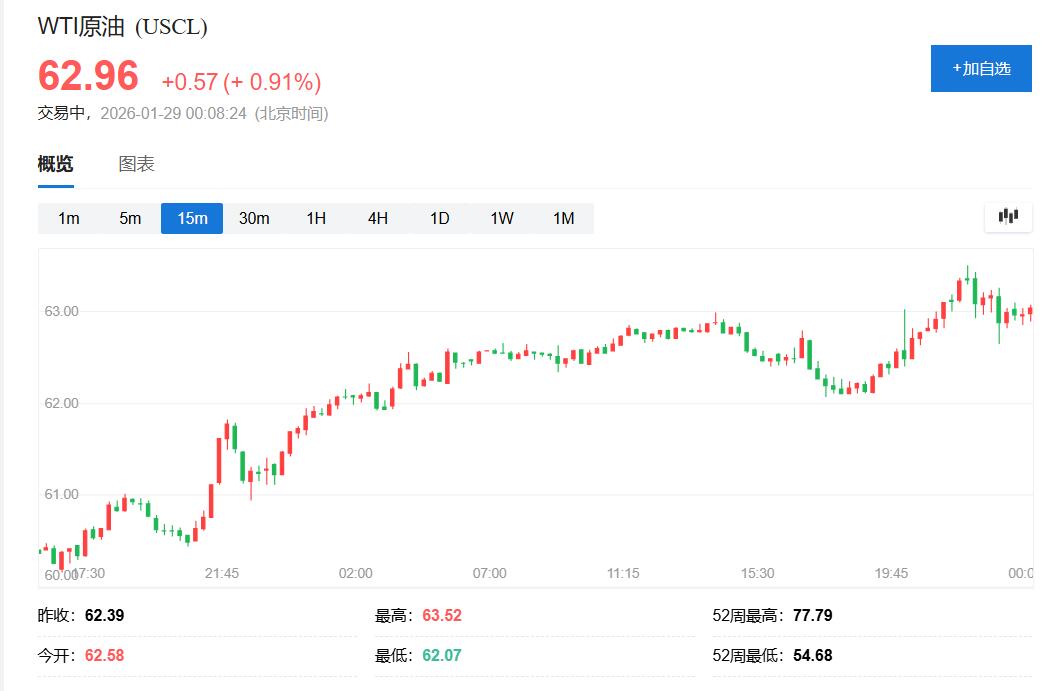
特朗普对伊“喊话”叠加美元走弱,原油创四个月新高
Hua Er Jie Jian Wen· 2026-01-28 18:01
Core Viewpoint - The recent geopolitical tensions, particularly involving the U.S. and Iran, have contributed to a significant rise in oil prices, with international crude futures reaching a four-month high amid supply disruptions and a weakening dollar [1][4]. Group 1: Oil Price Movements - International crude futures have increased over 10% this month, reaching new highs, with WTI crude at $63.52 and Brent crude at $68.53 [1]. - The Brent crude near-month price spread has exceeded $1, indicating a tightening supply [3]. Group 2: Supply Disruptions - A winter storm in the U.S. has severely impacted oil production, with exports from the Gulf Coast dropping to zero before rebounding [4]. - Kazakhstan's oil production has also faced interruptions, affecting the overall supply dynamics [4]. Group 3: Geopolitical Risks - The U.S. has deployed a significant naval presence in the Middle East, enhancing its military capabilities in response to tensions with Iran [5][6]. - Iran has expressed readiness for dialogue but has also indicated a strong defense posture against U.S. actions [6]. Group 4: Market Sentiment - Analysts suggest a shift towards a more positive market sentiment, with concerns over supply surplus diminishing [7]. - The cost of call options remains high compared to put options, reflecting market apprehension about upward price risks [7].
9日国际油价上涨 全周布油涨超4%
Xin Lang Cai Jing· 2026-01-10 06:07
Core Viewpoint - International oil prices continue to rise due to concerns over potential disruptions in Iranian oil production amid ongoing domestic protests and restricted Russian oil exports, driven by geopolitical tensions and supply risks [1] Group 1: Price Movements - As of January 9, the price of light crude oil futures for February delivery on the New York Mercantile Exchange increased by 2.35% [1] - The price of Brent crude oil futures for March delivery rose by 2.18% [1] - For the week, the main contract price of U.S. oil futures increased by a cumulative 3.14% [1] - The main contract price of Brent oil futures rose by a cumulative 4.26% [1] Group 2: Market Analysis - Analysts suggest that international oil prices are in a complex negotiation phase due to the dual impact of escalating geopolitical risks and a continuous rise in global crude oil inventories [1]
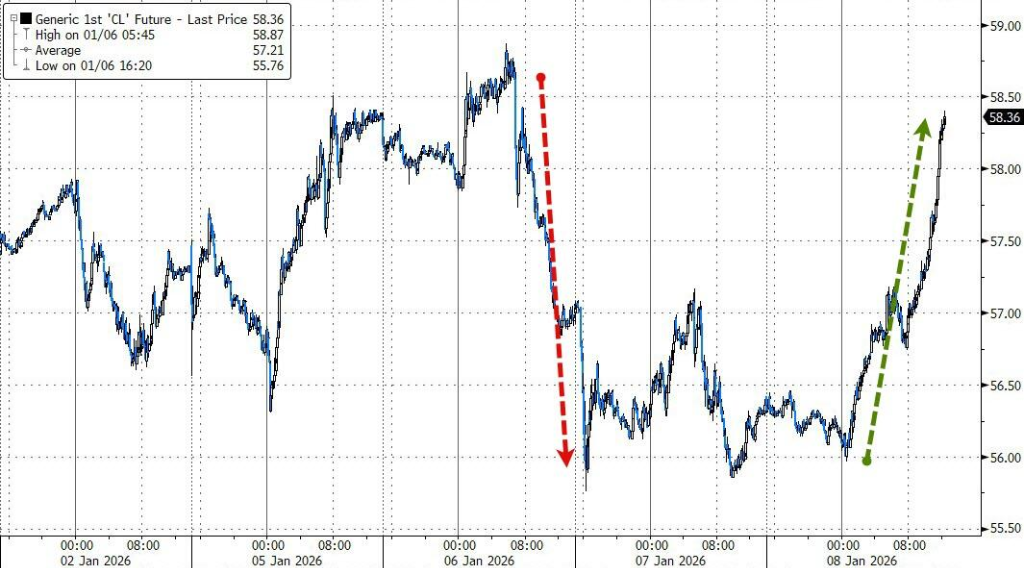
油价因委内瑞拉局势及供应担忧大涨逾3%,创两周新高
Hua Er Jie Jian Wen· 2026-01-08 22:45
Core Viewpoint - International oil prices rebounded on Thursday, rising over 3% to a two-week high, driven by concerns over supply disruptions from Venezuela, Russia, Iraq, and Iran despite an increase in U.S. gasoline and distillate inventories [1]. Group 1: Oil Price Movement - Brent crude futures settled at $61.99 per barrel, up $2.03 or 3.4%, marking the highest closing price since December 24 of the previous year [3]. - WTI crude futures increased by $1.77 or 3.2%, reaching $57.76 per barrel [3]. Group 2: Supply Concerns - Investors are evaluating the situation in Venezuela, where the U.S. plans to sell up to 50 million barrels of Venezuelan oil to domestic refiners, which may take years to significantly impact the Gulf Coast [1]. - A drone attack on a tanker heading to Russia in the Black Sea and Iraq's move to nationalize the West Qurna 2 oil field due to U.S. sanctions on Lukoil are contributing to supply risk concerns [1]. - Iran is facing nationwide protests due to economic difficulties, leading to internet blackouts, further complicating the supply landscape [1].
油价小幅上涨,市场评估供应风险加剧
Xin Lang Cai Jing· 2025-12-18 20:31
Group 1 - Oil prices increased slightly as investors assess potential further sanctions by the U.S. on Russia and supply risks from the blockade of Venezuelan oil tankers [1][4] - WTI crude oil futures for January delivery rose by $0.21, or 0.38%, closing at $56.15 per barrel [1][4] - BOK Financial's Dennis Kissler indicated that crude futures are seeking support from the blockade of Venezuelan oil exports, which could lead to production shutdowns if the blockade continues [1][4] Group 2 - Reports suggest that the U.S. is preparing new sanctions on Russia's energy sector if Moscow fails to reach a peace agreement with Ukraine, although no decision has been made by President Trump [1][5] - ING analysts noted that further measures against Russian oil could have a greater supply impact than the blockade of sanctioned tankers entering and leaving Venezuela [5] - The blockade may affect approximately 600,000 barrels per day of Venezuelan oil exports, although around 160,000 barrels per day to the U.S. are expected to continue [5] Group 3 - Venezuelan crude oil accounts for about 1% of global supply [5] - Bank of America analysts predict that lower oil prices will suppress supply, estimating that if the average WTI price is $57 per barrel by 2026, U.S. shale oil production could decrease by 70,000 barrels per day [3][5]
年内第十一次下调 油价每吨再降55元
Sou Hu Cai Jing· 2025-12-09 07:46
Core Viewpoint - The National Development and Reform Commission announced a reduction in domestic gasoline and diesel prices by 55 yuan per ton, marking the eleventh price cut since 2025, with the year's adjustments showing a pattern of "seven increases, eleven decreases, and six pauses" [1]. Group 1: Price Adjustments - The recent price adjustment translates to a decrease of 0.04 yuan per liter for 92-octane gasoline, 0.05 yuan for 95-octane gasoline, and 0.05 yuan for 0-octane diesel, resulting in approximately 2 yuan savings for filling a 50-liter tank of 92-octane gasoline [1]. - The overall average price of crude oil during the pricing cycle has decreased compared to the previous cycle, despite initial upward trends influenced by geopolitical factors [1]. Group 2: Market Dynamics - The demand for gasoline remains subdued due to the lack of holiday-related consumption, while diesel demand is affected by a weak economic outlook and accelerated adoption of alternative energy sources, limiting seasonal consumption boosts [2]. - Analysts predict that the next pricing cycle may see a shift to a positive change rate, but the expected fluctuations will be limited, with overall demand remaining weak and a high probability of price stabilization in the near term [2]. Group 3: Geopolitical Factors - The situation in Venezuela, which holds over 300 billion barrels of proven oil reserves, could disrupt international oil prices, especially if tensions escalate further [2]. - Current daily oil production in Venezuela stands at 1.1 million barrels, and any escalation in conflict could significantly impact global oil supply [3].
Oil News: Crude Oil Futures Slip as Ukraine Talks Cloud Oil Outlook and Demand
FX Empire· 2025-12-08 12:31
Core Viewpoint - The crude oil market is facing significant resistance levels, and the outlook appears bearish unless buyers can defend key support zones [1][6]. Technical Analysis - Crude oil is currently under resistance from the 200-day moving average at approximately $60.96, Friday's high at $60.50, and the 50-day moving average at $59.67, creating a strong ceiling for prices [1]. - The short-term retracement zone is identified between $59.23 and $58.44, which is seen as the next support area [1]. Market Sentiment - The ongoing Ukraine peace talks are contributing to supply risk, as any potential ceasefire could lead to increased Russian oil exports, which traders are cautious about [2]. - Analysts at PVM suggest that even speculation about renewed Russian exports is enough to dampen market sentiment [2]. Economic Factors - The Federal Reserve is anticipated to implement a quarter-point rate cut, with market expectations at around 84%, which typically would support crude prices; however, uncertainty regarding supply may counteract this effect [3]. - The market is not fully confident in a smooth policy path from the Fed, indicating that while lower rates may provide some support, they are unlikely to outweigh supply-side uncertainties [3]. Supply Dynamics - Trump's influence on Ukraine could potentially swing global oil supply by over 2 million barrels per day, creating a wide range of outcomes that the market is hesitant to price in aggressively [4]. - Additional factors such as potential new G7/EU restrictions on Russian exports, U.S. pressure on Venezuela, and increased Iranian oil imports by Chinese refiners contribute to a complex supply landscape [5]. Market Outlook - The overall outlook for crude oil remains bearish, with the market boxed under major moving-average resistance and momentum declining [6]. - The key area to monitor for potential dip-buyers is the $59.23–$58.44 retracement zone, which must hold for a bullish reversal to occur [6].
国投期货能源日报-20250617
Guo Tou Qi Huo· 2025-06-17 11:58
Report Industry Investment Ratings - Crude oil: ★☆☆, indicating a bullish bias but limited operability on the market [1] - Fuel oil: ☆☆☆, suggesting a short - term balance in trends and poor operability [1] - Low - sulfur fuel oil: ☆☆, also suggesting a short - term balance in trends and poor operability [1] - Asphalt: ☆☆, indicating a short - term balance in trends and poor operability [1] - Liquefied petroleum gas: ★☆☆, showing a bullish bias but limited operability on the market [1] Report's Core View - Amid geopolitical tensions in the Middle East, different energy products are affected in various ways. Investors should pay attention to supply risks and price fluctuations, and choose appropriate investment strategies based on product fundamentals and geopolitical situations [2][3][4][5] Summary by Related Catalogs Crude Oil - Before the US and Iran resume negotiations, the Israel - Iran conflict shows no clear sign of downgrading. Although OPEC's effective idle capacity and OPEC+'s production increase elasticity can make up for Iran's oil exports in about 6 months, investors should focus on the risk of attacks on Iran's oil production and export facilities and short - term supply reduction [2] - Based on the market pricing performance in 2011 when Iran threatened to block the Strait of Hormuz, the extreme upside risk of the Brent crude oil near - month contract points to $80 - 90 per barrel. Investors are advised to hold out - of - the - money call options for hedging and adopt a medium - term short strategy after the geopolitical situation eases [2] - Due to the direct impact of Middle East geopolitical risks on the supply of medium - sulfur crude oil, the tanker freight from the Middle East to China is supported, and the spread between SC and Brent is expected to rise [2] Fuel Oil & Low - sulfur Fuel Oil - After the pulse - like rise and subsequent decline of crude oil today, the upward trend of fuel - related futures has come to a halt [3] - The Israel - Iran conflict boosts the geopolitical premium of high - sulfur fuel oil, but the demand for high - sulfur fuel oil from ship bunkering and deep - processing is weak, and the demand boost from summer power generation in the Middle East and North Africa is limited due to high valuation. The FU crack spread is expected to be under pressure [3] - The supply of low - sulfur fuel oil remains abundant, the demand for low - sulfur marine fuel is insufficient, and the LU crack spread declines when crude oil strengthens due to geopolitical premium [3] Asphalt - Today, oil prices fell from high levels, and asphalt mainly fluctuated. Due to the gradual consumption of crude oil quotas, the increase in production of local refineries lacks resilience. After the peak maintenance period, major refineries plan to increase the operation of deep - processing units, and the increase in asphalt production is expected to be limited [4] - The shipment volume of 54 sample refineries has increased month - on - month, and the cumulative year - on - year growth has turned positive. The sales volume of road rollers, a leading indicator of asphalt consumption, increased significantly year - on - year from January to April, indicating a substantial boost in terminal demand soon [4] - The latest factory and social inventories of asphalt have both declined. The fundamental support factors for asphalt still exist, but the BU crack spread is under pressure before the risk of rising oil prices caused by geopolitical risks is eliminated [4] Liquefied Petroleum Gas (LPG) - The Middle East geopolitical conflict is still intensifying, increasing the risk of Iran's LPG production and exports. The international market prices in the risk and remains strong [5] - Currently, China's chemical demand for LPG is still recovering, and attention should be paid to the pressure of declining margins after the increase in import costs. The mid - month arrival volume and refinery gas release are both increasing. If the geopolitical risk eases, the supply pressure will bring strong downward pressure [5] - The fundamental supply - side pressure remains, but the market has been oscillating strongly recently to price in the risk [5]