
大宗消费

Search documents
寻见魔都消费密码:买车省下两万多?家电直降30%! 上海大宗消费市场迎来“开门红”︱一探·新春走基层
Di Yi Cai Jing· 2026-02-19 02:57
Core Viewpoint - The Shanghai mass consumption market is experiencing a strong start to the new year, driven by policies and consumer demand for smarter and better products [1] Group 1: Market Dynamics - The "trade-in" model is reshaping consumer behavior, with multiple subsidies enhancing the attractiveness of new purchases [1] - The shift from national subsidies to store-specific incentives is creating a more dynamic market environment [1] Group 2: Consumer Trends - Consumers are increasingly pursuing better quality-to-price ratios, influenced by the introduction of new products such as smart cabins and intelligent home systems [1] - The enthusiasm for purchasing new vehicles and upgrading to smart home products reflects a broader aspiration among Shanghai residents for a more advanced and intelligent future [1]
年关探店:市井烟火里的经济韧性
Xin Hua Wang· 2026-02-11 02:28
Core Viewpoint - The article highlights the resilience and vitality of the Chinese economy as observed through local businesses, particularly small eateries and the tourism sector, which serve as indicators of consumer behavior and economic health [1][3][5]. Group 1: Local Businesses and Consumer Behavior - Small eateries are described as the "nerve endings" of the consumer market, playing a crucial role in expanding domestic demand and promoting consumption [3]. - The "Ma Yuan Xiaolongbao" shop in Yinchuan exemplifies a successful local business that has expanded from a single store to 12 locations over 30 years, driven by quality and affordability [3][4]. - Despite facing increased competition and rising costs, such as an average monthly expense of 80,000 yuan for ingredients, rent, and labor, the shop maintains a profit margin of 15% [4]. - The rise in tourism has positively impacted local businesses, with the "Ma Yuan Xiaolongbao" becoming a popular spot for visitors, indicating a potential for growth [4]. Group 2: Tourism and Economic Activity - The article notes that the government’s promotion of cultural tourism has significantly increased foot traffic in places like the Huaiyuan Night Market, benefiting local food vendors [5][6]. - The Tengol Desert Resort Hotel has seen a surge in winter tourism, with occupancy rates expected to reach 70% during the Spring Festival, a significant improvement from previous years [10]. - In 2025, the city of Zhongwei recorded a 14% increase in both tourist numbers and spending, showcasing the effectiveness of tourism initiatives [11]. Group 3: Consumer Trends and Policies - The article discusses the impact of new policies, such as the "New National Subsidy" program, which has stimulated large-scale consumer markets, particularly in the automotive and home appliance sectors [15][16]. - Sales in home appliance stores in Yinchuan increased by over 50% during the New Year period, attributed to the effective implementation of the "New National Subsidy" policy [19]. - The automotive sector has also benefited from the "Old for New" policy, with a notable increase in customer inquiries and sales, indicating a recovery in consumer confidence [20][22]. Group 4: Agricultural Products and Local Economy - The consumption of local agricultural products, such as the Yinchuan specialty salt pool lamb, has become a vital link between rural industries and urban markets, driving demand and supporting rural revitalization [24][25]. - The sales of salt pool lamb during the pre-New Year period reached an average daily revenue of over 30,000 yuan per store, reflecting strong consumer interest [25]. - The overall agricultural processing output in Ningxia reached 1,058.9 billion yuan by the end of 2025, with significant contributions from products like wine and goji berries [28].

政策研究报告:中国提振消费的战略选择与国际经验,提振消费、扩大内需
Sou Hu Cai Jing· 2026-02-09 05:45
Group 1 - The core strategy for China's economic high-quality development is to boost consumption and expand domestic demand, driven by top-level design, external demand uncertainties, and the need to resolve structural contradictions in domestic consumption [1][5][6] - Over the past decade, China's consumption market has seen significant growth and structural upgrades, with consumption becoming the primary driver of economic growth, service consumption accounting for 46.15%, and a gradual narrowing of the urban-rural consumption gap [6][24][42] - There is still a notable gap in household consumption rates and service consumption proportions compared to international economies, indicating substantial room for improvement [6][59] Group 2 - The report identifies four key pillars for boosting consumption based on international experiences: institutional guarantees, income foundations, supply innovation, and expectation management, while also warning against excessive debt and asset bubbles [7][11] - Japan's high cost-performance and emotional value consumption, Germany's stable employment and social security system, and South Korea's cultural strategy driving consumption upgrades provide valuable references for China, while the financialization risks of the US's advanced consumption model should be approached with caution [7][11] - The report outlines a four-dimensional policy framework to enhance consumption, focusing on income security, innovative consumption supply scenarios, optimizing the consumption institutional environment, and promoting regional collaborative openness [2][8][14] Group 3 - Six new growth areas for consumption are identified: service consumption, "AI + consumption," green consumption, cultural and emotional consumption, digital consumption, and bulk consumption, with specific development directions and policy breakthroughs proposed for each area [2][8][14] - The report emphasizes the need to implement a resident income doubling plan, reform the service consumption supply side, eliminate unreasonable consumption restrictions, and create a matrix of international consumption center cities to fully unleash the potential of China's consumption market [2][8][14]

消费市场跟着跨年一起“嗨”
Xin Hua Ri Bao· 2026-01-05 23:23
Group 1 - Nanjing's retail and service sectors saw significant growth during the New Year holiday, with monitored enterprises achieving a total sales revenue of 1.67 billion yuan over three days, marking a year-on-year increase of 9.5% on New Year's Day [1] - The overall transaction volume in retail, catering, and accommodation sectors increased by 30%, 36.5%, and 214% respectively, as reported by UnionPay Business [1] - The city organized over 60 offline promotional activities and integrated online and offline marketing strategies to stimulate consumer spending, resulting in a 14.6% year-on-year sales growth and a 30.2% increase in foot traffic for monitored shopping malls and complexes on December 31, 2025 [1] Group 2 - The promotion of large consumer goods such as home appliances and automobiles significantly boosted sales, with over 40,000 units sold by participating retailers in the first two days of the holiday [2] - Nanjing launched a vehicle trade-in subsidy program during the New Year holiday, aimed at invigorating automobile consumption [2] - The integration of cultural and tourism activities with commercial events contributed to a vibrant consumer market, with themed markets and exhibitions attracting large crowds and enhancing related spending [2]

今年“双11”大宗消费稳健增长
Xin Hua Cai Jing· 2025-11-12 10:23
Core Insights - The "Double 11" shopping festival has shown robust growth in major consumer categories such as mobile communications, home appliances, and complete computers, becoming a significant driver of overall market consumption [1][2] - High-priced products have seen a notable increase in sales growth, indicating a shift in consumer purchasing behavior towards higher-value items [1][2] Group 1: Sales Performance - Meituan's flash purchase platform reported that from October 31 to November 11, transaction volume, number of orders, and per capita spending all reached new highs, with per capita spending increasing by nearly 30% [1] - Traditional high-priced categories like mobile phones and liquor saw sales growth exceeding 100% year-on-year, reflecting a strong consumer willingness to purchase high-value goods through instant retail channels [1] Group 2: Consumer Trends - Data from "What Worth Buying" indicated that from October 16 to November 11, the top five categories by GMV were mobile communications, home appliances, household electrical appliances, residential furniture, and complete computers, all of which are typical major consumer goods [1] - There was a rapid growth of over 30% in quality lifestyle products such as outdoor footwear and clothing, indicating a sustained consumer pursuit of quality living [1] Group 3: Technological Impact - JD.com reported explosive growth in 3C digital AI products during the "Double 11" period, with new mobile phone sales increasing by over four times year-on-year, and AI products like tablets and speakers also seeing over 100% growth [2] - The home appliance and furniture sector experienced a 150% increase in sales of new products, with "delivery and installation" service orders rising by over 90%, highlighting a growing consumer demand for comprehensive service offerings [2] Group 4: Market Dynamics - Experts attribute the steady growth in major consumer categories to the ongoing recovery of consumer confidence and continuous innovation in retail models [2] - The deep integration of online and offline retail models has provided consumers with a more convenient and efficient shopping experience, creating new growth opportunities for brands and physical stores [2]
风向变了!国家出手鼓励消费,但更强调先解决就业和增加收入
Sou Hu Cai Jing· 2025-10-24 14:52
Group 1 - The core issue is the sluggish consumer spending in China post-pandemic, despite government efforts to stimulate the economy [1][3] - The government is emphasizing employment and income growth as a means to encourage consumer spending, addressing fears of spending and lack of funds [3][5] - Measures include promoting entrepreneurship and simplifying business registration to create more job opportunities [5][6] Group 2 - The government is actively supporting the street vendor economy as a low-cost, flexible business model to boost employment and consumption [8][10] - Policies are being implemented to foster the development of the private sector, including tax reductions and easing administrative processes [12] - Recent pension adjustments and improved social security benefits aim to increase disposable income for retirees, encouraging them to spend [14] Group 3 - The government is also focusing on reducing healthcare costs to alleviate consumer concerns about medical expenses [16] - Support for the housing market and incentives for car purchases are part of the broader strategy to stimulate major consumer spending [16]
提振消费!广州 最新部署
Zheng Quan Shi Bao· 2025-10-21 15:28
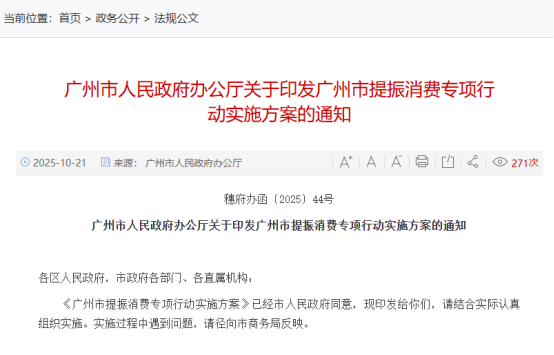
Core Viewpoint - The Guangzhou Municipal Government has issued a comprehensive implementation plan aimed at boosting consumption through various initiatives focused on income growth, service consumption, large-scale consumption, and environmental optimization [1]. Group 1: Income Growth and Employment - The plan emphasizes expanding channels for property income and enhancing the market value management of state-owned listed companies to stabilize investor return expectations [3]. - It includes strategies to activate idle rural collective land and legally owned housing through leasing, equity participation, and cooperation [3]. Group 2: Consumer Capability Support - The plan aims to strengthen support for childbirth and childcare, as well as improve medical and pension security, including setting reasonable standards for urban and rural residents' medical insurance funding [3]. - It also proposes a gradual increase in basic pension insurance benefits [3]. Group 3: Service Consumption Enhancement - The plan promotes the development of sports consumption, innovation in the silver economy, and the expansion of inbound consumption [3]. - Specific measures include implementing a 240-hour visa-free transit policy and enhancing customs facilitation services, as well as promoting inbound tourism with free one-day tours in Guangzhou for international transit passengers [3]. Group 4: Large-scale Consumption Upgrades - The plan outlines initiatives for a trade-in program for consumer goods and better housing consumption support, including the renovation of over 150 old residential communities by 2025 and an investment of 100 billion yuan in urban village renovations [4]. - It also supports the development of the used car market and the implementation of measures to facilitate used car sales [4]. Group 5: Quality Consumption Promotion - The plan focuses on fostering new consumption models, promoting high-quality development of the first-release economy, and enhancing the spillover effects of the Canton Fair [5]. - It includes initiatives to integrate domestic and international trade, supporting pilot enterprises in this area [6]. Group 6: Optimization of Restrictive Measures - The plan aims to systematically reduce consumption restrictions, including allowing individuals to directly apply for additional car quotas after 72 unsuccessful attempts [6]. - It emphasizes creating a first-class business environment and implementing a three-year action plan for building an internationally competitive business environment in the Guangdong-Hong Kong-Macao Greater Bay Area [6].
全力冲刺四季度经济 哪些增量政策值得期待?
Shang Hai Zheng Quan Bao· 2025-10-14 00:55
Group 1: Economic Policy and Investment - The fourth quarter is crucial for economic work and planning for the next year, with macro policies being implemented to ensure stable economic performance, requiring approximately 15 trillion yuan in investment and 13 to 14 trillion yuan in consumption [1] - New policy financial tools amounting to 500 billion yuan are expected to support project capital, enhancing infrastructure investment in the fourth quarter [4] - Local governments are anticipated to expedite the use of remaining special bond funds, with an estimated 680 billion yuan available for investment [5] Group 2: Consumer Support Policies - The government has issued 690 billion yuan in special bonds to support consumer goods replacement programs, with over 330 million people benefiting from subsidies, leading to sales exceeding 2 trillion yuan [2] - There are expectations for further support policies for large-scale consumption, including expanded subsidies for vehicle replacements and initiatives in health, medical, and digital sectors [2][3] - The retail sales of consumer goods are projected to exceed 50 trillion yuan for the year, with consumption contributing over 50% to GDP [3] Group 3: Foreign Trade and Investment - China is set to enhance its high-level opening-up policies, with the Hainan Free Trade Port scheduled to officially operate by December 2025, easing restrictions on foreign investment in tourism [7] - The 138th China Import and Export Fair will take place from October 15 to November 4, aiming to support foreign trade enterprises amid external challenges [7] - A series of favorable policies for foreign investment are expected to be implemented, focusing on advanced manufacturing, modern services, and high-tech sectors [7][8]
商务部:三方面促进消费持续恢复
Xin Hua Wang· 2025-08-12 06:25
Group 1: Domestic Consumption Recovery - Since May, domestic consumption has shown a recovery trend, with the Ministry of Commerce planning to promote sustained recovery through measures such as stabilizing bulk consumption, optimizing consumption platforms, and organizing consumption promotion activities [1][2] - The Ministry of Commerce has introduced measures to stimulate automobile consumption and will work with relevant departments to ensure these policies are effectively implemented [2][3] - The organization of key events like the China International Consumer Products Expo aims to enhance consumer confidence and stimulate consumption potential [3] Group 2: Service Trade Growth - From January to May, China's service trade maintained steady growth, with total service trade reaching 23,653.6 billion yuan, a year-on-year increase of 22% [4] - Service exports amounted to 11,517.9 billion yuan, growing by 26.3%, while imports were 12,135.7 billion yuan, increasing by 18.2%, leading to a significant reduction in service trade deficit [4] - Knowledge-intensive service trade also showed stable growth, with imports and exports totaling 9,886.7 billion yuan, reflecting a 10% increase [4]
覆盖“衣食住行游购娱” 《上海市提振消费专项行动方案》发布
Xin Hua Cai Jing· 2025-05-22 06:03
Core Viewpoint - The Shanghai Municipal Government has introduced a comprehensive "Consumption Promotion Action Plan" aimed at boosting consumer spending and enhancing the overall consumption environment in the city, aligning with national strategies to stimulate domestic demand and economic growth [1][5][10]. Group 1: Six Major Actions - The plan includes six major actions: increasing urban and rural residents' income, ensuring consumer capacity support, upgrading service consumption quality, renewing bulk consumption, cultivating new types of consumption, and enhancing the consumption environment [1][12]. Group 2: Urban and Rural Residents' Income Increase - The action plan emphasizes an employment-first strategy, enhancing skills training, and promoting reasonable income growth through targeted support for key sectors and small businesses [2][13]. Group 3: Consumer Capacity Support - Measures include increasing support for childbirth and childcare, optimizing elderly care services, and improving the social security system to enhance consumer capacity [2][15]. Group 4: Service Consumption Quality Upgrade - The plan aims to create a cultural consumption hub, develop a world-renowned tourism city, and promote the integration of cultural, tourism, and sports sectors to enhance service consumption quality [2][16]. Group 5: Bulk Consumption Renewal - Shanghai will implement initiatives for trade-in programs for consumer goods and better meet housing consumption needs through updated policies [3][17]. Group 6: New Type of Consumption Cultivation - The plan focuses on fostering cutting-edge digital consumption, including the development of "AI + consumption" scenarios and enhancing the supply for the aging population [3][18]. Group 7: Consumption Environment Enhancement - Key initiatives include strengthening consumer rights protection, optimizing consumption facilities, and creating a tourist-friendly city to improve the overall consumption environment [3][20]. Group 8: Support Policies - The action plan outlines the need for coordinated policies to support consumption, emphasizing the role of fiscal and financial measures in driving consumer spending [5][21].
